

Tiger Pride Returns at Muskegon Heights
February 3, 2016
By Tom Kendra
Special for Second Half
It’s hard to overstate the importance of basketball to a community like Muskegon Heights.
 On one hand, a bunch of kids playing a game in a gym seems like a low priority, almost trivial in a town whose violent crime rates and percentage of residents living in poverty are among the highest in Michigan.
But on the other hand, the “Tiger Pride” that is on display each time Heights alumnus Dell Stewart and his team of 13 players take the court – and the returning crowd of community members who are getting back on the bandwagon as the wins continue to pile up – could provide the spark to create real change in this beleaguered West Michigan town.
“Basketball has always been a source of pride in this community,” said Stewart, a 1989 Muskegon Heights graduate, who is in his fourth year as the Tigers’ head coach.
“Basketball and all sports almost ended here completely four years ago, but we weathered the storm. We’re back. And we want to be a source of hope and pride.”
The school is now known as the Muskegon Heights Academy, a public charter school which replaced the debt-ridden Heights district in 2012, but the basketball standards are as high as they have ever been in a community which boasts six MHSAA championships – 1954, 1956, 1957, 1974, 1978 and 1979.
Heights has its sights set on another banner after taking its high-energy show on the road Saturday night and improving to 10-1 with a convincing 55-45 victory over perennial power and longtime rival Benton Harbor, which was ranked No. 10 in the state in Class B.
The Tigers beat the “downstate Tigers” on Saturday with their trademark full-court pressure defense and multiple offensive weapons – and now should finally get a spot in the Top 10 of this week’s Class C Associated Press state poll.
Underclassmen led the way in Heights’ big win, with junior point guard Antoine Jones scoring 18 points and junior Serinus Daniels and sophomore DeCarri Brown each grabbing 10 rebounds.
 The energy of the team starts with the backcourt trio of Jones and his twin brother, Anthony, and senior captain Anthony Gordon. The starters inside are 6-foot-3 sophomore center Kieshon Watson and senior forward Deondre Wilson, but Daniels (a 6-6 junior) and Brown also see plenty of minutes.
“The thing I like about this team is that every game it seems like we have a different leading scorer,” said Stewart, who is assisted on the Tigers’ bench by his younger brother, Terry, a sharpshooter on the 1993 Heights team that lost to Saginaw Buena Vista in the Class B championship game. “We don’t have a lot of size, but we make up for that in different ways. We have the pieces of the puzzle to make a run.”
The win at Benton Harbor was just the latest impressive road victory for the Tigers, who turned some heads with big tournament wins in December over Southfield at Grand Rapids Ottawa Hills and Lansing Sexton at Battle Creek Central. Heights also handed host Kalamazoo Phoenix its first loss on Jan. 22.
Fans at home are starting to take notice – and come back.
When “the storm” Stewart referred to made landfall in 2012, a state-appointed emergency manager had taken over and there was uncertainty about whether the district would exist for the upcoming school year, let alone have a sports program.
That uncertainty led coach Keith Guy and high-profile players such as DeShaun Thrower (the state’s Mr. Basketball in 2014) and Joeviair Kennedy (now playing at Western Michigan University) to go to neighboring Muskegon High School – and many longtime Heights fans went with them. Soon, the traditional football school was now the place to be for basketball as well, as Thrower and Kennedy were joined by 6-9 Deyonta Davis (now at Michigan State) for an undefeated season and Class A championship in 2014.
Almost forgotten was the county’s traditional basketball power, Muskegon Heights.
Amidst all the new-found Big Reds’ basketball hoopla, Heights basketball picked up the pieces. With longtime administrators Glen Metcalf (athletic director) and Jerry Harris (faculty manager) leading the way, Heights was able to lure Stewart away from his job as head coach at Reeths-Puffer and back home to be head basketball coach and dean of students. His first order of business was to convince kids that they did not need to transfer to find basketball success.
 Stewart’s words were backed up by results in 2014, when the Tigers made a run all the way to the Class C Semifinals at Michigan State’s Breslin Center, where they lost to Pewamo-Westphalia.
“I looked up in the stands and saw some of the old fans coming back and even people I hadn’t seen in 15 years, people who were starving to be part of something positive in Muskegon Heights,” said Stewart.
The problem has been that for every step up, there have been two steps back in terms of the Heights’ image.
One month after the Tigers made it to the Breslin in 2014, starting center Marquis Gresham was murdered in a drive-by shooting. Last fall, Heights was back in the news for the wrong reasons, when a home football game against Muskegon Catholic Central was cancelled after a shooting earlier that day.
Those incidents weigh heavy on all of the town’s residents, but they seem 1,000 miles away, at least briefly, when the Tigers work their magic on the basketball court.
One of those Tigers having plenty of fun is junior forward Keshawn Gresham, Marquis’s little brother, who is one of 10 underclassmen on the Tigers’ 13-player varsity roster.
As he laughs and jokes with his teammates, as a big throng of community residents cheer on in support, one fact is apparent:
Basketball is more than just a game in Muskegon Heights.
 Tom Kendra worked 23 years at The Muskegon Chronicle, including five as assistant sports editor and the final six as sports editor through 2011. E-mail him at [email protected] with story ideas for Muskegon, Oceana, Mason, Lake, Oceola, Mecosta and Newaygo counties.
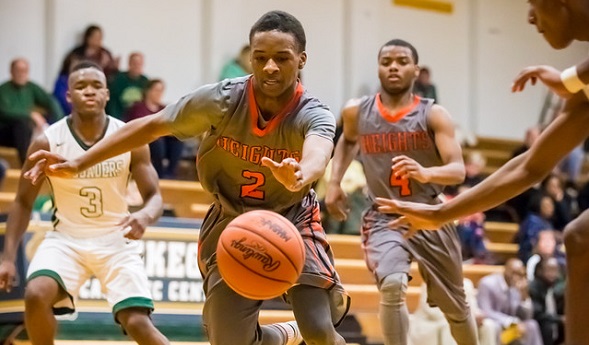
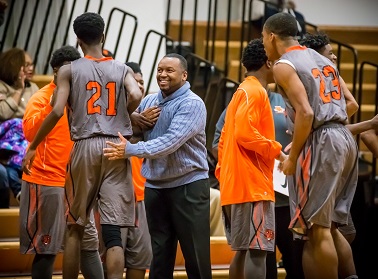
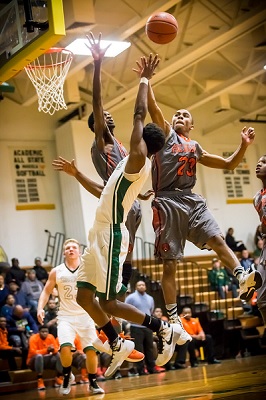
PHOTOS: (Top) Muskegon Heights junior point guard Antoine Jones drives up the court during a 70-47 win at Muskegon Catholic Central on Jan. 26. (Middle) Muskegon Heights coach Dell Stewart congratulates junior forward Serinus Daniels after a block on one end and a bucket on the other during the win over MCC. (Below) Muskegon Heights' Joe Moore (right) and Serinus Daniels (left) defend Muskegon Catholic's Christian Martinez. (Photos by Tim Reilly.)
New Haven Grows into Class B Contender
March 24, 2017
By Geoff Kimmerly
Second Half editor
EAST LANSING – Eric Williams, Jr., has learned a lot about becoming a champion these last few seasons.
And as Williams has grown, so too has New Haven’s success on the basketball court.
The Rockets will find themselves playing in their first MHSAA championship game Saturday night, thanks to a 78-49 win over Benton Harbor on Friday in what was the program’s first Semifinal as well.
Williams had 22 points, seven rebounds, four assists and three steals, continuing a closing run that could see him leave an unprecedented legacy at the school. He had 11 points, six rebounds and two steals in the first quarter Friday, setting the tone from the start.
“I just came out looking to be aggressive more, because last game I was just out there. I think I had to come in and prove something,” Williams said.
“I’ve learned I’ve just gotta stay calm and not get stage fright on the big stage. Learning to play defense and what team basketball really is, I think I’ve learned that over the (last) few years.”
New Haven (25-1) will face Ludington in the final game of this season, Saturday’s 6:30 p.m. Class B Final.
Williams, a 6-foot-5 guard, entered this week averaging 20.9 points, 6.5 rebounds, 4.1 assists and 3.8 steals per game. New Haven coach Tedaro France II said after Friday’s win that upping his defense has made Williams a complete player – and that newfound all-around game has made him “one of the hottest players in the state right now.”
The first Semifinal came three days after the Rockets' third straight Quarterfinal. They are now 72-5 during this three-season run, and Williams’ rise is just an example of how experience has benefitted the team as a whole.
“That’s something as a coach you can’t teach,” France said. “Kids have to play in big games, and sometimes like with these guys, we have to fail first before we have success. And we’ve failed a lot.
 “Me, I say to our kids, let’s win today. And in practice each day, we fail. I say, let’s learn from our mistakes. I don’t mind if they make 10 mistakes, but let’s not make the same ones. And I think our kids are learning to play through adversity. They know they can make mistakes, then just go back and get back on defense."
Following Williams’ hot start, New Haven took a 22-10 lead into the second quarter and a 43-19 advantage into halftime. The lead got up to 38 during the fourth quarter before Benton Harbor (22-4) finished on a 9-0 run.
The Tigers entered the postseason ranked No. 5 by The Associated Press – New Haven was No. 3 – and had plenty of success as well this season. But they struggled this time to get into a groove against an opponent that beat them at their own game.
New Haven excelled defensively, holding Benton Harbor to 33 percent shooting and taking advantage of 17 turnovers. The Rockets turned on the transition game, to the point Tigers freshman center Carlos Johnson said, “When we’re running up the floor … they were already up there.”
Benton Harbor also is used to outrebounding its opponents, and Johnson had 10. But as coach Corey Sterling said, it was like New Haven had “two or three Carloses” – the Rockets won the rebounding edge 44-31.
“Pretty much we do pressure defense and get out in transition, but they didn’t turn the ball over and they made shots, and that’s pretty much it,” Sterling said. “It seemed like they had an answer for everything we threw at them tonight.”
In addition to Johnson being one of the most highly-regarded freshmen in the state – and finishing with nine points and five blocks to go with those 10 boards – the game also featured one of the state's top sophomores in New Haven forward Romeo Weems, who tallied 14 points, 13 rebounds and five assists. Sophomore guard Roland Jeffery II added 10 points for the Rockets.
Junior guard Elijah Baxter scored 14 points to top Benton Harbor, which played in its second Semifinal in four seasons – and perhaps began a string of championship weekend trips to come.
“We’ve only got two seniors really in our rotation, and this is a good experience for guys like Elijah, Carson, Shawn (Hopkins) and Dennie (Brown),” Sterling said. “Now we know how to get here … now let’s work hard in the summer to take the necessary steps to try to win it all.”
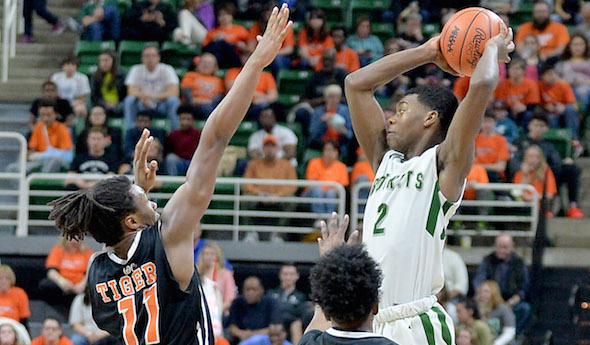
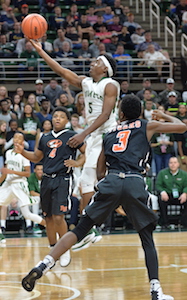
PHOTOS: (Top) New Haven’s Eric Williams, Jr., (2) looks to pass over Benton Harbor’s Carlos Johnson. (Middle) The Rockets’ A.J. Crawford III splits a pair of Tigers defenders during Friday’s Class B Semifinal.