

Tri-unity Christian Back on Top As Titus Leads Overtime Surge
By
Dean Holzwarth
Special for MHSAA.com
March 26, 2022
EAST LANSING – The Wyoming Tri-unity Christian boys basketball team fell short last season in its bid to add another state championship to its storied history.
Senior point guard Brady Titus wasn’t about to let history repeat itself.
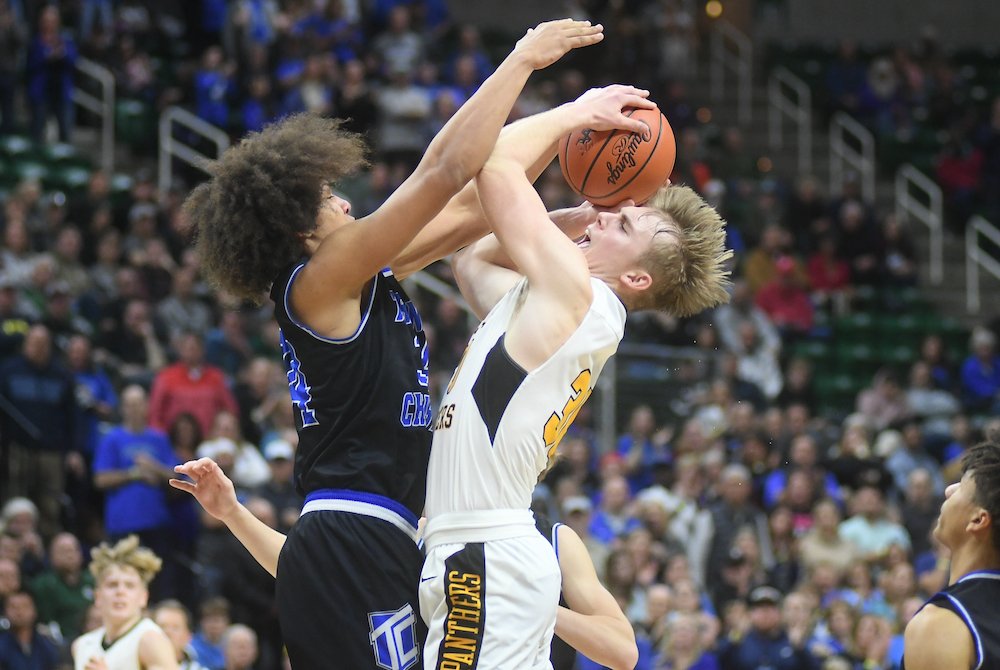
Titus scored a game-high 33 points to propel the Defenders to a thrilling 56-45 overtime win over Ewen-Trout Creek in Saturday’s Division 4 Final at the Breslin Center.
“There was so much motivation, just coming up short last year,” Titus said. “Just knowing that we lost to a team that we could’ve beat really carried on into this year, and there’s a great sense of relief knowing that we really did this as a team.
“I’m more than thankful, and it’s hard to describe how I feel right now other than a lot of excitement.”
The Defenders (20-6) lost to Detroit Douglass a year ago, 46-41, but gained redemption by outscoring the Panthers 13-2 in overtime Saturday.
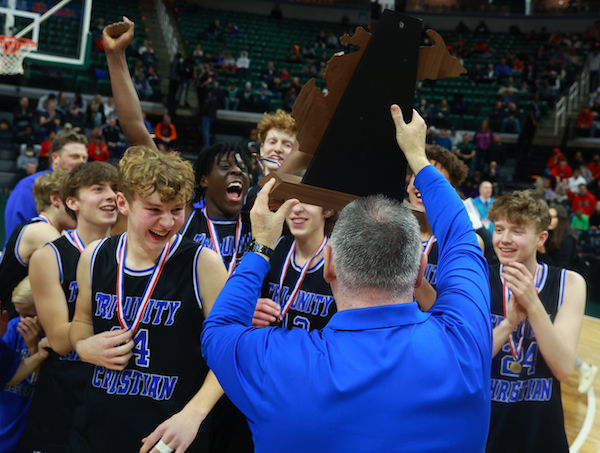
 Tri-unity captured its fifth Final, but first since 2011 under longtime coach Mark Keeler, who watched his team struggle in the second quarter after a strong start.
The Defenders led 16-11 after the first quarter, but Ewen-Trout Creek opened the second with an 11-1 surge to snare a 22-17 lead.
The Defenders countered with a 6-0 run to hold a slim 23-22 advantage, but Ewen-Trout Creek ended the half with seven straight points.
A 3-pointer from Eric Abramson at the buzzer gave the Panthers a 30-23 lead at the half.
“I was proud of my guys because we didn’t quit or get discouraged after that buzzer 3-pointer at the end of the first half,” said Keeler, who was appearing in his 10th Final. “Ewen-Trout Creek was gutty and tough, and they dominated the boards in the first half.”
Titus, who will play in college at Indiana Tech, scored 23 of his points in the second half and overtime after being held to 10 points in the first half.
He was poked in the eye inadvertently early in the third quarter, and it fueled his play.
“It was an accident for sure, but me being the person I am I took it personally,” Titus said. “That really fired me up to just go out there and play and compete.”
Titus stepped up several times when his team needed him during the second-half rally.
His driving lay-up with 33 seconds left knotted the score at 43-43 and sent the game to overtime after the Defenders got a defensive stop in the closing seconds.
 “He does it so often,” Keeler said of Titus’ heroics. “He’s just an amazing young man, and he made plays for us.”
Tri-unity turned to its defense in overtime to help secure the win.
Sophomore Owen Rosendall, who made three 3-pointers and finished with nine points, had a steal and took a defensive charge, while junior center Hanif James had a huge blocked shot with the Defenders clinging to a 47-45 lead in the final minute. He then scored inside on an assist from Titus.
“I don’t really go for blocks because I try to keep my hands up as straight as possible,” said James, who had seven points and seven rebounds. “If I see it, I go for it, and then Brady has great vision and I know he’ll find me when I’m open.”
Ewen-Trout Creek (22-3) was playing for its first Finals title since 1972.
The Panthers also finished Class D runner-up in 1982, losing to Covert 105-94.
“Overtime losses are always tough, but an overtime loss in a state championship game is something else,” Ewen-Trout Creek coach Brad Besonen said. “The fight and the grind these guys bring to the court every night showed tonight in front of a big audience on a big stage in one of the biggest games we can have as a high school team. I couldn’t be prouder of these guys.”
Jaden Borseth finished with 16 points and eight rebounds to lead the Panthers, while Brendan Polkky had 14 points and Abramson added 12.
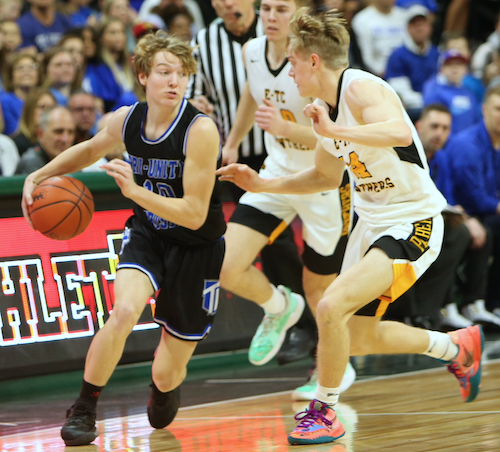
PHOTOS (Top) Tri-unity’s Hanif James (34) gets a hand on a shot attempt by Ewen-Trout Creek’s Jaden Borseth. (Middle) The Defenders’ Ethan Eerdmans (10) works to get past Ewen-Trout Creek’s Jonah Nordine. (Below) Tri-unity coach Mark Keeler raises the championship trophy toward his team Saturday. (Click for more from Hockey Weekly Action Photos.)

New Haven Locks Down, Lifts Class B Trophy
By
Paul Costanzo
Special for MHSAA.com
March 25, 2017
EAST LANSING – The New Haven boys basketball team has made a habit of lighting up scoreboards with explosive offensive performances.
But in their biggest game of the season, when pulled into a slowed-down game by Ludington, the Rockets dug deep and won with defense.
They held Ludington scoreless for the first 6½ minutes of the fourth quarter Saturday on the way to a 45-36 win to claim the Class B title at the Breslin Center. It was the first MHSAA Finals title for the Rockets, who were also making their first appearance in a boys basketball championship game.
“It was a great game, they’re a great team – they took away things that we do and played a great zone,” New Haven coach Tedaro France II said. “We kept our composure. It wasn’t a game that if you told me, we would come here and win this way. We scored the lowest point total we scored the whole year, and we found a way to win.”
The Rockets held Ludington to 11 of 49 (22.4 percent) shooting from the field, and while they were credited with just four blocks – all by sophomore Romeo Weems – the presence of shot blockers clearly caused problems for the Orioles, especially in the fourth quarter, when they shot 2 of 15 (13.3 percent) from the floor.
“You have to give a lot of credit to New Haven for that,” Ludington coach Thad Shank said. “They’re long and athletic and make it hard to finish. I thought we got a lot of great looks tonight, but that’s the game of basketball; sometimes they don’t always go in.”
Weems, who is already fielding Division I college offers, led all scorers with 19 points. He added 10 rebounds and three steals as well. Senior Eric Williams, Jr., had 14 points and seven rebounds for the Rockets (27-1), and Ashton Sherrell grabbed 11 rebounds.
Ludington was led by Calvin Hackert, who had 16 points. Sam LaDuke scored 10, and Noah Laman pulled down 10 rebounds for the Orioles. Six of Hackert’s points came in the final 1:30 on a pair of 3-pointers. Those were the only points the Orioles scored in the final quarter.
“We went with our man-to-man press trapping (in the fourth quarter), and they called a timeout because I don’t think they knew what to do,” Weems said. “I started giving everything I had left, getting scrappy, started rebounding more and got more aggressive.”
The game was played at a pace Ludington dictated, as the Orioles killed clock with long possessions and limited second-chance opportunities for the Rockets despite a massive size disadvantage. Ludington actually grabbed more offensive rebounds than the Rockets (14-10), and matched the Rockets in second-chance points (11).
Thanks to that, New Haven’s lead was just one heading into the fourth quarter.
“It was absolutely the way we wanted it to be,” Shank said. “We were hoping we would have the ability to control this game with our offense a little bit coming in. Be aggressive but patient, and really force them to guard a lot of things, and keep them from getting out in transition, and we did a pretty good job of that.”
 Ludington (25-3) led by as many as eight, taking a 15-7 lead in the second quarter. But a Weems 3 sparked a 16-4 New Haven run to end the first half, giving the Rockets a 23-19 lead heading into the break. The game remained tight from there until the Rockets were able to break it open in the final four minutes of the fourth quarter.
“We started off and nobody was hitting shots,” Weems said. “I just looked at (Williams) and was like, ‘He’s not in it yet,’ so I hit the shot and was like, ‘I have to hit this and let him know I have his back.’
“We started hitting shots and started going on runs, then they started going on runs. In the second half, we just took off, started playing hard, started pressuring them and got them out of their comfort zone.”
For France, a New Haven graduate, bringing home a Class B title was extra special.
“It just means a lot – you could see all the fans here – it just means so much to our school, to our town, the Village of New Haven,” France said. “This sport here is what a lot of people live through. I had a family that’s been coming to the games the last two years – they were sick, the wife is dying. He said they come to watch these kids play, and when they come they don’t feel pain, they don’t feel stress. For that hour and a half, they’re just there to watch these kids play, and it brings so much pride to them.
“Like I tell (the players), you’re not just playing for yourselves, you’re playing for more than just you, and these kids get that.”
Ludington’s season ended with its first trip to an MHSAA championship game since 1953, and one night after a buzzer-beating overtime win against River Rouge.
“It’s pretty cool to know that we made history and this team will probably never be forgotten,” Hackert said. “It’s a huge accomplishment. It’s just awesome, and we’ll never forget it.”
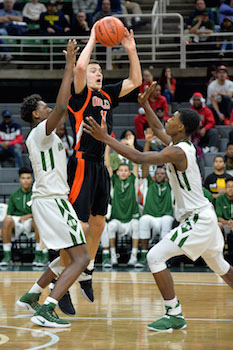
PHOTOS: (Top) New Haven’s Romeo Weems (23) and Ashton Sherrell (3) help surround a Ludington ballhandler during Saturday’s Class B Final. (Middle) Ludington’s Joshua Laman looks for an open teammate while being doubled by Rockets defenders.