

Twins X 2 Boost Unbeaten Mattawan
By
Pam Shebest
Special for MHSAA.com
January 22, 2019
MATTAWAN — With two sets of twins on his team, seeing double is nothing new for Mattawan boys basketball coach Ward Helakoski.

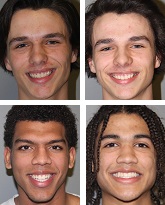
Jaden and Kelby Mabin are fraternal twins, but Matthew and Luke Pelak are identical. Telling the latter two apart was never much trouble for Helakoski, a Mattawan Middle School counselor who has known them since sixth grade, because Matthew and Luke were different sizes.
Then this year happened.
“Matt’s caught up (to Luke) this year, so that’s created some confusion,” Helakoski said. “They came in off the summer both tan from golfing,
“Hair was exactly the same. You’d almost have to look at them to see which was which. That was tougher for a while.”
Helakoski has figured it out, and the two sets of twins have found their best ways to contribute to Mattawan’s 10-0 start this winter.
The twins are four of eight seniors on the team and keys to the Wildcats’ success so far, said Helakoski, in his sixth year coaching the team. The Mabins and Matthew Pelak are starters, while Luke Pelak is first off the bench.
Between them, the Pelaks average 14 points, five rebounds and three assists per game. The Mabins combine for 13.2 points, eight rebounds and three assists.
And being a twin has its advantages, all four say.
Jaden Mabin said it is not so much the double looks he and his brother get, but “It’s just fun having a brother who’s been there with you for years right by your side.
 “We always want to see each other do the best. We’re always competing. I want to get more points than you, I want to make more shots than you. It’s kind of a friendly rivalry.”
Kelby Mabin, quick with a quip, does not quite agree.
“He might think we have competition, but we don’t,” he said of his twin. “It’s a one-sided battle if it is.
“I do outscore him; I do outplay him. It’s not competition,” he added, laughing.
The Mabins have three older siblings, and Kelby is the youngest of the two by three minutes. The Pelaks are the middle two of 11 children and the only twins, with Matthew the older of the two.
The Pelaks use their friendly rivalry to keep each other sharp on the court. “We always guard each other in practice and take it at each other,” Luke Pelak said.
But being identical can be confusing to opponents and referees.
“It’s obviously a lot of fun,” Luke said. “Even my parents confuse us sometimes if we’re facing the other way.
“Kids on the court actually confuse us, too. They’ll get in arguments about who’s guarding who.”
Mattawan is anchored by 6-foot-10 Division I college prospect Nolan Foster, and has been augmented this season by the addition of 6-4 senior guard Dexter Shouse, another Division I recruit whose father Dexter played a season in the NBA and overseas.
Mattawan has a one-game lead on Stevensville Lakeshore in the Southwestern Michigan Athletic Conference West and finishing second to Kalamazoo Central in the SMAC East last winter. Jaden Mabin said a key is the team has really stepped it up on defense – the Wildcats have allowed only Lakeshore to score 50 points, and that was in a double overtime win earlier this month. He added that the team has upped its tempo as it looks to improve on last season’s 15-7 finish.
Luke Pelak adds a boost off the bench, and brother Matthew said he admires his brother’s composure as the sixth man.
 “It was kind of tough seeing him not being able to start because I know how good he is, but I think he took it really well and he’s playing his role this year,” he said.
While all four enjoy the twin thing, all four are going to different colleges this fall. Of the four, only Kelby Mabin is hoping to play basketball.
“I love the talent it requires,” said Mabin, who has not yet settled on a college destination. “I feel that unlike other sports, you have to play defense and offense but you also have to have the IQ.
“It’s not just running the ball up and down the field and whoever has the most endurance, but who has the most skill and talent and athleticism.”
Jaden Mabin grew up thinking he would play basketball in college and beyond. But he opted for a football scholarship to Grand Valley State University instead although he received Division III basketball interest.
“It would be cool (to go to the same school as Kelby), but I want to be myself,” said Jaden Mabin. “I don’t want to be referred to as ‘Jaden-Kelby.’ I want ‘Jaden.’ I’ve been with him long enough.
“It’s been 17 years, so I think it’s time for us to be apart. A lot of twins dress alike. That’s not us. I want to be as opposite him as possible.”
The Pelaks are both headed to college on golf scholarships, Luke to Wayne State and Matthew to Eastern Michigan.
“It will be the first time we’re separated,” Matthew Pelak said. “It was more just wanting to have our own experiences with college, but we’re still close enough where we can hang out sometimes.
“We just wanted to have our own individual college experience.”
Tanner Knapp and Thomas Unold are the other two seniors on Mattawan’s boys basketball team. Juniors are Michael Lampos, Drew McNulty, Jalen Jones and Parker Miller. Luke Kerrins is the lone freshman on varsity. Assistant coach is Josh Brown.
 Pam Shebest served as a sportswriter at the Kalamazoo Gazette from 1985-2009 after 11 years part-time with the Gazette while teaching French and English at White Pigeon High School. She can be reached at [email protected] with story ideas for Calhoun, Kalamazoo and Van Buren counties.
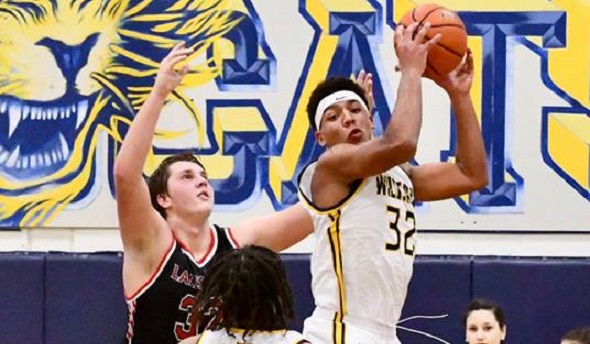
PHOTOS: (Top) Mattawan’s Jaden Mabin (32) looks to make a move in the post. (Middle) From top left: Matthew Pelak, Luke Pelak, Kelby Mabin and Jaden Mabin. (Below) Luke Pelak works to get a shot up Friday against Portage Northern. (Action shots by Erfan Pirbhai, head shots by Pam Shebest.)
Breslin Bound: 2025-26 Boys Report Week 2
By
Geoff Kimmerly
MHSAA.com senior editor
December 15, 2025
The calendar year may be drawing to a close, and schools soon shutting down for break. But there will be little rest for basketball fans seeking to see several of the state’s title contenders in action over the next three weeks.

Several leagues have either started play or will over the next few days, and this weekend starts full schedule of boys hoops showcases that will see many teams across the state playing at least once over the holidays before the regular-season schedule falls into routine in January.
“Breslin Bound” is powered by MI Student Aid and based on results and schedules posted for each school at MHSAA.com.
Week in Review
The countdown of last week’s five most intriguing results:
1. Arts & Technology Academy of Pontiac 60, Warren Lincoln 59 Last season’s Division 3 runner-up Lions (2-0) earned one of their most impressive wins over the last two winters by edging reigning Division 2 champ Lincoln (2-2) at the Best of Michigan Tournament at Detroit Mercy.
2. East Lansing 41, Detroit Martin Luther King 40 The reigning Division 1 champion Trojans (4-0) answered their closest call of the early season to win one of the most notable matchups at the Moneyball Tip-Off Classic at Don Johnson Fieldhouse.
3. Ishpeming Westwood 59, Kingsford 54 These two both made Semifinals at Breslin Center last season, and Westwood (5-0) came back from 17 points down to avenge a seven-point loss from last year to the Flivvers (3-1).
4. Lansing Sexton 86, Detroit Cass Tech 81 Sexton (2-1) opened this season with a loss at East Lansing but has rebounded to make a statement about its potential to build on last season’s Division 2 Quarterfinal run with this win over the Division 1 Technicians (3-1) at Don Johnson.
5. Grand Rapids Northview 50, Grand Rapids Catholic Central 44 The Wildcats (3-1) returned to The Invite at Calvin University and downed the Cougars (0-2), also Division 2 semifinalist last season.
Watch List
With an eye toward March, here are two teams in each division making sparks:
DIVISION 1
Auburn Hills Avondale (4-0) Winners of 16 games both of the last two seasons and runners-up in the Oakland Activities Association Red last winter, the Yellow Jackets may have more in store after this solid start including a 69-51 win over West Bloomfield on Thursday. Avondale’s holiday break slate is loaded with notable matchups against Freeland, Grand Blanc, Detroit Mumford and Hamtramck.
Jackson (3-0) The Vikings are off to a solid start as they look to build on last season’s 12-12 finish and tie for second in the Southeastern Conference White. Jackson opened league play Friday with a 60-47 win over Tecumseh, one of the other two teams that also tied for second in the league last season, and will get a first look at reigning champion Adrian on Friday.
DIVISION 2
Ludington (5-0) The Orioles’ fast start has included handing Spring Lake it’s only loss, 55-46 on Dec. 4, and delivering a first defeat to Fremont on Friday, 73-67 in overtime. Ludington lost to Spring Lake twice last season on the way to finishing 16-9, and the Orioles also are the early leaders in the West Michigan Conference Lakes after finishing second to Whitehall last winter.
Romulus Summit Academy (6-0) Last season’s Division 2 runner-up has not slowed down a bit, with a 35-29 win over Warren Fitzgerald on Saturday adding to a 65-59 overtime win over Detroit Edison and 65-54 victory over Detroit U-D Jesuit among notables during a busy but successful opening two weeks. Friday’s home game against Arts & Technology Academy of Pontiac could end up deciding the Charter School Conference Gold title.
DIVISION 3
Gobles (4-0) The Tigers have improved from four, to nine, to 12 wins over the last three seasons and could add to that climb after four double-digit victories to open this one. The team’s fast start included last week a 55-45 win over Bloomingdale – avenging a last season loss – and a 50-36 victory over Delton Kellogg, with which Gobles split Southwestern Athletic Conference Central meetings last winter.
Onsted (4-0) The Wildcats have won at least 18 games every season this decade and finished 21-2 in sharing the Lenawee County Athletic Association title with Adrian Madison last winter. Onsted split with Madison last season and won their first meeting again this time, 45-38 on Friday, with the rematch Jan. 29. Also worth noting: Onsted is in Division 3 this season after previously playing in Division 2 and Class B before that.
DIVISION 4
Concord (5-0) A 53-51 win over Bronson on Friday kept Concord perfect to start this season, with that also their first single-digit game of this winter. The Yellow Jackets finished the last one 17-10 and tied for second in the Big 8 Conference, and the Bronson win also avenged a December loss from a year ago – as did the 67-57 victory over Battle Creek St. Philip on Dec. 5. Concord will see reigning league champion Stockbridge for the first time Jan. 8.
Traverse City Christian (5-0) The Sabres finished 23-3 last winter, when they also started 5-0 before running into Lake Leelanau St. Mary. Those two faced off Friday, and this time TC Christian handed St. Mary its first loss, 55-36. Onekama and Bellaire were the other teams to defeat the Sabres last season, and neither is on the regular-season schedule this time – but matchups against Mount Pleasant Sacred Heart on Jan. 19, Traverse City St. Francis on Feb. 6 and Lake Leelanau St. Mary again Feb. 10 should be circled.
Can’t-Miss Contests
Be on the lookout for results of these games coming up:
Dec. 18 – Detroit Cass Tech at Detroit Martin Luther King (1-2) – They finished a combined 40-10 last winter, splitting their regular-season meetings. With Cass Tech defeating reigning champ Detroit Renaissance on Friday, this matchup could weigh much more heavily on the Detroit Public School League Blue title chase.
Dec. 20 – Grand Rapids Catholic Central (0-2) vs. Ann Arbor Huron (5-0) at Hazel Park – Arguably the top matchup at the D Zone Showcase will feature two teams that won Regional titles last season.
Dec. 28 – East Lansing (4-0) vs. Bloomfield Hills Brother Rice (5-0) at Ferndale – This Motor City Roundball Classic matchup will feature two of the favorites in Division 1.
Dec. 29 – Schoolcraft (2-1) vs. Grand Rapids South Christian (3-1) at Cornerstone University – These two are joined by Grand Rapids Forest Hills Northern and Paw Paw in the Green bracket.
Jan. 3 – Clarkston (4-0) at Grand Blanc (3-0) – This matchup might be the best of a strong slate at the annual Carmody Classic.
MHSAA.com's weekly “Breslin Bound” reports are powered by MI Student Aid, a division within the Department of Lifelong Education, Advancement, and Potential (MiLEAP). MI Student Aid encourages students to pursue postsecondary education by providing access to student financial resources and information. MI Student Aid administers the state’s scholarship and grant programs that help make college Accessible, Affordable and Attainable for you. Click to connect with MI Student Aid and find more information on Facebook and X @mistudentaid.
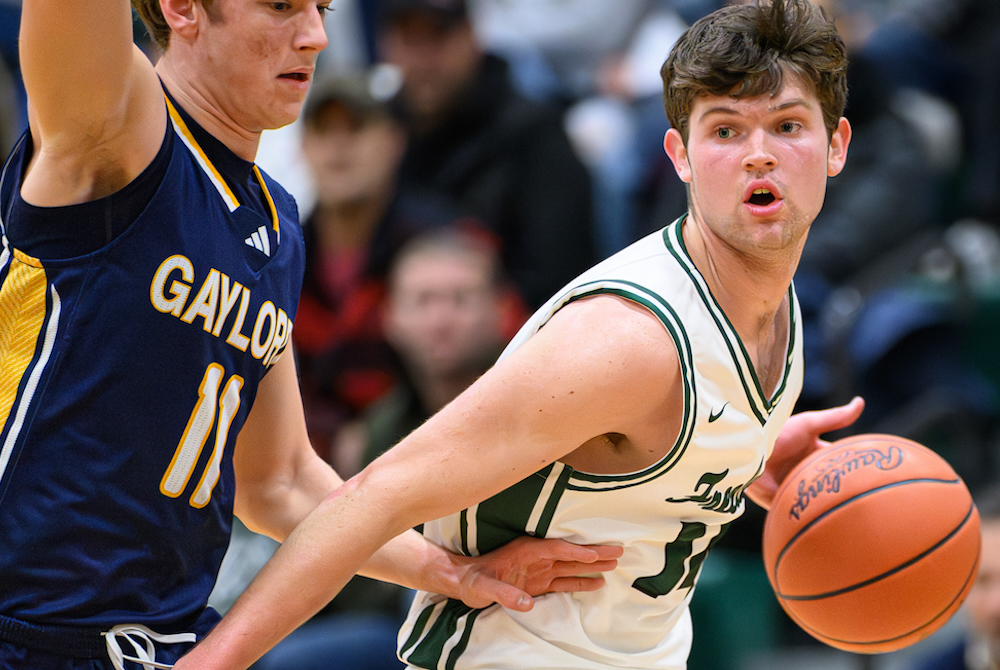
PHOTO Freeland senior forward Wilson Huckeby, right, navigates around a defender during the first quarter of last week's 70-47 Falcons win over Gaylord. (Photo by Kolleth Photo.)