

U-D Jesuit Continues Tourney Dominance
March 15, 2019
By Geoff Kimmerly
Second Half editor
EAST LANSING – Only three Detroit U-D Jesuit players have seen action in all 27 of their team’s games this winter.
Friday was further evidence of what the Cubs had been missing for parts of this season.
Now together and in game shape after injuries and illnesses, Jesuit has won its seven tournament games by an average of 28 points, adding a 63-25 Division 1 Semifinal win over Okemos to earn its second championship game appearance in four seasons.
The Cubs’ closest postseason win over the last three weeks was by 11 over league rival Warren DeLaSalle in the Regional Semifinal.
Total, Jesuit has won 19 straight games since its last defeat.
“It’s great being on the floor when we’re playing well like this,” Jesuit senior guard Daniel Friday said. “Everybody’s clicking and playing for each other and playing together. It’s really been a pleasure being with these guys on the floor. It’s been translating to blowouts; hopefully we keep that up.”
Jesuit (25-2) will take on Ypsilanti Lincoln in Saturday’s 12:15 p.m. Final at the Breslin Center, seeking its second championship to go with the Class A title won in 2016. Okemos finished 23-3.
Of course, it took only a few minutes into Friday’s press conference for the first questions to come about defending Lincoln’s freshman sensation Emoni Bates. Defense has been the Cubs’ strength as it’s worked through this season’s player absences, adding to the intrigue of Saturday’s matchup.
 Jesuit has kept teams to 50 or fewer points 13 times this winter, including four times during the postseason. The Cubs held a usually strong-shooting Okemos team to 21 percent from the floor and outrebounded the Chiefs 34-24 including 28-7 on Jesuit’s side of the court.
The Cubs scored the game’s first seven points and led by double digits for good by 1:35 to go in the first quarter. They made 55 percent of their shots from the floor for the game, including 7-of-8 during a second quarter that saw them extend the lead from 13 to 21 points.
“They’re a really deep team. They have a lot of threats outside and inside, and we never really played a team that big before,” said Okemos senior forward Evan Thomas, who led the Chiefs with 13 points and six rebounds. “It was definitely a big challenge to stop them inside, then they’d start hitting outside shots too and it just piled on. I think we worked hard and did what we could.”
Eleven players scored for Jesuit, with senior guard Jordan Montgomery leading with 17 points. Senior center Jalen Thomas added 15 points on 7-of-9 shooting and 11 rebounds, and senior guard Daniel Friday made 5-of-6 shots for 10 points.
Five Cubs had at least three assists.
“It’s been a very interesting year in terms of starting lineups and who we’ve had available off the bench,” Jesuit coach Pat Donnelly said. “This stretch … we’ve had that opportunity to build chemistry, and that’s what I like. I remember looking down at the stat sheet in the first half and we had 15 field goals on 10 assists. These guys are unselfish. They play the right way.
They move the basketball. They don’t care who’s scoring.”
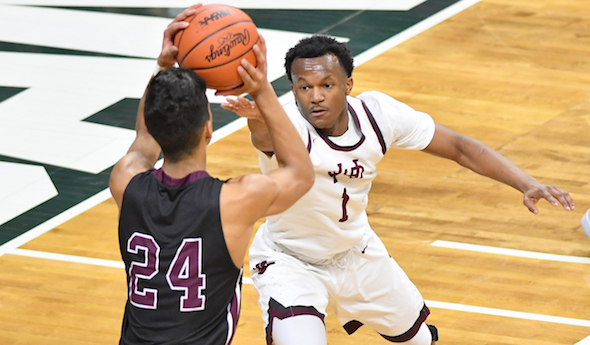
PHOTOS: (Top) U-D Jesuit’s Julian Dozier defends Okemos’ Evan Thomas during Friday’s second Division 1 Semifinal. (Middle) The Cubs’ Jordan Montgomery (3) and Chiefs’ Mason Kaczmarek go after a loose ball.
Nearly 25 Years After Leading Unexpected Run, Morton Directing Life-Changing Mission
By
Keith Dunlap
Special for MHSAA.com
August 11, 2026
Nearly a quarter century after presiding over arguably one of the most improbable boys basketball state championships in Michigan history, the same fight and underdog mentality still exists for Tim Morton.
 Back in 2002, Morton was the head boys basketball head coach at Auburn Hills Avondale, which produced a Hollywood-type run during that season’s Class B tournament.
Unranked and without a future Division I college player in the lineup, a Yellow Jackets team headlined by seven seniors went on a quest that stunned many statewide observers.
Avondale avenged the disappointment of not getting out of the District round the previous year and then recorded a stunning upset of a highly-ranked Flint Southwestern team in their Regional Final, winning in double overtime. But after squeaking out a six-point win over a solid Williamston team in a Quarterfinal and earning an 11-point win over Comstock Park in the Semifinals, surely midnight was going to strike for Cinderella in the championship game. After all, Avondale was up against a powerful Grand Rapids South Christian team which had multiple future Division I college players on its roster.
It didn’t matter as Avondale, led by tough-as-nails captains Mike Lewis and Wes Whiteside, senior Dionte Miller and sophomore Dave Holston, completed its stunning run with a 70-65 win to capture what still stands as the program’s only Finals basketball championship.
Morton said he thought his team the previous year that couldn’t make it out of Districts was more talented, but there were intangibles the 2001-02 team possessed that couldn’t be matched.
“I think that nobody really thought that they’d have a shot,” Morton said of his team. “I think that is why we were unranked, because of what had left. But you’ve got to have something to fight for, and I think the reason was the year before. We were motivated. I think playing that underdog role, we just loved it. We won games in so many different ways and got on that roll.”
This past March, Morton and other alumni of the Avondale team certainly were thrilled to see this year’s squad advance to the Semifinals for the first time since their 2001-02 team did so. This time, the Yellow Jackets suffered a three-point Semifinal loss to eventual Class A champion Rockford.
Today, Morton is also heading another team that has an underdog mentality but is motivated to fight for each other and surrounding communities.
Morton is the multi-area director for the Southeast Michigan chapter of the Fellowship of Christian Athletes, which aims to serve kids, coaches and communities by promoting through activities faith, self-esteem, serving others and being the best version of yourself.
The organization has roughly 50 student-led “huddles” that meet at high schools or middle schools, where students can have a safe haven to talk about problems, promote successes, go over scripture and bond during a challenging time of life.
Through volunteers and other staff members, the organization also conducts camps throughout the state for coaches, athletes and others to learn from each other and grow as leaders.
The chapter will have its annual golf outing Sept. 28 at Oakland University’s Sharf Golf Course.
“We just want to be really good at cultivating those relationships, making sure that we’re following up with people, and sharing what the Lord is doing so people feel like they can be connected to something bigger than themselves.”
 Playing for something bigger than themselves certainly worked for the 2002 team, and Morton said there is a 25th anniversary reunion in the works for next spring.
But while he nor anyone else in the Avondale community will forget that run in 2002, these days Morton is spearheading a team he said is playing for an even greater purpose, one he tried to describe to a group of youth football coaches in Flint during a recent gathering.
“I had only about 15 to 20 minutes to share with these guys,” Morton said. “I shared that we won a state title in 2002 and I was driven to be the best coach I could possibly be. A lot of great things happened, and the state championship happened. I’m on my way home from the state championship and we’re watching the video, and it’s crazy because this fear came over me. How are we going to do this again?
“Every coach that puts his or her full identity in the performance of the team, that’s scary and that’s not good. I got out six years later because of that fear. The most important relationships of my life were not good because I had to be validated by the performance of my team. That conversation kind of led into, “Why are you coaching? Why are you doing what you are doing? I wanted them to be motivated to be the best versions of themselves, for those kids, their wives and children. That’s why I’m in FCA. That’s my cause to fight for.”
2026 Made In Michigan
Aug. 7: Significance of Historic Run, Relationships Formed Live On for 1973 Unity Champs - Report
Aug. 4: Work Ethic Continues to Drive Van Dyk's Endeavors as Co-Owner of Family Farm - Report
July 24: Hackett Mentor's Care Sparked Lifetime in Hoops for BCAM President White - Report
July 24: Mackey Leaving Court with 500+ College Hoops Wins, Many More Lessons Shared - Report
July 16: Country Day Two-Time Champ Moore Building Perennial Winner at Harvard - Report
July 9: Multi-Sport Career at TC West Helps Gillis Thrive as Pro in Game She Once Left Behind - Report
July 2: Inspired by Home, Eager to Give Back, Spencer Hosts Hoop City Alumni Games - Report
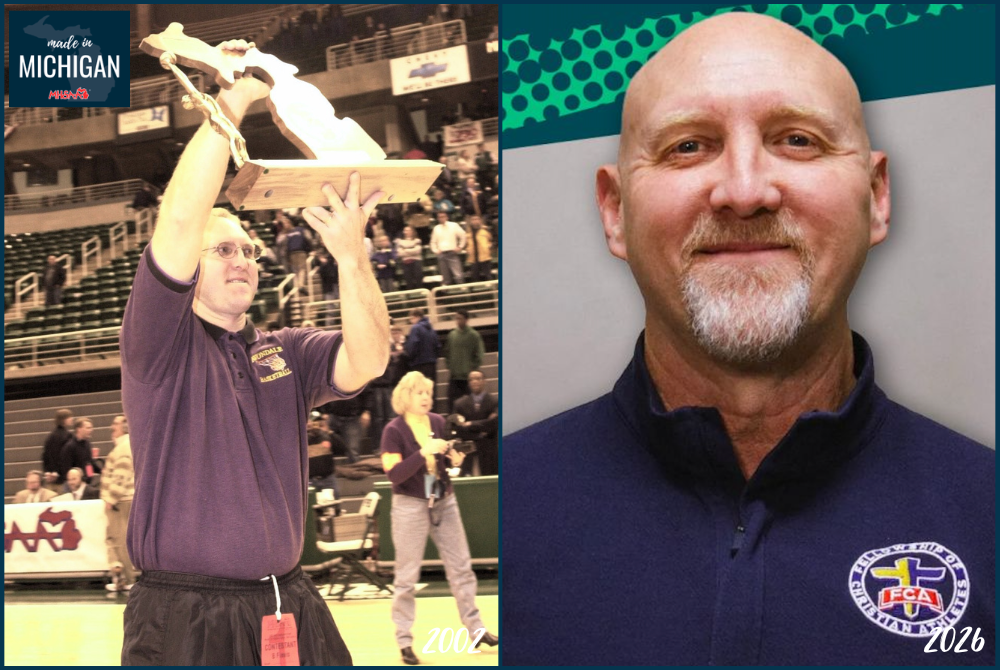
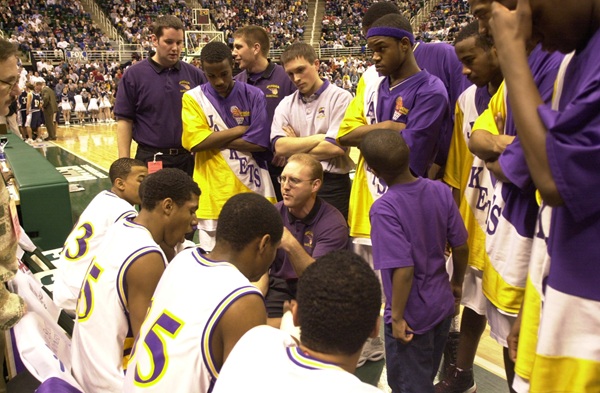
PHOTOS At left, Tim Morton raises the Class B championship trophy in 2002. At right, Morton now a director for Fellowship of Christian Athletes. (Middle) Morton, kneeling, speaks to his team during the championship win at Breslin Center. (MHSAA archives)