

U-D Jesuit Continues Tourney Dominance
March 15, 2019
By Geoff Kimmerly
Second Half editor
EAST LANSING – Only three Detroit U-D Jesuit players have seen action in all 27 of their team’s games this winter.
Friday was further evidence of what the Cubs had been missing for parts of this season.
Now together and in game shape after injuries and illnesses, Jesuit has won its seven tournament games by an average of 28 points, adding a 63-25 Division 1 Semifinal win over Okemos to earn its second championship game appearance in four seasons.
The Cubs’ closest postseason win over the last three weeks was by 11 over league rival Warren DeLaSalle in the Regional Semifinal.
Total, Jesuit has won 19 straight games since its last defeat.
“It’s great being on the floor when we’re playing well like this,” Jesuit senior guard Daniel Friday said. “Everybody’s clicking and playing for each other and playing together. It’s really been a pleasure being with these guys on the floor. It’s been translating to blowouts; hopefully we keep that up.”
Jesuit (25-2) will take on Ypsilanti Lincoln in Saturday’s 12:15 p.m. Final at the Breslin Center, seeking its second championship to go with the Class A title won in 2016. Okemos finished 23-3.
Of course, it took only a few minutes into Friday’s press conference for the first questions to come about defending Lincoln’s freshman sensation Emoni Bates. Defense has been the Cubs’ strength as it’s worked through this season’s player absences, adding to the intrigue of Saturday’s matchup.
 Jesuit has kept teams to 50 or fewer points 13 times this winter, including four times during the postseason. The Cubs held a usually strong-shooting Okemos team to 21 percent from the floor and outrebounded the Chiefs 34-24 including 28-7 on Jesuit’s side of the court.
The Cubs scored the game’s first seven points and led by double digits for good by 1:35 to go in the first quarter. They made 55 percent of their shots from the floor for the game, including 7-of-8 during a second quarter that saw them extend the lead from 13 to 21 points.
“They’re a really deep team. They have a lot of threats outside and inside, and we never really played a team that big before,” said Okemos senior forward Evan Thomas, who led the Chiefs with 13 points and six rebounds. “It was definitely a big challenge to stop them inside, then they’d start hitting outside shots too and it just piled on. I think we worked hard and did what we could.”
Eleven players scored for Jesuit, with senior guard Jordan Montgomery leading with 17 points. Senior center Jalen Thomas added 15 points on 7-of-9 shooting and 11 rebounds, and senior guard Daniel Friday made 5-of-6 shots for 10 points.
Five Cubs had at least three assists.
“It’s been a very interesting year in terms of starting lineups and who we’ve had available off the bench,” Jesuit coach Pat Donnelly said. “This stretch … we’ve had that opportunity to build chemistry, and that’s what I like. I remember looking down at the stat sheet in the first half and we had 15 field goals on 10 assists. These guys are unselfish. They play the right way.
They move the basketball. They don’t care who’s scoring.”
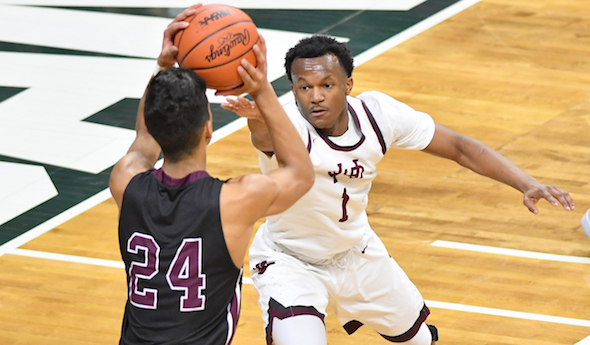
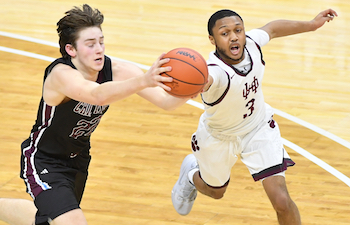
PHOTOS: (Top) U-D Jesuit’s Julian Dozier defends Okemos’ Evan Thomas during Friday’s second Division 1 Semifinal. (Middle) The Cubs’ Jordan Montgomery (3) and Chiefs’ Mason Kaczmarek go after a loose ball.
Beecher Earns Opportunity to 'Complete the Task' with Semifinal Win
By
Keith Dunlap
Special for MHSAA.com
March 23, 2023
EAST LANSING — Flint Beecher and Ecorse entered their Division 3 Semifinal on Thursday with at least one common thread of motivation.
Both lost in last year’s Semifinals, so both the Buccaneers and Raiders were looking to leave Breslin Center with some vindication.
Ultimately, Beecher was the team that did so, earning a 64-54 win over Ecorse and advancing to its seventh championship game since 2012.
Senior guard Robert Lee and senior forward Kevin Tiggs both scored 17 points to lead the way for Beecher (23-4).
“We’re not satisfied with this,” Beecher head coach Marquise Gray said. “This is just one part of completing the task.”
The difference in the game turned out to be that Beecher simply had more depth, which eventually wore down Ecorse.
Beecher featured an eight-player rotation, while Ecorse, with the exception of one substitution late in the third quarter, played its starters throughout until the game got away late.
“We figured we would wear them down,” Gray said. “Looking at their bench, we saw that they didn’t have a deep bench. But the focus, energy and effort was on us, and us executing defensively and offensively.”
 A big reason why Ecorse was short-handed was because one of its best players, senior Kenneth Morrast, was out after suffering a broken wrist in a Regional Final.
Ecorse head coach Gerrod Abram said he believes his team would have won this weekend’s championship if his squad was at full strength, but also heaped praise on Beecher and its playmakers.
Abram said before Morrast’s injury, his squad didn’t play any zone all year. But after he was injured, Abram said his team had to adjust on the fly and start playing a zone defense that he didn’t want to employ, but had to in order to keep players out of foul trouble.
Senior Malik Olafioye scored 22 points, and sophomore point guard Darrien Reddick scored 14 to lead Ecorse (20-5).
“Extremely proud of the effort we put out,” Abram said. “We knew it was going to be a big task with the way they play. We gave everything that we had. We just ran out of gas at the end.”
Beecher took a 40-34 lead into the fourth quarter, but Ecorse scored the first five points of the fourth to cut Beecher’s lead to one with 6:10 remaining in the game.
The Buccaneers answered, going on a 9-0 run to grab a 49-39 lead with 4:30 left.
Ecorse closed to within seven at 51-44 with 3:37 remaining following a 3-pointer by Reddick, but Beecher responded with four straight points to take a 55-44 lead with 2:42 remaining.
Beecher ultimately punctuated the win on a flying dunk by Lee with 1:09 remaining. Lee was also fouled on the dunk, and he made the free throw for a three-point play to give Beecher a 60-48 lead.
“What I really focused on was just trying to get my teammates involved,” Lee said. “Not try to force shots. Just let the game come to me.”
Now, Beecher will turn its focus to reclaiming its status as the best in the state.
“That’s something we have talked about, remembering the feeling that we had last year when we didn’t complete the job,” Gray said. “Guys have been taking it to heart. It’s not a rite. You have to earn your way here. It’s not a given.”
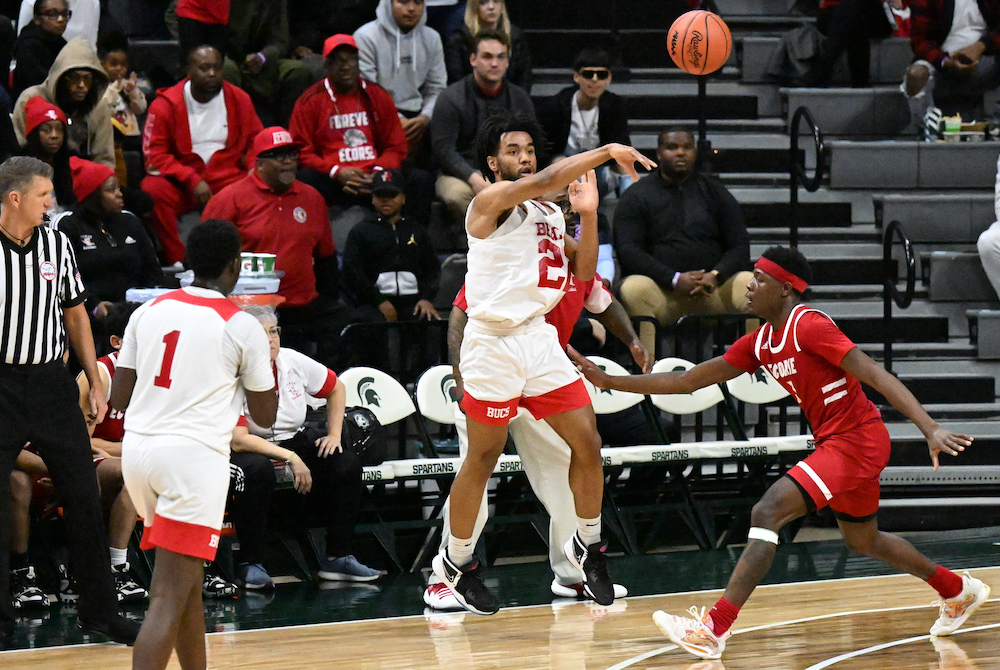
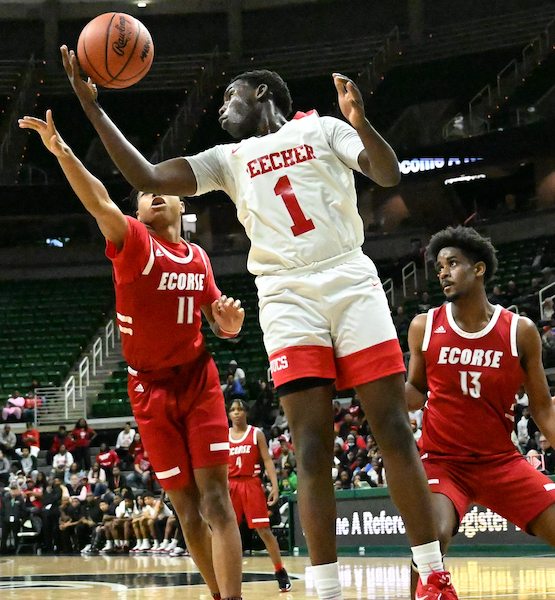
PHOTOS (Top) Flint Beecher’s Robert Lee Jr. (22) sends a pass into the post during Thursday’s Semifinal win over Ecorse. (Middle) The Bucs’ Kevin Tiggs Jr. (1) pulls in a rebound while Ecorse’s Deontae Jude (11) also grabs for the ball.