

U-D Jesuit Wins Matchup of Undefeated
March 25, 2016
By Geoff Kimmerly
Second Half editor
EAST LANSING – Detroit U-D Jesuit’s first trip to the Class A Semifinals in 2014 was filled with awe.
 The second trip, last season, ended in disappointment.
There was no longer awe Friday, and no less excitement – just a laser-like focus on taking the next step for the first time in program history, led by the best player to wear a Cubs uniform.
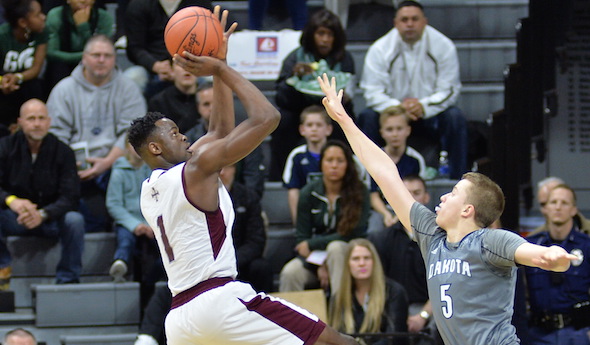
Senior guard Cassius Winston has played prominent roles in getting U-D Jesuit to the Breslin Center the last three seasons, and his 27 points and 12 rebounds were one of a few reasons the Cubs got past Macomb Dakota 72-51 in a matchup of undefeated teams considered the best in Class A heading into the postseason.
“Like I’ve said before, this is the final to my high school career, and I don’t think I’ve had a successful high school career unless we can win a state championship,” Winston said. “It means the world to finally get over that hump. We came in two years expecting to win it and came up short. Now we made it past that hump to make it to Saturday, so we’ve got to finish it off.”
The Cubs (27-0) will face North Farmington in Saturday’s noon Class A Final.
U-D Jesuit and Dakota were ranked 1 and 2, respectively, by The Associated Press at the end of the regular season, and both were playing to make an MHSAA Final for the first time. Dakota also was riding a perfect run, with the loss Friday ending its season at 26-1.
The Cubs’ 2014 run ended with a 10-point Semifinal loss to eventual runner-up Bloomfield Hills. Last winter, U-D Jesuit edged a point closer, losing by nine to eventual champion Detroit Western International.
The Quarterfinal win over No. 4 Ypsilanti Community on Tuesday to make this third straight trip definitely was worth celebrating. But Cubs coach Pat Donnelly said hoots and hollers were replaced by a quieter focus that showed him again that his players were all business.
 “We did discuss the last two years and the feeling that we had leaving here Friday afternoon, and we talked about that throughout the season,” Donnelly said. “That allowed us to win the Quarterfinal and be very focused walking off the floor. … I think you saw the result of that today.”
It was quickly apparent during an 18-3 run that began 2:41 into the game and ended 2:28 into the second quarter with U-D Jesuit up 25-9. The lead grew to as many as 25 points as the Cubs also held Dakota to its second-fewest in a game this season.
The more sizable U-D Jesuit outrebounded the Cougars 39-24 and also shot 58 percent from the floor to Dakota’s 35 percent success rate, which got off to a cool 19-percent first-half start.
Winston, who will next play at Michigan State and was named the state's Mr. Basketball on Monday, made 8 of 16 shots from the floor in front of a Breslin crowd that included a full lower bowl and a number of fans in the upper bowl as well.
“That was probably the hypest game I ever played in,” Dakota junior Jermaine Jackson said. “Cassius is a great player. Mr. Basketball coming in, that’s a tough task.”
Junior Gregory Eboigbodin added 13 points and 18 rebounds for U-D Jesuit. Senior guards Steven Marshall and Tavin Allison led four Dakota players in double figures with 13 points apiece, and Jackson and sophomore Thomas Kithier each scored 12. Kithier also had nine rebounds and four assists.
Donnelly said he told Dakota coach Paul Tocco after not to let a Breslin loss take anything away from an excellent season, as the Cougars were now experiencing what the Cubs had experienced twice before.
“Obviously we’re disappointed, but we’ve very proud of the season we had,” Tocco said. “I know the experience of losing to Clarkston in the Regional championship last year was a big-time motivator for us to move beyond that point. It motivated our entire program. And we took another step, two steps, beyond that this year.
"To get here, I’m not going to lie – it’s a lot of fun. We tried to treat it as a business-type trip. We weren’t just happy to be here. We just got outplayed tonight.”
The Boys Basketball Finals are presented by Sparrow Health System.
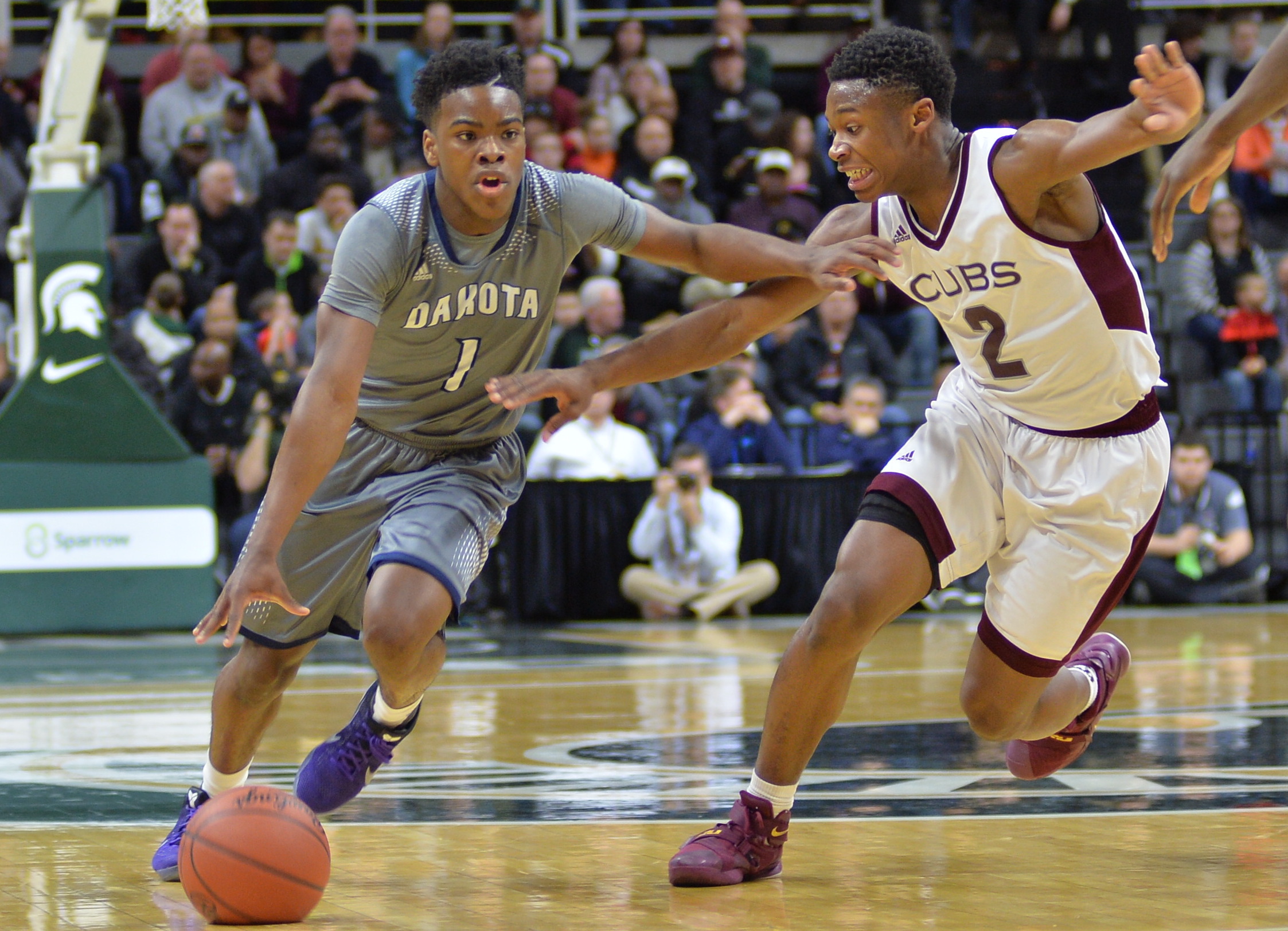
PHOTOS: (Top) U-D Jesuit’s Ike Eke (1) launches a shot over the outstretched hand of Macomb Dakota’s Thomas Kithier. (Middle) Dakota’s Jermaine Jackson (1) works to get past U-D Jesuit’s Elijah Collins.
Hoopfest Returns This Weekend to Jenison
March 21, 2017
By Geoff Kimmerly
Second Half editor
March Magic Hoopfest will return to Jenison Field House for this weekend’s Michigan High School Athletic Association Boys Basketball Finals, marking the eighth championship weekend the event has run concurrent with the games being played at Michigan State University’s Breslin Center.
A number of favorite attractions will return including slam dunk (on lowered rims), 3-point shootout and half-court shot areas where fans can come at any time and participate, and the festivities also will include a court for timed “Around the World” shooting games and another court featuring the Michigan Army National Guard skills challenge. Also returning is the Walk of History, showcasing championship games, life-size photos and display boards from throughout the MHSAA Finals’ near century-long run.
Two Hoopfest center courts will host a number of games throughout the event, including the “JumpBall Jamboree” made up of teams of boys and girls in grades 3-8, and a series of games between Special Olympics Project UNIFY high school teams.
Admission to the March Magic Hoopfest is $2 per person, and fans attending the MHSAA Boys Basketball Semifinals and Finals will be admitted free with their game tickets. Hours on March 23 and 24 will be 2 p.m. to 7 p.m.; the event is open from 10 a.m. to 6 p.m. on March 25. Jenison Field House, site of Hoopfest, also was the site of the MHSAA Boys Basketball Finals for 31 years. To find out more general information about the event, visit the March Magic Hoopfest Website.
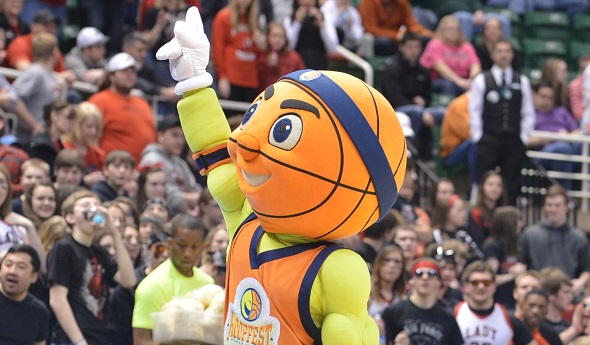
Hoopfest also will be home to Hoopie, the event’s mascot who made his first public appearances during the 2014 MHSAA Finals.
The March Magic Hoopfest is being conducted in partnership between the Greater Lansing Sports Authority (GLSA), a division of the Greater Lansing Convention and Visitors Bureau, and the MHSAA, with vital support coming from the Department of Intercollegiate Athletics at Michigan State University.
“For more than 90 years, basketball teams have ended their seasons at the MHSAA Tournament, and Hoopfest allows fans to share first-hand in the atmosphere that has made this such a historic event,” MHSAA Director of Brand Management Andy Frushour said. “It’s a great stop-over for our fans coming to or leaving the Breslin Center, and it’s also a great place to bring the family for some fun even for those who won’t be attending this weekend’s Finals.”
The Greater Lansing Sports Authority’s mission is to be the leading voice of sports tourism in the Greater Lansing area and to promote economic growth by attracting a diverse range of sporting events to the region. The GLSA strives to enhance the quality of life for area residents through the development of local sports and fitness programs for all ages and supports the continued development and maintenance of safe, high-quality athletic facilities.
“The March Magic Hoopfest sets off a great weekend of MHSAA tournament games and helps create a multi-day event which will involve the Lansing area and thousands of visitors from across the state,” said Mike Price, Executive Director of the Greater Lansing Sports Authority. “If you’re coming to the championships, Hoopfest is a destination to visit before and after the games; and if you’re not coming to the games, Hoopfest is a fun, wholesome, inexpensive, family activity.”
PHOTO: Hoopie entertains the crowd during the 2014 MHSAA Finals.