

Undefeated Mio Poised to Build on Bolt Nation's Proud Hoops Tradition
By
Tom Spencer
Special for MHSAA.com
January 20, 2023
Wins, losses and championships may not be what this year’s Mio boys basketball players leave at the top of their footprint when they’re done.
 But they certainly could.
“I’m proud to say these boys have gotten many compliments throughout the last couple of seasons as to how they conduct themselves and represent our basketball program, one another, our school, and our community both on — and off — the court,” said head coach Ty McGregor. “This group’s legacy will be more about their high character than records and titles.”
McGregor knows about leaving a legacy. He scored 32 points to lead the Thunderbolts to the 1989 Class D championship. His scoring in the 78-67 deciding win over Beal City allowed Mio to cap a perfect 28-0 season.
He also knows the legacy, perhaps better than most, of Michigan’s all-time boys career scoring leader, Jay Smith, who led Mio to the 1989 Semifinals and a 24-2 record. Smith and McGregor are brothers-in-law.
Smith, who set the bar while playing before the 3-point line was added to Michigan high school basketball, went on to play and coach at the college level. Smith recently returned to the University of Michigan basketball program as the director of player personnel and development under Juwan Howard.
McGregor went on to play professionally in Europe and coach with Smith at Grand Valley State and Central Michigan. He also squeezed in two years coaching the Thunderbolts before the college coaching and returning to Mio in 2017.
Today’s Thunderbolts leadership — seniors Austin Fox, Gage Long, Nathan Hurst — have helped Mio to an unbeaten start.
They also have the Thunderbolts starting to think of capturing a conference title that has eluded them for 13 years.
“We only have 10 total boys in our high school basketball family, so it’s vital all lead and take ownership,” McGregor said. “Our kids show up in the classroom basketball court, so right there is 80 percent of being successful.
 “We talk about ‘real-life stuff’ a ton, and a big part of what we’re about is always leaving places better than when we found them,” McGregor continued. “These three seniors will most definitely leave our program a better place when their time here is complete, which makes a highly competitive, overly intense, passionate coach like myself smile!”
Fox, averaging 16.4 points per game, Long at 12.4, and Hurst at 10, are the team’s leading scorers. Long leads the team in rebounding, and Fox tops the steal list.
Sophomore Zeke Morris is right behind the seniors in scoring, rebounding, and steals. Junior Hunter Perez leads the team in assists.
Any and all five Thunderbolts on the court at any moment can drive the team’s success, according to McGregor.
“I’ve stated all along, we don’t have a superstar or superstars; we do things by committee,” noted McGregor. “In order for us to be successful in any way, ‘by committee’ is how it has to be done.
“We have five players that on any given night can get us double-digit scoring,” he went on. “Austin Fox, Gage Long and Nathan Hurst clearly do a great job with leadership, but everyone has taken ownership of this team.”
Defending is the team’s top priority, McGregor is quick to point out. His team is currently holding opponents to just 25 points per game.
“We know there will be nights where we will really shoot it in and nights where we can’t throw it in the ocean,” he said. “That’s basketball, but we should never have off nights at the defensive end — that’s all about effort, focus.
“We are holding true to our priorities thus far,” he continued. “This type of defensive success widens our margin for error in other areas that we don’t have as much control over.”
What the Thunderbolts can control is attitude and effort, and MacGregor views that as the key to their success so far: “Our kids’ attitude and effort have been off the charts. It’s vital we always stay on top of those things.”
The postseason is already on the minds of the Thunderbolts, McGregor acknowledged.
“The postseason is clearly the most important part of the season in our minds,” McGregor said. “We want to continue to hold each other accountable and make daily deposits on preparation, commitment, effort, and attitude, which we hope will pay dividends in March.”
Mio’s style of play may not turn heads, but McGregor believes it gets the job done.
 “Unfortunately for our kids and Bolt Nation, their head coach is very black-and-white — he’s not into ‘Top 10’ highlights,” McGregor said. “We play a very fundamental, disciplined style of hoops, doing our best to not over complicate things.
“We’re more about eliminating mistakes than playing high-risk hoops.”
McGregor’s wife Kristi took over coaching the Mio girls basketball program this season. Mio didn’t have enough players last year to field a girls team.
All of the girls who hoped to play last year still have eligibility – and could end up with the top seed in their District.
Coaching at the same school as his wife has been a spectacular experience, the boys coach said. And, it gives them something else to argue about, Ty McGregor joked.
“It is absolutely awesome to have the opportunity to teach the game of life, the game of hoops, and be a part of Bolt Nation alongside my wife, Kristi,” he said. “It gives us the opportunity to discuss, analyze, and assist one another, all in hopes of teaching kids in our small community to dream big, work hard, and commit to something bigger than themselves.”
The Thunderbolt boys, 7-0 overall and 2-0 in the Big Dipper portion of the North Star League, will resume play Tuesday at Posen.
“I don’t look at or take much stock in an unbeaten record this early in the season,” McGregor said. “We don’t even discuss it, as we are more concerned with our daily approach to be better than we were the day/game before.”
 Tom Spencer is a longtime MHSAA-registered basketball and soccer official, and former softball and baseball official, and he also has coached in the northern Lower Peninsula area. He previously has written for the Saginaw News, Bay County Sports Page and Midland Daily News. He can be reached at [email protected] with story ideas for Manistee, Wexford, Missaukee, Roscommon, Ogemaw, Iosco, Alcona, Oscoda, Crawford, Kalkaska, Grand Traverse, Benzie, Leelanau, Antrim, Otsego, Montmorency, Alpena, Presque Isle, Cheboygan, Charlevoix and Emmet counties.
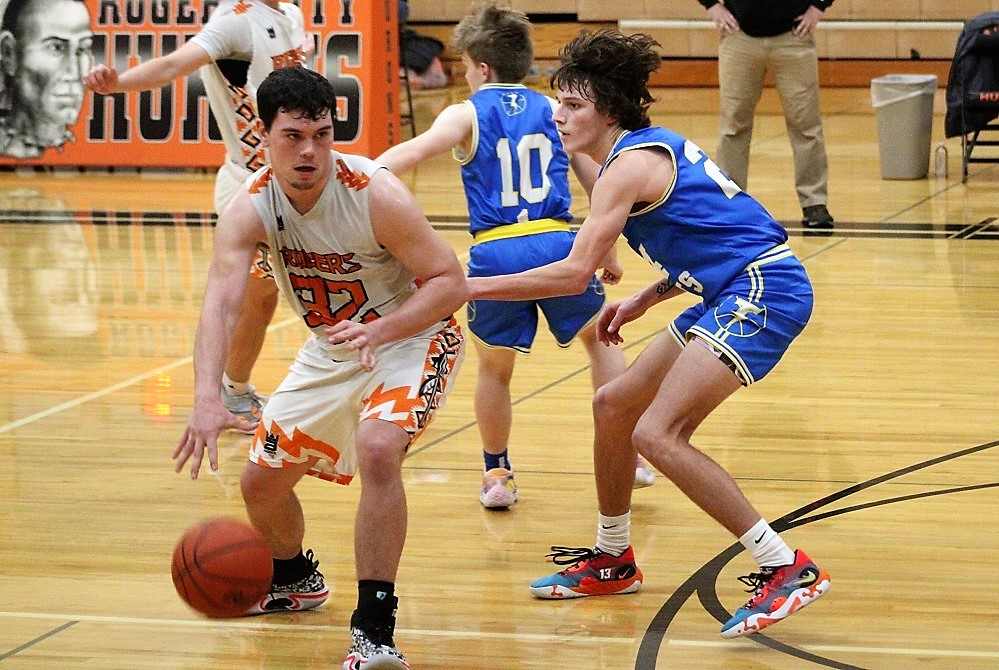
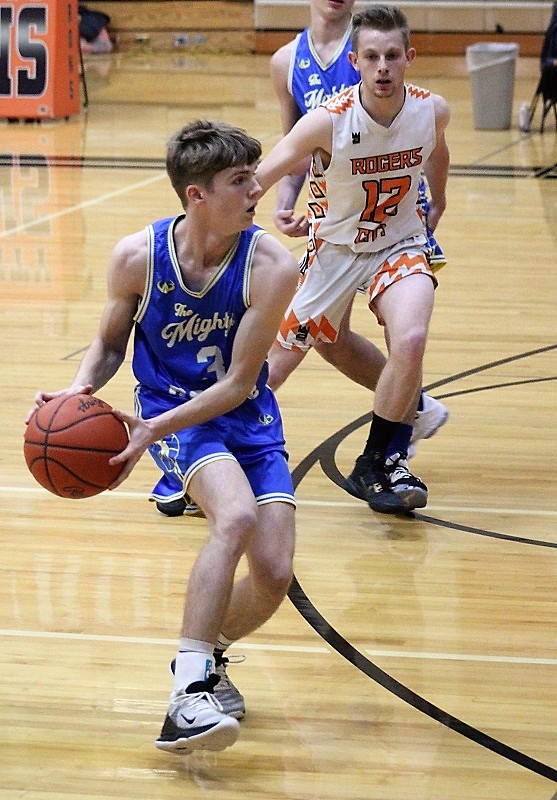
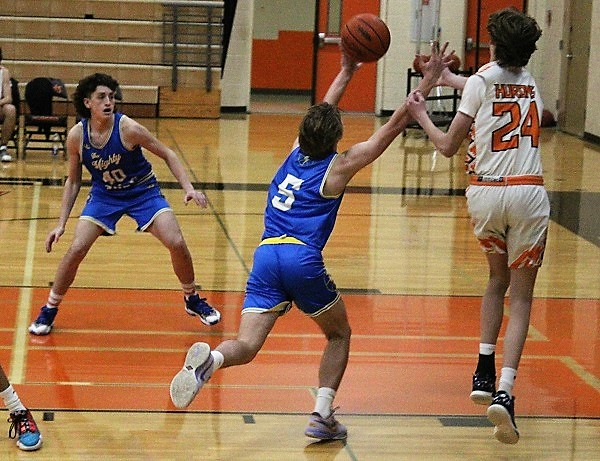
PHOTOS (Top) Mio’s Gage Long (24) defends during a 57-17 win over Rogers City on Tuesday. (Middle) Nathan Hurst (3) looks for an open teammate. (Below) Austin Fox (5) intercepts a pass into the lane. (Photos by Jessi Fox.)
Breslin Bound: Boys Report Week 2
December 20, 2012
By Geoff Kimmerly
Second Half editor
As with football during the fall, Second Half tries to hit all classes and all corners of the state for these weekly boys and girls basketball reports.
But sometimes, focusing on the powers in Class A and B is simply unavoidable.
Most of this week's 10 notable performances came from some of our biggest and best-known schools. (Results and records based on those reported to Score Center at MHSAA.com)
1. Warren DeLaSalle (3-0) – The Pilots have been the Detroit Catholic League team to beat for half a decade, and that could continue this winter. DeLaSalle beat Farmington Hills Harrison 64-50 before edging Class B power Grand Rapids Christian 77-76 in double overtime.
2. Gibraltar Carlson (2-0) – The Marauders’ 70-53 win over Saginaw Buena Vista might not have earned the biggest headline from Saturday’s Metro Detroit Saginaw Valley Challenge at West Bloomfield. But given Buena Vista’s rich tradition, it was still intriguing – although Carlson is coming off a run to its Regional Final too.
3. Romulus (2-1) – I hope to avoid repeating teams on this list from week to week. But Romulus beating reigning two-time Class B champion Lansing Sexton 67-52 makes the Eagles a must again.
4. Grand Rapids Christian (1-3) – It’s been a tough go for these Eagles, who are expected to contend in Class B. But despite finishing the week with that close loss to DeLaSalle, they did beat reigning Class A runner-up Rockford 48-39 earlier on.
5. Rockford (1-2) – The Rams also opened with a couple of losses, but finished the week with a 63-53 win over Muskegon – which made this list last week and is considered a possible contender this season.
6. Bessmer (5-0) – After going 10-11 in 2011-12, Bessemer is halfway to matching that win total. Last week’s were close ones – 50-48 over Hurley, Wis., and 55-51 over Ironwood.
7. Lansing Eastern (2-1) – The Quakers have had three Division I college prospects graduate or move to schools out of state over the last two years, but keep rolling. They picked up solid wins over Williamston (68-58) and East Lansing (55-50).
8. East Jackson (4-0) – The Trojans are off to another nice start coming off a 15-win season. They opened last week beating Brooklyn Columbia Central 51-45 before doubling up Manchester 102-61 – after another high-scoring 100-94 win over Manchester a year ago.
9. Saginaw (4-0) – The reigning Class A champion is on the move again. After beating Midland 86-77 and then Saginaw Heritage 81-34, the Trojans came back Saturday to beat a strong Detroit Southeastern team 57-56 in the MDSV Challenge.
10. Flint Southwestern (3-1) – The Knights are already halfway to last season’s win total, thanks in part to victories last week over Flint Northwestern (63-59) and Flint Powers Catholic (70-39).
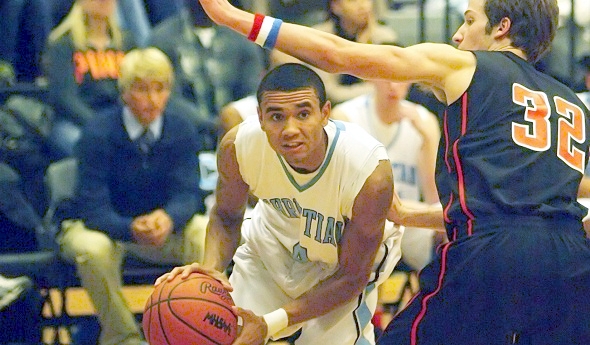
PHOTO: Grand Rapids Christian's Drake Harris attempts to drive around a Rockford defender during last week's win against the reigning Class A runner-up. (Click to see more at HighSchoolSportsScene.com.)