


Undefeated Williamston Reaches Final Game with 1 More to Win
By
Tom Kendra
Special for MHSAA.com
March 25, 2022
EAST LANSING – It’s been 82 years since Williamston won a boys basketball state championship.
Now the Hornets are one win away from ending that drought and seemingly the entire town, located only about 10 miles away from East Lansing, packed the Breslin Center on Friday to watch its own version of “Hoosiers” take another step.
Williamston (26-0) used its variety of weapons to jump ahead of Freeland early in a battle of unbeatens, then gradually pulled away for a 65-45 victory in the night’s second Division 2 Semifinal.
“It feels like we have the whole city with us, pushing us,” said 6-foot-4 Williamston senior Jacob Wallace, who scored 12 points. “I’m playing not only for my coaches and teammates, but the whole community.”
The Hornets will need all hands on deck in Saturday’s highly-anticipated showdown with reigning Division 2 champion Grand Rapids Catholic Central, an explosive team which downed Ferndale, 82-71, in Friday’s first Division 2 Semifinal.
Williamston, an experienced team with 10 seniors, had to avoid looking past a pesky Freeland team.
The Hornets took control early behind the play of senior point guard Mason Docks and 6-10 senior post player Max Burton.
Docks was a thorn in Freeland’s side all night long, leading Williamston with 19 points, five steals and four assists. Burton set the tone early inside and finished with nine points, six rebounds and three assists.
 Williamston, which won the Capital Area Activities Conference White title, has played its best basketball in the postseason – winning its six tournament games by an average of 26 points.
“I would say the main feeling I have right now is excitement,” said Docks. “We’ve been preparing all season for this moment. Now it’s time to go out and have some fun and play our game.”
Tight defense and good execution on offense were the formula once again, as the Hornets built a 14-7 lead after one quarter and then extended it to 31-18 by halftime.
After Williamston built the lead to 19 points, Freeland showed why it came into Friday’s Semifinal undefeated as well, using an 8-2 run to end the third quarter trailing by just 12 points.
However, a 12-4 Hornets spurt to open the fourth quarter built the lead back to 20 points, 60-40, and they cruised from there.
Jackson Newman played a strong all-around game for Williamston with nine points, five rebounds and two steals. The Hornets finished with a commanding 42-20 advantage in points in the paint.
Freeland (25-1), which won its first Regional championship since 1971 and made its first-ever trip to the Semifinals, was paced by senior Bryson Huckeby’s 19 points and seven rebounds.
“Coach (John Fattal) has been telling us all year, like when we were 10-0 and kept winning, that we hadn’t arrived yet,” said Huckeby. “Well, when I stepped out on this court and saw all of those people there to support us, I knew we had arrived. That atmosphere tonight is something that I will never forget.”
Jacob Kundinger scored 10 points for the Falcons, and center Alex Duley contributed five points, four assists and three steals.
The stage is now set for an epic Division 2 Final game which will be a contrast in styles. Williamston likes to play a more controlled game and has won all 26 with precision half-court execution, while GRCC never stops running.
“We’ve prided ourselves on defense all year, but tomorrow night will be our greatest challenge by far in that department,” said sixth-year Williamston coach Tom Lewis. “We have to get back in transition because they just go, go, go. We have to limit their runs.”
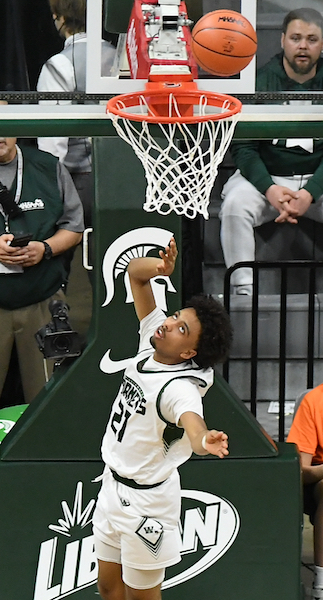
PHOTOS (Top) Williamston's Max Burton extends his reach as Freeland's Alex Duley (24) attempts to direct a shot around him. (Middle) The Hornets' Mason Docks gets to the basket Friday. (Click for more from Hockey Weekly Action Photos.)
Lenawee Christian Earns Saturday Return
March 20, 2014
By Geoff Kimmerly
Second Half editor
EAST LANSING – From 1998-2001, Adrian Lenawee Christian’s boys basketball team made four MHSAA Quarterfinals and advanced to three Semifinals.
Senior guard Brad Harrah remembers and is reminded every day.
“Every time I come out to practice, I see those banners and they remind me of the last time we were here,” he said. “It just drives our team.”
It helped drive the Cougars on Thursday into an MHSAA Final for the first time.
Lenawee Christian survived a third-quarter comeback by sharp-shooting Cedarville to advance to its first boys basketball championship game with a 67-58 victory in the final Class D Semifinal at the Breslin Center.
“It just means everything to us. As one of our players said, it’s our only option. We don’t have any other option but to come out and win this game and come out and win Saturday,” Harrah said. “Just to get back to where the program was, and take it a step farther, is just incredible.”
The Cougars (21-4) will face two-time defending champion Southfield Christian at 10 a.m. Saturday.
 Total, Lenawee Christian has made the season’s final week eight times over the last 17 years. Its last three Quarterfinal runs were stopped by Class D powerhouse Wyoming Tri-unity Christian – but this week the Cougars were able to break through with an overtime win Tuesday over Battle Creek St. Philip.
Lenawee Christian took a one-point lead Thursday on junior Nick Mewborn’s 3-pointer before the first-quarter horn, and pushed the advantage to 10 by halftime.
But Cedarville (24-2) just needed a few more minutes to heat up.
The Trojans made 8 of 15 shots from the floor during the third quarter, and junior forward Brad Causley scored 15 of his 22 points during the period as Cedarville pulled within 48-47. The Trojans then tied the score 49-49 on another Causley bucket 28 seconds into the fourth quarter.
“Being such an experienced team and having a great tradition, we knew they would have a run and were going to come back,” Lenawee Christian coach Scott McKelvey said. “They have so many great shooters on their team, and we had to weather their run. … I thought we did a great job keeping our composure.”
The key was getting the ball in the post to 6-7 senior forward Kingsley, who finished with 22 points and 16 rebounds. Sophomore 6-7 center Maxwell had 12 points, including the go-ahead basket to break the fourth-quarter tie and another bucket to push the lead back to six with 5:33 to play.
Senior guard Grant Hohlbein also added 15 points and seven rebounds for Lenawee Christian – with six of those points coming in the fourth quarter.
The Trojans also cooled off substantially, making only 2 of 16 shots from the floor during the final period.
“Every coach in America says when you’re making shots, you look good,” Cedarville coach Dave Duncan said. “But I’m proud of our effort – it was a pretty gutsy effort I felt like we played with in the second half.”
Junior guard Joey Duncan also had 22 points for the Trojans and grabbed nine rebounds. Senior center Dann Stenback added 12 points and five rebounds.
Cedarville made its third Quarterfinal in four seasons this week, with the Semifinal berth its first since 2009.
Click for a full box score and video from the press conference.
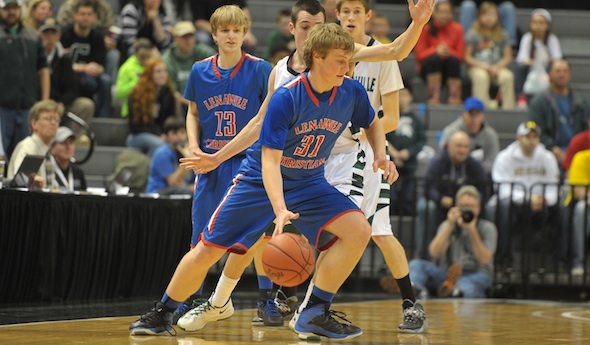
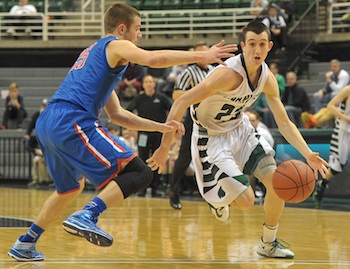
PHOTO: (Top) Adrian Lenawee Christian’s Nick Mewborn works to find an opening in the Cedarville defense during Thursday’s Class D Semifinal. (Middle) Cedarville's Joey Duncan attempts to drive past a Lenawee Christian defender.
HIGHLIGHTS: (1) Grant Hohlbein keyed an 8-0 fourth quarter run for Adrian Lenawee Christian with a pair of baskets, including this baseline drive. He ended the game with 15 points. (2) Brad Causley had 22 points and nine rebounds for Cedarville in the Class D Semifinal. Here he scores on a putback off a blocked shot.