

Unity Rides Impressive Run Into Saturday
March 15, 2019
By Geoff Kimmerly
Second Half editor
EAST LANSING – The last two weeks have seen Hudsonville Unity Christian thrust into the statewide spotlight with a pair of wins over teams expected to contend for this season’s Division 2 title.
But the Crusaders have belonged in that conversation all season as well, and showed why again Friday in clinching a spot in their first MHSAA boys basketball championship game since 1973.
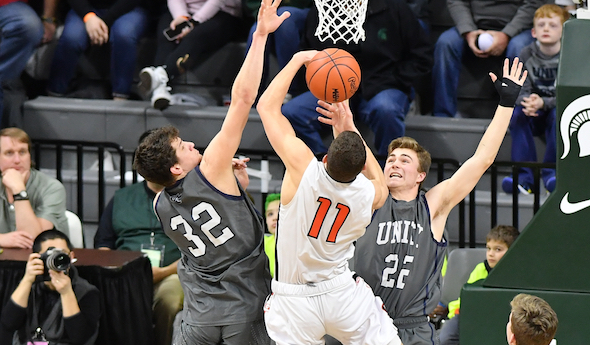
Unity Christian ran its winning streak to 21 this winter with a 69-30 victory over Ludington in the night’s first Division 2 Semifinal at Breslin Center.
The impressive showing fit well following the Regional Final win over 2018 Class B champion Benton Harbor and Tuesday’s 36-point Quarterfinal win over Grand Rapids South Christian, which handed the Crusaders their last loss, by two on Dec. 21.
“We talked about flying under the radar because we’ve done that all year long, and that’s been a good thing – that’s fine with us,” Unity coach Scott Soodsma said. “I think we have just really turned it up a notch. These kids are just winners, and they were getting close to the end of their careers, and they want to go out champions. So I think they just actually on their own decided to turn it up a notch.”
Unity (25-2) will face River Rouge in Saturday’s 6:45 p.m. championship game. As noted, it will be the Crusaders’ first Final since 1973, and they also finished Class B runners-up in 1963.
But the program has been building toward this opportunity. Last week’s Regional title was its first since 2008, but Unity won its third straight league and District championships rolling toward the end of February.
The Crusaders led Friday for all but 59 seconds when the teams were tied early, and by double digits for the final 27 minutes. The lockdown defense added to a postseason effort that has seen Unity give up only 47 points on average over seven playoff wins.
 “There was stuff we thought was open when we went in at halftime, but our offense was being played so far away from the basket and so far off the 3-point line that we had a heck of a time taking advantage of any of those things,” Ludington coach Thad Shank said.
“When you’re a team that can really pressure the ball like they do, you don’t even have to play great defense behind that ball pressure because it causes so much havoc.”
On the other side of the court, senior guard Noah Wiswary was the only Unity scorer in double figures with 17 points. But while 12 players got on the board, the team’s shooting percentage stayed at a sparkling 59 percent from the floor for the game. Unity also had 18 assists on 29 field goals.
“We just want to win. That’s all we want to do,” Wiswary said. “We just want to get the state championship. We want to win, and sharing the ball is the best way to do that, so that’s what we do.”
Senior forward T.J. VanKoevering added eight points and six rebounds for the Crusaders.
Senior guard Joshua Laman led Ludington with nine points.
Although ending on a tough note, the Orioles provided one of the surprises of the tournament. They entered the postseason 9-10, but defeated five opponents all with at least 13 wins to make it to the Semifinals for the second time in three seasons. Ludington finished 14-11.
“Going into the postseason 9-10 definitely isn’t easy when you’ve got a bunch of people looking at you, looking at the first game of Districts and thinking oh, they don’t have a chance,” Ludington senior Sam Bandstra said. “But in the postseason we came together as a team. It wasn’t about us, and we came out and played as a team, and we shocked some people. When we’re playing the intense defense we were playing and really moving the ball and playing as a team – we came together at the right time.”
PHOTOS: (Top) Ludington’s Joshua Laman (11) works for a shot against Unity’s Derek Slager (22) and T.J. VanKoevering during Friday’s Division 2 Semifinal. (Middle) Unity’s Grant Balcer pushes the ball upcourt.
Breslin Bound: Boys Report Week 8
January 28, 2013
By Geoff Kimmerly
Second Half editor
Eight weeks of success is enough to expect that any team still undefeated – like our top team among last week's high performers – should keep making noise over the month and a half to come.
But there's something to be said about starting anew on Jan. 1. And we've got a few on this week's list as well that have surged since the calendar year got a new start.
Remember, results and overall records below are those listed in our MHSAA Score Center. Are either incorrect? Please help us out after filling in this brief registration.
1. Big Rapids (11-0) – The Cardinals have won 20 straight regular-season games dating back to the mid-point of last winter and lead the Central State Activities Association.
2. Rochester Adams (10-1) – The Highlanders’ lone loss came against Oxford all the way back on Dec. 14; they’ve won four straight by double figures and are just two wins from equaling last season’s total.
3. Zeeland East (10-2) – The Chix are in first place by a win over two others in the O-K Black and have won four straight including beating league favorite Muskegon 67-61 on Friday.
4. Allen Park Inter-City Baptist (10-2) – Before Saturday’s 14-point loss to Detroit Country Day, the Chargers had won three straight and earlier this month edged reigning Class D champion Southfield Christian by a point.
5. Lansing Waverly (9-2) – The Warriors opened this season with losses to Holt and Jackson Lumen Christi by a combined five points, but since have won nine straight including avenging that loss to the Titans on Friday.
6. Bessemer (10-1) – The Speedboys are undefeated in-state, with their only loss to Washburn, Wis., after winning 10 games total last season.
7. Crystal Falls Forest Park (6-3) – The Trojans opened this winter with two losses, but are on a roll and edged 2012 Class D Semifinalist Carney-Nadeau on Friday, 70-67.
8. Pittsford (9-2) – The Wildcats hit a rough patch from Jan. 11-15, when they lost two games; otherwise, they’re undefeated this season.
9. Temperance Bedford (8-1) – Despite losing to Sylvania Southview of Ohio on Saturday, the Kicking Mules opened with eight straight wins and beat Ann Arbor Pioneer 56-54 the night before.
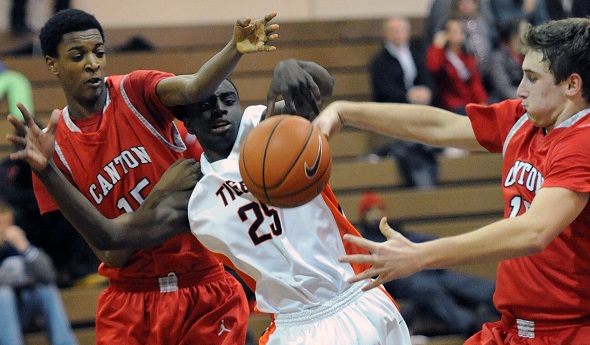
10. Canton (7-5) – The Chiefs also are running well in January with five straight wins including Friday’s 55-50 victory over Westland John Glenn which avenged their last lost before the run, 53-48 to John Glenn on Jan. 4.
PHOTO: Canton players (in red) try to gather a loose ball during a game against Cincinnati Withrow on Dec. 28 at Detroit County Day. (Click to see more at HighSchoolSportsScene.com.)