

Vander Klay's Dedication to Wyoming Schools Netted 400+ Wins, Trip to Breslin
By
Dean Holzwarth
Special for MHSAA.com
April 6, 2026
WYOMING – Over the past 31 years, it was relatively easy to notice a boys basketball team coached by Thom Vander Klay.
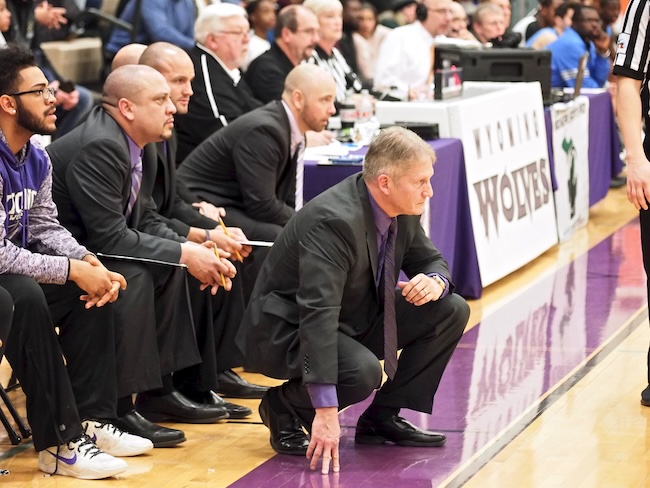
 Athletic and tough-nosed players who competed hard while playing an up-tempo offense and in-your-face defense were trademarks of his teams at Wyoming Park and Wyoming High School.
“In some ways, at Wyoming Park, and then Wyoming, our athletes have been very similar through those 31 years of varsity,” Vander Klay said.
“Some teams were more skilled and more athletic than others, but they were the same. We never had big kids. We’ve always had kind of gritty kids that would compete hard and play fast, and we had quite a few of them on every team. That bled into what we did.”
Vander Klay will retire from teaching after 40 years at the end of May, and his time as the longtime basketball coach will end as well.
“It’s been a struggle, and it’s hard because it’s my home,” Vander Klay said. “I live in Wyoming, my kids went to Wyoming and I went to Wyoming (Park). I’m the youngest of three and my older brother and sister were Vikings and that’s who I was. I was Wyoming, and I still am, so it was really difficult to say I was going to step away from things I really enjoyed doing.”
Vander Klay has been coaching for 41 years. He was the junior varsity coach at Wyoming Park before replacing Kelly McEwen in 1995.
When Wyoming Park and Wyoming Rogers merged in 2012, he became the head coach at the new Wyoming High School.
During his tenure, he went 424-274 as a varsity coach and won nine conference championships, six District titles and one Regional title. He also helped coach football and track & field.
“So many memories and so many kids, and you love those kids,” said Vander Klay, who coached his two sons, Brock and Chase. “When I think back to when I started, guys like Jack VerDuin, Ron Engels, Dick Locke, Frank Grimm and Kelly McEwen were great mentors that I had. I go back to those days and blink, and here we are 40 years later and I'm the old guy.”
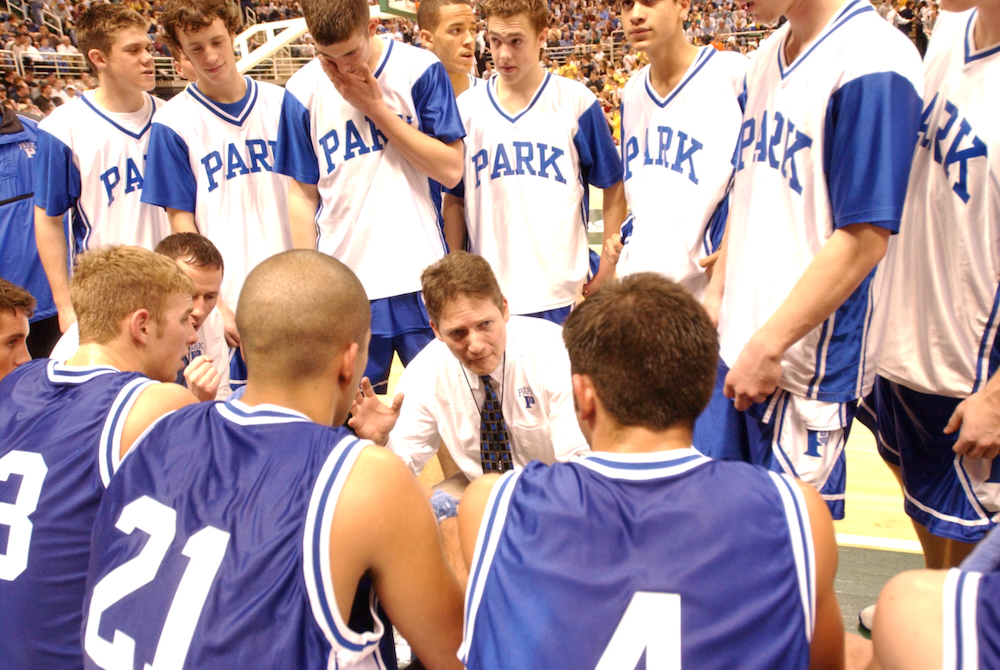
Vander Klay’s best season came in 2004 at Wyoming Park, led by eventual Michigan State standout Drew Neitzel. The Vikings advanced to the Class B Semifinals, losing to Detroit Renaissance.
 Vander Klay was named Class B Coach of the Year and enjoyed his time coaching Neitzel, the Mr. Basketball Award winner who is widely considered one of the best players in program history.
“Drew was so well-rounded,” Vander Klay said. “A great leader, great student, great attitude and just mentally tough and so skilled.
“Coaching him was more about trying to get all five guys on the same page, but those teams that Drew played on, we had good players other than him, too. It wasn't just him because we had other guys who stepped up – but he was the best player in the state.”
Jacob Underhill, Vander Klay’s longtime assistant and junior varsity coach, said Vander Klay has been more than just a mentor.
“He has been the blueprint for the teacher and coach I strive to be,” Underhill said. “He has always been incredibly gracious in sharing his knowledge of the game and his wisdom on how to lead young men. Every decision he makes is filtered through a single focus: doing what is best for the students and athletes of Wyoming.
“While his retirement marks the end of an era, his legacy is undeniable. Since the merger of Wyoming Park and Wyoming Rogers, he has been the heartbeat of the basketball program. He has had a profound impact on my professional career, and I cherish the time we’ve spent serving the community together.”
Underhill has witnessed firsthand the influence Vander Klay has had on former players with whom he has reconnected.
“It’s a true testament to his character,” Underhill said. “He is an exceptional human being who makes everyone around him better and ensures they recognize their own value.”
The 62-year-old Vander Klay is keeping his options open in terms of a return to coaching elsewhere.
“I’ll take some time off and maybe there is something else out there,” he said. “I'm wide open to anything, and maybe I’ll coach again and maybe not. We will see what the future holds.”
Two other longtime Grand Rapids-area coaches also stepped down after longstanding careers on the hardwood.
Unity Christian coach Scott Soodsma retired after 43 years on the sidelines. He won more than 800 games and three MHSAA Finals championships as a boys and girls coach. Soodsma coached his last game in the Division 2 Boys Basketball Final at Breslin Center. The Crusaders lost to Freeland, 42-32.
Sparta boys basketball coach Scott Berry also retired after 34 seasons. He won 245 games at Comstock Park and Sparta.
 Dean Holzwarth has covered primarily high school sports for Grand Rapids-based WOOD-TV for five years after serving at the Grand Rapids Press and MLive for 16 years along with shorter stints at the Ionia Sentinel and WZZM. Contact him at [email protected] with story ideas for Allegan, Kent and Ottawa counties.
PHOTOS (Top) Coach Thom Vander Klay (kneeling) talks to his Wyoming Park team during a break in its 2004 Class B Semifinal at Breslin Center. (Middle) Vander Klay (kneeling) coaches his Wyoming High team. (Top photo from MHSAA archives; middle photo submitted by Thom Vander Klay.)
Breslin Bound: Boys Report Week 5
January 11, 2016
By Geoff Kimmerly
Second Half editor
It’s hard to tell this early how well some of our early risers will play out the final two months of this boys basketball season.
But judging by some of the scores we’ve seen, it fair to believe at least a few are in contention to stay, at least at the league level.
Each week during the regular season, we’ll glance at four teams from each class that have caught our attention. Results and records below are based on schedules posted at MHSAA.com.
Class A
East Lansing (6-0) – It’s fair to call East Lansing the best of a strong group in the Capital Area Activities Conference Blue; keyed by standout sophomore Brandon Johns and a strong group of 3-point shooters, the Trojans lead the league and have wins over reigning champion Lansing Everett and CAAC White contender Williamston.
Flushing (4-0) – The Raiders are off to their best start this decade after finishing last season with nine wins over their last 10 games; this winter’s victories are by 20, 13, 38 and 22 points, respectively.
Pontiac (8-0) – The Phoenix is off to its best start since 2010-11 with Oakland Activities Association White play beginning this week; Pontiac was a solid 14-7 a year ago and a league runner-up to Troy Athens, which is in a different division this season.
Rochester Adams (6-0) – Led by scoring machine Spencer Littleson, the Highlanders are off to their best start since 2012-13 with three straight wins by five or fewer points after a fourth in overtime to open this season.
Class B
Alma (5-1) – After opening with a loss to Haslett, Alma has run off five straight victories to build a one-game lead in the Tri-Valley Conference Central over Freeland, which the Panthers beat 42-38 on Dec. 15. Alma beat Freeland by a win to claim the league title last season.
Detroit University Prep (7-0) – University Prep has been nearly unstoppable, with Auburn Hills Avondale and Detroit Cass Tech the only opponents to finish within striking distance.
Dowagiac (7-0) – The Chieftains have won back-to-back overtime games over Niles and Edwardsburg after five-point wins over Sturgis and Jackson to end December; they’ve helped erase memories of the team’s three straight losses to close last winter.
Standish-Sterling (4-0) – The Panthers are 4-0 for the first time since 2010-11, and including last year have won nine straight in the regular season – with eight of those nine wins by double digits.
Class C
Bad Axe (7-0) – The Hatchets are playing for their second straight league title and are off to a solid start with five double-digit wins but also two close ones – including last week’s 42-41 Greater Thumb Conference West opener over Vassar.
Erie-Mason (6-0) – The Eagles have topped out at 12 wins twice this decade, but find themselves halfway there already and tied early for first in the Lenawee County Athletic Association and with four straight wins by 12 or more points.
Ishpeming (4-0) – The Hematites again got a late start coming off a fourth straight trip to Ford Field for the MHSAA Football Finals, but have caught up quickly; we’ll see how far along they are when they face rival Negaunee on Wednesday.
Lakeview (6-0) – The Wildcats are playing for their third straight league title and face last season Central State Activities Association Silver runner-up Kent City on Friday; Lakeview has had only one game decided by fewer than 10 points so far, last week against Morley Stanwood.
Class D
Buckley (5-0) – The Bears improved from a combined three wins from 2012-14 to reach 11-11 last winter, and are continuing the rise as they sit tied for first in the Northwest Conference and with four games scoring at least 76 points.
Crystal Falls Forest Park (6-0) – The Trojans will again have to deal with reigning Class D champion Powers North Central in the Skyline Central Conference West, but they’re gearing up with a streak of four straight wins by at least 20 points.
Ewen-Trout Creek (4-1) – Despite a two-point overtime loss to Houghton on Thursday, Ewen-Trout Creek is in first place in the Copper Mountain Conference Porcupine Mountain standings coming off two straight sub-.500 finishes.
Onaway (4-0) – The Cardinals have been an upper division team in the Ski Valley Conference over the last three seasons, but hope to be a contender this time and look strong so far with wins of 44, 17, 21 and 26 points, respectively.
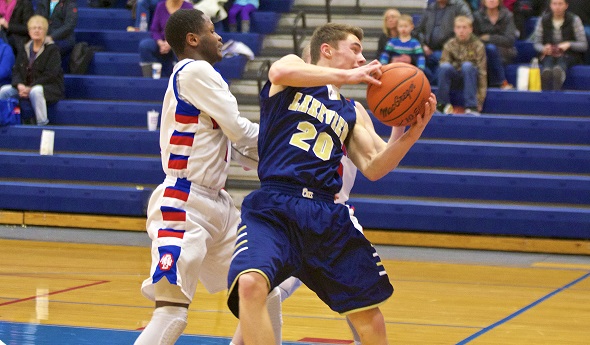
PHOTO: A Lakeview player, right, works for position during last week’s win against Remus Chippewa Hills. (Click for more photos from HighSchoolSportsScene.com.)