

'Ville' Coach Driven to Make Difference
By
Tom Markowski
Special for Second Half
December 30, 2015
DETROIT – It’s unlikely. But if Juan Rickman ever gets bored, he would be a prime candidate to participate in a sleep-deprivation study.
 Rickman, 32, spent five seasons as the boys basketball coach at Detroit Crockett, then became the coach at Detroit East English Village Prep when Crockett merged with Detroit Finney for the start of the 2012-13 school year.
His fulltime job is serving as an attendant agent for the Detroit Public Schools. In layman’s terms, he’s a truant officer. He also works for Wayne County in its juvenile detention department.
And if that’s not enough, Rickman and a partner are in the process of starting a medical transportation business. Rickman said he has the drivers lined up. Purchasing the vehicles is the next step.
Rickman also is a husband and a father. He and his wife Kateena have a 16-month-old daughter, Amira.
A graduate of Detroit Cass Tech and the University of Michigan-Dearborn, Rickman is driven. Achievement is the driving force that supplies the motivation for himself and his family, and for the students for whom he is responsible.
“I’m grinding, just grinding,” he said. “My wife and I have a budget.
“She’s totally into my life. You want a means to an end. We want to buy a house.”
A typical day for Rickman begins at 7:45 a.m. at East English. School ends at 3:30 p.m., and then study table begins a half hour later for his players and lasts an hour and a half. Practice runs from 5:50-8 p.m. His job with Wayne County begins at 11 p.m. and he’s off at 7 – then he’s back at East English.
Rickman isn’t Superman, so this routine isn’t played out every day. But there are weeks where he’ll work three nights for Wayne County, then work a Sunday.
“There are some days I don’t sleep,” he said. “This past week I got up Monday morning and didn’t sleep until 11 (p.m.) on Wednesday.
“When my wife wasn’t working, I had to (work extended hours). Sometimes I’ll take some time off (from Wayne County). The thing is, I know when I need to tone it down.”
Kateena returned to work for an insurance company soon after giving birth. Though this helps monetarily, it also forces the Rickmans to send their child to day care.
 It can be a dilemma, and it is a balancing act. But they’re determined to create a good life for themselves and their child.
Juan Rickman said he planned on cutting back on his hours during the holidays to spend more time with his family.
Along with the rewards financially from their hard work is the satisfaction of knowing they are contributing to their community. Because of his jobs within DPS and Wayne County, Juan Rickman deals with many troubled youths. He knows he’s in a position to set an example as a positive role model, and there is a responsibility to fulfill these expectations.
“I take it seriously,” Rickman said. “A big part of my job is to get these kids into college. I’ve had six of my players go on to a Division I school, but what I’m most proud of is the others. I didn’t have to work hard to get the Division I kids in school. College coaches came after them. I’m more proud of the D-II and the (players who went to) NAIA (schools). Look at Jaylin McFadden. We worked hard to get him into Ferris State.
“And these players come back around. Even the ones I kicked off the team come back. It’s a good feeling.”
Rickman and others at East English also helped the team manager earn a scholarship. Devin Smith is a senior and he’s earned a scholarship to Madonna University in Livonia through a fund the university set up.
East English is off to a 1-2 start, but the Bulldogs are expected to be a significant factor in the race for the Public School League title.
“I’m content coaching high school basketball,” Rickman said. “I’ve had opportunities to go to the next level. I didn’t like the situation.”
 Tom Markowski is a columnist and directs website coverage for the State Champs! Sports Network. He previously covered primarily high school sports for the The Detroit News from 1984-2014, focusing on the Detroit area and contributing to statewide coverage of football and basketball. Contact him at [email protected] with story ideas for Oakland, Macomb and Wayne counties.
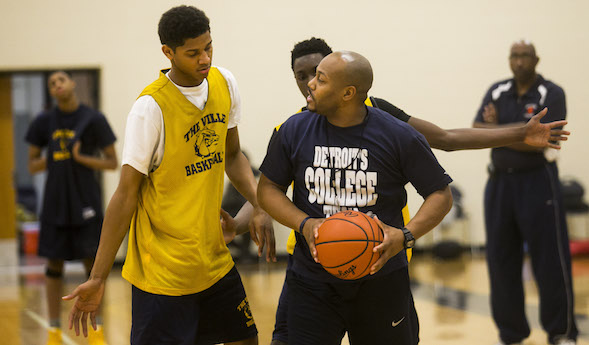
PHOTOS: (Top) Detroit East English boys basketball coach Juan Rickman works with his players during a practice. (Middle) Rickman, with wife Kateena, holds daughter Amira. (Photos courtesy of the Rickman family.)
Balanced Muskegon 'D'-termined to Reign
January 10, 2017
By Tom Kendra
Special for Second Half
Jermayne Golidy emerged as the “go-to” player on Saturday in Muskegon’s first real test of this young basketball season.
 But the smooth, 6-foot-4 senior wasn’t even in the starting lineup on the previous night in a lopsided win at cross-town rival Muskegon Mona Shores.
“That’s the kind of team we are – you never know who will be the leading scorer,” said Golidy, who finished with 28 points, 12 rebounds and two blocked shots as Muskegon rallied from a halftime deficit to post an impressive 68-55 win over visiting powerhouse Chicago Whitney Young in the final game of the Muskegon Showcase tournament at Redmond-Potter Gymnasium. “I came out a little shaky and nervous, but I knew I had to start playing if we were going to win.”
Defense has always been paramount for Muskegon basketball, but fifth-year head coach Keith Guy knows that in order for the Big Reds to get back and compete for another Class A championship after winning it all in 2015, it will take three other Ds:
Diversity on offense, depth and good decisions.
“We don’t have one guy on this team; we have 10 guys who can put it on the floor and score,” said Guy, whose team is off to a 6-0 start. “We have to use all of our weapons and we have to make good decisions with the ball. If we do that, we’ll be fine.”
It’s a change from recent Muskegon teams which featured a marquee player surrounded by a supporting cast. DeShaun Thrower (2014) and Deyonta Davis (2015) were back-to-back Mr. Basketball Award winners, and last year’s team relied on the senior backcourt duo of Michael Littlejohn and Linwood Lee at crunch time.
This year’s team may not have any five-star college recruits, but the sum of its parts may be better than any other team in the state.
Golidy was one of those supporting cast members the past two seasons who is still trying to adjust his mindset in his senior year.
He started off the season with a game-high 20 points in a victory at Rockford, then was relatively quiet over the next three games, seemingly slipping back into his understudy role.
So his coach benched him.
“We thought we could get more out of him,” explained Guy, who has a 96-13 record at Muskegon, where he is assisted by Maurice Sain, Louis Murray and Josh Wall. “He had a rough week of practice, so he did not start against (Mona) Shores. We put him back out there, and he responded.”
After playing just 13 minutes and scoring eight points in the win over Shores, Golidy came out with renewed purpose against Chicago Whitney Young, an elite magnet public school which boasts such distinguished alumni as Michelle Obama and Jahlil Okafor of the Philadelphia 76ers. Golidy basically never left the floor, playing 30 of 32 minutes.
 Muskegon trailed 23-21 at halftime, but it was a 3-pointer early in the third quarter which put the Big Reds ahead to stay. When defenders came out on him, Golidy drove his lean frame to the basket, while also scoring on offensive rebounds and putbacks. Golidy finished 10 of 15 from the floor (with two 3-pointers) and 6 of 8 from the free-throw line.
“I feel like I can play all-around,” said Golidy, who helped the Big Reds to the Class A Regional Finals last year, where they were upset by Hudsonville. “Each game might be different. If we are getting out-rebounded, I’ll go down in the paint. If we need a 3, I’ll take that.”
The problem for Muskegon opponents is that Golidy is just one of four extremely versatile seniors in the Big Reds’ starting lineup who all measure between 6-4 and 6-6 and can play both inside and outside, thereby creating a matchup nightmare.
Markell Jackson (6-6) is the tallest and thinnest of the four, with a massive wingspan that has allowed him to grab a team-high 9.4 rebounds per game. Anthony Bethea III (6-5) is the strongest and most natural post player, and has a nice left-handed shooting stroke. Sam Cornett Jr. (6-5), who joined the Big Reds after formerly playing for his dad Sam at Grandville, supplies speed and ball-handling skills of a guard.
One of the biggest challenges for Guy is keeping those seniors engaged and challenged throughout the long season.
Muskegon, frankly, has not been tested much in the Ottawa-Kent Conference Black since Guy came over from Muskegon Heights in 2012. Therefore, he has made it a point to seek out the best nonconference opponents he can find, often in early-season tournaments.
Already this winter, Muskegon has knocked off East Kentwood in the Muskegon Area Sports Hall of Fame Classic over Christmas break and Chicago Whitney Young at the Muskegon Showcase last weekend. Next up is a tussle with host school Grand Rapids Ottawa Hills in Saturday’s fourth and final game at the annual Floyd Mayweather Basketball Classic.
“We love these big games; that’s where we play our best,” said Golidy. “We’re trying to go 28-0, get a ring and get a state championship. Those are our goals.”
 Tom Kendra worked 23 years at The Muskegon Chronicle, including five as assistant sports editor and the final six as sports editor through 2011. E-mail him at [email protected] with story ideas for Muskegon, Oceana, Mason, Lake, Oceola, Mecosta and Newaygo counties.
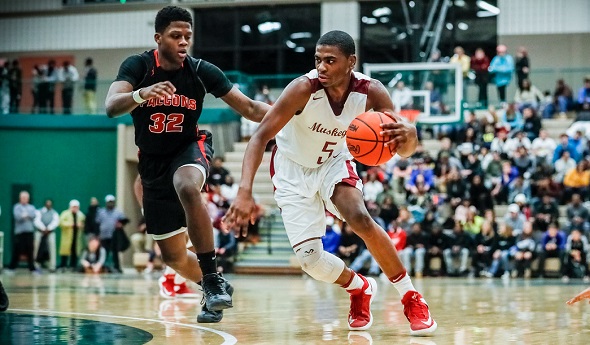
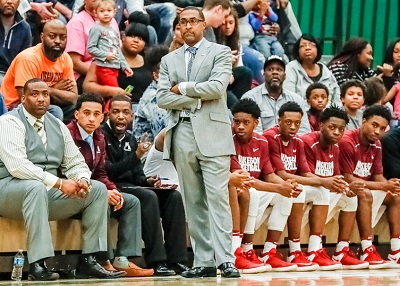
PHOTOS: (Top) Muskegon senior Jermayne Golidy looks to make a move during the Big Reds' 68-45 win over East Kentwood in the Meijer Muskegon Area Sports Hall of Fame Classic on Dec. 28 at Muskegon Reeths-Puffer High School. (Middle) Muskegon coach Keith Guy and his bench look on during the Big Reds' win over East Kentwood. (Photos by Tim Reilly.)