

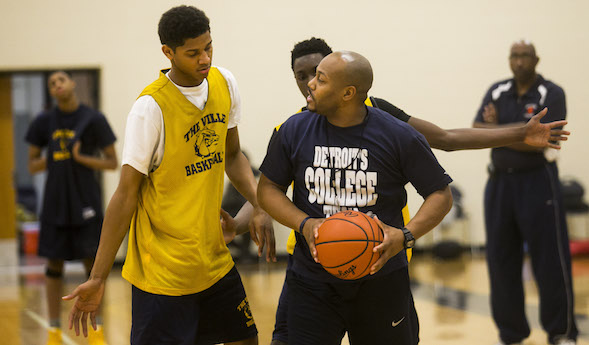
'Ville' Coach Driven to Make Difference
By
Tom Markowski
Special for Second Half
December 30, 2015
DETROIT – It’s unlikely. But if Juan Rickman ever gets bored, he would be a prime candidate to participate in a sleep-deprivation study.
 Rickman, 32, spent five seasons as the boys basketball coach at Detroit Crockett, then became the coach at Detroit East English Village Prep when Crockett merged with Detroit Finney for the start of the 2012-13 school year.
His fulltime job is serving as an attendant agent for the Detroit Public Schools. In layman’s terms, he’s a truant officer. He also works for Wayne County in its juvenile detention department.
And if that’s not enough, Rickman and a partner are in the process of starting a medical transportation business. Rickman said he has the drivers lined up. Purchasing the vehicles is the next step.
Rickman also is a husband and a father. He and his wife Kateena have a 16-month-old daughter, Amira.
A graduate of Detroit Cass Tech and the University of Michigan-Dearborn, Rickman is driven. Achievement is the driving force that supplies the motivation for himself and his family, and for the students for whom he is responsible.
“I’m grinding, just grinding,” he said. “My wife and I have a budget.
“She’s totally into my life. You want a means to an end. We want to buy a house.”
A typical day for Rickman begins at 7:45 a.m. at East English. School ends at 3:30 p.m., and then study table begins a half hour later for his players and lasts an hour and a half. Practice runs from 5:50-8 p.m. His job with Wayne County begins at 11 p.m. and he’s off at 7 – then he’s back at East English.
Rickman isn’t Superman, so this routine isn’t played out every day. But there are weeks where he’ll work three nights for Wayne County, then work a Sunday.
“There are some days I don’t sleep,” he said. “This past week I got up Monday morning and didn’t sleep until 11 (p.m.) on Wednesday.
“When my wife wasn’t working, I had to (work extended hours). Sometimes I’ll take some time off (from Wayne County). The thing is, I know when I need to tone it down.”
Kateena returned to work for an insurance company soon after giving birth. Though this helps monetarily, it also forces the Rickmans to send their child to day care.
 It can be a dilemma, and it is a balancing act. But they’re determined to create a good life for themselves and their child.
Juan Rickman said he planned on cutting back on his hours during the holidays to spend more time with his family.
Along with the rewards financially from their hard work is the satisfaction of knowing they are contributing to their community. Because of his jobs within DPS and Wayne County, Juan Rickman deals with many troubled youths. He knows he’s in a position to set an example as a positive role model, and there is a responsibility to fulfill these expectations.
“I take it seriously,” Rickman said. “A big part of my job is to get these kids into college. I’ve had six of my players go on to a Division I school, but what I’m most proud of is the others. I didn’t have to work hard to get the Division I kids in school. College coaches came after them. I’m more proud of the D-II and the (players who went to) NAIA (schools). Look at Jaylin McFadden. We worked hard to get him into Ferris State.
“And these players come back around. Even the ones I kicked off the team come back. It’s a good feeling.”
Rickman and others at East English also helped the team manager earn a scholarship. Devin Smith is a senior and he’s earned a scholarship to Madonna University in Livonia through a fund the university set up.
East English is off to a 1-2 start, but the Bulldogs are expected to be a significant factor in the race for the Public School League title.
“I’m content coaching high school basketball,” Rickman said. “I’ve had opportunities to go to the next level. I didn’t like the situation.”
 Tom Markowski is a columnist and directs website coverage for the State Champs! Sports Network. He previously covered primarily high school sports for the The Detroit News from 1984-2014, focusing on the Detroit area and contributing to statewide coverage of football and basketball. Contact him at [email protected] with story ideas for Oakland, Macomb and Wayne counties.
PHOTOS: (Top) Detroit East English boys basketball coach Juan Rickman works with his players during a practice. (Middle) Rickman, with wife Kateena, holds daughter Amira. (Photos courtesy of the Rickman family.)

Breslin Bound: Boys Report Week 8
January 28, 2013
By Geoff Kimmerly
Second Half editor
Eight weeks of success is enough to expect that any team still undefeated – like our top team among last week's high performers – should keep making noise over the month and a half to come.
But there's something to be said about starting anew on Jan. 1. And we've got a few on this week's list as well that have surged since the calendar year got a new start.
Remember, results and overall records below are those listed in our MHSAA Score Center. Are either incorrect? Please help us out after filling in this brief registration.
1. Big Rapids (11-0) – The Cardinals have won 20 straight regular-season games dating back to the mid-point of last winter and lead the Central State Activities Association.
2. Rochester Adams (10-1) – The Highlanders’ lone loss came against Oxford all the way back on Dec. 14; they’ve won four straight by double figures and are just two wins from equaling last season’s total.
3. Zeeland East (10-2) – The Chix are in first place by a win over two others in the O-K Black and have won four straight including beating league favorite Muskegon 67-61 on Friday.
4. Allen Park Inter-City Baptist (10-2) – Before Saturday’s 14-point loss to Detroit Country Day, the Chargers had won three straight and earlier this month edged reigning Class D champion Southfield Christian by a point.
5. Lansing Waverly (9-2) – The Warriors opened this season with losses to Holt and Jackson Lumen Christi by a combined five points, but since have won nine straight including avenging that loss to the Titans on Friday.
6. Bessemer (10-1) – The Speedboys are undefeated in-state, with their only loss to Washburn, Wis., after winning 10 games total last season.
7. Crystal Falls Forest Park (6-3) – The Trojans opened this winter with two losses, but are on a roll and edged 2012 Class D Semifinalist Carney-Nadeau on Friday, 70-67.
8. Pittsford (9-2) – The Wildcats hit a rough patch from Jan. 11-15, when they lost two games; otherwise, they’re undefeated this season.
9. Temperance Bedford (8-1) – Despite losing to Sylvania Southview of Ohio on Saturday, the Kicking Mules opened with eight straight wins and beat Ann Arbor Pioneer 56-54 the night before.
10. Canton (7-5) – The Chiefs also are running well in January with five straight wins including Friday’s 55-50 victory over Westland John Glenn which avenged their last lost before the run, 53-48 to John Glenn on Jan. 4.
PHOTO: Canton players (in red) try to gather a loose ball during a game against Cincinnati Withrow on Dec. 28 at Detroit County Day. (Click to see more at HighSchoolSportsScene.com.)