

Western's White Enjoys 'Special' Career
By
Tom Markowski
Special for Second Half
May 4, 2016
WALLED LAKE – Seeking a higher level of performance, many high school athletes have channeled their energy to one sport.
 Many refer to this concentration as specialization – and Cody White, for one, isn’t buying it.
White, a junior at Walled Lake Western, is a three-sport athlete and he loves every minute of it. He plays basketball during the winter, baseball in the spring and football in the fall. During the summer he competes in AAU basketball, travel baseball, 7-on-7 football games with his Western teammates, and he participates in a few summer football camps.
White has played these same sports all throughout high school. His freshman year he competed in track and field, along with baseball. White hasn’t ruled out returning to track and field, in addition to baseball, as a senior – but this season he’s sticking with just baseball.
It’s a hectic schedule but, again, White wouldn’t have it any other way.
“I couldn’t see myself not competing in those sports,” he said. “I love them so much. I want to finish my senior year playing all three.”
White estimates that he’ll have two days off, away from sports, in June. In July he’ll take a week off, between his summer baseball team schedule ending and the start of football practice.
There’s no question White is driven, but it’s more than that. In some high schools, and with some coaches, playing multiple sports can be a challenge. There are some coaches who would prefer the students to play one sport and only one sport.
According to Western football coach Mike Zdebski, that isn’t the case at his school.
“We encourage them to play more than one sport,” Zdebski said. “For one, we want them to get their money’s worth. We have a pay-to-play policy of $425. You play one sport and it costs $425. You play three sports and it costs the same. And, two, playing other sports helps them develop other skills. In basketball you create space. In baseball you chase fly balls, and that helps with depth perception. Besides you get to work with other coaches and other teams.
“We’re lifting weights during the summer. If a kid is playing summer baseball or AAU basketball, if they have time they can come by and lift weights. And what we always tell them, if you’re tired let us know. You can take a break.”
Zdebski – whose team finished 12-1 last fall – was quick to point out some excellent athletes in the past, like former Kansas City Royals outfielder/Oakland Raiders running back Bo Jackson, who were multiple-sport athletes. And, more recently, there’s Luke Glendenning of the Detroit Red Wings. Glendenning was an all-state running back at East Grand Rapids.
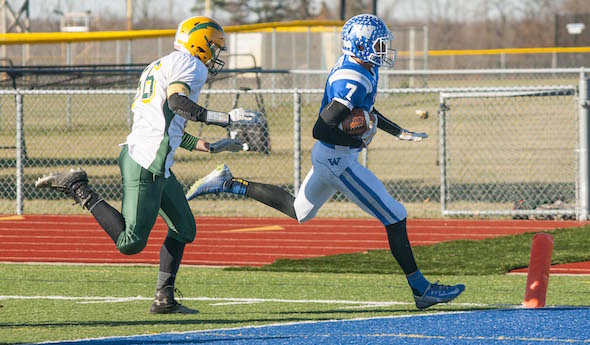
 When his high school career is done, White will play football in college. Two months ago he committed to sign with Michigan State this winter. At 6-foot-3 and 200 pounds, White played receiver, defensive back and also returned kicks last fall. He played a big role in Western’s run to the Division 2 Semifinals.
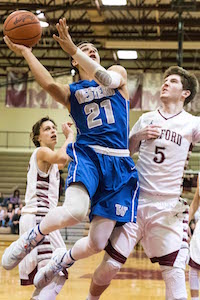
During baseball season, White pitches and plays middle infield and right field. He plays the wing and shooting guard in basketball.
His interest in playing a variety of sports came at an early age and, as is the case with most children, a family member was the one who introduced White to athletics. Former NFL player and Detroit Lions executive Sheldon White is his father, but the first sport White played, at age 3, was baseball. Two years later he began playing football and basketball.
Sheldon White also played three sports at his high school in Dayton, Ohio, (Meadowdale High) and helps his son manage his busy schedule, particularly during the offseason.
“Growing up was a little different (for me) than the usual kid,” Cody White said. “Going to Lions games and just being around football all the time. I think I love the game more because I was around it so much.
“But I think playing three sports helped me, too. The twisting of your hips in baseball, when you swing the bat, you’re using different muscles. And all the jumping you do in basketball. You have to move in tight spaces.
“With football, you’re with the football guys. By doing all three you meet different people.”
Playing multiple sports has definitely been the right road for White to follow. And his busy schedule hasn’t hindered his work in the classroom.
White has a 3.54 grade-point average pending his grades for this semester.
 Tom Markowski is a columnist and directs website coverage for the State Champs! Sports Network. He previously covered primarily high school sports for the The Detroit News from 1984-2014, focusing on the Detroit area and contributing to statewide coverage of football and basketball. Contact him at [email protected] with story ideas for Oakland, Macomb and Wayne counties.
PHOTOS: (Top) Cody White (right) runs away from a Midland Dow defender during their Regional Final this fall. (Middle) White works for a shot against Milford. (Photos by Teresa Presty.)
1st & Goal: 2026 Week 2 Preview
By
Geoff Kimmerly
MHSAA.com senior editor
September 3, 2026
If you’re traveling for the long weekend and see stadium lights shining in the distance, you might want to make a quick stop and check out one of these matchups.
 Nearly 80 percent of this weekend’s games will be played Thursday, although those waiting for Friday won’t miss out as there are plenty of opportunities that night as well to see high-profile nonleague clashes or conference openers that could eventually determine championships.
Staying close to home? Tune in to the NFHS Network for the majority of games across the state, and follow the MHSAA Scores page for results as they’re submitted.
Bay & Thumb
Almont (1-0) at Armada (1-0) – Thursday
Almont has continued to set the standard in the Blue Water Area Conference with three straight league championships. The Raiders’ most recent league loss came in 2022 – to Armada, which has finished second once and third in the league twice over that stretch. Both opened this season with wins over 2025 playoff teams, Armada over St. Clair Shores Lakeview and Almont over Marysville.
Keep an eye on these THURSDAY Saginaw Swan Valley (1-0) at Freeland (0-1), Lapeer (0-1) at Goodrich (1-0), Saginaw Heritage (0-1) at Midland Dow (1-0), Marysville (0-1) at Port Huron (1-0).
Greater Detroit
Detroit Martin Luther King (1-0) at Orchard Lake St. Mary’s (1-0) – Friday
This power pair is facing off for the first time since 2006, and theirs will certainly be one of the most discussed games statewide this weekend. St. Mary’s is coming off winning last season’s Division 2 championship and opened with a 35-27 win over Muskegon Mona Shores, while King reached the Division 3 Regional Finals last fall and began this one by downing annual Ohio contender Toledo Whitmer.
Keep an eye on these THURSDAY Howell (1-0) at Belleville (0-1), Rochester Adams (0-1) at Rochester (1-0), Clarkston (1-0) at Rochester Hills Stoney Creek (1-0). FRIDAY Davison (1-0) at Detroit Catholic Central (1-0).
Mid-Michigan
DeWitt (1-0) at Mason (1-0) – Thursday
This has developed into one of the most intriguing rivalries in the Lansing area, with both teams playing at Ford Field over the last three seasons – with 2023 also when these two started their current series. DeWitt has a 2-1 edge and won last year’s matchup 44-37 – the Panthers’ closest game during a run to the Division 3 championship – but Mason has brought back nearly its entire starting lineup this fall.
Keep an eye on these THURSDAY Fenton (0-1) at Haslett (0-1), Durand (1-0) at New Lothrop (1-0), Lansing Sexton (1-0) at Portland (1-0), Hastings (0-1) at Williamston (1-0).
Northern Lower Peninsula
Ogemaw Heights (1-0) at Traverse City St. Francis (1-0) – Friday
Ogemaw Heights made its first run to the Semifinals last season since 2009, and its only loss of the regular season came 42-32 to St. Francis in Week 2. The Falcons opened last week with an impressive win over Freeland, and the Gladiators downed Elk Rapids. This matchup is joined on St. Francis’ schedule by three games against teams that finished last season at Ford Field.
Keep an eye on these THURSDAY Escanaba (0-1) at Gaylord (1-0), East Jordan (0-1) at Oscoda (0-1). FRIDAY Boyne City (0-1) at Charlevoix (1-0), Grand Rapids Christian (0-1) at Traverse City West (0-1).
Southeast & Border
Pewamo-Westphalia (1-0) at Ottawa Lake Whiteford (0-1) – Friday
These two small-school powers are playing for the first time, but it might not be the last time this season as both stand to be in the Division 7 playoff chase in two months. Whiteford also played a first-time opponent last week, falling to Monroe St. Mary Catholic Central 37-28, while the Pirates are also coming off a tough opener after having outlasted North Muskegon 17-9.
Keep an eye on these THURSDAY Monroe Jefferson (1-0) at Carleton Airport (0-1), Brooklyn Columbia Central (1-0) at Michigan Center (1-0), Union City (1-0) at Reading (1-0). FRIDAY Flat Rock (0-1) at Monroe St. Mary Catholic Central (1-0).
Southwest Corridor
Cedar Springs (0-1) at Battle Creek Harper Creek (1-0) – Friday
Harper Creek hasn’t received enough attention for its run over the last three seasons, which has included two straight Interstate 8 Athletic Conference titles and a combined 22-6 record. The Beavers opened this campaign with a fourth-straight win (and third-straight shutout) of rival Battle Creek Lakeview and now will have a chance to avenge last fall’s lone regular-season loss. Cedar Springs won that Week 2 matchup 30-20 and is seeking to bounce back after falling to Zeeland West last week.
Keep an eye on these THURSDAY Grand Rapids Forest Hills Central (0-1) at Portage Central (0-1), Lansing Everett (0-1) at Battle Creek Central (1-0). FRIDAY Stevensville Lakeshore (1-0) at Niles (0-1), Lowell (0-1) at St. Joseph (1-0).
Upper Peninsula
Menominee (1-0) at Marquette (1-0) – Thursday
These former Great Northern Conference rivals are meeting for the first time since 2022, the last season of football for that league. The Sentinels have won four of their last five matchups, but both have found success since their last time facing off. Over the last three seasons, Menominee has played at Ford Field twice – winning last year’s Division 7 title – and Marquette has reached the Division 3 playoffs twice and opened with a close but impressive loss last week to Negaunee.
Keep an eye on these THURSDAY Ishpeming Westwood (0-1) at Calumet (1-0), Houghton (0-1) at Kingsford (1-0). FRIDAY Gladstone (1-0) at Negaunee (1-0), North Muskegon (0-1) vs. Iron Mountain (1-0) at Petoskey.
West Michigan
East Kentwood (1-0) at Byron Center (1-0) – Thursday
Rare are the days when Muskegon/Rockford isn’t be the default “game of the week” in West Michigan. But don’t look past this matchup this time. East Kentwood is coming off a run to the Division 1 Semifinals last season, which included a 43-14 win over 2024 Division 2 runner-up Byron Center in Week 2. The Bulldogs emerged from an 0-2 start last season, including that defeat by the Falcons, to go 7-2 the rest of the way, and they’ve already avenged the first of last year’s losses by downing Hudsonville 41-20 last week.
Keep an eye on these THURSDAY Grand Rapids South Christian (1-0) at East Grand Rapids (1-0), Detroit Cass Tech (1-0) at Grandville (1-0). FRIDAY Muskegon (0-1) at Rockford (0-1), Midland (1-0) at Zeeland West (1-0).
8-Player
Portland St. Patrick at Blanchard Montabella – Friday
There may not be a team in MHSAA 8-player football history that scheduled a tougher slate to start the season than Montabella, which avenged last fall’s Division 1 championship game loss with a 62-12 win over Martin last week and now gets the reigning Division 2 champion Shamrocks. St. Patrick handed the Mustangs their only regular-season defeat a year ago, 42-16, in Week 9 on the way to a perfect run, and even had a few more days to prepare this time with its Week 1 opponent Wyoming Tri-unity Christian canceling its season.
Keep an eye on these THURSDAY Merrill (1-0) at Morrice (1-0), Central Lake (1-0) at Gaylord St. Mary (1-0), Britton Deerfield (1-0) at Climax-Scotts (1-0). FRIDAY Pickford (1-0) at Rudyard (1-0).
MHSAA.com's weekly “1st & Goal” previews and reviews are powered by MI Student Aid, a division within the Department of Lifelong Education, Advancement, and Potential (MiLEAP). MI Student Aid encourages students to pursue postsecondary education by providing access to student financial resources and information. MI Student Aid administers the state’s scholarship and grant programs that help make college Accessible, Affordable and Attainable for you. Click to connect with MI Student Aid and find more information on Facebook and Twitter @mistudentaid.
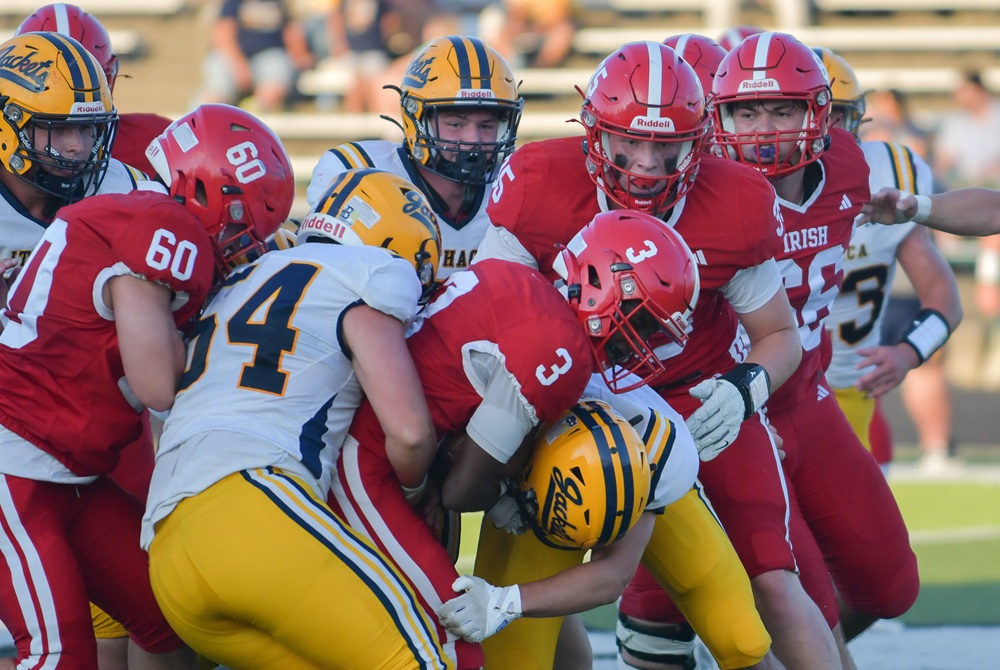
PHOTO Ithaca defenders wrap up a Mount Pleasant Sacred Heart ball carrier during their 48-6 Week 1 win. (Click for more from High School Sports Scene.)