

Whitens Leads Jets' Pursuit of Record Run
December 13, 2016
By Dennis Grall
Special for Second Half
POWERS – Jason Whitens stands rather nonchalantly, but there is no doubt he is focused on his assignment.
 It is not as easy to see his steely resolve in football because of the helmet and distance from which a fan watches Whitens prepare for the next play. It is much easier to see his features in basketball, where fans are almost as close to him as the defender.
In either sport, he scans the defense, then decides the best mode of attack. In both sports, he is efficient and effective, to such a degree that he has helped North Central win back-to-back MHSAA championships in 8-player football and Class D basketball.
The Jets brought a 55-game winning streak into the current basketball season, after extending their 8-player football mark to 26 straight wins. Whitens has been an integral part of each notable run.
He ran for an astounding 359 yards in the football finale as North Central throttled Deckerville 58-21. Deckerville had allowed only 50 points over its previous 12 games. Whitens also passed for 100 yards, but this game his running skills were needed as he averaged 20.7 yards per carry while scoring six touchdowns,
Last week Whitens entered basketball season with a school-record 1,410 points in three seasons, with an outside shot at reaching the year-old Upper Peninsula career mark of 2,178 points owned by Gage Kreski of St. Ignace.
Basically, the 6-foot-4, 210-pound senior is a threat to beat an opponent in a variety of different ways. That skill set has made Whitens an attractive college recruit in both sports, with interest from Division I and Division II schools such as the University of Wisconsin, Michigan State University, Central Michigan, Lake Superior State and Grand Valley State.
That attention is understandable since he is a two-time 8-player state Player of the Year from The Associated Press in football and was basketball’s Class D state Player of the Year last season as well. He is also Michigan’s representative for the Wendy’s Heisman Award as a scholar/athlete.
While all of those accolades are fantastic, Whitens remains a down-to-earth senior who has one primary goal as he approaches his final months in high school. Like his teammates, he wants to win another Class D basketball title.
And he spreads the credit around. “The surrounding cast has been phenomenal,” Whitens said, referring to teammates, family, friends and coaches.
“That has prepared me and my teammates for what we have done, how all of this has been given to us so we could perform. The best part of it has been all of us being together.”
 That togetherness began before this group of players was born. Gerald Whitens and Tim Bilski, dads to senior teammates Jason and Dawson, played on North Central’s 1984 Class D championship basketball team and were part of a 33-game winning streak that ended in the 1985 Semifinals.
“Sports bring people together; you make friends and create bonds,” said Jason Whitens. Noting what helps make it fun, he added, “We don’t talk about the game as much as we talk about the guys.”
Many of these Jets have been playing backyard games together since pre-school days, with only the rewards changing.
“When we were younger, we all dreamt of this and knew we could do it,” Whitens said in a recent interview at school. “That is why it is not a shock to do it. Now we are basking in it, we’re just going to enjoy it and say ‘that was fun.’”
He recalled traveling various distances to 3-on-3 tournaments as youngsters. “That is what separates us from other schools,” he said. “We’ve played together for so long we know where each other is and how each other plays.”
And did we mention their highly competitive spirit?
“You will never meet a more competitive group than us,” said Whitens. “We want to win; that is our number one goal (in ping pong or anything). We always want to one-up each other, but there is no ill will because you beat someone. We always want to beat each other.
“We are always competing; there is no backing down from a challenge.”
North Central football coach Kevin Bellefeuil, who officiates basketball with Gerald Whitens, touched on that competitive level about his quarterback.
“The guy competes every time he is on the floor, on the field, on the diamond, every minute he is out there. If you want him to lie down, then take him out of the game,” Bellefeuil said.
“His dad is a pretty good competitor; his mom (Faye) is a competitor as well.”
His mother is a Granquist, and that family has been very athletically accomplished at North Central. Tom Granquist, Jason’s uncle, held the school basketball scoring record that Whitens broke last year. His cousin, Rob Granquist, was an all-star quarterback and cager just ahead of Whitens, and is No. 3 on the school’s basketball point chart.
“As a group, they all have a competitive spirit,” said Bellefeuil.
Jason Whitens, noting how it was important to keep up and surpass his relatives, said “there was always something to strive for, something you tried to do better. I was always motivated. I never just settled on doing something today or tomorrow.
“It is something I had to get intrigued about myself. It was second nature. I was always around it, I wanted to be a part of it. It just inspired me to be the best I could be,” Whitens said.
“Hopefully I can set an example and make (younger relatives) better than me. That would be selfish if I didn’t want that for my family.”
 That competitive spirit and deep will to win may have reached a notable mark when Whitens was a freshman.
Playing in the basketball Class D Quarterfinal in Marquette, Whitens missed the front end of a 1-and-1 free throw set with no time left that sealed an 81-79 loss to Cedarville. That was the last time the Jets have lost on the hardwood.
A basket by Whitens at the buzzer was denied after the officials conferred and decided he had to shoot free throws.
“That was a huge impact as a basketball player and as a human being, as a person,” Whitens said in reflection. “I look at basketball in a whole new perspective now. It is not life or death. When I’m around family and friends, that is real.
“That (situation) helped set the bar. I didn’t want to feel or be put in a position where I would let my team down. I matured a lot from that point. I realized you can’t always play perfect. You are always going to make mistakes. That did inspire me to become better.”
The Jets have won 57 straight games since that loss. Surpassing the mark of 65 straight wins set by Chassell from 1956-58 “is in the back of our mind. It is a process, and we’re taking one game at a time. The most important thing is having fun and being prepared as the ride goes along,” Whitens said. “It is hard to do it yourself. It is great to do it together as one.”
Next up is Carney-Nadeau on Thursday, with Menominee providing a possible substantial challenge Monday.
He is also going through his senior season pondering his future in sports. “Where to go and what to play (football or basketball), that is mixed up right now. What (sport) to commit to and who to commit to. I’m not really close deciding where to go or what sport to play,” he said.
“It is a wild, crazy and confusing ride.”
 Denny Grall retired in 2012 after 39 years at the Escanaba Daily Press and four at the Green Bay Press-Gazette, plus 15 months for WLST radio in Escanaba; he served as the Daily Press sports editor from 1970-80 and again from 1984-2012. Grall was inducted into the Upper Peninsula Sports Hall of Fame in 2002 and serves as its executive secretary. E-mail him at [email protected] with story ideas for the Upper Peninsula.
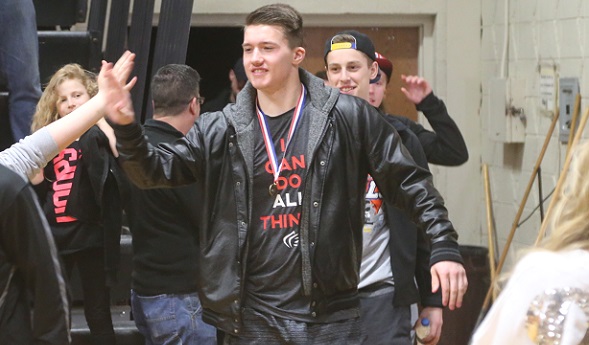
PHOTOS: (Top) Jason Whitens high fives during last season’s post-basketball championship celebration at Powers North Central High School. (Middle) Whitens looks for an opening during the Class D Final win over Waterford Our Lady. (Below) Whitens runs away from a Deckerville defender during last month’s 8-Player Football Final. (Top photo by Paul Gerard; bottom photo by Dennis Grall.)

Breslin Bound: Boys Report Week 2
December 18, 2017
By Geoff Kimmerly
Second Half editor
It's difficult to draw much from the first two weeks of a four-month basketball season.
But it doesn't take long to sense a turnaround coming (see Detroit Mumford below) or a new championship contender on the rise (hello Grand Rapids Catholic Central?). This week's installment includes a few more teams that quickly have made an impression, to carry us through the end of 2017.
 Breslin Bound is powered by MI Student Aid, and will return during the first week of January. These reports are based on results and schedules posted for each school at MHSAA.com – to offer corrections, email me at [email protected].
Week in Review
The countdown of last week’s five most intriguing results:
1. Grand Rapids Catholic Central 73, Grand Rapids Christian 49 – The Cougars reversed a 39-point loss suffered last season to the eventual Class A runner-up.
2. Hazel Park 74, Detroit U-D Jesuit 63 – Last week a win over Detroit East English got Hazel Park on this list, and this time it’s a double-digit victory over the Cubs (20-4 last season).
3. Dansville 42, Pewamo-Westphalia 34 – The Aggies followed a win over Class B Detroit Osborn with this one over reigning Central Michigan Athletic Conference champion P-W, which beat Dansville by 18 and two points in their meetings last season.
4. Saginaw 69, Saginaw Arthur Hill 61 – The Trojans bounced back from an early-week loss to Detroit Renaissance to beat the rival Lumberjacks for the seventh straight time since falling to them during the 2014-15 postseason.
5. Warren DeLaSalle 77, West Bloomfield 67 – The Pilots have played two of their first three games against teams that made at least the MHSAA Semifinals last season, winning this one over the Class A Lakers.
Watch List
With an eye toward March, here are two teams in each class making sparks:
CLASS A
Mount Pleasant (3-0) – The Oilers improved to post upper-division finishes in the formerly two-division Saginaw Valley League the last two seasons, going 15-9 overall last winter. All of the SVL will play in one division this winter, and Mount Pleasant is off to a nice start with three double-digit wins including a 22-pointer over a Midland Dow team it split with last season.
Troy (3-0) – The Colts play in a tough Oakland Activities Association Red that includes Clarkston, West Bloomfield and Hazel Park among others, but they could be in the mix after reaching the Quarterfinals (and falling there to West Bloomfield) last winter. Troy finished last week by handing rival Athens its first loss, 66-58.
CLASS B
Detroit Mumford (4-0) – With one more win, Mumford will be halfway to bettering last season’s 9-12 finish. The Mustangs have three straight double-digit wins after beating St. Clair Shores South Lake, Oak Park and Warren Michigan Collegiate on successive days over the weekend.
Spring Lake (3-0) – Back-to-back overtime wins over Class A teams has Spring Lake riding high. The Lakers got past Rockford 48-46 and Grand Haven 69-66 last week as they prepped for the Ottawa-Kent Conference Blue season and powerhouse Grand Rapids Catholic Central – which Spring Lake eliminated in last year’s Regional Final after finishing third to the Cougars in league play.
CLASS C
Houghton Lake (2-0) – They are only two games win, but a 35-28 overtime win over Beaverton on Thursday should have the Bobcats’ spirits high. The Beavers were runners-up in the Jack Pine Conference last season and Houghton Lake came in fifth after losing to Beaverton by 29 and 23.
Iron Mountain (4-0) – The Mountaineers might be the favorites in the Mid-Peninsula Conference after finishing third last winter despite going 2-1 (including a District win) over co-champion Norway. The Knights left the league this year, but Iron Mountain surely still enjoyed taking a 48-40 win from them Friday.
CLASS D
Bear Lake (3-0) – Only two weeks into the season, the Lakers are making some noise in the West Michigan D. They sit atop the conference after opening with a 12-point win over reigning champion Baldwin, and that’s been by far Bear Lake’s closest game. The Lakers finished 15-7 overall and tied for third in the league last season.
Wyoming Tri-unity Christian (4-0) – As usual, Tri-unity will play a wide variety of opponents including many larger to prepare for the postseason, a strategy that frequently pays off. One of the losses it took last year on the way to the Quarterfinals was against Grand Rapids NorthPointe Christian, and Tri-unity avenged with a 49-41 win Friday.
Can't-Miss Contests
Be on the lookout for results of these games coming up:
Tuesday – Flint Hamady (3-0) at Flint Beecher (3-1) – The reigning Class C champion Buccaneers took three from their rivals last season, but one meeting by only four points.
Tuesday – McBain (2-0) at Buckley (1-1) – Although the Bears took a four-point loss on opening night two weeks ago, both of these teams were perfect for the regular season last winter and Buckley is the reigning Class D runner-up.
Wednesday – Grand Rapids Catholic Central (3-0) at Wyoming Godwin Heights (2-0) – By early returns, these are looking like two of the best teams from Grand Rapids and two of the state’s best in Class B as well.
Dec. 26 – Detroit Martin Luther King (2-0) vs. Southfield Christian (2-1) at Cass Tech – Southfield Christian was a last-second basket from playing for the Class D title last season and can see how it stacks up against the Class A Crusaders.
Dec. 29 – Saginaw (1-1) vs. Detroit Cass Tech (2-0) at Detroit Renaissance – There are high expectations for the Technicians, making this matchup with an annual power arguably the most intriguing at the Motor City Roundball Classic.
PHOTO: Spring Lake got past Grand Haven in overtime last week to stay undefeated. (Photo by Tim Reilly)