


Work Ethic Continues to Drive Van Dyk's Endeavors as Co-Owner of Family Farm
By
Paul Costanzo
Special for MHSAA.com
August 4, 2026
Matt Van Dyk’s work ethic was always easy to spot, even for those not spending every day at Imlay City’s basketball practices.
 “The only way he could get out of work in the summer was for church or basketball, nothing else,” Imlay City boys basketball coach Don Gauthier said. “We would have summer league games in Flint or wherever we were playing, and he would show up five minutes before tip off, covered in mud, dirt, or whatever he was doing on the farm, and with no excuses, would come out there and play as hard as anybody. That work ethic, it was contagious to everybody else.”
That work ethic was born in the fields at Van Dyk Farms, grew through his time on the court for Imlay City and eventually Michigan State, and continues to serve him in his role as part owner of that same family farm, which serves as one of the largest produce suppliers in the eastern United States.
“I’ve had some phenomenal coaches in my life,” Van Dyk said. “My high school coach was Don Gauthier, and he really instilled work ethic into us. I think his favorite quote was, ‘Hard work beats talent when talent doesn’t work hard.’ When I think about high school, just that work ethic of working hard every day really helped with being at the college level, but also with farming. And, really, I’ve been blessed to have role models that have all echoed that same mentality. My high school coach, my junior college (St. Clair County Community College) coach Dale Vos, and at Michigan State with coach (Tom) Izzo, plus my father, Doug Van Dyk.”
Matt Van Dyk, a 2012 Imlay City graduate, returned home to the 1,000-acre family vegetable farm after graduating with his agri-business degree from MSU in 2017.
While he’s officially one of the owners, he said his unofficial title is field operations, as he oversees planting, growing and harvest operations.
“I’m the person they call when something’s broken down, or they need to know what field to go into next,” he said.
Van Dyk has immersed himself in the Imlay City community since his return, joining the township board for a while, as well as his church council. He’s also giving back as an athlete, helping with the basketball program. His wife, Rachel, who played volleyball at MSU, was the varsity girls volleyball coach at Imlay City for three seasons and still works with clubs in the area.
“The Bible says that to who much is given, much is expected, and I’ve been given a lot, more so than I deserve,” he said. “The opportunity to play at Michigan State, not many people get that opportunity. For me, to be able to use that and give back is what we’re called to do. With the farm, too. I have the opportunity to work on a family business, and some people will say that you’re starting on second base – well there’s a lot that’s expected from me with this opportunity that I’m given. That is where my true worth comes from; it doesn’t come from personal success, it comes from what our team here at Van Dyk farms can accomplish.”
While Van Dyk describes his time at MSU as an opportunity he was given, the reality is it was one he fought long and hard to earn.
After becoming an all-state selection in Class B and Blue Water Area Conference MVP at Imlay City, he originally went to Hope College after high school but transferred to SC4 following one semester.
During his lone year there, he was named the Michigan Community College Athletic Association Eastern Conference Freshman of the Year, First-Team All-MCCAA and National Junior College Athletic Association Region XII All-Defense.
That earned him scholarship offers from in-state Division II programs, but he chose instead to walk-on at MSU and follow his dream of playing for the Spartans. At worst, he thought, he would graduate with a top-notch degree in the field he wanted.
Of course, he ended up with much more than that. After two years as a walk-on, Van Dyk earned a scholarship for his final season at MSU. He wound up playing in 53 games during his career, starting four during the 2016-17 season.
“I guess while you’re in it, it’s just work,” he said. “You put your head down, take it one day at a time. Looking back and seeing how there are no days off in life, you’re like, ‘OK, maybe that was pretty awesome what I did.’ I got to go to Italy, got to go to Madison Square Garden, got to play at Duke, got to travel the world.”
He also went viral.
While work ethic was what pushed Van Dyk to reach his dreams, he was also a remarkable athlete, possessing one of the best vertical leaps on the roster. That came out in a game against Ohio State his junior season, during which he threw down a massive dunk off an alley-oop. The play made the ESPN SportsCenter Top 10.
“That’s not my style of play at all,” Van Dyk said with a laugh. “Dunking, that’s what got me on the team, was my athleticism. But being flashy, that’s not my thing. It’s a funny way to work things out, and I’m forever indebted to Alvin Ellis for throwing it off the backboard.”
Now, as Van Dyk is back in Imlay City with his wife and two young daughters with another on the way in November, he’s putting his head down to better his family’s business and the community at large. All while continuing to set the right example for the next potential athlete willing to work for what he earned.
“They see him, and he played at Michigan State, and there’s his picture on the wall,” Gauthier said. “Most young kids have big dreams, and they have a guy right there in their hometown that did it. They look up to that. For the athlete and basketball player he is, he’s just a better person. He’s very humble, he doesn’t act big time toward anybody. That’s even more impressive.”
2026 Made In Michigan
July 24: Hackett Mentor's Care Sparked Lifetime in Hoops for BCAM President White - Report
July 24: Mackey Leaving Court with 500+ College Hoops Wins, Many More Lessons Shared - Report
July 16: Country Day Two-Time Champ Moore Building Perennial Winner at Harvard - Report
July 9: Multi-Sport Career at TC West Helps Gillis Thrive as Pro in Game She Once Left Behind - Report
July 2: Inspired by Home, Eager to Give Back, Spencer Hosts Hoop City Alumni Games - Report
PHOTOS (Top) At left, Matt Van Dyk puts up a jumper for Imlay City. At right, Van Dyk and his daughters enjoy a moment in one of his family’s fields. (Photos provided by Matt Van Dyk.)
Breslin Bound: 2023-24 Boys Report Week 11
By
Geoff Kimmerly
MHSAA.com senior editor
February 12, 2024
Anticipation and prognostication are among themes this week all over Michigan, whether your favorite team is one of the best around or hasn’t had much success but is looking to finish this winter on a higher note.
 Sunday morning, the MHSAA will announce this season’s District brackets. The formula for this season’s brackets has been released, making it possible to forecast throughout this week how teams will be placed based on Michigan Power Ratings.
But keep in mind, teams can still move up and down those ratings through their games Saturday night. And there are several notable matchups coming up, including finales to multiple league tournaments and more likely eventual championship deciders in conferences across the state.
“Breslin Bound” is powered by MI Student Aid and based on results and schedules posted for each school at MHSAA.com.
Week in Review
The countdown of last week’s five most intriguing results:
1. West Bloomfield 60, North Farmington 58 Avenging a 61-46 loss to the Raiders (15-2) on Jan. 4, West Bloomfield joined reigning champ North Farmington as teams with only one loss in Oakland Activities Association Red play – and West Bloomfield (13-5) finishes its league schedule against the bottom three teams in the standings.
2. Muskegon 48, Muskegon Reeths-Puffer 28 Just 10 days after Reeths-Puffer’s 63-45 win over the Big Reds gained statewide attention, Muskegon (13-2) took the rematch in a big way to create a tie with the Rockets (15-2) atop the Ottawa-Kent Conference Green.
3. Menominee 60, Iron Mountain 58 (OT) The Maroons (13-5) made their upcoming Division 3 District even more interesting by handing the Mountaineers (17-1) their only loss. Those two are Nos. 2 and 4 in statewide Division 3 MPR and will be expected to meet again in the District Final at West Iron County.
4. Saginaw Heritage 73, Saginaw 66 The Hawks (13-2) opened a close Saginaw Valley League race even more, downing the former solo leader to join the Trojans (12-6) and Davison as teams with only one conference loss.
5. Painesdale Jeffers 73, Lake Linden Hubbell 49 The Jets (18-1) remain undefeated in Copper Mountain Conference play after handing Lake Linden-Hubbell (15-3) its first league loss and as the overall CMC race draws to a conclusion.
Watch List
With an eye toward March, here are two teams in each division making sparks:
DIVISION 1
Dearborn (18-0) The Pioneers steadily have climbed toward this run, and they head into this week a win from tying last year’s total (after finishing 19-7) and atop the Kensington Lakes Activities Association East standings after sharing the championship last season with Livonia Franklin. Dearborn is alone on top this time thanks in part to a 78-68 win over Belleville (14-4) on Jan. 19, and those two meet again Friday. An early win over Detroit Catholic Central (12-7) showed what was possible, and only the Shamrocks and Wayne Memorial (13-4) have gotten within single digits of catching the Pioneers.
East Lansing (16-2) The Trojans’ only losses have come to a pair of championship contenders – Division 1 Orchard Lake St. Mary’s (17-1) and Division 2 Warren Lincoln (16-3) – and despite that 56-37 defeat to the Eaglets two weekends ago, East Lansing has moved into the top spot in statewide Division 1 MPR. A 57-53 win over Lansing Waverly (13-5) on Friday certainly helped, and the Trojans have maintained a half-game lead on Okemos (16-2) in the Capital Area Activities Conference Blue with their rematch set for Feb. 23. East Lansing won the first meeting 66-54 and also has defeated East Kentwood, River Rouge, Detroit Martin Luther King, Saline and West Bloomfield among others.
DIVISION 2
Ferndale (11-7) The Eagles graduated all five starters and most of their top subs off last season’s Division 2 championship team, so a few defeats certainly could be expected this winter especially considering they continue to play one of the state’s toughest schedules. That slate has helped Ferndale reach No. 10 in statewide Division 2 MPR, and they’re on the move with a 7-2 record over their last nine games including an 84-62 win Saturday over Port Huron Northern (15-4) and with the two defeats during that time by four to West Bloomfield and five in overtime to North Farmington (see above). The other losses came to those two in their first meetings as well, plus Bloomfield Hills Brother Rice (14-5), Muskegon (13-2) and Detroit U-D Jesuit (14-5).
Lansing Sexton (11-4) The J-Dubbs are another team surging, with a 75-54 win over Flint Beecher before holiday break starting a nine-game streak that has Sexton one win from tying last year’s total when it finished 12-10. A 2-4 start included four losses to Division 1 teams – Okemos and Lansing Waverly (see above), plus Holt and Kalamazoo Central. Sexton also is three games ahead of second-place Charlotte and Olivet in the CAAC White and one win from clinching a share of the league title after edging both by three points over the last 10 days.
DIVISION 3
Pewamo-Westphalia (15-2) The Pirates’ only losses this winter have come to undefeated rival Laingsburg (18-0), and while that likely will keep them from a piece of the Central Michigan Athletic Conference title, it also speaks well to P-W’s overall work. The Pirates opened with a 20-point win over Saginaw Nouvel (14-4) and have swept Fowler (12-7) and downed Division 1 Grand Rapids Forest Hills Northern at the Cornerstone University Holiday Showcase. Another Division 3 contender, Sanford Meridian (15-2), comes to Westphalia on Friday, and a third meeting with Laingsburg is possible – it would be played at Breslin Center in the Division 3 championship game.
Schoolcraft (15-3) The Eagles have clinched a share of the Southwestern Athletic Conference Valley title, their fourth-straight league championship, and can make it their first outright since 2020-21 with a win Friday against Parchment. Schoolcraft is only two seasons removed from winning the Division 3 championship and has built on last season’s 16-8 finish with a pair of big wins over Kalamazoo Hackett Catholic Prep – which ended the Eagles’ season a year ago – and 12 straight victories after a .500 start that included losses to Division 2 Flint Powers Catholic (15-3), Hudsonville Unity Christian (14-4) and Olivet (13-5). Wins over Wyoming Tri-unity Christian (13-4), Watervliet (14-4) and Centreville (13-2) have highlighted this run.
DIVISION 4
Crystal Falls Forest Park (15-2) After also winning 15 games last season (in finishing 15-9), the Trojans need just one more victory to guarantee their best season since 2015-16. They’ve also won nine straight, with the lone losses by five to Division 2 Kingsford (16-2) and one to reigning Division 4 champion Munising (14-4) back-to-back in early January. A 27-point win over second-place Powers North Central on Feb. 2 has Forest Park closing in on the Skyline Central Conference Small schools title, and a Feb. 21 trip to Lake Linden-Hubbell (15-3) will give the Trojans another nice test before the postseason.
Rudyard (12-4) The Bulldogs control their league title aspirations with a chance to earn at least shares of both. They avenged a 22-point loss to Pickford from Jan. 4 with a 62-52 win Friday to join the Pirates tied for first in the Eastern Upper Peninsula Conference with two league games to play. Rudyard also will face Straits Area Conference leader Sault Ste. Marie this Friday with a win potentially setting up a three-way tie atop that league with one game to go for that trio. Rudyard did lose its first matchup with the Blue Devils, 50-44 on Jan. 11, but has avenged a previous loss to SAC second-place St. Ignace. Rudyard is the reigning champ in the EUPC and finished third in the SAC a year ago.
Can’t-Miss Contests
Be on the lookout for results of these games coming up:
Tuesday – Grand Rapids Christian (15-2) at Grand Rapids Northview (13-3) – After Christian’s 54-43 win over Northview on Friday, combined with the Eagles’ loss to Byron Center three days before, these two are tied atop the O-K White with five league games to play.
Thursday – Ithaca (11-6) at Saginaw Nouvel (14-4) – Ithaca pulled into a first-place tie with Nouvel in the Tri-Valley Conference White last week with a 43-41 victory, and the winner of the rematch will clinch a share of the championship.
Friday – Saginaw (12-6) vs. Saginaw Arthur Hill (12-4) at Dow Event Center – Barring a possible Regional rematch, this will be the final meeting in the 114-year rivalry between these longtime state powers, as the schools will merge this summer.
Saturday – Detroit Catholic High School League at Detroit Mercy – Warren De La Salle Collegiate (12-6) faces Orchard Lake St. Mary’s (17-1) and Detroit Catholic Central (12-7) takes on Brother Rice (14-5) in Tuesday’s semifinals to reach this Cardinal division championship tipping off at 7 p.m.
Sunday – Detroit Public School League Tournament at Wayne State – Detroit Cass Tech (17-1) faces Detroit Western (10-7) and Renaissance (14-4) takes on King (14-5) in Tuesday’s semifinals to reach this 5 p.m. championship game.
MHSAA.com's weekly “Breslin Bound” previews and reviews are powered by MI Student Aid, a division within the Department of Lifelong Education, Advancement, and Potential (MiLEAP). MI Student Aid encourages students to pursue postsecondary education by providing access to student financial resources and information. MI Student Aid administers the state’s scholarship and grant programs that help make college Accessible, Affordable and Attainable for you. Connect with MI Student Aid at www.michigan.gov/mistudentaid and find more information on Facebook and Twitter @mistudentaid.
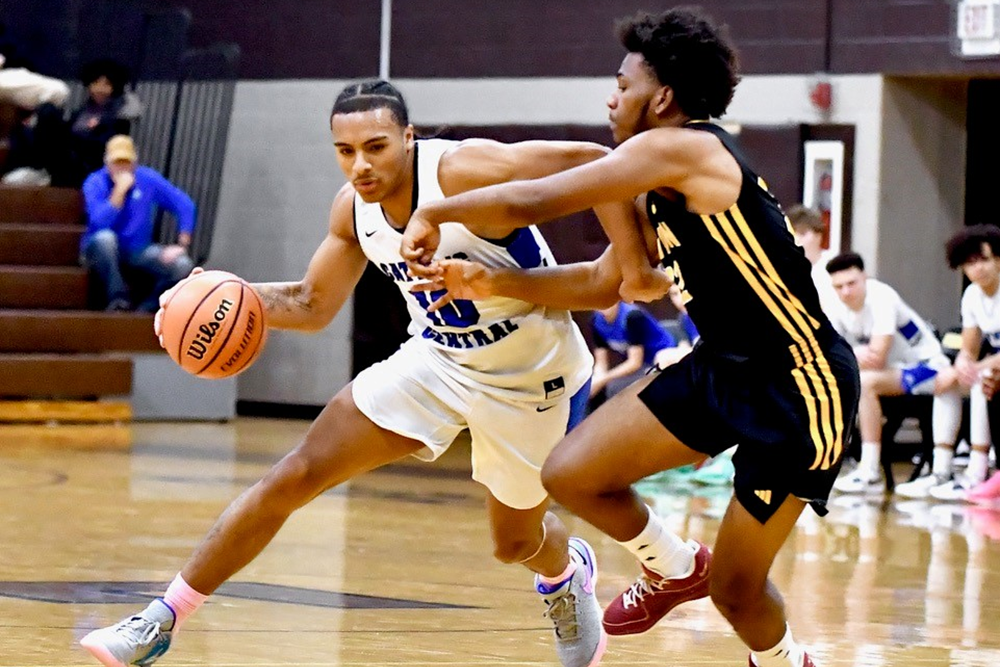
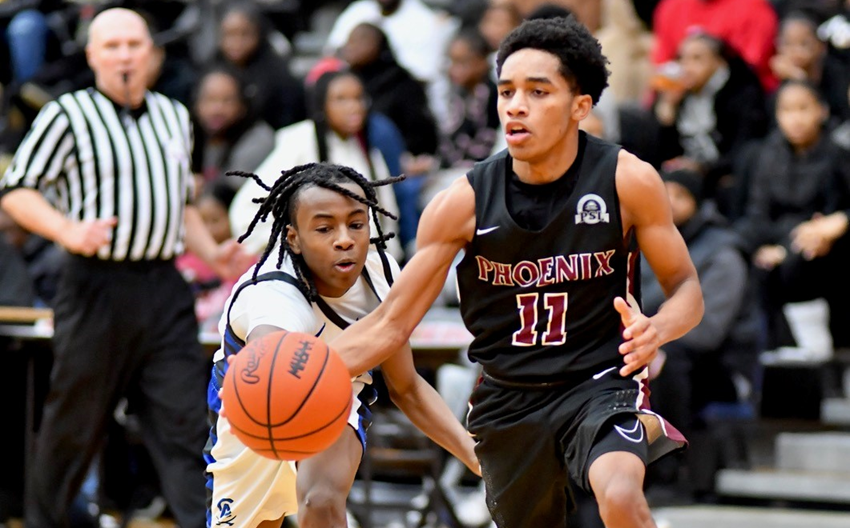
PHOTOS (Top) Detroit Catholic Central and Davison face off earlier this season. DCC will play in the Catholic High School League Bishop Tournament this week. (Middle) Detroit Renaissance takes on Flint Carman-Ainsworth, also earlier this winter. Renaissance is among contenders for the Detroit Public School League Tournament title. (Photos by Terry Lyons.)