

A Year Older, Buckley Sets Aspirations High
December 15, 2016
By Dennis Chase
Special for Second Half
BUCKLEY – The Buckley Bears are hoping pizza parties become a regular occurrence this winter.
 As an incentive to improve defensively, Buckley basketball coach Blair Moss is rewarding his players with pizza parties if they can hold opponents under 40 points.
Through three games, all impressive wins, the Bears have earned one party, beating McBain Northern Michigan Christian 86-39 last Thursday.
“He (Moss) knows we can put up points in a hurry,” junior standout Denver Cade said, “but he wants to see us lock down the other team.”
So far, added emphasis on the team’s man-to-man defense seems to be working. The up-tempo Bears are averaging 92 points offensively, and surrendering 49.
“I know we can score,” Moss said. “That’s not the problem. The problem is locking it down on defense. On nights we’re not making our shots, we’re going to need to have stops (on defense). Since summer, that’s what I’ve been preaching. We’ve talked about it and worked hard on it.”
Focusing on that facet of the game is a priority because Buckley has high aspirations after making a run to the MHSAA Class D Regional Finals last March with a lineup comprised of four sophomores and a freshman. The Bears nearly won the Regional, taking Bellaire to the wire – the teams were tied at 55 with just over a minute to go – before losing 61-57.
“We were young and, as a coach, you wonder how your players are going to handle that kind of pressure,” Moss said. “We threw the ball away in the last couple minutes and that really hurt us. That’s being young. But I think we’ve learned from that.”
That loss became a motivator for the Bears.
“We used it as fuel,” junior Austin Harris said. “We started working even harder after that.”
In the months that followed, players hit the weight room and were in the gym as often as possible. Three starters were heavily involved with AAU. In addition, Moss set up a busy summer schedule that had the Bears traveling all over the state. They competed in scrimmages at Northwood University, Central Michigan University, Ferris State University, as well as local gyms, including Cadillac, where they saw two of the north’s best teams in McBain and Manton. All told, Buckley played nearly 40 games, almost all against larger schools.
“Playing that type of competition has helped prepare us for what’s ahead,” Cade said.
The 6-foot-3 Cade is listed as one of the top 100 players in the state by the Detroit Free Press. He’s off to a solid start, averaging 26 points and eight rebounds a game.
“He’s a winner,” Moss said. “He’s my general on the floor.”
The 6-foot-3 Harris is talented as well. He’s averaging 18 points, eight rebounds and eight assists. He registered a triple-double in Tuesday’s 100-59 win over Suttons Bay. Harris plays on the wing, but also moves to the point on occasion. Moss would like to play him strictly on the wing to increase his scoring opportunities and balance the floor with Cade on the opposite wing.
Cade and Harris are joined in the lineup by juniors Joey Weber and Brock Beeman and sophomore Ridge Beeman. Weber, who also plays the point, and Ridge Beeman average 11 points; Brock Beeman averages nine per game.
 All four juniors were on varsity as freshmen.
“You might get one of these groups every 10 years or so,” Moss said. “You’re just so thankful. They’re all so coachable – and they’re just as good in the classroom as they are on the court. They’ve been playing together since they could walk. They’re in the gym all the time. Their basketball IQ is very high.
“How many coaches start four freshmen at the high school level? I knew we were going to take our lumps that year. We were not very physical, but I knew we were talented enough that we could be in every game.”
The Bears finished 11-11 in 2014-15 and improved to 16-7 a year ago. They now have their sights set higher, starting with winning the Northwest Conference.
“It’s not going to be easy,” Cade warned.
Frankfort, heading into Thursday night’s game, has won 26 league games in a row and returns two top players in juniors Jaylon Rogers and Matt Loney. Glen Lake - bolstered by Lake City transfer Cade Peterson, the quarterback on the Lakers’ MHSAA Finals football team – is 2-0 and seems primed for a breakout campaign. And then there’s Benzie Central, which has given Buckley fits in recent seasons.
“This is the toughest I’ve seen this league,” Frankfort coach Reggie Manville said. “And what’s really scary is that all those teams at the top of the league have most of their starters coming back next season.”
Moss previously coached the Benzie Central varsity for seven seasons. After stepping down, he took two years off from coaching and then re-emerged at Buckley. He’s now in his fourth season.
“I still had that drive, that urge to coach,” he said. “I missed working with kids. I missed the camaraderie with the coaches.”
Todd Kulawiak, the elementary school principal at Buckley, reached out to Moss. The two have a connection – they were former standouts at Benzie under coach Will Lynch and are the two all-time leading scorers in school history. Kulawiak was also an all-state distance runner under Blair’s father, Pete.
Although the Bears struggled the first couple years under Moss, the coach could see what he had coming. Now he’s pushing that group, and himself, so they can reach their potential.
“We’re very capable if we keep focused, keep our heads on straight and keep working hard,” he said.
That drive to improve was a major reason he put together such an aggressive schedule in the summer. He wanted his team to face quality competition, and he was pleased with the results.
“It seemed like we were getting better all the time,” he said.
As an offshoot, Moss also wanted to get his players exposure, especially in camps at college venues.
“They deserve it,” he said. “I want (college coaches) to see our kids. It’s like I told Denver’s father, ‘You’re talking $100,000 for a college education. If he puts the time in now, bingo.’”
Buckley is not particularly big – “We’re mostly a five-guard lineup,” Cade said – so the Bears like to use their athleticism and push tempo.
“With Coach Moss, it’s go, go, go,” Cade said. “If the (MHSAA) had a shot clock, we would be one of the teams that would benefit from it the most because we find a way to get quick, quality shots.”
Opposing coaches have noticed.
“They’re extremely good shooters from the perimeter, and that sets up their offense,” Manville said. “You have to defend that shot. Now, they’re all starting to penetrate to the basket and dish, which makes them more difficult to guard. And if you want to help defend, you’ve got a problem.
“The other problem is they run. They want to score a lot of points. They scored 100 points Tuesday night. Scoring 100 is difficult nowadays. They must have been really efficient. And they’re getting better defensively. I know that’s something they’re working on.”
If Buckley needs size, the Bears can turn to 6-5 Nick Kuhn, who is still developing his game. He had eight points off the bench in a season-opening 91-50 win over Bear Lake.
Buckley’s ability to score, combined with its game experience and chemistry, gives the Bears a good base. But there’s another strength that’s just as important to the team’s success, Harris said.
“Our team has a lot of heart,” he said. “We play really, really hard.”
So now the goal is to play off those strengths while continuing to work on other aspects, like defense. It could make the difference in winning a league title and advancing along the March Madness tournament trail.
“Everybody at that next level can score,” Harris said. “It really comes down to who can play defense.”
 Dennis Chase worked 32 years as a sportswriter at the Traverse City Record-Eagle, including as sports editor from 2000-14. He can be reached at [email protected] with story ideas for Manistee, Wexford, Missaukee, Roscommon, Ogemaw, Iosco, Alcona, Oscoda, Crawford, Kalkaska, Grand Traverse, Benzie, Leelanau, Antrim, Otsego, Montmorency, Alpena, Presque Isle, Cheboygan, Charlevoix and Emmet counties.
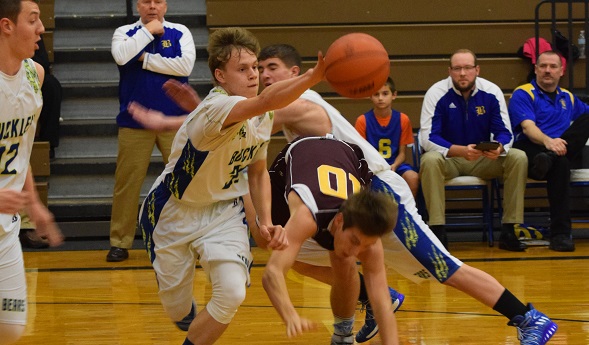
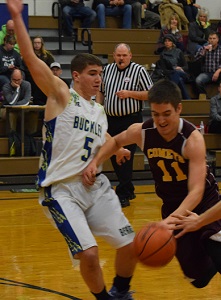
PHOTOS: (Top) Buckley’s Ridge Beeman (30) works to gather a loose ball against McBain Northern Michigan Christian on Dec. 8. (Middle) Joey Weber (5) blocks off a driving Bobcats player during the 86-39 win. (Photos courtesy of the Buckley athletic department.)
Breslin Bound: Boys Report Week 2
December 19, 2016
By Geoff Kimmerly
Second Half editor
 Basketball season generally is broken down into three sections – and we’re in the midst of an exciting first as schools prepare for a break from class but not the action on the court.
The first month of the season features nonleague tilts between top teams from all over the state – see our “Week in Review” presented by MI Student Aid for some of last week’s best – and keep an eye out for more as we move into the final week of December before that second phase – the heating up of league competition.
Week in Review
The countdown of last week’s five most intriguing results:
1. Flint Beecher 59, Detroit U-D Jesuit 57 (OT) – Beecher, the reigning champion in Class C, has played arguably the toughest schedule in the state so far but came back from an early-week loss to reigning Class B champion Detroit Henry Ford by downing the reigning Class A champion Cubs during Super Saturday at Southfield.
2. East Lansing 59, Lansing Everett 53 – As noted in last week’s report, Everett handed the Trojans their first and only loss last season on the way to the Class A Semifinals; East Lansing and star Brandon Johns again are expected to be title contenders.
3. Wayland 77, Detroit Henry Ford 54 – The Wildcats, 17-3 a year ago, handed the reigning Class B champion its first loss during the Battle for I-96 showcase after Ford had downed Beecher just days before.
4. Freeland 54, Alma 48 – The undefeated Falcons trailed late before coming back to beat their Tri-Valley Conference Central rival; last season, Alma won the league with a sweep of second-place Freeland (which won 19 games) and then beat Freeland again during the Regional.
5. Detroit East English 79, Macomb Dakota 63 – Also Saturday at Southfield, East English added to an earlier win this season over Beecher by ending Dakota’s 41-game regular-season winning streak.
Watch List
With an eye toward March, here are two teams in each class making sparks:
CLASS A
Kalamazoo Central (4-0) – The Maroon Giants are always in the championship mix, so this start is nothing new. But it’s included four double-digit wins including 67-55 over Battle Creek Central in the opener and 62-45 over Detroit Western.
Dearborn Heights Crestwood (4-0) – After finishing 10-12 and last in the Western Wayne Athletic Conference Blue last season, Crestwood has matched reigning co-champ Belleville with a 4-0 start. A big test comes Tuesday against the other 2015-16 co-champ, Romulus.
CLASS B
Bridgeport (4-0) – The Bearcats have finished third, sixth and fifth in the TVC East the last three seasons, respectively, but moved into prime position early with last week’s 69-59 win over reigning co-champion Frankenmuth. They’ll meet again Feb. 10.
Detroit Mumford (4-0) – The Mustangs won six and seven games, respectively, over the last two seasons, and are approaching those totals with four more games to go this month. They’ve pulled off a pair of close calls, by five over Gibraltar Carlson and four over Detroit Southeastern.
CLASS C
Iron River West Iron County (3-0) – After winning four games last season and two the season before that, West Iron is close to surpassing both by the end of the first week of January. The highlight so far probably was last Monday’s 61-43 win over Crystal Falls Forest Park, a 22-game winner last winter.
Marlette (4-0) – The Red Raiders are coming off back-to-back 15-7 finishes and after starting 2-2 a year ago. They could turn into a heavy favorite to claim the Greater Thumb Conference East title outright after sharing last winter; after two weeks, Marlette is the only team in the league with a winning overall record.
CLASS D
Baldwin (4-0) – After squeezing past Scottville Mason County Central by three in its opener, Baldwin has won its last three games by an average of 32 points. The Panthers won their District and fell in the Regional Semifinal last season.
Lansing Christian (4-0) – Since making the Class D Semifinals in 2013, the Pilgrims have fallen as low as five wins and built back with 10 two seasons ago and 14 last winter. They play in the Greater Lansing Activities Conference with all bigger schools, so they will see only a few opponents their size the rest of the way.
Can't-Miss Contests
Be on the lookout for results of these games coming up:
Monday – Powers North Central (3-0) at Menominee (0-1) – The Class B Maroons might be the last tall obstacle to stand in the reigning Class D champion's way as it pursues the MHSAA record for longest winning streak (see last week’s report); Menominee fell only 64-60 in the teams’ second meeting last season.
Tuesday – Detroit U-D Jesuit (2-1) at Macomb Dakota (3-1) – This is a rematch of last season’s Class A Semifinal, won by Jesuit 72-51, as the Cubs went on to win the MHSAA championship.
Tuesday – Ann Arbor Pioneer (3-2) at Ann Arbor Skyline (2-2) – Skyline lost to Pioneer three times and Ann Arbor Huron twice in finishing 13-8 last season; Skyline is coming off a 95-92 triple-overtime win over Huron and will now try to avenge against this local rival as well.
Tuesday – Traverse City St. Francis (2-2) at Frankfort (2-0) – Frankfort won the Northwest Conference title last winter, but one of its two regular-season losses came to St. Francis, 69-68, as the Gladiators went on to finish second in the Lake Michigan Conference.
Tuesday – Boyne City (2-0) at McBain (3-0) – This should help in some early sorting out of the top Class C teams in the northern Lower Peninsula; McBain made the MHSAA Semifinals last season and Boyne City made the Semifinals the season before.
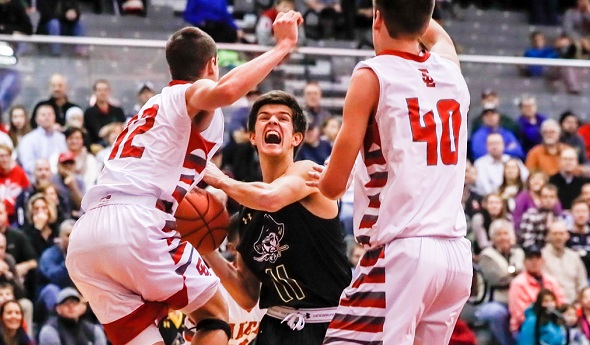
PHOTO: A pair of Spring Lake defenders wall off a driving Grand Haven player during Friday’s 53-52 overtime win by the Buccaneers. (Photo by Tim Reilly.)