

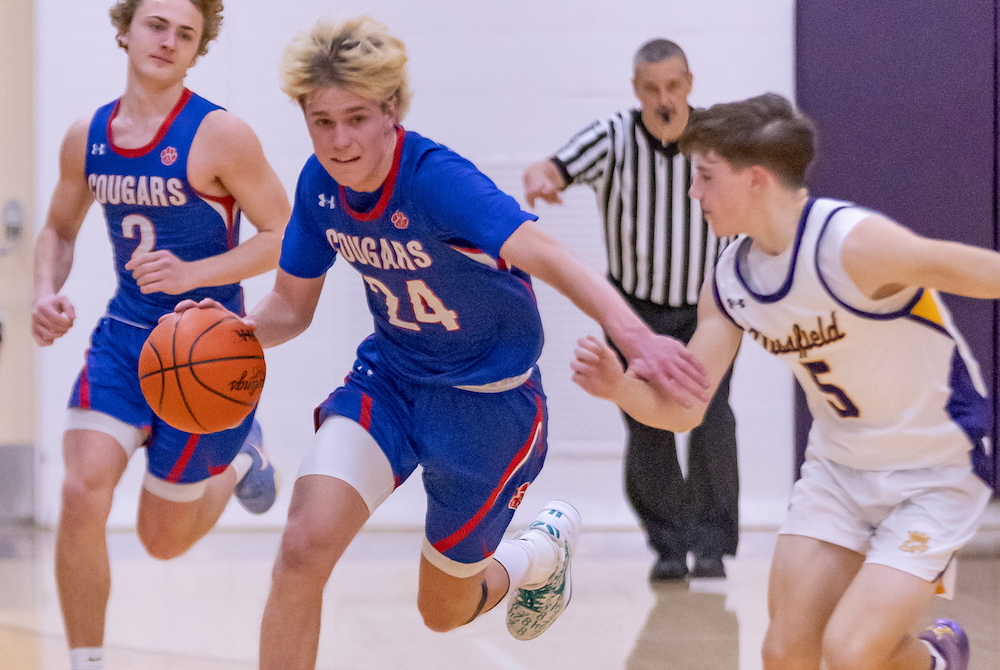
Youngest Salenbien Sibling Making Name as Family's Latest 1,000-Point Scorer
By
Doug Donnelly
Special for MHSAA.com
January 28, 2025
When Jaxon Salenbien was getting close to reaching the 1,000-point milestone for his career, he had some pretty good people to turn to for advice.
 Salenbien is the third member of his family to reach 1,000 points. Both of sisters scored more than 1,000 points while also playing for Adrian Lenawee Christian and his father, Jamie Salenbien, is a state-championship winning coach.
“My dad has coached ever since I can remember,” said Jaxon, a junior. “My sisters were always playing. I just kind of flowed right into it. I’ve just always been around it. I’ve watched a ton of basketball. I think that’s helped.”
The talent certainly runs deep in the family.
Jamie Salenbien played high school basketball for Hudson and set the school’s single-game scoring record. His wife, Deborah, played in college.
Jaxon’s older sisters Dani and Bree both were all-state players at Lenawee Christian and led the team to back-to-back Class D/Division 4 championships. Dani scored more than 1,000 points before playing at Hillsdale College. Bree scored more than 2,000 points, won four straight Associated Press Class D/Division 4 Player of the Year honors and is now playing at Gonzaga. Jaxon’s older brother Tyler was all-state in football.
“I used to watch them; now they are watching me and cheering me on,” Jaxon said. “We always have supported one another. It’s harder for Bree since she’s so far away, but when she’s home, she comes to my games.”
Salenbien was an instant starter on the LCS varsity team as a freshman, scoring nearly 450 points. He had a knack for getting to the free throw line and was a dangerous 3-point shooter.
Last year he teamed with senior Brandon Summer – a 1,000-point scorer himself – to light up the scoreboard but was also a top-notch playmaker, dishing out more than six assists a game.
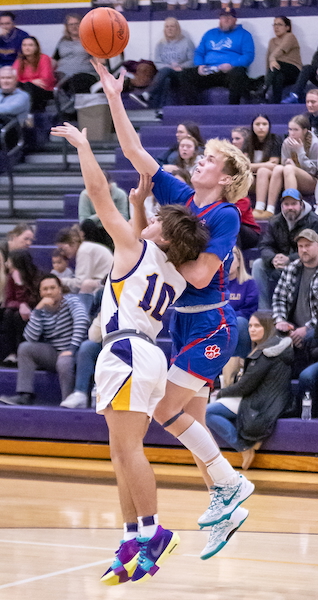 This winter, as a junior, Salenbien has been even more assertive with the basketball, shooting from the outside more often and driving with authority. He’s twice scored more than 30 points in a game, including 37 in an overtime win over Springport. It was during that game that he surpassed the 1,000-point milestone.
"Jaxon is not only super talented but also one the most dedicated gym rats I've ever coached,” Cougars coach Matt Summer said. “He is a great leader and a phenomenal teammate. His passion for the game is second to none. I'm super happy for him to hit this scoring milestone in his career."
That Springport win also was his first back in the lineup after an ankle injury forced him to miss two games.
“(The milestone point) had a weird timing to it because the game was so close,” he said. “They never said it over the PA system or anything because the game ended up going into overtime. I didn’t know exactly when I got it, but my coach told me.
“It’s a cool milestone to get as a high school player,” he added. “It was on my radar, but we just want to win as a team.”
Salenbien said there has been no magic formula to being more assertive on the basketball floor – he’s just playing the role on the team that an upperclassman should.
“Being an upperclassman, that’s what you are always going to do,” he said. “Taking control down the stretch is important for the junior and senior guards.”
The Cougars are off to a 12-2 start with a key stretch of Tri-County Conference games coming up. They lost their first TCC game recently to Petersburg Summerfield, which is 13-0.
The Cougars have excelled at 3-point shooting – averaging nearly 10 made triples a game.
“It’s so much fun,” Salenbien said. “Teams can’t key on one person. If they do, we have shooters everywhere.”
Jaxon is the youngest of the Salenbiens, who are all two years apart. He was in third grade when Dani started on the varsity. In fifth grade, his dad – who won 104 games in five seasons as the LCS girls varsity coach – coached him. Since then, his dad has been an assistant coach on several of his teams, including this year.
“When I was younger, he coached me in maybe fifth grade, but he’s never been my head coach, but always an assistant,” Jaxon said. “He’s always coaching me even if he’s not my coach.”
His sisters were definite basketball role models.
“Watching them has helped and just conversations we get to have,” he said. “Dani comes to pretty much every game now. Right before I reached 1,000 points, Bree and I had an hour-long conversation about things I need to work on and being coachable. It’s helpful to have those two to look up to on and off the court.”
Bree’s advice: Be coachable, be a leader and never think you can win a game by yourself.
His mom, who keeps the scorebook for LCS, offers her own advice – sometimes during games when he reaches the scorer’s table and checks in.
“We always say she’s the emotional support, and my dad is the basketball support,” Jaxon said. “She keeps me in line. She tells me to not complain to the referee and keep my head.”
 Doug Donnelly has served as a sports and news reporter and city editor over 25 years, writing for the Daily Chief-Union in Upper Sandusky, Ohio from 1992-1995, the Monroe Evening News from 1995-2012 and the Adrian Daily Telegram since 2013. He's also written a book on high school basketball in Monroe County and compiles record books for various schools in southeast Michigan. E-mail him at [email protected] with story ideas for Jackson, Washtenaw, Hillsdale, Lenawee and Monroe counties.
PHOTOS (Top) Adrian Lenawee Christian’s Jaxon Salenbien (24) pushes the pace bringing the ball upcourt against Blissfield. (Middle) Salenbien elevates to get a hand on a loose ball. (Photos by Michelle Sullivan.)

Esler Pilots DeLaSalle Back to Final Week
By
Tom Markowski
Special for Second Half
March 19, 2018
WARREN – There isn’t much that Greg Esler hasn’t seen or experienced as a coach and as a father.
 Through it all he’s learned to take nothing for granted, in life and as a coach.
Esler, 63, coached St. Clair Shores Lake Shore to its first and only MHSAA boys basketball title in 1994, in Class B. That team was led by Travis Conlan, who finished second in the voting for Mr. Basketball that season. Conlan would go on to play at University of Michigan, one of a number of Esler-coached players who went on to the college – and for some – professional ranks.
Esler is in his 31st season as a head coach, with the last 24 at Warren DeLaSalle. Twenty-one times the Pilots have won a District title with Esler on the bench. In 2007, DeLaSalle reached a Class A Semifinal for just the second time in school history, as it lost to Manny Harris and Detroit Redford 56-50. (Note: In addition to two Class A Semifinal appearances, DeLaSalle also reached a Class B Final in 1982).
Consistency has been a hallmark of Esler’s programs, and even after all these years a fire burns in his stomach. He’s retained a burning desire to compete and to win. As the years have piled up, Esler has become more appreciative of the success his program has achieved and the experiences gained.
So when DeLaSalle defeated Macomb Dakota, 56-51, in a Regional Final last Wednesday, there was reason to celebrate. As good as DeLaSalle has been recently, it hadn’t won a Regional title since 2010. The Pilots have been to the Detroit Catholic League final each of the last three seasons and have won five District titles since 2010 including the last three. But the end of last season stung more than most. DeLaSalle reached a Regional Final and then lost to Troy, 48-40, in an ugly game where the Pilots shot less than 30 percent from the field.
Most of that team is back as the Pilots head into the final week of this season. Esler has nine seniors including two of the top players in the league in point guard Justin Fischer and guard-forward Luke Pfromm, the starting quarterback on the Division 2 championship football team.
Esler started coaching at Warren St. Anne grade school in 1983, then went to DeLaSalle for three seasons beginning in 1985 under then-coach Gary Buslepp. Esler got his shot as a head coach in 1987 at Lake Shore and quickly made that program relevant. Lake Shore reached the Class B Semifinals in 1993 before losing to coach Norwaine Reed and Saginaw Buena Vista.
Esler took over the DeLaSalle program at the start of the 1994-95 season. His career record stands at 530-216 heading into tonight’s Class A Quarterfinal against Detroit U-D Jesuit.
“We instilled a system here,” he said. “The first thing is to have your players in condition. Second is defense. I’ve always stressed defense. And third, and maybe this should be first, is talent. We’ve always had really good players here. And the players we’ve had want to get better.”
What often goes unnoticed in a basketball program is the work of the assistant coaches. Esler has been blessed with loyal and knowledgeable assistants. His top assistant is Tom Mehl, who played for Esler for two seasons at Lake Shore. Mehl was on staff for Esler’s last four seasons at Lake Shore and has been with Esler every step of the way at DeLaSalle.
Jeff Becker is in his 13th season as an assistant, and another, Dave Grauzer, recently left the program and now is an assistant at Traverse City West.
 “Surrounding yourself with good people is at the top of the list,” Esler said. “One thing about Tom, there’s no one I’ve seen who can go to a game to scout and pick up something no one else would see. Like a player who takes two dribbles before driving to his right or left. For Becker, it’s organization. He works well with the kids, and he’s got the post players. Mehl has the guards.
“Over the years I’ve listened. Listened to other coaches. I don’t have all the answers. I talk to Steve Hall at (Detroit) Cass Tech all the time. He’s been a great friend over the years.”
This team has a closeness not always seen. The fact that there are nine seniors is one reason. Esler points out that he’s been with this group for more than 100 days this season, and when you’re around a group that long tempers can flare – so it’s important to keep the present in perspective and realize they all want to reach the same goal.
“We do a lot of things outside of basketball,” Esler said. “Last week four of my captains read to the students at (St. Clair Shores) St. Germaine grade school. My wife, Renee, is a fourth and fifth grade teacher there, and it’s way for the players to interact with the younger students.
“I read an article recently on (Michigan) coach (John) Beilein and how the game has changed. The kids have changed. We watch game film but not like we used to. Their attention span isn’t like it used to be. The technology now, with Facebook and texting, it’s unbelievable. We might watch film for 20 minutes where we used to watch for hours.
“My players will tell you, I love the practices much more than they do. Games are like taking a test. If you didn’t win, maybe you failed at some area that cost you. They love each other and they do a good job of listening. All five starters have scored 20 points or more in a game this season. And they don’t get rattled. We were down four to Dakota with four minutes to go and Pfromm came to me in the huddle and said, ‘Don’t worry coach. We got this.’ I can see why they won a state title in football.”
Fischer has matured significantly as a leader and force offensively. A three-year starter, he has signed with Lake Superior State.
Fischer came into the program as a skinny 5-foot-10 freshman. By the time he was a junior, he had grown five inches. Now he’s 6-4 and weighs 185 pounds.
“I was a pass-first guard as a sophomore,” he said. “I’ve worked on my shooting, just working on my total game.
“We were pumped up for that Dakota game. We got the crowd going crazy. We were down and Luke hit a couple of 3s. I had a dunk and hit four free throws late.”
DeLaSalle (18-7) will play Catholic League Central rival Detroit U-D Jesuit (22-3) next. The Class A Quarterfinal will be played Tuesday at 5 p.m. at Calihan Hall, the site of the Catholic League final. Jesuit won that game, 71-64. In fact, Fischer has lost nine consecutive games to U-D as a varsity player.
He shouldn’t feel alone. DeLaSalle hasn’t defeated U-D since 2014 when the teams tied for the Catholic League Central regular-season title – a streak of 14 straight defeats to the Cubs. U-D won this season’s meetings 64-45, 59-57 and 64-55.
Esler keeps U-D recent domination of his program on the light side.
“I’ve said I’d have to coach until 2031 to get to .500 against them,” he said.
 Tom Markowski is a columnist and directs website coverage for the State Champs! Sports Network. He previously covered primarily high school sports for the The Detroit News from 1984-2014, focusing on the Detroit area and contributing to statewide coverage of football and basketball. Contact him at [email protected] with story ideas for Oakland, Macomb and Wayne counties.
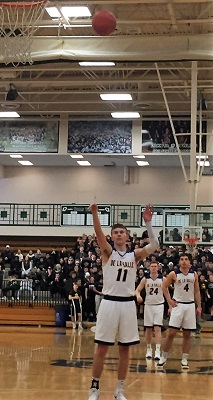
PHOTOS: (Top) Warren DeLaSalle coach Greg Esler talks things over during his team’s Regional Final win against Macomb Dakota. (Middle) Justin Fischer launches a free throw during the 56-51 victory.