

Menken Giving Back Through Coaching, Telling Story of Donor's Life-Saving Gift
By
Pam Shebest
Special for MHSAA.com
November 17, 2026
KALAMAZOO — In 2017, Andrew Nicholson was a 19-year-old senior at Holly High School.
 Roy Menken was a 52-year-old bowler who was dying of Alpha-1 antitrypsin deficiency, a fatal lung disease.
The two had never met, but through tragedy, the teen saved Menken’s life.
Menken, an assistant bowling coach at Kalamazoo Central, was given about six months to live when he got a call at 5:45 a.m. on May 24, 2017, from University of Michigan Health.
After waiting for 27 months, Menken was finally getting a new pair of lungs.
“Normally they give you about four hours to get to U of M,” Menken said. “In my case, Andrew’s lungs didn’t match anyone else in the U of M program, so I was the only one called.”
With his wife driving “like a mad person,” they made it to the medical center in Ann Arbor in less than two hours.
Preparing for the surgery, he said, he felt “a little scared, because you never know. Actually, I felt sad for the person who had passed. We were told that it was a young man, and he was involved in an accident.”

The teen was killed the day before in a welding accident.
Working in a junk yard, he was asked to weld some 55-gallon drums, which, unknown to him, still had some lacquer thinner in them.
“A week before I showed my son how to weld,” said Keith Nicholson, Andrew’s dad. “He made an eighth-inch weld and it burned through and blew up. Broke his neck, broke his forearm, broke his shoulder, broke his whole left side of his body, crushed his head.”
Fortunately for Menken, when the teen got his driver’s license at age 16, he checked the donor box.
“The day my ex-wife took him to get his driver’s license, she was standing there next to him and he said, ‘Donor, what’s that mean?’” Keith Nicholson said. “She said if you die, they can take your organs and help other people.
“Andrew shrugged his shoulders and said, ‘Well, they’re not going to do any good for me.’”
Those organs not only helped Menken, but saved four other lives, were life-changing for 12 more people (bones, etc.) and life-altering for another 33 (skin, science, etc.)
Menken sent a letter to Gift of Life Michigan through the hospital, hoping it would be forwarded to the donor’s family. The family answered, beginning a life-long friendship.
Keith Nicholson said he responded because “I was more curious making sure everything was all right. I’m really happy. I couldn’t ask for a better recipient.”
They have not only become “family,” but on the two-year anniversary of the transplant, Keith Nicholson went to Kalamazoo from Trenton to pick up the classic 1959 Impala that Menken started restoring before the surgery but could no longer finish.
Nicholson completed work on the car and said Andrew would have done it himself if he’d had a chance.
“The only thing I ever said to Roy (about the transplant) was when we were out in the shop welding on the car, he tried to sneak out there (to help)," Nicholson recalled.
And that question was a stark reminder.
“I stopped welding, looked at him and said, ‘Is this what you think of my son’s gift to you?’”
Living a full life
Fueled by healthy new lungs, Menken wasted no time getting back into sports.
The transplant was in May 2017, and by that September he was playing golf. He started bowling in November.
When he walked into Continental Lanes that first day, he saw his son, Donald, who was working there.
“You could just see the emotion on his face,” Menken said. “So was (manager) Dave Fawley and my other son, Perry.
“I slowly got back into the leagues that January and haven’t quit bowling since except when COVID hit.”
Bowling at least five days a week is no problem for Menken. The hardest part, he said, is wearing a mask when he is around people, something transplant recipients are supposed to do.
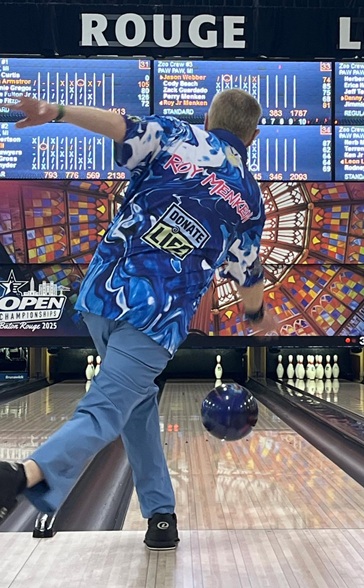
The mask hasn’t interfered with his game. He’s shot a couple of 300 games since then.
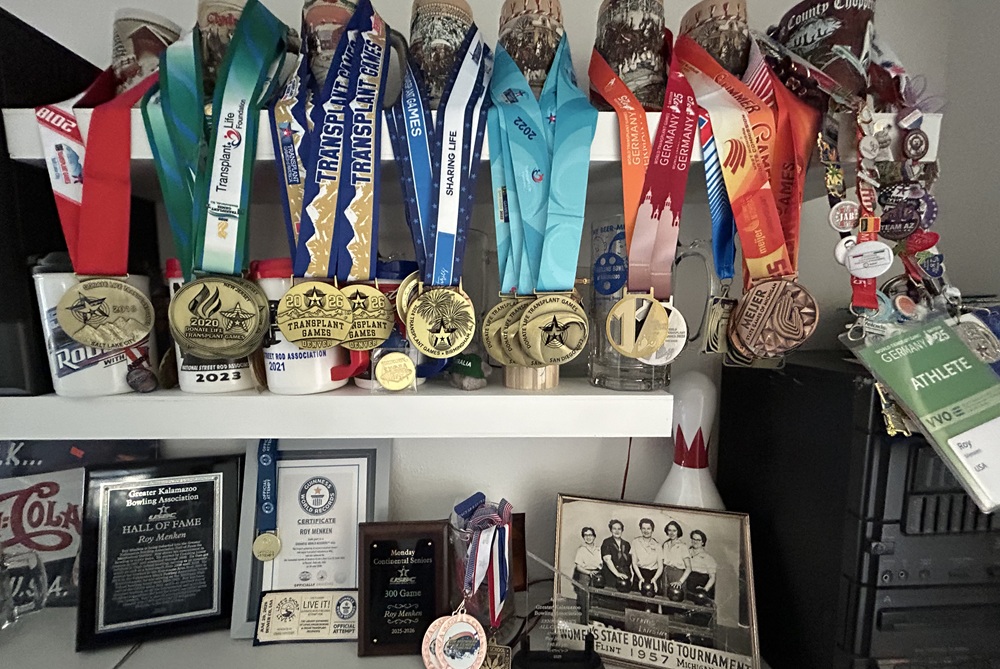
Menken also competes in Transplant Games of America and World Transplant Games. Several of his 12 gold medals came from both tournaments, including a mixed doubles gold in the U.S. Games with Becky Sheets from Charlotte, who was six months out from a heart transplant.
Traveling is no problem for Menken and his wife, Jan. The World Games, held every two years, move from country to country. Last year they were in Dresden, Germany, and next year will be in Belgium.
Menken still has to travel to Ann Arbor for checkups every three months and gets weekly infusions of Prolastin (an enzyme his liver doesn’t release) at home.
He is also in chronic rejection and relapsed twice before rebounding, which he attributes to how active he is and the 12 morning pills and 16 evening pills he takes each day.
As a teen, Menken was diagnosed with sports-induced asthma and began using inhalers.
He said doctors never really discovered that he had Alpha-1 until one day in 2013, while he was working as a building operator for Kalamazoo County and had trouble catching his breath.
“They sent me to their doctor, and he said do you realize you are disabled?” recounted Menken, who refused to believe it.
It was not until he went to Ann Arbor for tests that he was diagnosed with end-stage lung disease and given two years to live.
He and his wife “left U of M and we were both in shock,” he said.
After returning home, he was put on two liters of oxygen and could no longer work at his job. Once he got the call for surgery, Menken said he was more afraid that something would happen to cancel the surgery than he was of dying.
The operation lasted 14 hours and when he woke the next day, he wasn’t scared but knew the operation was a success when he saw “my wife and her Aunt Marcia Godisak, who was also one of my respiratory nurses, just the looks on their faces, even though I couldn’t speak because I was still on a ventilator.”
Coaching a passion
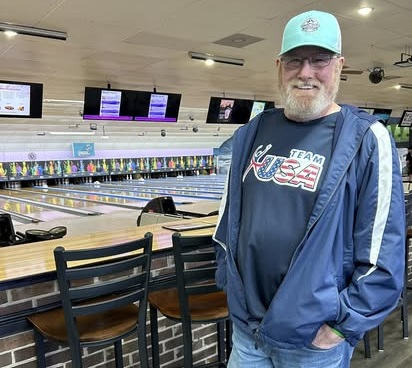
Menken coached bowling at Portage Northern for 10 years, then started at Galesburg-Augusta until COVID-19 shut down the program. He has helped coach at Kalamazoo Central the past two years and spends time talking to clubs and schools about his journey and organ donations.
He is also in charge of the Saturday morning junior bowling leagues at Continental.
“He brings a lot of bowling knowledge that I don’t have,” K-Central head coach Krys Briggs said. “I have not had the experience, so I find people I know that are definitely more knowledgeable than I am.

“The kids love him.”
The coach also said she passed around an article about Menken’s transplant journey for the bowlers who did not know about it.
“Personally. it makes me want to work on my health and make sure that I’m healthy just so that I don’t have to go through that,” said junior bowler Kaeden Lutzka, who heard Menken speak during one of his classes. “If I stay healthy and someone needs my organs, I can be a donor since I’m a donor on my license.”
Menken said the feeling of survivor’s guilt still haunts him.
“We honor Andrew every day,” he said.
Keith Nicholson said, “The biggest misinterpretation, and I know people say it because it’s the most common, but it’s not that we lost a son. I know where he went. I know what happened. He was just an amazing kid. He touched a lot of people’s hearts.
“Roy had less than six months to live. I’m happy for him.”

Pam Shebest served as a sportswriter at the Kalamazoo Gazette from 1985-2009 after 11 years part-time with the Gazette while teaching French and English at White Pigeon High School. She can be reached at [email protected] with story ideas for Calhoun, Kalamazoo and Van Buren counties.
PHOTOS (Top) Roy Menken’s collection of bowling awards includes several medals earned competing in national and world games for bowlers who have received organ transplants. (2) Andrew Nicholson, as an organ donor, provided lungs that have extended Menken’s life. (3) Menken, at a bowling center, is an assistant coach for Kalamazoo Central. (4) Menken rolls for a spare during tournament play. (5) Kalamazoo Central head bowling coach Krys Briggs and junior Kaeden Lutzka. (Menken, Nicholson and awards photos courtesy of Roy Menken. Headshots by Pam Shebest.)
Century of School Sports: Connection at Heart of Coaches Advancement Program
By
Geoff Kimmerly
MHSAA.com senior editor
November 19, 2024
As we believe that educational athletics are an extension of the academic classroom, it’s important to recognize as well that coaches – similar to teachers during the school day – are another first point of contact for more than 170,000 high school athletes and thousands more who play middle school sports in Michigan.
For two decades, the MHSAA’s Coaches Advancement Program has served as an avenue to provide our coaches with a variety of tools to assist in working through issues they encounter daily while building up their teams and building these relationships.
Past Executive Director John E. “Jack” Roberts, when writing about the CAP program in 2017, noted “the thousands of dollars and hours that the MHSAA devotes to CAP demonstrates this organization’s belief that nothing – absolutely nothing – is more important in the process of educational athletics than the quality of the coach-athlete connection.”
That commitment and dedication to the coach-athlete connection continues as the MHSAA moves through its 100th anniversary year.
Through the end of the 2023-24 school year, coaches had completed 41,167 sessions within the eight-level program since its creation for the 2004-05 school year. Counting this past weekend’s CAP 1 and 2 courses taught at Detroit Henry Ford, another 1,167 sessions have been completed since the start of the 2024-25 educational year.
The CAP program is broken into nine levels, each addressing a set of topics:
- CAP 1: Coaches Make the Difference, The Coach as Teacher, Sports Medicine and First Aid.
- CAP 2: Effective Communication, Legal Responsibilities, Psychology of Coaching.
- CAP 3: Additional Coaching Responsibilities, Effectively Working with Parents, Managing Time and Energy.
- CAP 4: Understanding Athletic Development, Strength and Conditioning, Preparing for Success.
- CAP 5: Healthy Living, Teaching Emotional Toughness, Resolving Conflicts in Athletics.
- CAP 6, 7, 8 & 9: Current Issues and Topics in Educational Athletics.
Those who complete the program receive a level of certification after their first 12 hours (completing CAP 1 and 2). Through this past school year, 2,295 individuals have advanced through CAP 5 – earning them themselves CAP Masters Certification. From that group, 476 have advanced through CAP 6, 100 through CAP 7 and 87 through CAP 8, with the first class to complete that module in 2015-16. CAP 9 was created this fall.
Perhaps just as notably, 20,960 individuals have completed CAP 1 over the last two decades. Completion of either CAP 1 or CAP 2 became a requirement for first-year varsity head coaches beginning with the 2016-17 school year, and predictably numbers have climbed since that time with 12,515 completing CAP 1 over the last eight school years.
The program is constructed and coordinated by MHSAA Assistant Director Kathy Vruggink Westdorp, who joined the MHSAA staff in 2004 after several years as a principal, athletic director, teacher and coach in Grand Rapids and Forest Hills public schools. She lives the program’s philosophy of providing CAP training “anytime, anywhere” across the state, and over just the last five months CAP 1 alone has been delivered at 19 schools plus during 14 dates at the MHSAA office in East Lansing. Flint Kearsley isn’t on the list of CAP 1 hosts this year, but instead welcomed in 45 students for a CAP 5 session in early August.
Additionally, colleges and universities in Michigan are licensed to present up to five levels through their undergraduate or graduate studies, and eight are scheduled to do so again this school year.
The faculty for 2024-25 includes well-known leaders in Michigan educational athletics, officiating and sports medicine. Instructors include past and present athletic directors, principals, officials, coaches, college professors, athletic trainers, leaders from the Michigan Interscholastic Athletic Administrators Association (MIAAA) and MHSAA staff.
For more information, see the Coaches Advancement Program page.
Previous "Century of School Sports" Spotlights
Nov. 12: Good Sports are Winners Then, Now & Always - Read
Nov. 5: MHSAA's Home Sweet Home - Read
Oct. 29: MHSAA Summits Draw Thousands to Promote Sportsmanship - Read
Oct. 23: Cross Country Finals Among MHSAA's Longest Running - Read
Oct. 15: State's Storytellers Share Fall Memories - Read
Oct. 8: Guided by 4 S's of Educational Athletics - Read
Oct. 1: Michigan Sends 10 to National Hall of Fame - Read
Sept. 25: MHSAA Record Books Filled with 1000s of Achievements - Read
Sept. 18: Why Does the MHSAA Have These Rules? - Read
Sept. 10: Special Medals, Patches to Commemorate Special Year - Read
Sept. 4: Fall to Finish with 50th Football Championships - Read
Aug. 28: Let the Celebration Begin - Read
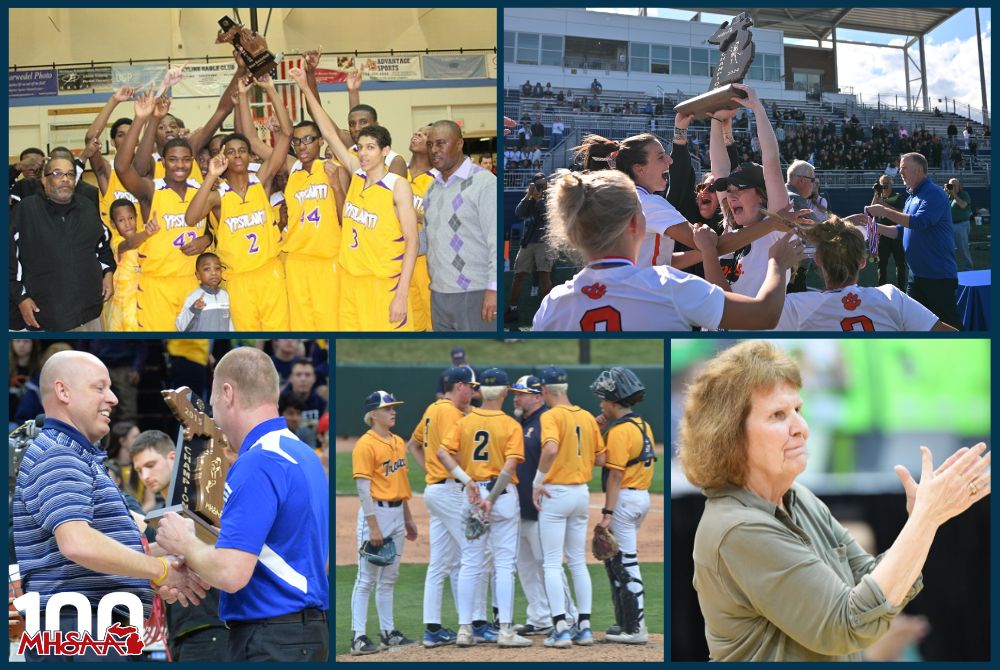
PHOTOS Clockwise from top left: (1) Former Ypsilanti Community and current Wayne Memorial boys basketball coach Steve Brooks (far right) celebrates with a trophy-winning team. (2) Brighton girls lacrosse coach Ashton Peters raises the Division 1 championship trophy in the spring. (3) Pontiac Notre Dame Prep volleyball coach Betty Wroubel applauds during pre-match introductions. (4) Trenton baseball coach Todd Szalka (middle) huddles on the mound during last season's Division 2 Semifinals. (5) Past Calumet athletic director Sean Jacques (left) passes the Class C championship trophy to his girls basketball coach in 2015. All five have received levels of CAP certification.