

Marquette Primed to Continue Dynasty
October 21, 2015
By Dennis Grall
Special for Second Half
MARQUETTE – Red is the dominant color when you talk about cross country in Michigan's Upper Peninsula.
Courtesy of one of the pre-eminent cross country programs in the state, red is worn by the Marquette High School teams that have been a scourge to the rest of the U.P. since the sport's inception.
 The boys have won 22 Upper Peninsula big-school championships heading into Saturday's U.P. Finals at Beauchamp's Grove in Flat Rock, in the countryside west of Escanaba. The boys have been competing since 1966, and Marquette began its title string in 1979.
The girls have been even more dominant, claiming 29 U.P. titles since the sport began in 1980, including a string of 13 straight (1980-92).
Both teams have won the past two U.P. Division 1 titles and are expected to repeat again Saturday.
All of the championships have come with Dale Phillips as head coach. Phillips, 73, started coaching both teams in 1977. He was inducted into the Upper Peninsula Sports Hall of Fame in 2009 for his coaching exploits with Marquette's cross country and track and field programs.
Asked what has kept him running the program for 39 years, Phillips did not hesitate. "My love working with the program and the young men and young women and seeing the success they can achieve," he said, noting he is coaching a second generation of runners and enjoys visiting the parents of today's athletes, many of whom he coached.
"They are a great recruiting tool," he said of parents bringing their kids into the program.
Phillips traces the program's success to when it started piling up those various trophies. "Then we started drawing boys and girls into it. They like what we do," he said. "The program kept building. It is like the Menominee football program. It seems they re-load every year, just like we do.
"You are going to hit a down period. There were some lean years," said Phillips. Of course, those "lean years" meant settling for second, third or fourth place.
"Sometimes you just don't get that quality you need. You just get kids into the program and they really work."
This year's leaders are Lance Rambo for the boys and Lindsey Rudden for the girls. Rambo is looking into running at either Central Michigan University, Michigan State or Grand Valley State after graduation. Rudden, who has never won a U.P. cross country title but owns eight U.P. track championships (with MHSAA meet records in the 800, 1,600 and 3,200 and with the 1,600 and 3,200 relay units), has verbally committed to run for MSU.
But it is not about super individuals. Rather, it is about the overall depth of the program and the family-like atmosphere. "The varsity cheers for the jayvee group, and the jayvees cheer for their varsity teammates. They know they are a total team. It is not just the top seven we are interested in," Phillips said.
 "You don't have to be the number one or two runner," Phillips tells his squads. "You can be number five, six or seven. You can help us immensely by getting ahead of the scorers of our opponents."
To illustrate, at the recent Great Northern Conference meet at Marquette's Presque Isle (complete with a water spout on Lake Superior, tornado warning, lightning, thunder and rain), the first nine girls jayvee finishers wore Marquette red. Marquette's boys and girls swept the varsity and junior varsity team titles.
"We emphasize that we are a team. The kids get so close as a team," Phillips said of the runners gathering for a variety of activities such as meals, movies and swimming. "We are a family. That word has come up for years."
Of course, a lot of that likely comes from the success they have all enjoyed together throughout their careers and from watching their predecessors do the same thing.
Agreeing that success breeds success, Phillips said, "that is a tremendous positive we have going for us. We have a large freshman class out and they learn how we do our workouts correctly and how we handle pace (of racing). We have some talent coming up."
The Redmen set such a tremendously high bar of success without piling up excessive mileage. "We try to get them to reach their peak at the end of the season," said Phillips.
While every coach tries to accomplish that goal, there is a fine line to reach in the process – no matter the sport or the level the athlete is playing.
"Leadership on a team is important," said Phillips, noting he sends groups of runners out at various distances and locations and tries to match them up with those of similar skill sets. With captains such as Rambo and Rudden setting the pace this year, Phillips knows the workouts will be fruitful. "Those kids lead by example. They keep the young runners going. They have responded well over the years," he said.
The coaching staff sets mileage limits and tries to monitor how much the athletes do on their spare time. "We are not a high mileage team," said Phillips. "We try to get a recovery day after a tough workout or a tough meet. We structure our program to keep the legs fresh and minimize injuries."
The runners do just 30-40 miles a week, much of it on an exquisite city trail system or at a grassy park close to nearby Northern Michigan University. "If we do a hard workout, we try to find a soft surface," said Phillips. "We can do hard workouts but they are not hard on the legs."
 Including pre-and-post stretching sessions, the weekday workouts last two hours a day in August before classes begin and no more than 90 minutes a day once the academic season starts. "We do longer intervals before the start of the season and shorter intervals later," he said, adding runners are told not to run on one of the weekend days.
Having quality runners throughout the group prevents varsity runners from becoming complacent. "Our jayvees keep the varsity on their toes," Phillips said.
He also encourages his runners to use alternative sports in their training to keep their legs fresh. "If you don't feel like running, jump on a bike. Biking is an excellent cross-trainer. They also go cross country skiing. You shouldn't run 365 days a year," he said.
"If you're in a winter sport, you can't get in better shape than running in cross country," said Phillips, noting several of Marquette's highly successful winter athletes have been on his teams. "That has been a drawing card as well" to attract participation.
In his 39 years at the helm, Phillips said a major highlight was when the girls won the prestigious Holly Invitational and the boys were 10th out of 30 teams in 1982. It was the first time the Redettes and Redmen participated, and many of the downstate runners were surprised to learn Marquette came from the Upper Peninsula.
The girls finished second, fifth, seventh, ninth and 11th and beat Clio, ranked No. 1 in the state at the time. "They couldn't believe someone from the U.P. could come down and dominate a big meet," said Phillips.
Competing in Holly, and big meets in Wisconsin, gives his runners a chance to see "other faces and other teams" and a chance to gauge their performances. That is especially important because cross country (in addition to track and field, tennis, golf, and swimming and diving) is split into Upper Peninsula and Lower Peninsula Finals.
While Phillips and former U.P. cross country coaches John Prokos, Dave Lahtinen and Arne Henderson previously made a strong push to merge for an all-peninsula MHSAA Finals, they were unable to convince the majority of U.P. teams to accept the proposal, which has been rejected twice.
In the meantime, Marquette makes everyone else look at red across the Upper Peninsula.
 Denny Grall retired in 2012 after 39 years at the Escanaba Daily Press and four at the Green Bay Press-Gazette, plus 15 months for WLST radio in Escanaba; he served as the Daily Press sports editor from 1970-80 and again from 1984-2012. Grall was inducted into the Upper Peninsula Sports Hall of Fame in 2002 and serves as its executive secretary. E-mail him at [email protected] with story ideas for the Upper Peninsula.
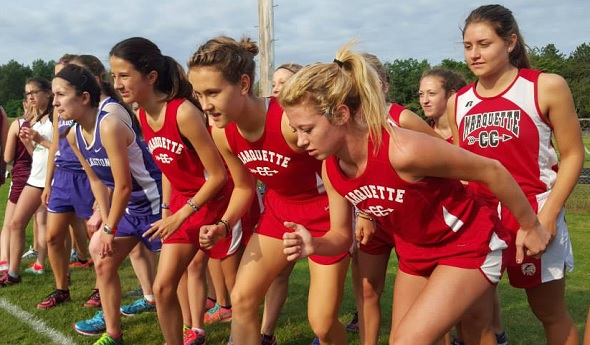
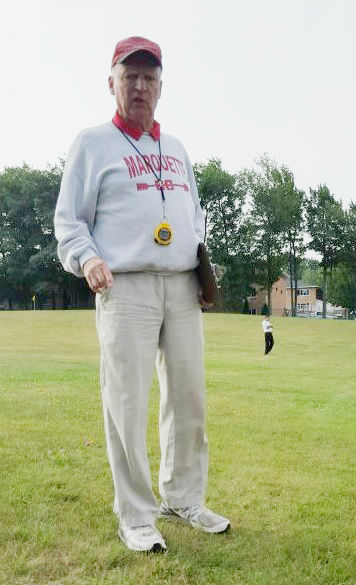
PHOTOS: (Top) Marquette’s girls cross country runners, including Lindsey Rudden, front right, prepare for the start at Marquette’s cross country relays earlier this season. (Middle) A pair of Marquette runners including Lance Rambo, right, compete during the boys race. (Below) Coach Dale Phillips has led the program for 39 years. (Photos courtesy of Marquette athletic department.)
Friendship Binds Champion Sister Acts
By
Dennis Chase
Special for MHSAA.com
November 2, 2017
By Dennis Chase
Special for Second Half
TRAVERSE CITY – Former college teammates Calvin Ackley and Rob McConnell used to joke that if their seven “little girls” ever took up cross country, and ran on the same team one day, that maybe, just maybe, they could win an MHSAA Finals championship.
The one team theory did not happen.
The championships? Well, that’s another story.
Rob and Tori McConnell’s four daughters have played prominent roles in Mount Pleasant Sacred Heart’s recent dominance in Division 4. The top-ranked Irish are favorites to three-peat Saturday at the Lower Peninsula Finals at Michigan International Speedway.
Meanwhile, Calvin and Amy Ackley’s daughter, Adelyn, will be seeking to defend her Division 3 individual championship. Top-ranked Hart, led by three Ackley sisters, will attempt to win the school’s first MHSAA team championship in any sport.
So, in the end, it wasn’t one school that benefitted. It was two.
“The next best thing,” said Calvin Ackley.
Ackley and McConnell go back 25 years, They were the top two runners on the Cornerstone University cross country team in 1992-93. The two friends eventually went their separate ways, but then reconnected a few years later after they had married and started having children – girls, lots of girls.
The families started getting together a couple times a year.
“We like to visit during the summer,” said Bailley McConnell, a senior at Sacred Heart. “We’re all good friends. They’re like family.”
The girls like to be active when they’re together – going out for runs, playing on the sand dunes near Silver Lake, swimming, jumping around on a trampoline, and 4-wheeling.
“We’re pretty energetic when we’re together,” said Alayna Ackley, a senior at Hart. “We have a lot of fun.”
They’re having a lot of fun this fall, too.
And not just on the trails. The girls like to peruse athletic.net, a website filled with running results, to keep track of each other.
“We’re always looking to see how they’re doing and comparing it to how we’re doing,” said Bailley.
A little friendly competition of sorts.
“It’s like, ‘OK, the McConnells are doing this. We need to step it up,’” said Calvin.
Hart and Sacred Heart both have failed to finish first just once this season – in September’s all-division Spartan Elite race at Michigan State. Hart finished second, eight points behind Rockford, the state’s No. 1 team in Division 1.
The Ackley sisters own three of the top six times statewide in Division 3 – Adelyn, a junior, is first (16:54.5), Alayna fifth (18:22.8) and Savannah, a freshman, sixth (18:31.6). Lynae Ackley, a freshman and first cousin, is 10th (18:41).
Sacred Heart has three of the top nine times in Division 4 – Bailley is third (18:30.1), Scout Nelson, a junior, fourth (18:37.4) and Desiree McConnell, a sophomore, ninth (19:10.5).
 A year ago, all four McConnell sisters placed in the top 18 at the Finals. Alexis, who was third overall in Division 4, graduated and is now at Cornerstone (she was the Eagles’ No. 1 runner at their last NAIA meet). Cammie, who was fourth at MIS in 2016, broke her femur in August when she fell during a night run. The junior has missed the entire season.
“If they had Cammie, they could be as good as any team in the state,” said Calvin.
Still, the Irish’s depth has helped offset the losses. Sacred Heart posted a perfect score of 15 in winning last Friday’s Regional. Nelson, Bailley and Desiree McConnell, Lauren McDonald and Rowan Fitzpatrick went 1-5. Sara Peltier took seventh.
“It’s super exciting to be able to do what we’ve done,” said Bailley, who was second overall at last year’s Division 4 meet. “We have a motivated team.”
Hart claimed its Regional by placing five runners in the top 11. Adelyn finished first, Alayna third, Savannah fifth, Lynae 10th and Brenna Aerts 11th.
“We’re trying to stay humble and be confident in our abilities,” said Alayna. “We’re not letting (the No. 1 ranking) get to our heads.”
It’s been quite a ride for Rob McConnell and Calvin Ackley. They both got back into a more serious running mode when their children developed an interest in the sport.
“I didn’t want to send the girls out (on runs) by themselves, especially when they were younger, so I would follow in the car,” said Calvin, 46. “Then, I thought, I might as well get back in shape. In the last five years, I’ve enjoyed running more than I ever did when I was younger. When you get older, you enjoy a different perspective on it. And it’s been a great bonding experience with my daughters.”
Amy Ackley, also a runner at Cornerstone, continues to run as well, marathons included.
Calvin Ackley said the couple “did not push” their daughters into running – they also have three younger sons – but they wanted a healthy lifestyle for their children. So they set an example.
“Our girls don’t train by running mega miles,” said Calvin, a teacher/coach at the middle school. “They run maybe 30 to 40 miles (a week). The key in running is consistency, training in those (winter) months that everyone likes to forget about. That makes a big difference.”
Rob McConnell runs anywhere from 70 to 100 miles a week. He and Tori, who ran at Alma College, enjoyed running in local races when their girls were young. The girls tagged along and soon wanted to be part of it.
“They wanted to do the fun runs, then the 5Ks,” said Rob. “Eventually they ran some half marathons.”
Rob and Tori like running long distances as well. In fact, they ran the Boston Marathon in 2013 – the year of the bombing.
Rob, 43, has won the masters division in the Fifth Third River Bank 25K the last two years, and he ran a 2:42:15 in the 2016 Detroit Free Press Marathon.
“I was able to stay ahead of him in college,” said Calvin, “but I wouldn’t have a chance now. He’s a training machine. I don’t know how he keeps it up. His work ethic is second to none. He’s running phenomenal times.”
McConnell, who has his own construction company, runs with the Sacred Heart team during practice.
“On the weekends,” said Bailley, “Mom joins in.”
Rob, like Calvin, enjoys the bonding experience.
“That’s probably what got us, especially me, back into racing,” he said. “Relationship-wise, it was one of the best things we ever did – doing something with our daughters and having fun at the same time.”
 There was a stretch when the girls were running in middle school, Bailley admitted, that they went through a phase and grew tired of training.
“We were like, ‘We don’t want to run. We don’t want to do this,’” she said.
But the girls, with a little coaxing, stuck with it and were rewarded.
“We realized where (training) got us,” said Bailley. “Whatever you put in, you get out.”
Sacred Heart has set the Division 4 championship meet record for the lowest score the last two years. In fact, last year’s score of 34 was the lowest since the MHSAA Finals went to divisions.
Hart has a shot at setting the Division 3 mark this season. No matter what the score, though, the Pirates would just like to end the drought.
“I want to see a green sign by the highway that says, ‘Welcome to Hart, home of the state champions,’” said Calvin, a Hart graduate. “That’s been my mantra for five years. I keep telling the middle school boys and girls that they can do this.”
The Hart boys are ranked No. 3 in the coaches poll.
“Our coach (Terry Tatro) has always said cross country would be the first sport to bring home a state title,” said Alayna. “I’ve always wanted to get that for him. I’ve been running for my coach for six years (since middle school). I want to make it happen for him, our school and for each other.”
Calvin Ackley has a vested interest in both the girls and boys teams. His nephews, Alex Enns and Andrew Whitney, were Hart’s top two finishers in Saturday’s boys Regional triumph, and Abram Enns (Alex’s brother) finished as the fourth counter on his team.
And, by the way, remember that joke a few years back about the seven girls running on the same team and winning a championship?
Well, that chapter is still not closed. Bailley is “leaning” toward joining her sister Alexis at Cornerstone next year. Alayna Ackley has Cornerstone on her short list.
Who knows what will happen?
“I joke now with Calvin that maybe we can get our daughters to go to Cornerstone and win an NAIA national championship,” said Rob. “That would be a great story in itself.”
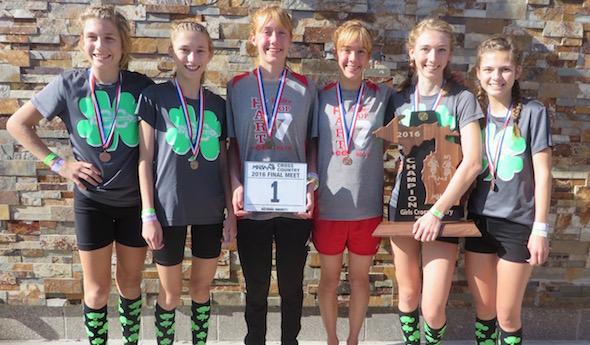
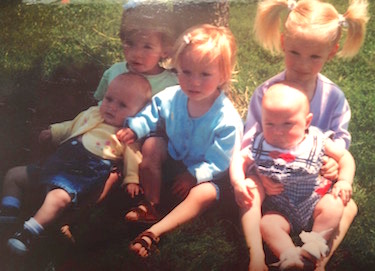
PHOTOS: (Top) Sacred Heart’s McConnell sisters and Hart’s Ackley sisters celebrate their successes during last season’s MHSAA Finals at Michigan International Speedway; from left: Desiree McConnell, Bailley McConnell, Adelyn Ackley, Alayna Ackley, Alexis McConnell and Cammie McConnell. (Middle) There were only five sisters between the two families before Savannah and Desiree were born; from left: Alayna Ackley, holding Cammie McConnell, Bailey McConnell in the middle and Alexis McConnell holding Adelyn Ackley. (Below) From left, Desiree, Cammie, Alexis and Bailey McConnell in front and Alayna and Adelyn Ackley behind them at a middle school MEGASTAR meet in 2015. (Photos courtesy of the Ackley family.)