

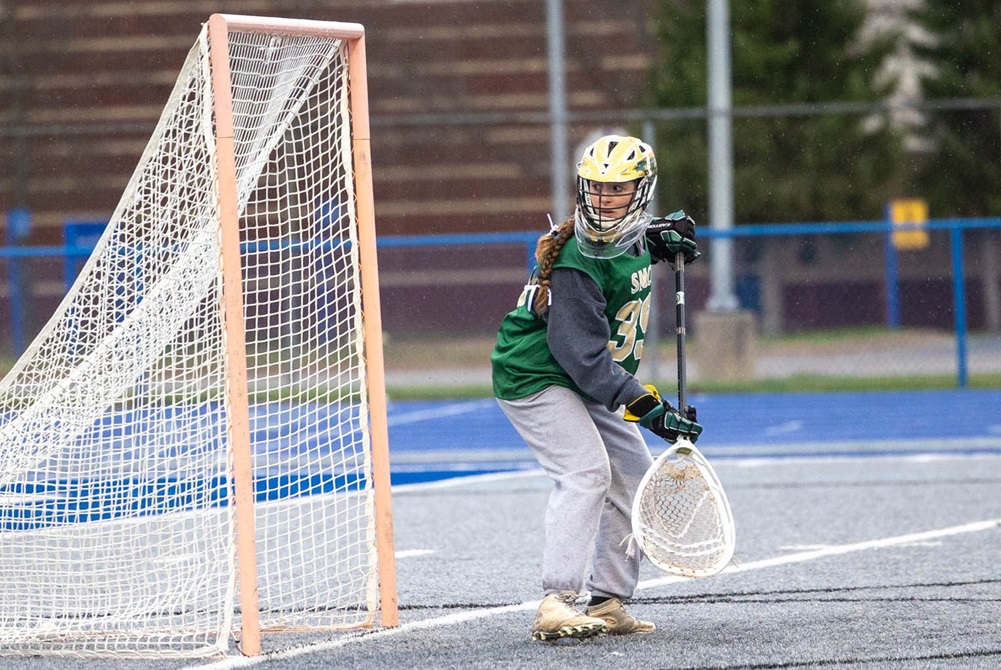
Martin Makes Home in Goal for Monroe St. Mary's Boys Lacrosse, Ice Hockey Teams
By
Doug Donnelly
Special for MHSAA.com
April 29, 2025
Lacrosse isn’t the best sport to choose if you don’t like coming home with bruises every once in a while.
 For Chloe Martin, the bruises are just part of the deal.
“I love it,” Martin said of lacrosse. “It’s a fast game and a challenge. I love that.”
Martin is a senior on the Monroe St. Mary Catholic Central boys lacrosse team. SMCC doesn’t offer girls lacrosse, so she plays on the boys team. That’s nothing new to her, either. She was also a member, representing SMCC, of the Downriver Unified cooperative boys ice hockey team this past winter.
“I didn’t expect to enjoy (lacrosse) as much as I did, but once I started playing and started playing with the boys, I fell in love with the sport,” Martin said.
Martin picked up ice hockey at the age of 8 while a student at Triumph Academy, a K-8 school near Monroe. She was hooked, but under one condition – she wanted to be in the net.
“When I was younger, I played forward and defense, but I didn’t really enjoy it,” she recalled. “When someone on the team said they needed a goalie, I raised my hand right away. It’s a lot of fun. I don’t think I would be playing if I wasn’t playing goalie.
“I like getting shots coming at me. It’s fun.”
Martin, from Monroe, joined the SMCC lacrosse team as a high school freshman. She played ice hockey as a sophomore and again as a senior. “I played travel hockey my junior year and, to be honest, I kind of regret it,” she said.
As a sophomore, she was able to be teammates with her brother, Walker.
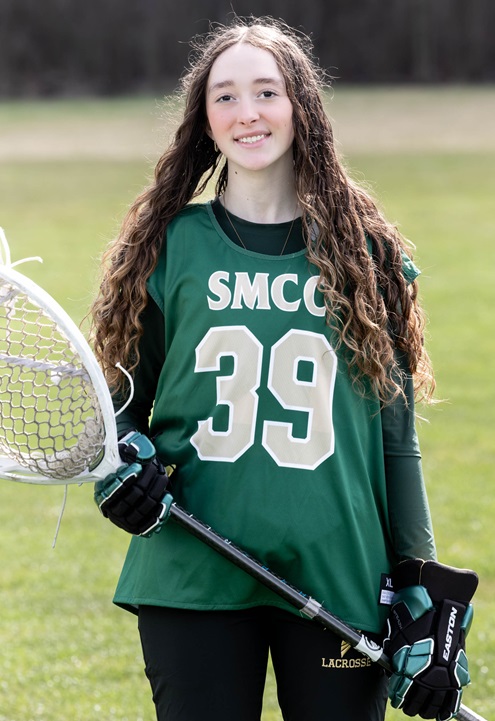 “He was one of my biggest inspirations playing hockey,” she said. “We had a strong connection, and I wanted to play with him and his friends. That was one of my favorite teams to ever play on.”
Her brother also got her started in lacrosse.
“The reason I joined lacrosse was because of my older brother,” Chloe said. “Our coach saw that I was a goalie for hockey and wanted me to be a goalie for lacrosse. I agreed and played lacrosse.”
Lacrosse – for both boys and girls – is played in the spring in Michigan. The sport involves a ton of running and highly-skilled passing and catching. It also takes teamwork.
Martin prefers the boys game over the girls game. She’s tried both.
“I love playing against the boys. I tried playing girls lacrosse, and it wasn’t my thing,” she said. “For girls, there are different rules and I don’t really like it. I’m trying to get into it because I want to play either college hockey or lacrosse.”
She’s not sure which sport she likes better: “It’s not that big of a difference. There is more padding for hockey and less for lacrosse. You have a crease, and you are moving in the same type of direction. Lacrosse is less wear-and-tear on my hips. I have bad hips.”
While lacrosse has a bigger field, Martin said there is more action.
“Lacrosse is quicker than hockey,” she said. “You can have the ball in the other zone but three seconds later they can be down shooting on me.”
This season has been a strong one for Martin in net.
Earlier this month she helped the Falcons to a one-point win over Jackson at Albion College, recorded her first varsity shutout April 16 against Brownstown Woodhaven and made a school-record 19 saves on April 4 against Ypsilanti Lincoln. That save total was high enough to make the MHSAA record book.
“Nineteen is kind of a lot of shots,” Martin said. “I’ve faced more than that in hockey. I’d say facing 19 shots in lacrosse is kind of like facing 50 shots in hockey.”
SMCC athletic director Jared Janssen said Martin has been a key factor in the team’s success and that she’s an inspiration to others.
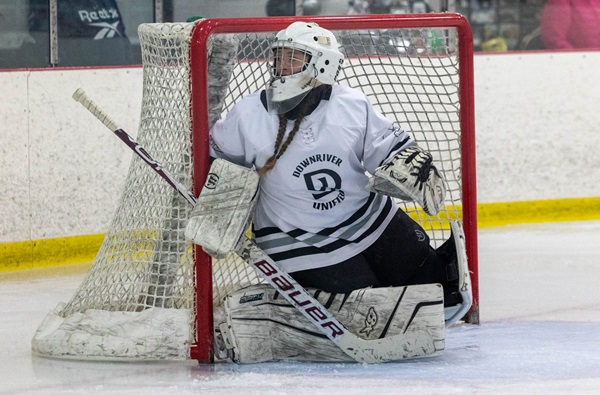 “Chloe stands out as an excellent player with the boys and performs at a high level in both hockey and lacrosse,” he said. “She has been a leader for hockey and lacrosse, and that has led to more girls participation in both programs. Our girls lacrosse program has grown from only one girl to four this year.”
Goalie remains her favorite position.
“It’s a lot harder to be goalie than you think. You don’t expect the ball coming at you as hard and as quick as they are. You kind of get used to it. You don’t get used to getting hit, but you get used to seeing the ball and where the players are shooting from.”
The 17-year-old daughter of Alison and Nathan Martin loves mountain biking, fishing and baking. She has her sights on playing a sport in college and becoming a nurse. That stems from the time her dad got COVID and pneumonia at the same time.
“He was in the ICU for three months,” Martin said. “When that happened, I just decided I wanted to be a nurse and help people. That’s what I love doing.”
As for the bruises, Martin is getting used to them. She wears a chest plate, elbow pads, glove and mask. There are no shoulder pads in lacrosse and little other protection, especially for the legs.
After a recent game, she had a bruise the size of softball on her leg.
“It’s rough. I get a lot of bruises, but I love it,” she said. “It’s mostly on my legs. It hurts a lot, but after a few seconds it goes away. There are so many bruises I get in lacrosse. I’ve never gotten this bruised from hockey.”
 Doug Donnelly has served as a news and sports reporter at the Adrian Daily Telegram and the Monroe News for 30 years, including 10 years as city editor in Monroe. He's written a book on high school basketball in Monroe County and compiles record books for various schools in southeast Michigan. He is now publisher and editor of The Blissfield Advance, a weekly newspaper. E-mail him at [email protected] with story ideas for Jackson, Washtenaw, Hillsdale, Lenawee and Monroe counties.
PHOTOS (Top) Monroe St. Mary Catholic Central’s Chloe Martin defends her team’s goal during a lacrosse game. (Middle) Martin, without a protective mask, which she wears for two sports. (Below) Martin monitors the puck while in net for Downriver Unified. (Action photos by Stephanie Hawkins; posed photo provided by Monroe St. Mary Catholic Central.)
Hockey Players Transferring Winter Puck Skills to Spring Golf Swings
By
Tom Lang
Special for MHSAA.com
May 26, 2023
When the Michigan seasons shift from winter to spring, some high school golf teams are a little more eager than others for the hockey season to officially end.
This is especially true for the school golf programs in Brighton, Hartland and Muskegon Mona Shores – examples of boys teams that love having hockey players transition from the indoor frozen ice to play golf outdoors on the lush green grass.
“I would take a golf team full of hockey players any day,” said Hartland golf coach Nathan Oake. “I love them.”
We can tell, because his program is full of them.
Hartland and Brighton each have eight hockey players on their 16-golfer varsity and JV rosters.
Mona Shores has three hockey players this year, but usually has more. In 2023 it’s Oliver MacDonald (all-state honorable mention in hockey), Nathan McNarland and Nicholas Taylor, who was voted Division 1 all-state golf last spring, then leading his team to fifth place at the MHSAA Lower Peninsula Division 1 Final.
 Brighton golfer Winston Lerch was also Division 1 all-state last year in golf and an assistant captain on the hockey team this winter that finished Division 1 runner-up to Detroit Catholic Central. Here in 2023, he shot a 65 to open the season at Oakland University for medalist and has committed to Grand Valley State for golf with his 72-stroke average.
Joining Lerch in the Bulldogs boys golf program are hockey players like Levi Pennala, winner of hockey’s Wall Award sponsored by State Champs as the top high school goalie. Pennala – who recently shot 72 at the Kensington Lakes Activities Association championship tournament, his career low for high school golf – finished in the top 30 last year at the LPD1 Final. Then early this spring when he was away at a high-level junior hockey tournament, freshman hockey player Adam Forcier stepped in and shot a school record 18-hole round for a freshman at 73. Jacob Daavetilla also works into the starting lineup at times.
Forcier tied the record of Davis Codd – who, as a pro hockey player on leave from the Saginaw Spirit OHL hockey team when COVID-19 shut down the league, won the LPD1 Final in 2021 for Brighton.
Brighton golf coach Jimmy Dewling said Codd was one of the earliest to prove to others you can play both hockey and golf and excel. In fact, that June in 2021, Codd went to an NHL scouting camp in Pennsylvania before the Golf Finals, drove overnight back to Forest Akers to play the two championship rounds, won the title, then immediately returned to Pennsylvania to resume the hockey camp.
“On our team, we believe, and TBone (Codd) was a perfect example of it, if there’s any time you have the opportunity to be competitive, it is going to make you a more well-rounded competitor and therefore better at your particular sport,” Dewling said.
“We like hockey players. In the winter, they have to think to where the puck is going, be smart enough to react, and understand how that emotion is going to carry over from one play to the next. When it’s your shift you have to forget about the last shift, or take something from the last shift and put it into the next shift, to have consistent play.
“It’s the same on the golf course,” Dewling continued. “It’s one hole to the next, one shot at a time, being tough, and that’s only going to come from competition reps. We love the athletic ability more so than anything; the toughness and competitiveness all year.”
In addition to Lerch and Pennala starting on varsity golf, they are joined by traditional golfers Matt Doyle, Riley Morton and Andrew Daily, who is committed to Wayne State and finished LPD1 runner-up last spring.
 Going into the 2023 golf postseason, Brighton is ranked No. 2 in Division 1. The Bulldogs have won the Next Tee Invite at Oakland Hills, the North Star Invite at Plum Hollow and the KLAA Conference Championship – earning Brighton’s first conference title since 2007. The Bulldogs also were runners-up at The Meadows Invite at Grand Valley State University. The team is averaging 297 for 18 holes.
Oake admitted this is a rebuilding year for Hartland’s golf program. The varsity lineup has only two returning players with varsity golf experience – Keller King and Brady Betteley.
“So, we opted to keep a group of tough competitors with a solid combination of speed and strength – and who are not concerned about the cold conditions that we play in,” Oake quipped.
Five others rotate into the Eagles’ golf starting lineup with King and Betteley: Isaac Frantti is an all-state hockey defensemen playing his first season of golf but shot a career-low 79 at American Dunes recently. He just signed a United State Premier Hockey League tender to play in Connecticut next year. Ian Kastamo scored the winning goal in Hartland’s Division 2 hockey championship victory in 2022, and LJ Sabala is a varsity hockey player as well.
Then there are two non-hockey freshmen getting shots to start occasionally – Dallas Korponic, who finished third at his weight at the Individual Wrestling Finals, and Michael Maurin. Five more sophomores and juniors are hockey players on the JV golf team.
“We hope to be competitive with (Brighton) again soon, but they have the talent to make a big splash this year,” Oake said. “I also play golf at the same club as many Brighton players, so I see them quite a bit and we are friendly. When the Brighton team walked by our team on a recent Monday and all said hello to me and our guys, one of my players looked at me and said that this was the biggest difference between hockey and golf. In hockey, the small talk would be (traded) for the ice, and it would not be very nice out there.
“Either way, I believe both sports are filled with fierce competitors and respect, but when the game is over a handshake and a golf hat tip are offered to the victor.”
This story was updated and reposted with permission of MIGolfJournal.com.
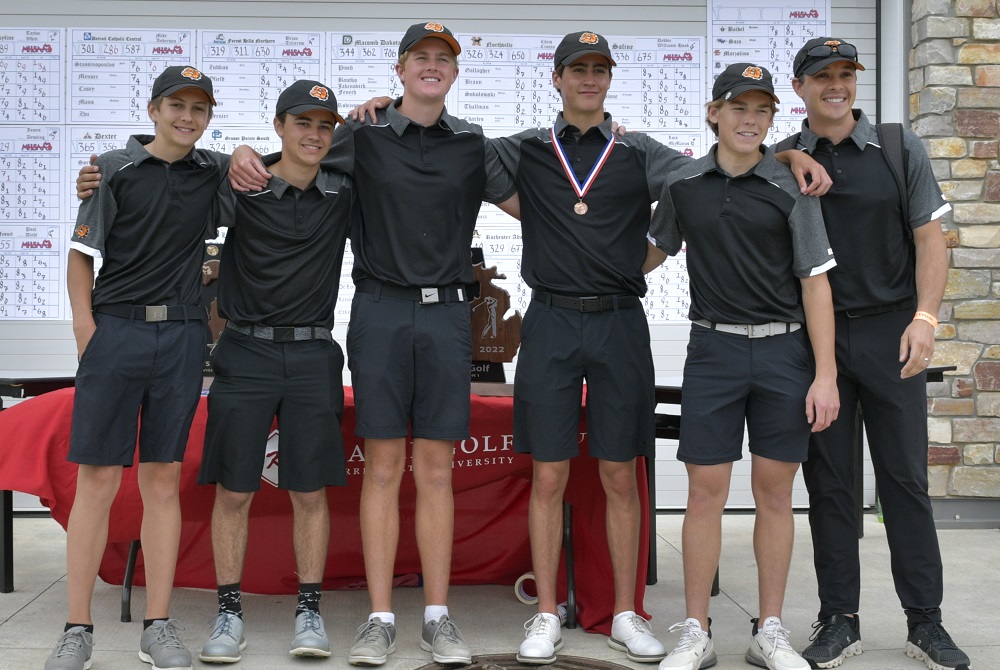
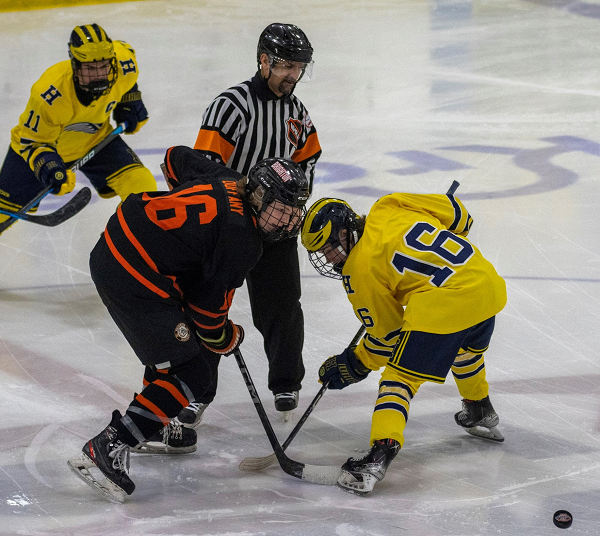
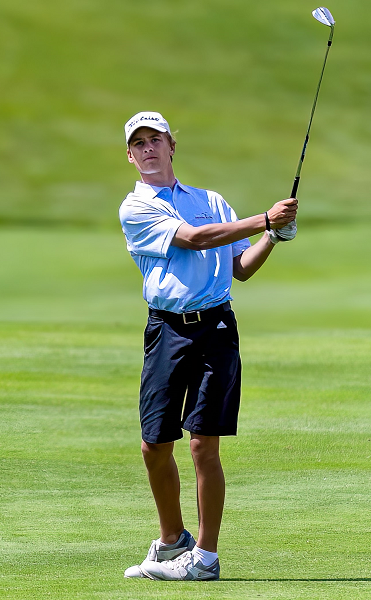
PHOTOS (Top) Brighton takes a team photo after finishing third at last season’s LPD1 Final, and all five golfers are back this season including hockey players Levi Pennala (second from left) and Winston Lerch (second from right.) (Middle) Hartland’s Ian Kastamo (16) takes a faceoff against Brighton this winter. (Below) Mona Shores’ Nicholas Taylor fires an iron shot. (Photos courtesy of High School Sports Scene, Sapshots Photography and Mona Shores’ athletic department, respectively.)