

Petoskey Boys Follow Seniors' Lead in Returning to Top of D2 Mountain
By
Nick Cooper
Special for MHSAA.com
February 24, 2026
BELLAIRE – After a brief reprieve, a familiar group finished on top of Division 2 boys skiing Monday as Petoskey took home the team championship at Schuss Mountain.
A year after the East Grand Rapids ended the Northmen’s five-year title streak, Petoskey regained the throne in large part due to complete team contributions as the Northmen earned nearly a half of the top 12 places in both slalom and giant slalom.
Petoskey co-head coach Jac Talcott credited the team’s success to a special mindset that he and his upperclassmen have instilled.
“We stuck to our core values. These kids ski every race like it’s the states,” Talcott said.
 Petoskey’s return as champion came by way of both upperclassmen and up-and-comers succeeding, which had Talcott reflecting on the contributions of his team leaders.
“It’s exceptionally special to have two seniors like Taylor Keiswetter and Liam Cleary. They lead in their roles very exceptionally. It takes sacrifice, but it also takes key performances. They both knew that was their job, and they both served their roles as captains really well,” said Talcott.
Finishing just two points behind was Great North Alpine with a score of 51 points. Harbor Springs finished third with a total of 121 points, followed by Orchard Lake St. Mary’s (131), Bloomfield Hills (214), Pontiac Notre Dame Prep (225), Caledonia (241), Grand Rapids West Catholic (241.5) and East Grand Rapids (277).
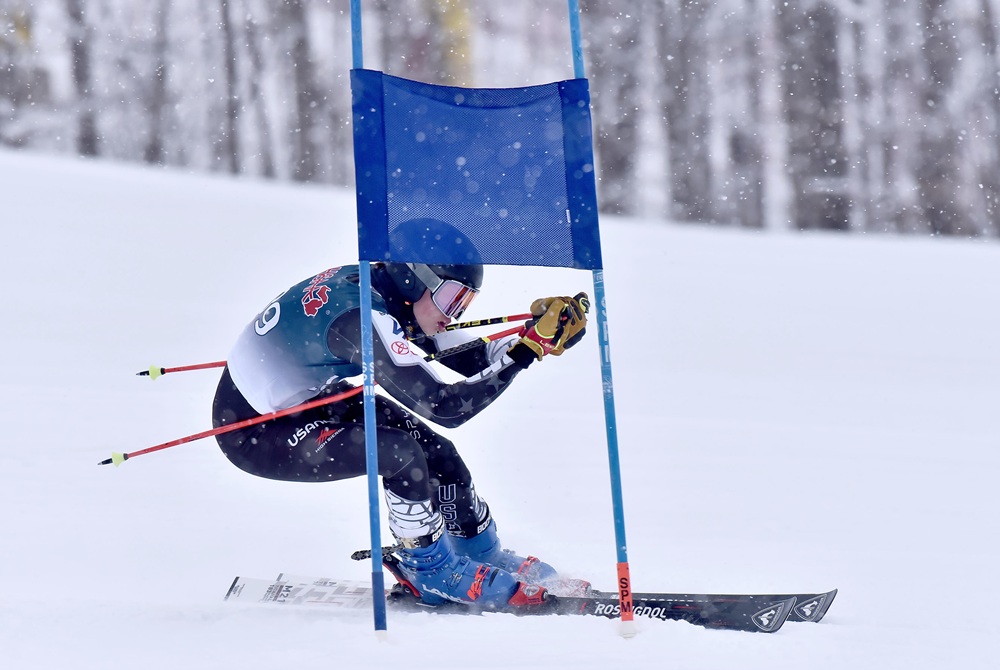
Taylor Keiswetter’s first-place finish in the giant slalom with a time of 49.38 helped the Northmen regain prominence. Keiswetter finished nearly a full second ahead of Benjamin Dyste of Great North Alpine (50.33). Third place was claimed by Cadillac’s Zane Wallis with a time of 50.74 followed by Great North Alpine’s Corbin Bogard (50.79) and Hackett/Vicksburg’s Bryce Johnson (50.97).
Petoskey veteran Dettmer credits a regrowth in continuity amongst the team as a reason for their return to prominence.
“As a team, we have gotten a lot closer. We’ve always had great team energy. We’ve always been together; it’s just that finally we have all the kids that have grown together,” said Dettmer, who finished with a team-best score in the slalom.
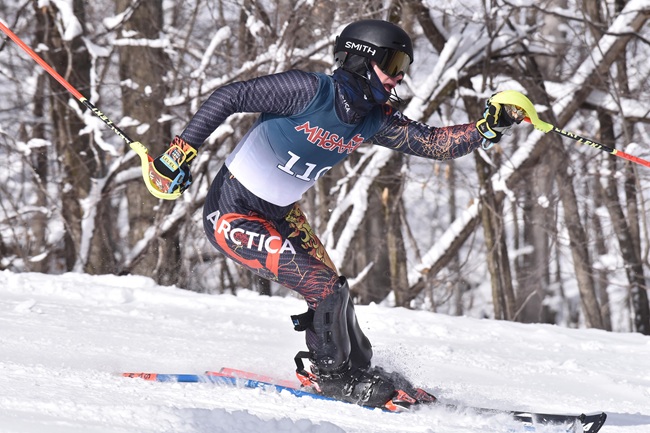
Orchard Lake St. Mary’s Pierson Kuhn finished first in the slalom with a time of 65.02. Finishing second was Great North Alpine’s Bogard clocking in at 66.35. Dyste of Great North Alpine finished third with a time of 66.95, followed by Orchard Lake St. Mary’s Noah Morley (67.10) and Dettmer (67.46).
PHOTOS (Top) Petoskey’s Taylor Keiswetter races to the championship in giant slalom at Schuss Mountain. (Middle) Great North Alpine’s Corbin Bogard races to one of his top-five finishes Monday. (Click for more from Todd VanSickle.)

- Boys Swim & Dive
- Wrestling
- Girls Swim & Dive
- Competitive Cheer
- Girls Bowling
- Girls Skiing
- Boys Skiing
- Girls Basketball
- Boys Basketball
- Boys Bowling
- Gymnastics
- Ice Hockey
- MHSAA News
MHSAA Winter Sports Start with Extended Basketball Schedules, New Wrestling Weights
By
Geoff Kimmerly
MHSAA.com senior editor
December 13, 2022
The addition of two games to basketball regular-season schedules and a new series of wrestling weight classes are likely the most noticeable Winter 2022-23 changes as an estimated 65,000 athletes statewide take part in 13 sports for which the Michigan High School Athletic Association sponsors postseason tournaments.
Girls gymnastics and boys ice hockey teams were able to begin practice Oct. 31, with the rest of those sports beginning in November – including also girls and boys basketball, girls and boys bowling, girls competitive cheer, girls and boys skiing, Upper Peninsula girls and boys and Lower Peninsula boys swimming & diving, and girls and boys wrestling.
A variety of changes are in effect for winter sports this season, including a several that will be noteworthy and noticeable to teams and spectators alike.
Basketball remains the most-participated winter sport for MHSAA member schools with 33,000 athletes taking part last season, and for the first time, basketball teams may play up to 22 regular-season games. This increase from the previous 20-game schedule allows more games for teams at every high school level – varsity, junior varsity and freshman.
Another significant change has been made in wrestling, as the majority of boys wrestling weight classes have been adjusted for this season in anticipation of a national change coming in 2023-24. The updated boys weight classes are 106, 113, 120, 126, 132, 138, 144, 150, 157, 165, 175, 190, 215 and 285 pounds. Only 215 and 285 remain from the previous lineup. There is also one change to girls weight classes, with the 255 class replaced by 235 to also align with national high school standards.
A series of notable changes will affect how competition takes place at the MHSAA Tournament levels. In hockey, in addition to a new classification process that spread cooperative and single-school programs evenly throughout the three playoff divisions, the MHSAA Tournament will employ two changes. The Michigan Power Ratings (MPR) will be used to seed the entire Regional round, not just the top two teams, and prior to the start of Semifinals, a seeding committee will reseed the remaining four teams in each division with the top seed in each then facing the No. 4 seed, and the No. 2 seed facing No. 3.
Bowling also will see an MHSAA Tournament change, as the Team Regional format will mirror the long-standing Team Final with teams playing eight Baker games and two regular games at both levels. And as also applied during the fall girls season, there is a new qualification process for divers seeking to advance to Lower Peninsula Boys Swimming & Diving Finals. In each of the three divisions, each Regional will be guaranteed 10 qualifiers for the Finals, with six more “floating” qualifier entries to be distributed to the Regionals that have one of the previous year’s top six returning Finals divers in their fields. If a team changes division from the previous season, any floating top-six spots are added to the six already allowed in the school’s new division.
A gymnastics rules change provides an opportunity for additional scoring during the floor exercise. A dance passage requirement was added in place of the former dance series requirement to encourage creativity and a more artistic use of dance. The dance passage requires gymnasts to include two Group 1 elements – one a leap with legs in cross or side split position, the other a superior element.
In competitive cheer, the penalty for going over the time limit in each round was adjusted to one penalty point for every second over the time limit, not to exceed 15 points. The new time limit rule is more lenient than the past penalty, which subtracted points based on ranges of time over the limit.
The 2022-23 Winter campaign culminates with postseason tournaments, as the championship schedule begins with the Upper Peninsula Girls & Boys Swimming & Diving Finals on Feb. 18 and wraps up with the Boys Basketball Finals on March 25. Here is a complete list of winter tournament dates:
Boys Basketball
Districts – March 6, 8, 10
Regionals – March 13, 15
Quarterfinals – March 21
Semifinals – March 23-24
Finals – March 25
Girls Basketball
Districts – Feb. 27, March 1, 3
Regionals – March 7, 9
Quarterfinals – March 14
Semifinals – March 16-17
Finals – March 18
Bowling
Regionals – Feb. 24-25
Finals – March 3-4
Competitive Cheer
District – Feb. 17-18
Regionals – Feb. 25
Finals – March 2-3
Gymnastics
Regionals – March 4
Finals – March 10-11
Ice Hockey
Regionals – Feb. 20-March 1
Quarterfinals – March 4
Semifinals – March 9-10
Finals – March 11
Skiing
Regionals – Feb. 13-17
Finals – Feb. 27
Swimming & Diving
Upper Peninsula Girls/Boys Finals – Feb. 18
Lower Peninsula Boys Diving Regionals – March 2
Lower Peninsula Boys Finals – March 10-11
Wrestling – Team
Districts – Feb. 8-9
Regionals – Feb. 15
Finals – Feb. 24-25
Wrestling – Individual
Districts – Feb. 11
Regionals – Feb. 18
Finals – March 3-4
The MHSAA is a private, not-for-profit corporation of voluntary membership by more than 1,500 public and private senior high schools and junior high/middle schools which exists to develop common rules for athletic eligibility and competition. No government funds or tax dollars support the MHSAA, which was the first such association nationally to not accept membership dues or tournament entry fees from schools. Member schools which enforce these rules are permitted to participate in MHSAA tournaments, which attract more than 1.3 million spectators each year.