


Be the Referee: Curbing Gamesmanship
September 12, 2019
This week, MHSAA officials coordinator Sam Davis explains a new rule in soccer meant to keep teams in the lead from running time off the clock by making lineup changes.
Be The Referee is a series of short messages designed to help educate people on the rules of different sports, to help them better understand the art of officiating, and to recruit officials.
Below is this week's segment - Curbing Gamesmanship By Substitution - Listen
There’s a change to high school soccer rules nationally this year designed to curb gamesmanship by a team leading a contest toward the end of a game.
In the last five minutes of regulation, or the last five minutes in the second part of overtime, a rules change this year will stop the clock when that team makes a substitution. The clock will stop even if the team that is trailing makes a substitution at the same time.
This is the same as the NCAA rules, and aims to prevent teams from making multiple substitutions in the closing moments of a game as a way to help protect their lead by running time off the clock.
Past editions
Sept. 5: Football Safety Rules Changes - Listen
Aug. 29: 40-Second Play Clock - Listen
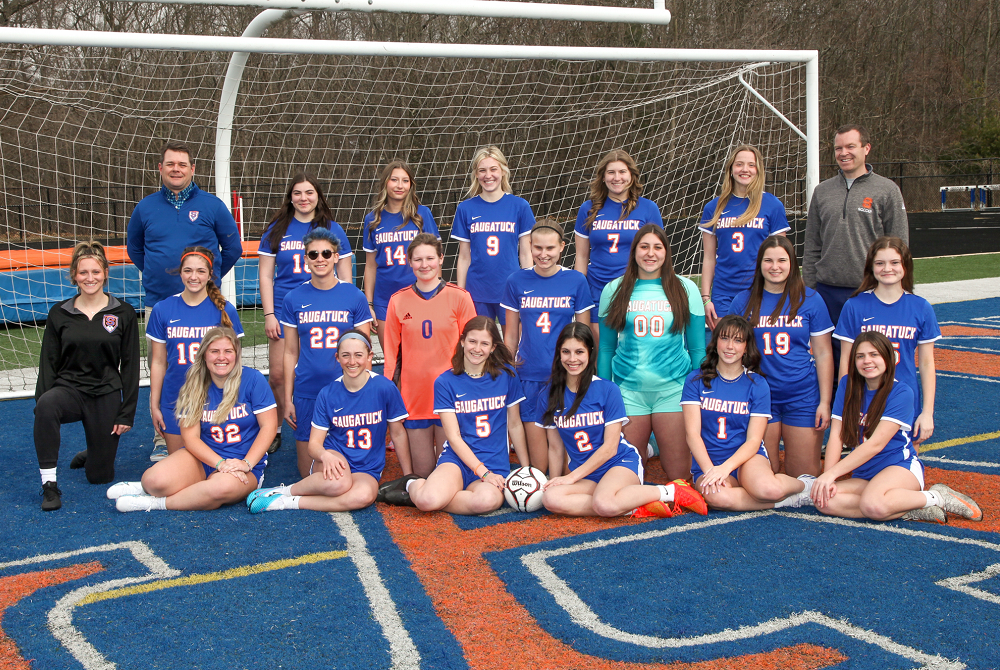
Team of the Month: Saugatuck Girls Soccer
By
Geoff Kimmerly
MHSAA.com senior editor
May 12, 2023
As mid-May approached two years ago, girls soccer was nowhere to be found in the Saugatuck trophy case, and the team’s championship banner hung blank in the school’s gym next to well-populated celebrations for cross country, track & field and other programs with histories of success.
 Just less than 24 months later, things have changed – and are still accelerating as the Trailblazers are putting up numbers from the pitch now as well.
The Saugatuck girls soccer program capped its 2021 season by winning its first District title, then repeated last season. And just over a week ago, the Trailblazers clinched their first league championship in the sport, claiming the Southwestern Athletic Conference Lakeshore title with a 3-0 win over Holland Black River.
Saugatuck’s girls soccer team – the MHSAA/Applebee’s “Team of the Month” for April – is undefeated since suffering its lone loss of the season March 27. The Trailblazers are 14-1, up to No. 9 in the Division 4 coaches poll, and show no signs of slowing down with 10 shutouts including five over their last six games.
“There’s a lot of enthusiasm, especially because soccer hasn’t been big in our school … so to actually get some notice for what we’re doing in soccer, I think our girls are just really super excited about all the attention they’ve received,” said Trailblazers coach Jordan Campbell, who took over the girls soccer program in 2014. “But I think they are also a pretty confident group. I think they expected to be able to compete really well, and last year we lost six games and I think our seniors this year took that all a little personally because they felt that we were better than some of those teams.
“It’s kind of like we want to make sure that (Saugatuck girls) soccer is not just a team that’s just around and can be competitive, but it’s a team that you’ve got to be prepared for.”
After the 2020 season was canceled due to COVID-19, Saugatuck won 12 games both of the last two. The Trailblazers finished 12-6-3 last year, and already this spring has avenged three of those losses and turned the three draws into three victories.
A group of seven seniors has set things in motion again after helping make the charge over the last two seasons. Senior Adele Nieuwsma moved to Saugatuck from out of state before the 2021 season and made the Division 4 all-state third team a year ago. Haley Rivera, Erin Moerler and Eva Kierzek join her as captains and came up through the Saugatuck recreation and community programs. Iris Kuipers, Ellen Martinsson and Mia Zerfas further bolster the senior class – Kuipers, along with sophomore keeper Kennedy Gustafson, earned all-state honorable mention in 2022.
The team is surging, and the program is growing. The Trailblazers are up about 10 players over totals from the last two seasons, to 35 this spring, which has allowed for varsity and junior varsity teams.
It was a memorable moment for sure when the “2021” was added to the girls soccer banner in the gym, signifying that first District title. These seniors may need to return to celebrate the “2023” for the league title – and perhaps more – that could be part of this memorable run before it finishes next month.
“We’ve had really solid core seniors, and they’ve really stepped up and I almost feel like we’re on autopilot with this group because they do everything on their own and they push each other, and they work to get each other involved and they care about the younger kids and try to get them involved,” Campbell said. “I think it’s a huge thing we’ve seen with this group coming up and getting some experience and building, and seeing where we were when they started as freshman to the last couple of years.”
Past Teams of the Month, 2022-23
March: Croswell-Lexington competitive cheer - Report
February: Hart girls & boys basketball - Report
January: Taylor Trillium Academy girls bowling - Report
December: Byron Center hockey - Report
November: Martin football - Report
October: Gladwin volleyball - Report
September: Negaunee girls tennis - Report
PHOTO courtesy of the Saugatuck athletic department.