


Be the Referee: Curbing Gamesmanship
September 12, 2019
This week, MHSAA officials coordinator Sam Davis explains a new rule in soccer meant to keep teams in the lead from running time off the clock by making lineup changes.
Be The Referee is a series of short messages designed to help educate people on the rules of different sports, to help them better understand the art of officiating, and to recruit officials.
Below is this week's segment - Curbing Gamesmanship By Substitution - Listen
There’s a change to high school soccer rules nationally this year designed to curb gamesmanship by a team leading a contest toward the end of a game.
In the last five minutes of regulation, or the last five minutes in the second part of overtime, a rules change this year will stop the clock when that team makes a substitution. The clock will stop even if the team that is trailing makes a substitution at the same time.
This is the same as the NCAA rules, and aims to prevent teams from making multiple substitutions in the closing moments of a game as a way to help protect their lead by running time off the clock.
Past editions
Sept. 5: Football Safety Rules Changes - Listen
Aug. 29: 40-Second Play Clock - Listen
Preview: Final 8 Filled with Ranked Contenders, Familiar Champs
By
Geoff Kimmerly
MHSAA.com senior editor
June 16, 2022
This weekend’s Girls Soccer Finals field includes two of the winningest champions in MHSAA history, and two teams hoping to celebrate the ultimate prize for the first time.
Hudsonville Unity Christian with 10 Finals titles and Marian with nine trail only Madison Heights Bishop Foley’s 12 on the list of most MHSAA girls soccer championships.
Unity’s opponent in the Division 3 Final – two-time runner-up Williamston – is joined by Division 1 Bloomfield Hills as contenders seeking that first title. The other four finalists have a combined 12 championships between them.
Following is this weekend’s schedule:
Division 1 - Friday - 4 p.m.
Bloomfield Hills vs Northville
Division 2 - Saturday - 4 p.m.
Bloomfield Hills Marian vs Grand Rapids Forest Hills Central
Division 3 - Saturday - 1 p.m.
Williamston vs Hudsonville Unity Christian
Division 4 - Friday - 1 p.m.
Royal Oak Shrine vs Kalamazoo Christian
Tickets cost $11 and may be purchased online only at GoFan. One ticket is good for all soccer, softball and baseball games at MSU’s Old College Field that day. All four Finals will be broadcast and available with subscription from MHSAA.tv, with free audio broadcasts on the MHSAA Network.
Below is a glance at all eight teams taking the field, with statistics through Regionals:
Division 1
BLOOMFIELD HILLS
Record/rank: 14-2-3, No. 12
League finish: Third in Oakland Activities Association Red
Coach: Alan Zakaria, ninth season (77-30-19)
Championship history: Will be playing in first MHSAA Final.
Players to watch: Drew Martin, sr. M (16 goals, 8 assists); Esther Rosett, sr. F (15 goals, three assists); Ava Badallo, sr. F (15 goals, eight assists); Jenica Opdahl, soph. GK (1.10 goals-against average, 10 shutouts).
Outlook: Bloomfield Hills clinched its first Regional title with a 2-1 win over 2021 champion and No. 3-ranked Hartland, and then reached the championship game with a 1-0 Quarterfinal win over No. 9 Portage Central. The Black Hawks are on an 11-0-3 streak over the last two months. Martin made the all-state third team and Rosett earned an honorable mention last season. Senior Alice Spiegel also is among team leaders with seven assists from the midfield.
NORTHVILLE
Record/rank: 18-0-5, No. 1
League finish: First in Kensington Lakes Activities Association West
Coach: Jeannine Reddy, first season (18-0-5)
Championship history: Third MHSAA title (most recent 2014), two runner-up finishes.
Players to watch: Lauren Moraitis, sr. D (9 goals, 23 assists), Sylvia Bohlen, sr. F (9 goals, 4 assists), Caroline Meloche, soph. D (13 goals, 2 assists); Simran Magnan, fr. GK (0.13 goals-against average).
Outlook: The top-ranked Mustangs have given up seven goals total this season and only one over five playoff games – the 2-1 Semifinal win over No. 5 Rochester. Northville also defeated No. 14 Salem in the District Final after tying Salem in both regular-season meetings. Nine senior starters have helped Northville improve from 12-9 a year ago and win its first Regional title since that most recent championship season. Reddy previously led Canton to a Division 1 runner-up finish in 2016.
Division 2
BLOOMFIELD HILLS MARIAN
Record/rank: 17-1, No. 2
League finish: First in Detroit Catholic League Central
Coach: Reid Friedrichs, first season (17-1)
Championship history: Nine MHSAA titles (most recent 2021), three runner-up finishes.
Players to watch: Elle Ervin, soph. F (18 goals, 17 assists); Isa Agrusso, sr. M (19 goals, 9 assists); Abby Lucchesi, sr. M (5 goals, 16 assists); Angelina Briggs, sr. M (18 goals, 9 assists).
Outlook: Marian is seeking a fifth-straight Division 2 title and sits third in MHSAA history with nine total. All nine were won with retired coach Barry Brodsky, but Friedrichs brings a significant resume as a former all-stater at Ann Arbor Pioneer, Big Ten Player of the Year at Michigan State and coach at a variety of stops including Alma College and highly-regarded school and club programs. He inherited a roster and returned an all-state first teamer in Ervin, second teamer in Briggs and third teamer in Lucchesi. This tournament run has included a District Final win over No. 8 Bloomfield Hills Cranbrook Kingswood and Semifinal win over No. 7 Haslett.
GRAND RAPIDS FOREST HILLS CENTRAL
Record/rank: 19-2-1, No. 4
League finish: First in Ottawa-Kent Conference White
Coach: Ashley Ludtke, fifth season (75-11-2)
Championship history: Four MHSAA titles (most recent 2017), one runner-up finish.
Players to watch: Theryn Hallock, sr. F (32 goals, 14 assists); Lauren Koczenasz, sr. D (14 goals, 4 assists), Ruthie VanSkiver, sr. M (13 goals, 5 assists), Dailey Tucker, jr. F (9 goals, 16 assists).
Outlook: Forest Hills Central reached the Semifinals for the third-straight season and pushed through to the weekend with a 3-1 Semifinal win over No. 6 Richland Gull Lake. FHC also defeated No. 3 Spring Lake in the Regional Final. Hallock, who will play basketball at Michigan State, returned to the soccer field this spring for the first time since middle school and paces the offense for a team that lost only to Gull Lake in its regular-season opener and Division 3 finalist Hudsonville Unity Christian. Senior Stella Sutton also is among team leaders in assists with 14 (and six goals) from the midfield.
Division 3
HUDSONVILLE UNITY CHRISTIAN
Record/rank: 21-1-1, No. 2
League finish: First in O-K Blue
Coach: Randy Heethuis, 33rd season (599-102-40)
Championship history: Ten MHSAA titles (most recent 2016), three runner-up finishes.
Players to watch: Brianna Rose, jr. D (5 goals, 1 assist); Jessie Postma, jr. M (5 goals, 13 assists); Ava Lutke, fr. F (25 goals, 18 assists); Jenna Schreiber, jr. M (12 goals, 8 assists).
Outlook: After also reaching the Semifinals last season, Unity is back in the championship game to finish a run that’s included wins over No. 4 Grand Rapids South Christian, No. 5 Elk Rapids and No. 14 Holland Christian. Unity has given up only five goals over its last 16 games, a stretch that began with a shutout April 29 of Division 2 finalist Forest Hills Central. The only loss came in the season opener to Division 1 No. 2 Hudsonville. Rose made the all-state first team last season, and Postma earned an honorable mention. Juniors Jordan Steen (11 goals/4 assists) off the bench and Olivia Bosworth (8/12) also are among top contributors offensively.
WILLIAMSTON
Record/rank: 16-2-1, No. 1
League finish: First in Capital Area Activities Conference Red
Coach: Steve Horn, seventh season (80-24-5)
Championship history: Division 3 runner-up 2010 and 2008.
Players to watch: Ella Kleiver, jr. F (35 goals, 8 assists); Kaley Douglass, sr. F (11 goals, 9 assists); Liz Bellinger, sr. M (6 goals, 22 assists), Ellie Maxson, sr. D (3 goals, 2 assists).
Outlook: The Hornets won their second-straight Regional title and took the next step in the Semifinal, defeating No. 3 Pontiac Notre Dame Prep in a shootout to advance. Williamston also defeated No. 7 Essexville Garber and No. 13 Flint Powers Catholic during this tournament run, with its only losses this season to Division 1 No. 6 Midland Dow and Division 2 No. 7 Haslett. Bellinger, Kleiver and junior keeper Abby Pieper made the all-state first team last season, Douglass made the second team, Maxson made the third and senior Sophie Casey and junior Emma Gorsline earned honorable mentions. Pieper and junior Taylor Stenzel have combined this spring to give up 17 goals – or 0.94 per game. Junior Breyer Fenech had added seven goals and 10 assists entering the week.
Division 4
KALAMAZOO CHRISTIAN
Record/rank: 19-5, No. 7
League finish: First in Southwestern Athletic Conference
Coach: Jay Allen, seventh season (148-30-13)
Championship history: Four MHSAA titles (most recent 2008), three runner-up finishes.
Players to watch: Ellie Batts, sr. M; Elizabeth Netz, soph. GK; Taylor Leonard, jr. M/F. (Statistics not submitted.)
Outlook: Kalamazoo Christian finished Division 4 runner-up three straight seasons from 2017-19, and is back this weekend after giving up only one goal over six playoff games. This tournament run has included wins over No. 3 Lansing Christian and No. 4 North Muskegon. The Comets have 15 shutouts total, with sophomores Sophia Nash and Phoebe Zeyl and senior Madison Triemstra lined up to provide defense in front of Netz. Leonard made the all-state second team last season, and Batts made the third.
ROYAL OAK SHRINE
Record/rank: 16-4-2, No. 10
League finish: Third in Detroit Catholic League AA
Coach: Mark Soma, 22nd season (record N/A)
Championship history: Division 4 champion 2019, runner-up 2021.
Players to watch: Elena Gallagher, soph. GK (0.95 goals-against average, 9 shutouts); Norah Tisko, jr. F (6 goals, 5 assists); Bridgette Drouillard, sr. M (14 goals, 16 assists); Julia Bock, soph. F (9 goals, 5 assists).
Outlook: Shrine is making a third-straight trip to the Division 4 Final, this time after an overtime Semifinal win over Bad Axe and with victories over No. 2 Madison Heights Bishop Foley, No. 5 Clarkston Everest Collegiate and No. 14 Plymouth Christian Academy also part of the run. The Everest win avenged a regular-season loss. Gallagher and Drouillard made the all-state first team last season, and Tisko earned an honorable mention. Senior Claire Plaskey (4 goals/8 assists) also is among key contributors in the midfield.
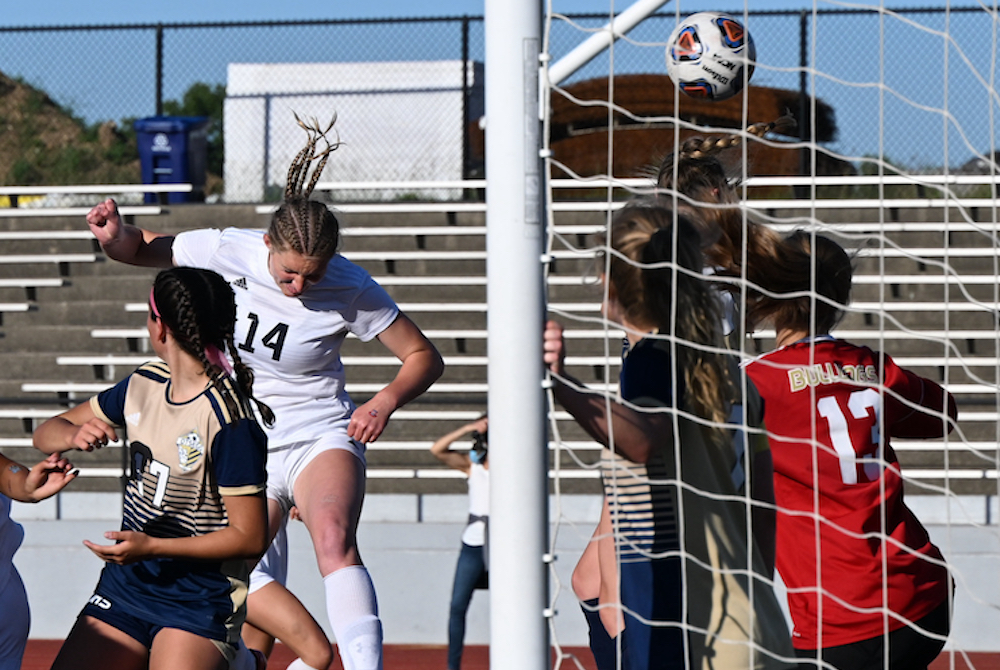
PHOTO Unity Christian’s Rachel Cremer (14) sends a shot toward the Otsego goal during their Division 3 Regional Final. (Photo by Gary Shook.)