

Be the Referee: Soccer Handling
By
Paige Winne
MHSAA Marketing & Social Media Coordinator
September 5, 2024
Be The Referee is a series of short messages designed to help educate people on the rules of different sports, to help them better understand the art of officiating, and to recruit officials.
Below is this week's segment – Soccer Handling - Listen
In soccer, a kicked ball that inadvertently touches a player’s arm is not a handball. If a ball is kicked at someone’s face and they instinctively put their hand in front of their face to block the ball – that is also not a handball. There was no intent.
Handball – or handling – is called when the touch with a hand or arm is deliberate.
However, if a ball glances off an offensive player’s arm and goes into the goal, the goal is not allowed. Even if the touching was accidental or inadvertent, it’s no goal. If the touching leads to an immediate goal-scoring opportunity, then it’s also whistled for handling.
As long as the inadvertent touching doesn’t lead directly to a goal, it’s play on.
Previous 2024-25 Editions
Aug. 24: Football Holding - Listen
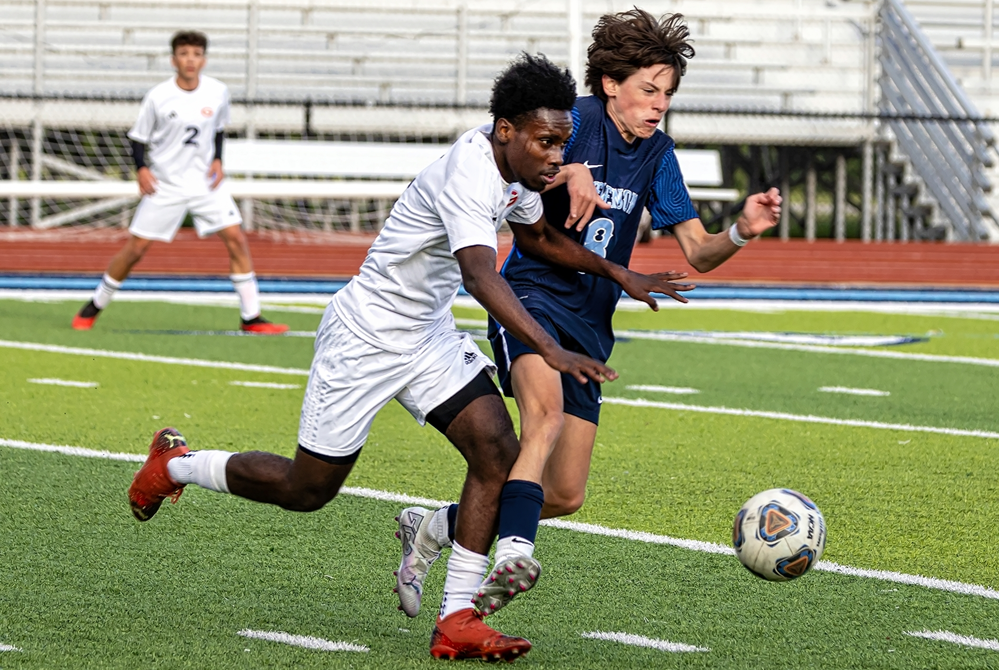
PHOTO Westland John Glenn and Sterling Heights Stevenson players pursue the ball during their matchup this season. (Photo by Douglas Bargerstock.)
Hayes Continues to Cultivate Growth of Lacrosse, Generations of Officials
By
Geoff Kimmerly
MHSAA.com senior editor
May 18, 2022
This spring, more than 60 years after she graduated from high school, Pat Hayes is officiating five and sometimes six girls lacrosse games a week.
The sport has grown significantly especially over the last 20 years, and there are games at all levels to be played. And Hayes, who has helped guide that growth from the sport’s start in Michigan, has helped make sure those games do get played whether as the assigner of officials to work them, trainer of officials build up the ranks or often as the umpire herself.
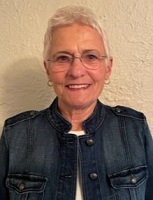 “I played four sports in high school; that’s all we had back then – basketball, swimming, field hockey and tennis,” Hayes said. “And (my coach) said to me, ‘Just remember the last time you didn’t have officials on one of your field hockey games, or basketball games.’ I said, ‘Well, we always had umpires.’ And she said, ‘When you leave here, that’s your time to give back to the next girls. And I’ve been doing that ever since.”
A knowledgeable leader and valued voice for girls lacrosse from its start in Michigan, Hayes’ dedication to the sport began long before its eventual sponsorship by the Michigan High School Athletic Association began with the 2004-05 school year. A longtime coach and official, Hayes has helped guide the growth of the sport most recently as one of the most respected umpires, officials assigners and trainers in the state – and she is being honored for those contributions with this year’s MHSAA Vern L. Norris Award.
The Norris Award is presented annually to a veteran official who has been active in a local officials association, has mentored other officials, and has been involved in officials’ education. It is named for Vern L. Norris, who served as executive director of the MHSAA from 1978-86 and was well-respected by officials on the state and national levels.
Hayes is in her 22nd year as an MHSAA-registered official, a tenure which has included eight years of soccer, five of volleyball and one of basketball – and every season of lacrosse since it became an MHSAA-sponsored sport nearly two decades ago. She also has built a legendary international career as an official for field hockey, which while not an MHSAA-sponsored sport is played by more than 30 of the state’s high schools.
Hayes has officiated both field hockey and lacrosse since graduating from Detroit Western High School in 1958. She also has more than three decades of coaching experience across multiple sports, and is best-known by the most recent generations in her sports as a prized trainer and officials assigner especially in lacrosse and field hockey.
“My reward, when I train somebody, is watching them excel, and my real reward is if they get picked to do a (MHSAA) Final, and there have been several of them that I have trained that have done that,” she said. “And several of them now are doing college lacrosse, which is even more of a reward for me. Watching them go and excel and move on to the next level is my reward.”
While still a student at Wayne State University in 1960-61, Hayes coached field hockey and started the lacrosse program at Grosse Pointe Sacred Heart Academy. After two years there, she moved to Bloomfield Hills Academy of the Sacred Heart, where she remained until 1970 teaching chemistry and biology, coaching field hockey, lacrosse, basketball and volleyball and serving as athletic director as well.
She then left teaching with the birth of her second of three daughters, but continued to officiate. When her daughters reached high school at Birmingham Seaholm, she returned as a coach of the Maples’ freshman boys and then junior varsity girls basketball teams. In 1985 she began a 22-year stint at Detroit Country Day coaching girls lacrosse with five years also coaching freshman boys basketball. She coached the Yellowjackets girls lacrosse team to the first Division 2 championship game and a runner-up finish in 2005.
Hayes currently assigns lacrosse officials for 28 schools as part of the Lacrosse Zebras Organization of Michigan. She has worked seven MHSAA Girls Lacrosse Finals and also officiated college lacrosse at the Division II and III levels. She is retiring this spring after 35 years assigning girls soccer officials as well.
Perhaps her most legendary work has come in field hockey. She played on the U.S. national team and over the last half-century has been considered among the top field hockey officials in the world. She has officiated that sport at the college level for 45 years, with an NCAA Championship assignment in 1986, and she also officiated three World Cup tournaments and the 2004 Olympics as a technical official. She assigns officials for all of Michigan’s high school field hockey games during the sport’s fall season.
Hayes has been recognized numerous times for her extensive service to school sports. She was inducted into the U.S. Lacrosse Michigan Chapter Hall of Fame in 2009 and was named an honorary member of the USA Field Hockey Hall of Fame in 2004. She was named to the Bloomfield Hills Roeper School Hall of Fame in 2016 and Detroit Catholic High School League Hall of Fame in 2018. She received the Oakland County Athletic Director Association’s Lifetime Achievement Award in 2015.
"Pat has been a leader and pioneer in officiating, especially creating opportunities for female officials. She has been a true leader for years in lacrosse, soccer and field hockey," MHSAA Executive Director Mark Uyl said. "She has that perfect combination of compassion, toughness, grace and grit. Michigan's officiating community is fortunate to have Pat Hayes."
Hayes graduated from Detroit Western High School in 1958 and with a bachelor’s degree in education from Wayne State University in 1962.
In addition to her continued service to athletics, Hayes has received the Good Neighbor Award for volunteering with the Quarton Lake Neighborhood Association in Birmingham.
Hayes and husband John Hayes were married 50 years, until his death in 2016. Their three daughters all played college athletics, but not lacrosse or field hockey – instead golf, volleyball and soccer.
Previous recipients of the Norris Award
1992 – Ted Wilson, East Detroit
1993 – Fred Briggs, Burton
1994 – Joe Brodie, Flat Rock
1995 – Jim Massar, Flint
1996 – Jim Lamoreaux, St. Ignace
1997 – Ken Myllyla, Escanaba
1998 – Blake Hagman, Kalamazoo
1999 – Richard Kalahar, Jackson
2000 – Barb Beckett, Traverse City; Karl Newingham, Bay City
2001 – Herb Lipschultz, Kalamazoo
2002 – Robert Scholie, Hancock
2003 – Ron Nagy, Hazel Park
2004 – Carl Van Heck, Grand Rapids
2005 – Bruce Moss, Alma
2006 – Jeanne Skinner, Grand Rapids
2007 – Terry Wakeley, Grayling
2008 – Will Lynch, Honor
2009 – James Danhoff, Richland
2010 – John Juday Sr., Petoskey
2011 – Robert Williams, Redford
2012 – Lyle Berry, Rockford
2013 – Tom Minter, Okemos
2014 – Hugh R. Jewell, West Bloomfield
2015 – Sam Davis, Lansing
2016 – Linda Hoover, Marshall
2017 – Michael Gentry, Shelby Township
2018 – Jill Baker-Cooley, Big Rapids
2019 – David Buck, St. Joseph
2020 – Hugh Matson, Saginaw
2021 - Lewis Clingman, Grand Rapids
MICHIGAN HIGH SCHOOL ATHLETIC ASSOCIATION
20, 30, 40, 45, 50, 55 & 60-YEAR OFFICIALS
The officials on this list are receiving their 20, 30, 40, 45, 50, 55 or 60-year service awards.
20-YEAR OFFICIALS
Adrian – Christopher M. Jones
Albion – Matt M. Overweg
Ann Arbor – Brad R. Nevin
Ann Arbor – Luis E. Acosta
Auburn – David J. Radke
Battle Creek – Melvin C. McKnight
Bay City – Thomas E. Barnikow
Bay City – Martin Brown
Bellaire – William J. Johnston
Bellaire – Michael A. Sizen
Belmont – Terrence P. Kerwin
Berrien Springs – Daryl L. Boughton
Beulah – Joe M. Johnson
Birch Run – Joel D. Barnes
Boyne City – Hal G. Price
Brimley – Vincent A. Gross
Bristol – Milan Vuchenich
Burton – Michael J. Vogt
Byron Center – Patrick J. Lane
Canton – Christopher J. Floyd
Canton – Robert R. Maybouer
Canton – Donald W. Mullett
Cassopolis – Charles A. Conner
Cassopolis – Douglas S. Conner
Chesterfield – Erik C. Law
Chesterfield – Ronald G. Masters
Clinton Township – Richard G. Croci
Coldwater – Courtney J. Dean
Coloma – James G. Kalinowski
Commerce Township – James J. McGuigan
Davison – Scott McConnelee
Davison – Edward D. Rodden
Dearborn – Ralph D. Capler
Dearborn – Oliver H. Fragoso
Dearborn – Joseph M. Salmassi
Detroit – Hershell Bell Jr.
Detroit – Rayford Evans
Detroit – Donald F. Gay Jr.
Detroit – Andrew Hill Jr.
Detroit – Herman Pierce
Detroit – Sherell S. Stanley Esq.
Detroit – Gregory Williams
Detroit – Richard A. Hughes
DeWitt – Bret J. Wegenke
Dryden – Mark E. Stevens
Farmington Hills – Jeffrey E. Dornseifer
Farmington Hills – Rob T. Holmes
Farwell – James C. Betts
Fenton – Donald G. Lougheed
Flat Rock – Patricia L. Brodie
Flint – Chris R. Daly
Flushing – Angela Del Morone
Flushing – William J. Furno
Flushing – Thomas F. Theile
Freeland – Bob Diekman
Fremont – Ty Miller
Fruitport – Chad J. Vanderstelt
Gaylord – Michele R. Curtis
Gladwin – Kevin S. Krenzke
Gobles – Michael R. Spencer
Grand Haven – Michael E. Keith
Grand Haven – Ben Wieringa
Grand Ledge – Matthew R. Allen
Grand Rapids – Marquese T. Allen Sr.
Grand Rapids – Kecia Y. Bennett
Grand Rapids – Charles F. Ely III
Grand Rapids – Brett A. Lambert
Grand Rapids – Jay Spencer
Grand Rapids – Gregory S. Yarhouse
Grosse Pointe – Lisa Favors
Grosse Pointe Woods – Michael A. Zilli
Gwinn – Kathy G. Foulks
Gwinn – Steven M. Foulks
Hamtramck – Thomas A. Habitz Jr.
Hartland – Steven P. Tannar
Hillsdale – Bruce A. Britton
Holland – Michael D. Costello
Holland – Vincent L. Duckworth
Holland – Karl Z. Nadolsky
Holland – Heather M. Tietze
Holland – Matt B. Vanderhulst
Holland – David M. Zessin
Howell – Ryan E. Decker
Hudsonville – Bruce Ritsema
Ironwood – Dan L. Meyer
Ironwood – Jeffrey R. Wasley
Ishpeming – John L. Burke
Jackson – Todd R. Sonnenberg
Jackson – Justin D. Ward
Jenison – Mark K. Lundvick
Kalamazoo – Bruce Beery
Kalamazoo – Kris M. Brown Jr.
Kalamazoo – Alan E. Clark
Kalamazoo – William S. Wilkinson
Kaleva – Michael Phillips
Kentwood – Gerry Erb
Lake Orion – Debra L. Bunker-Plasters
Lambertville – Tom M. Condon
Lambertville – Steven M. Rechsteiner
Lansing – Joseph Bard Jr.
Lansing – Donald Childs
Lansing – Natalie J. Queen
Lapeer – Peter S. Haggadone
Litchfield – Mickey J. Rowe
Livonia – Dennis O. Betts
Livonia – Kevin J. Kashat
Ludington – Genevieve M. Knudsen
Ludington – J. R. Schoon
Macomb – Marc W. Sonnenfeld
Manistique – Kelley L. Spettel
Marinette – Jim Kostura
Marquette – Blaine M. Barabas
Marquette – Roxin Zhang
Mason – Heidi S. Hopper
Mason – Robert D. Manes
Midland – Stephen A. Kamin
Milan – Ryan P. Chadderton
Millington – Glen W. Reinert
Monroe – Terrance E. Leabhart
Monroe – Thomas M. Malik
Mount Pleasant – Audie S. Hawkins Sr.
Newport – Kenneth H. Trimiew
North Branch – Luke D. Reynolds
North Muskegon – Anthony T. McBride
Novi – Rick A. VanDerVeer
Novi – Jeffrey S. Woodbury
Okemos – Matthew D. Wilcox
Ontonagon – Patrick A. Pestka
Oxford – Elizabeth A. Cilfone
Petoskey – John F. Tompkins
Portage – Curtis D. Messing
Portage – William L. Rutledge
Portage – David W. Steinmiller
Reese – Kent A. Houghtaling
Reese – Kris K. Shoemate
Richland – Glenn R. Bushouse
Rochester – Luis J. Arellano
Rochester Hills – Peter L. Olson
Rockford – Todd J. Frazier
Royal Oak – James V. Stockel
Rudyard – Steven T. May
Saginaw – Luke S. Schmiege
Sault Ste. Marie – Mike Heyboer
Scotts – David J. Blough
Shelby Township – Gregory J. Lefevre
Shelby Township – Denise L. Roeschke
Southfield – Joel E. Moore
Springport – Steven B. Keeler
St. Helen – Donald L. Hancock
Standish – Steven J. Stodolak
Sterling Heights – David R. Krellwitz
Stevensville – Daniel S. Barz
Swanton – Paul Ramirez
Swartz Creek – Mike Gomez
Swartz Creek – Timothy M. Mowry
Taylor – Cedric Binns
Toledo – Jeremy L. Petroff
Trenton – Eric A. Towe
Trenton – Jason J. Towe
Troy – Peter R. Bucheli
Vanderbilt – John W. Bifoss Jr.
Vicksburg – Carl E. Keller
Wakefield – Peter W. Yon
Warren – Kevin S. Kitka
Washington – William B. Pochinco
West Bloomfield – Kenneth M. Bertin
Westland – Calvin E. Denson
Wolverine – Daniel D. Ashenfelter
Wyoming – Darryl M. Dillard
Ypsilanti – Eva L. Bower
Zeeland – Ted C. Patrick
30-YEAR AWARDS
Albion – Arthur E. Kale
Battle Creek – Laurie S. Mueller
Bay City – Gary L. Merrill
Beverly Hills – Thomas I. Prysby
Bonita Springs – Bryan R. Wild
Byron Center – Todd A. Powell
Cambridge – Mark D. Dooley
Capac – Tom R. Mailloux
Carleton – Geno R. Walker
Cedar Springs – Shane P. Wood
Charlotte – Ron W. Bristol
Charlotte – Michael K. Sumner
Cheboygan – Thom L. Wissner
Columbiaville – Russell M. Cossaboom
Davisburg – Leo P. Flynn
Dearborn Heights – Kenneth E. Butler
Detroit – Damon M. Brown
Detroit – Rich J. Plackowski
DeWitt – Jeffrey R. Spedoske
DeWitt – Mark R. Uyl
Dowagiac – Larry G. Brewer
Dowagiac – Don East
East China – Kirk A. Seibert
East China – Michael J. Welser
East Tawas – Kenneth C. Baker
Escanaba – Kevin P. Ayotte
Essexville – David A. Lovely
Falmouth – Don L. Blue Jr.
Fennville – Philip R. Bard
Ferndale – Mose F. Smith Jr.
Gaylord – Vern W. Collins
Grand Blanc – Dean P. Tondreau
Grand Haven – Lori L. Spelde
Grand Ledge – Daniel P. West
Grand Rapids – Pete M. Cool
Grand Rapids – Geoffrey Henderson
Grand Rapids – Dwayne W. Moore
Grass Lake – Daniel S. Trudell
Harbor Beach – Darryl J. Wehner
Hartland – Larry A. Mach
Hemlock – James R. La Grow II
Holton – Joseph M. Stine
Indian River – David M. Reeb
Iron Mountain – Bruce M. Tapio
Iron Mountain – Hans E. Wienke
Jackson – Paul A. McDonald
Kalamazoo – O'Neal Ollie
Lake City – Richard A. Bradley
Lake Orion – Michael K. Sopko
Lakeport – Kenneth E. Marzka
Lansing – Scott Barnes
Lansing – Lloyd Richard Kieft
Leslie – Juan P. Zamora Jr.
Livonia – Sharon E. Harris-Agrusa
Ludington – Aaron R. Condit
Mesick – Daniel L. Cochrane
Monroe – James T. Beck
Monroe – Brian A. Lamour
Morrice – Andrew P. Flynn
Mount Clemens – Shawn C. Dinkfelt
New Baltimore – Thomas L. Hebben
Norton Shores – Brian R. Holman
Novi – Ron S. Angell
Oakland Township – John C. Bowie
Ortonville – Stephen M. Hendershott
Owosso – Thomas F. Rau
Paw Paw – David P. DeCou
Petersburg – David J. Szenderski
Pinckney – Charles F. Krochmal
Pinconning – Denny M. Wiltse
Port Huron – Tyrone T. Christmas
Portage – William F. Louthan
Reese – David H. Selden
Riverview – Gary E. Kulchar
Rockford – Angela C. DeVito
Saginaw – Michael W. Clark
Saginaw – Brian J. Weaver
Saint Charles – Larry G. Graf
Shelby Township – David J. Roeschke
South Haven – Timothy J. Rediess
South Rockwood – James E. Martin
Southfield – Wayne C. Smith
Spring Lake – David C. Gross
St Clair – Dale R. Kaufman
St Ignace – Eric J. Danielson
St Ignace – Robert J. Lee
St Johns – Daniel J. LeVeque
St Joseph – John W. Ruddell
Stevensville – Larry L. Ward
Swartz Creek – Terry L. Scrivener
Sylvania – Shawn R. Glass
Traverse City – Kevin A. Novorolsky
Waterford – Marc J. Cooper
West Bloomfield – Donald C. Brewer
West Bloomfield – Barry E. Yett
West Branch – Anthony J. Buckett
Whitehall – Warren F. Kent III
Wyandotte – John P. Rzeppa
40-YEAR AWARDS
Adrian – Brenda Betz
Allen Park – Brett S. Davis
Bay Harbor – Peter C. Fitzsimons
Berrien Springs – Michael B. Emerson
Boyne City – Jeffery A. Grice
Buckley – Charles E. Bott
Burton – Gibbon J. Goulish
Chesterfield – James P. Lewis
Dearborn – Gary J. Trocino
Dearborn Heights – Alan Kevwitch
Dearborn Heights – Shaun P. Soraghan
Decatur – Daniel K. Benson
Farmington – Gerald G. Potter
Farmington Hills – Peter Beer
Fenton – Mark D. Larson
Gladwin – Rick C. Stone
Goshen – Stephen V. Grinczel
Grand Rapids – William J. Wagner
Grand Rapids – Brian M. Zdanowski
Grandville – Peter J. VanGessel
Greenville – Thomas W. Kohn
Grosse Pointe – Michael J. Peltz
Holly – Dale M. Smith
Howell – Thomas J. Guilmette
Howell – Kenneth G. Wikle
Jackson – Tim E. Hoffman
Jackson – Phillip T. Westheimer
Jackson – Dennis V. Whitehead
Kalamazoo – Trent J. Anderson
Kalamazoo – Michael T. Aumack
Kalamazoo – Carol Willson
Lake Worth – Russell D. Johnson
Livonia – David J. Askew
Livonia – James M. Gibbons
Mason – Mark R. Sefcik
Monroe – Michael T. Knabusch
Newport – George S. Harvey
Oak Park – Robert L. Czech
Owosso – Michael Selleck
Oxford – Michael L. Dunn
Paw Paw – Horace M. Turner
Plainwell – John R. Martin
Portage – Gary A. Therrian
Posen – Mary E. Wozniak
Quinnesec – David R. Soderbloom
Saginaw – Rudy T. Kocsis
Saginaw – Ray Powers
Shelby Township – Helmut Egger
St. Clair Shores – Ross Klein
St. Ignace – Martin J. Spencer
Troy – Ramiro J. Bucheli
Weidman – Eric E. Gronda
West Bloomfield – Brian W. McKenna
Wolverine – Stephen M. Johnson
45-YEAR AWARDS
Adrian – Don C. Fry
Alma – Bruce M. Moss
Bristol – David J. Blough
Brooklyn – Thomas W. Crampton
Brown City – Richard Lee
Climax – Wayne C. Patterson
Crystal – Robert A. Youngs
Davison – Douglas C. Dillon
Davison – Randy Hutton
Detroit – Patricia E. Jones
Detroit – Bertha M. Smiley
DeWitt – John C. Hoekje
Farmington Hills – John D. Scott
Fenton – Richard D. Massa
Frankenmuth – Dennis Krafft
Gladstone – David P. Gagnon
Hazel Park – Ronald R. Nagy
Highland – Deborah S. Heck
Imlay City – Jeff M. Weingartz
Ionia – Paul D. Carmichael
Iron Mountain – John J. Sacchetti
Iron Mountain – Doug A. Schupp
Ironwood – Jeff D. Haapoja
Kalamazoo – Kirk G. Hart
Lansing – Bryan L. Smith
Linden – Reed W. Johnson
Manistee – Tom L. Guenthardt
Muskegon – Jeffery A. Burr
Negaunee – Philip M. DeGabriele
Norton Shores – Richard L. Anderegg
Norton Shores – Jim Tate
Plymouth – Thomas J. Poma
Posen – Frank Wozniak
Rapid River – Jeffrey A. Schram
Saginaw – Charles S. Sherman
Saginaw – Suzanne R. Swanton
Shelby Township – Michael L. Hessen
St. Clair – Garth E. Jones
Sturgis – David R. Cherry
Trenton – Max Monas
Troy – Joseph E. Thilman
Warren – Larry R. Leeper
Warren – Stephen Stuckey
Williamston – Michael A. Nestell
50-YEAR AWARDS
Battle Creek – Charles M. Hobbs
Brighton – Bruce D. Ritter
Davison – Patrick J. McKenna
Farmington – Raymond A. Cranston
Grand Rapids – Tom J. Essenburg
Howell – James L. Downs
Iron Mountain – Kenneth E. Marchetti
Ludington – Ronald E. Mousel
Plymouth – Brian F. Foust
Saginaw – John B. Musulin
Spruce – Leslie L. Miller
St. Clair Shores – George Mihalic
St. Joseph – Frederick A. Fenrick
Sunrise – Thomas J. Lieckfelt
Taylor – Alphonse P. Ruffner
Tekonsha – Brian C. Briegel
Westland – James J. McPartlin
Wyoming – Robert L. Stewart
55-YEAR AWARDS
Clarkston – Tony Malinowski
Comstock Park – Paul L. VanOveren
Grand Rapids – Kenneth H. Terpstra
Haslett – Rodney H. Horton
Negaunee – Roland K. Koski
Owosso – Jim G. Niemiec
Rochester Hills – Walter E. Popyk
West Bloomfield – Alan K. Kaczander
60-YEAR AWARDS
Mount Pleasant – Norman R. Sorenson
St. Clair Shores – Diane M. Johnson
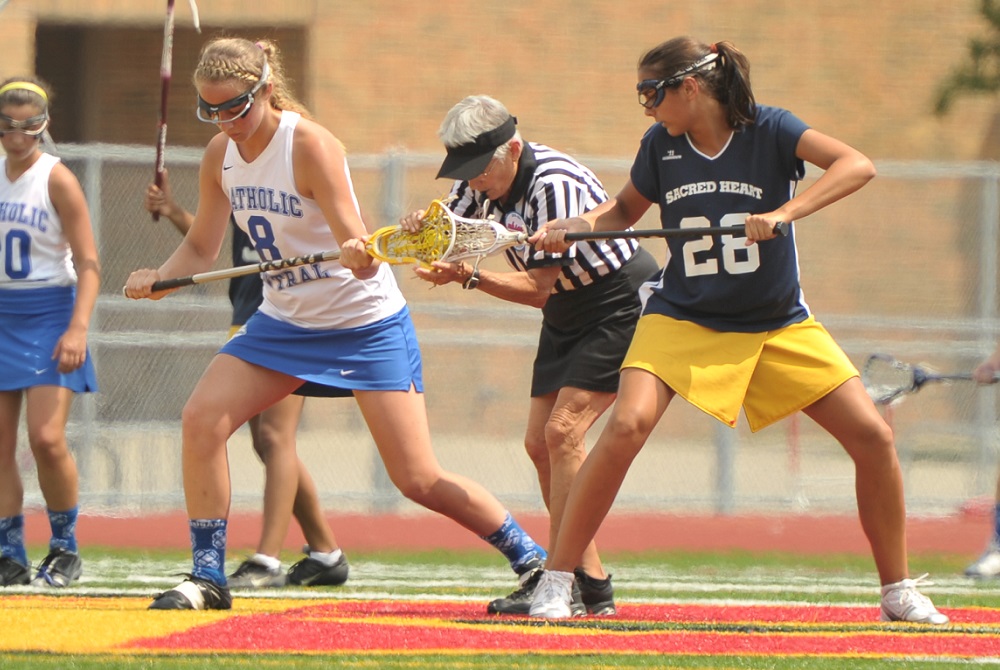
PHOTO Official Pat Hayes sets up the opening faceoff for the 2009 Division 2 Final. (MHSAA file photo.)