

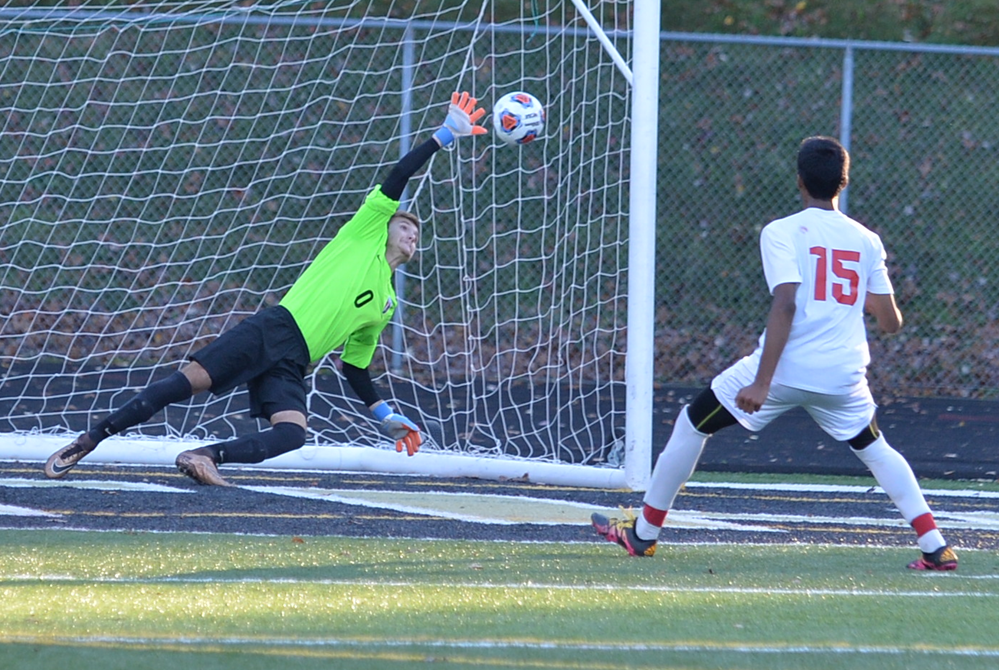
Be the Referee: Soccer Overtime
By
Paige Winne
MHSAA Director of Brand Management
October 24, 2023
Be The Referee is a series of short messages designed to help educate people on the rules of different sports, to help them better understand the art of officiating, and to recruit officials.
Below is this week's segment – Soccer Overtime - Listen
Soccer games in the postseason have one big noticeable difference from the regular season. In the postseason, games cannot end in a tie – so games go to overtime and possibly a shootout.
Here’s how that works:
If the game is tied at the end of regulation, it will go to overtime, which is two 10-minute periods played in its entirety. There is no sudden death or golden goal winner. If there is a winner at the end of the 20 minutes, that team wins and advances to the next round. If there’s still a tie, we move to a shootout.
In the shootout, the teams alternate taking five penalty kicks. If it’s still tied after five kicks, they each kick until the tie is broken.
Previous Editions
Oct. 17: Tennis Spin - Listen
Oct. 10: Blocked Kick - Listen
Oct. 3: Volleyball Double & Lift - Listen
Sept. 26: Registration Process - Listen
Sept. 20: Animal Interference - Listen
Sept. 13: Feet Rule on Soccer Throw-In - Listen
Sept. 6: Volleyball Jewelry - Listen
Aug. 30: Football Rules Similarities - Listen
Aug. 23: Football Rules Differences - Listen

Be the Referee: Fumble Out of Bounds
By
Paige Winne
MHSAA Director of Brand Management
August 25, 2026
Be The Referee is a series of short messages designed to help educate people on the rules of different sports, to help them better understand the art of officiating, and to recruit officials.
Below is this week's segment – Fumble Out of Bounds - Listen
We are on the football field today, where the offense has the ball on their own 20-yard line. It’s 3rd-and 10. They run a draw play, with the running back gaining nine yards before fumbling at the 29 yard-line.
The fumbled ball goes forward to the 35-yard line before another offensive player recovers. Where should the ball be marked?
Because the ball was recovered in-bounds, it’s first down for the offense at the point of recovery, the 35-yard line.
If the ball had rolled out of bounds at the 35-yard line, before anyone could recover it, it would have been brought back to the spot of the fumble – the 29-yard line – making it 4th-and-1 for the offense.
(Photo by Larry Arreguin/Team Arreguin Photos.)