

Hornets' Sorg Soars as Top Coach, Official
October 2, 2015
By Geoff Kimmerly
Second Half editor
WILLIAMSTON – Brent Sorg was a high school sophomore, on crutches a few weeks after knee surgery, when he stepped in to officiate a Lansing area 30-and-over men’s league soccer game although he couldn’t move more than a few feet from his post at midfield.
A dozen years later, Sorg ran matches at the highest U.S. level as one of 24 Major League Soccer referees during the 2004 and 2005 seasons.
 That he remains one of the country's elite officials after rising so quickly is a story worth telling on its own – but only half of the 40-year-old's remarkable climb on the pitch.
Sorg is better known in Michigan high school soccer as the boys coach at Williamston, which he led to the MHSAA Division 3 Final last fall for the second time in three seasons.
That's quite a combination; in fact, he knows of only one other high-level official, from North Carolina, who coaches a high school team as well. But here's the kicker, pun intended: Sorg, a three-sport athlete in high school, never played a competitive soccer game past the eighth grade.
“It is sort of interesting to reflect on the path of how I’ve gotten there,” Sorg admitted during a Williamston practice last week. “The continuing education piece, surrounding yourself with good people, being willing to try things; that’s why I think I’ve been able to have some success. You don’t always do the cookie cutter approach. The game is very simple, but there’s always more than one way to go about it.”
He’s proof – although surely there are common strands tying together his officiating, coaching and day job success.
Soccer has become Sorg's passion. That, and sharp time management skills, play large parts in his pulling off coaching a contending high school team plus officiating high-level matches during free weekends, when he’s not working 8:30 p.m. – 6:30 a.m. most days protecting the capital city.
All in all, it’s been an eventful 365 days for the Hornets’ leader, who in addition to taking his team back to a championship game also officiated an NCAA Men’s Tournament Quarterfinal and a Women’s Semifinal, and was promoted to sergeant for the Lansing Police Department.
“He works hard at both (soccer) professions and continues to learn,” said Eaton Rapids coach Matt Boersma, a friend and colleague who has worked with Sorg on the board of the Michigan High School Soccer Coaches Association. “Brent is a great example of hard work. He has put it in in all three of his professions – cop, coach and ref – and has seen that hard work give great returns."
Starting down the path
Sorg did play under a legendary coach at East Lansing, but not five-time boys soccer champion Nick Archer.
Instead, he played junior varsity for the football program led by Jeff Smith, who won one MHSAA title and led the Trojans to two runner-up finishes during his multiple-decade tenure. Sorg also played basketball and baseball – but after tearing a right knee ligament as a sophomore, decided he was done as a high school athlete. He knew then he wanted to become a police officer and wanted to guard his knee for that future.
Sorg’s soccer playing career had ended a few years before; admittedly, he probably wasn’t good enough to play past junior high. But he had friends on East Lansing’s team and became a regular cheering them on – while he also became a regular on the pitch in another capacity.
He officiated his first games as a sixth grader at the request of his club coach, who needed someone to handle littler kids' matches at $6 apiece. That seemed like a pretty good deal. At 16 and 17, Sorg started making a few hundred dollars a weekend at youth tournaments and was part of the MHSAA Legacy Program. He later was mentored by Lansing’s Dean Kimmith in soccer and Rick Hammond for football and basketball, registering to officiate all three sports.
Sorg’s first coaching opportunity came from the same source. He graduated from East Lansing in 1994 and went on to Michigan State University, and a few years in his former club team needed a youth coach. Sorg and a buddy decided to give it a shot – and Sorg found another calling.
 He stuck with coaching, moved up on the club scene, did the course work to earn his National "B" coaching license from the United States Soccer Federation, and then coached a season of junior varsity at Haslett in 2000. He also continued to officiate – he’s worked six MHSAA Finals in boys or girls socccer – eventually climbing the college ranks as well and earning his National Referee badge in 2002 on his way to MLS.
Sorg may referee only a dozen or so games in this season, depending on what his schedule allows. For example: He officiated at Virginia Tech on Sept. 27, landed in Detroit at midnight and finally made it to bed at 2 a.m. before starting his coaching and working life again the next day. Work duties eliminated the next two weekends from his officiating calendar.
But when available, Sorg gets games in the Big Ten, Atlantic Coast Conference, Horizon League and American Athletic Conference, and handled the NCAA Division III Men’s Final in 2013.
“Brent is a great referee. I can't remember if I've ever had a complaint about him,” said Steve Siomos, who assigns officials for the Big Ten and Horizon League among others. “The only thing that held him back to go to the top was his job and his coaching high school kids. Those were the two priorities; referee(ing) was after that.”
Building the program
Josh Ward is the second from his family to play for Sorg. He followed his brother Jake, joining the Williamston varsity for the 2012 playoff run.
Josh knew the Hornets' program probably more than most newcomers, but still chuckled to himself the first time he heard Sorg’s annual start to fall practice.
“He loves this program. One of his quotes at the beginning of every soccer season is that this is the best soccer program to play for, I think he says, in the world,” Ward said. “So he loves this place.”
It’s true.
“I’m pretty honored by it. I say that every day,” Sorg said. “I’m in a pretty good position, with an athletic director and staff that does a nice job supporting us and what we do. We’re pretty lucky.
“(And) we’re so lucky to have people who care about their community and schools. I get comments all the time how our practice fields are better than some game fields.”
Sorg was hired in 2005, with just his club experience and that one year of JV coaching to his credit. The Williamston program had been average most seasons, but with potential for more backed also by an excited parent base that has since contributed to the building of a stadium used for multiple MHSAA Finals.
Whatever coaching skills Sorg missed out on by not playing, he’s apparently learned. The Hornets were 18-3-2 and won their first district title his first season, and have finished under .500 only once during his tenure. The 2012 team was 19-8-1 and lost the MHSAA Division 3 Final 1-0 in overtime to Grand Rapids South Christian. Last year’s team finished 13-4-6 and fell 1-0 to Hudsonville Unity Christian in the Final. This fall, Williamston is 12-3 and ranked No. 3 in Division 3, despite a schedule featuring teams currently ranked in all four divisions, including Division 3 No. 1 Flint Powers Catholic, Division 4 No. 1 Lansing Christian and Mason, formerly No. 1 in Division 2.
 Sorg has learned much by watching and listening – be it at local, state and national coaching conferences, or when he’s on the sideline as an official waiting for his college games to start. Boersma noted that Sorg is a regular at the National Soccer Coaches Association of America convention, and the Hornets’ pregame warm-up includes a drill Sorg picked up reffing Wake Forest. He's also absorbed what he could mixing with longtime mid-Michigan coaches like Archer, retired Eaton Rapids coach Joe Honsowitz, recently-retired Jamal Mubarakeh of DeWitt and Hornets girls coach Jim Flore.
Sorg also has surrounded himself with experience, including assistant Steve Horn, who transformed Lansing Everett into a Division 1 power from 2005-11. Williamston’s 2012 goalkeeper, Charlie Coon, works with the current goalies, and junior varsity coaches Jason Davis and Bruce Collopy have been involved with the program for years as well.
Discipline is a staple, as one might guess with a police officer as coach – although the drive to do things right and to completion was nurtured by parents Rich and Pat, who moved the family to Michigan from Texas when Brent was 10. “It’s about … how you carry yourself. You have to work for it. That’s such an emphasis for me and the program," Brent said.
Ward said his coach finds a balance between making practices fun and competitive – “which is kinda hard to do,” Ward said.
When a player snuck in a cell phone during the team’s preseason overnight camp, Sorg made him carry each of his teammates the length of the field – something more memorable for the entire team that simply making the rule-breaker run alone.
“And at the end of the day, for me, it’s not always about the soccer component, but developing young men. Making them into good human beings and good citizens,” Sorg said.
Right on time
As Sorg was climbing the officiating ranks, Mason coach Nick Binder was rising as a player, starring first for the Bulldogs before moving on to MSU from 1999-2003. Sorg worked Binder’s youth, high school and college games, and the two now meet as leaders of elite Capital Area Activities Conference programs.
“It’s very cool to see a local guy on TV officiating the highest level of professional soccer in our country,” Binder said. “(And) as a coach, I have the utmost respect for what he’s done at Williamston over the last decade in which we’ve both been coaching. His attention to detail and motivation to elevate Williamston among the area and state’s elite programs is evident, even from the outside. His schedule is always loaded with strong competition with a clear purpose to be battle-tested when the state tournament begins.”
Sorg does indeed load up the schedule to make sure his teams are prepared. The never-stop-learning approach was another trait passed on by his parents, and Sorg practices it in a variety of ways, be it reading up on the psychological component of a game or comparing notes on motivation with peers like Lansing Sexton football coach Dan Boggan, who took the Big Reds to the Division 4 Football Final last fall.
Former Waverly and Haslett soccer coach Jack Vogel told Sorg early on that it would take five years for Sorg to establish his program and 10 to get everything the way he wanted it.
This is season 11 for Sorg's Hornets. There’s no question he’s reached a desired coaching destination in addition to his lofty standing wearing the official’s shirt.
“When I reflect on that, it’s exactly what it is,” said Sorg of Vogel’s advice. “There’s no doubt that it’s happened.
“I think we’ve done a lot of good things here. I’m proud of what we’ve built.”
 Geoff Kimmerly joined the MHSAA as its Media & Content Coordinator in Sept. 2011 after 12 years as Prep Sports Editor of the Lansing State Journal. He has served as Editor of Second Half since its creation in Jan. 2012. Contact him at [email protected] with story ideas for the Barry, Eaton, Ingham, Livingston, Ionia, Clinton, Shiawassee, Gratiot, Isabella, Clare and Montcalm counties.
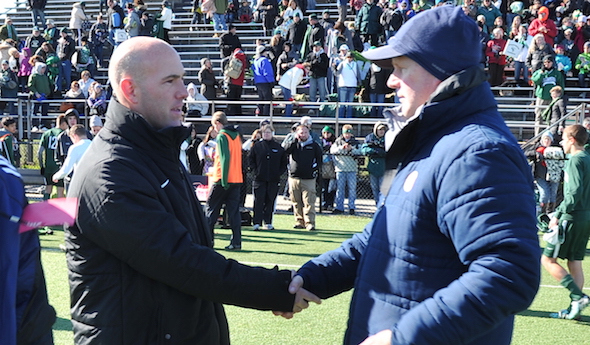
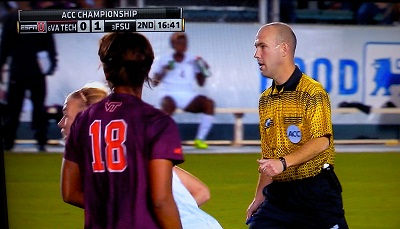
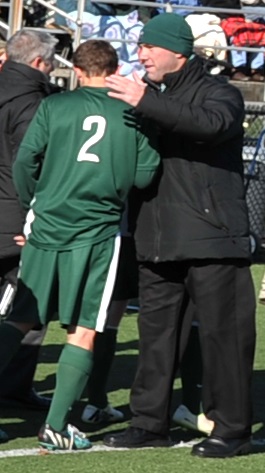
PHOTOS: (Top) Williamston boys soccer coach Brent Sorg, left, shares hands with Hudsonville Unity Christian's Randy Heethuis after last season's Division 3 Final. (Middle) Sorg has been a college official for 15 seasons, including during this ACC championship game. (Below) Sorg comforts one of his players after the Division 3 Final loss.
Preview: Contenders Aiming to be Champions
November 1, 2013
By Geoff Kimmerly
Second Half editor
Five teams will look to make history Saturday as they play for their first MHSAA boys soccer championships. And at least two are assured of doing so.
The Lower Peninsula Division 1 and 4 championship games feature four teams looking to win for the first time, including first-year school Bloomfield Hills. Spring Lake in Division 2 also is going for its first Finals win, but against three-time champion East Lansing and one of the state’s winningest coaches in Nick Archer.
Only in Division 3 is a team assured of adding to its trophy collection. Flint Powers Catholic is hoping for its first title since 1996, but must beat reigning champion Grand Rapids South Christian to earn it.
Below is Saturday's schedule, followed by a look at each team in the hunt.
Division 1 at Troy Athens, Noon
Bloomfield Hills (16-2-5) vs. Ann Arbor Skyline (20-1-5)
Division 2 at East Kentwood Crestwood Middle School, Noon
East Lansing (24-2) vs. Spring Lake (16-6-3)
Division 3 at Troy Athens, 3 p.m.
Grand Rapids South Christian (21-1-3) vs. Flint Powers Catholic (14-8-2)
Division 4 at East Kentwood Crestwood Middle School, 3 p.m.
Grand Rapids Covenant Christian (22-1-3) vs. Lansing Christian (21-0-1)
All four Finals will be streamed live on MHSAA.TV and available on a subscription basis. A one-day pass costs $9.95 and allows access to all four games plus the Lower Peninsula Cross Country Finals. A month pass costs $14.95 and allows fans to also watch live the Volleyball Semifinals and Finals and Lower Peninsula Girls Swimming & Diving Finals. Radio broadcasts of the Soccer Finals will be available on MHSAAnetwork.com.
Click for links to brackets and scores. All statistics below are through the Regional Finals.
DIVISION 1
ANN ARBOR SKYLINE
Record/rank: 20-1-5, No. 3
Coach: Chris Morgan, fourth season (53-17-16)
League finish: Second in Southeastern Conference Red
Championship history: Has never played in an MHSAA Final.
Players to watch: Alec Lasinski, jr. F (32 goals, six assists); Nick Russo, sr. M (11 assists, three goals).
Outlook: Skyline has improved in the win column each season during its four as a varsity program and won its second straight District title two weeks ago. The Eagles beat No. 5 Caledonia and honorable mentions Okemos and Salem to win the Regional and advance to the championship game. Lasinski earned an all-state honorable mention as a sophomore and leads an offense that has outscored opponents 74-15 with 14 shutouts this fall.
BLOOMFIELD HILLS
Record/rank: 16-2-5, unranked
Coach: Dougie Macaulay, first season (16-2-5)
League finish: Second in Oakland Activities Association White
Championship history: First season as a school.
Players to watch: Alex Joneson, jr. F; Griffin Hamel, sr. GK (statistics not submitted).
Outlook: This is the first year of Bloomfield Hills soccer and school, which was created by a merger of Lahser and Andover. Lahser won one MHSAA title and finished runner-up twice during its history. The only teams to score more than one goal on Bloomfield Hills this season were the two that beat the Black Hawks, Rochester Hills Stoney Creek and Birmingham Groves. Bloomfield Hills has won 13 straight, including avenging that loss to Groves with a 4-1 win in the District opener.
DIVISION 2
EAST LANSING
Record/rank: 24-2, No. 4
Coach: Nick Archer, 38th season (572-152-72)
League finish: Second in Capital Area Activities Conference Blue
Championship history: Three MHSAA titles (most recent 2005), two runner-up finishes.
Players to watch: DeJuan Jones, jr. F (25 goals, eight assists); Tommy Lammers, sr. M (six goals, five assists); Ben Swanson-Ralph, sr. F (14 goals, 12 assists).
Outlook: East Lansing advanced with its first Regional title since 2007, but was poised for such a run after claiming the league and District titles in 2012 with Swanson-Ralph making the all-state first team and Lammers earning an honorable mention. The Trojans spent much of this season ranked No. 1 before a couple close losses near the end to No. 6 DeWitt and Division 1 honorable mention Okemos. East Lansing then beat DeWitt and No. 2 Linden on its way to this championship game.
SPRING LAKE
Record/rank: 16-6-3, unranked
Coach: Jeremy Thelen, 13th season (200-70-11)
League finish: Second in Lakes 8 Conference
Championship history: 2011 runner-up.
Players to watch: Nic Ellingboe, sr. F (19 goals, seven assists); Kyle Zietlow, jr. M (10 goals, 12 assists); Keegan George, soph. F (13 goals, six assists).
Outlook: This is Spring Lake’s second Division 2 Final appearance in three seasons, and the Lakers are riding a seven-game winning streak including a shootout victory over Fruitport after losing to the Trojans in the league championship game. In fact, Spring Lake could make a run at three Finals berths in four seasons next fall; Ellingboe and defender Adam Ross are the only senior starters.
DIVISION 3
FLINT POWERS CATHOLIC
Record/rank: 14-8-2, No. 6
Coach: Tony Rowe, second season (28-15-2)
League finish: First in Saginaw Valley Association
Championship history: Class B champion 1996.
Players to watch: Jared Pechette, sr. M (10 assists, eight goals); Christian Mansour, sr. M (15 assists, five goals); Charlie Emmert, sr. F (13 goals, three assists).
Outlook: Powers has piled up successes with two league titles under Rowe, a 2003 graduate in his first varsity coaching position. The Chargers are riding a 12-game unbeaten streak after beginning the season 3-6. Although Powers has only six seniors, three start in the midfield with Brad Tuttle joining Pechette and Mansour.
GRAND RAPIDS SOUTH CHRISTIAN
Record/rank: 21-1-3, No. 1
Coach: Jason Boersma, third season (58-8-8)
League finish: First in O-K Gold
Championship history: Two titles (most recent 2012), one runner-up finish.
Players to watch: Marlon Bykerk, sr. M (11 goals, 17 assists); Cody Kok, sr. M (11 assists, nine goals); Nick VanderHorst, sr. M (13 goals, three assists), Zac Medendorp, sr. GK (0.45 goals-against average, 15 shutouts).
Outlook: South Christian is playing for its third title in four seasons led by a talented midfield including 2012 all-stater Bykerk and honorable mention Kok and a keeper whose shutout total makes the MHSAA record book (Medendorp earned his 16th in the Semifinal against No. 5 Whitehall). The Sailors’ lone loss this season was in their opener, 1-0 to Division 2 honorable mention Grand Rapids Christian – and South Christian won the rematch 2-1.
DIVISION 4
GRAND RAPIDS COVENANT CHRISTIAN
Record/rank: 22-1-3, No. 1
Coach: Mike Noorman, 10th season (127-66-14)
League finish: First in River Valley Conference
Championship history: 2012 runner-up.
Players to watch: Corbin Prince, sr. M (27 goals, 15 assists), Travis Bouwkamp, jr. F (23 goals 16 assists), Cole Bleyenberg, sr. F (12 goals, nine assists), Austin Brower, sr. GK (0.28 GAA, 13 shutouts).
Outlook: After falling short to Hamtramck Frontier International in last season’s Division 4 Final, Covenant Christian has dominated in its quest to finish the run this fall. Brower was an all-stater as a junior and Prince made the second team. They are two of 11 seniors on a team that started with seven straight shutouts and has given up only three goals during the postseason despite dispatching of No. 2 Kalamazoo Hackett Catholic Central and No. 10 Bellaire during the run.
LANSING CHRISTIAN
Record/rank: 21-0-1, honorable mention
Coach: Joel Vande Kopple, sixth season (114-15-5)
League finish: Does not play in a league.
Championship history: Has never played in an MHSAA Final.
Players to watch: Jordan Terry, sr. F (26 goals, 11 assists), Martin Lang, Jr., jr. F (18 goals, eight assists), Brayan Guzman-Ortiz, jr. F (11 goals, six assists), Alex McDowell, soph. M (11 goals, five assists).
Outlook: The Pilgrims didn’t enter the tournament among the top 10. But Lansing Christian proved its skill early with wins over Division 2 Haslett and Division 3 Williamston, and then beat Division 4 honorable mention Genesee Christian and No. 7 Bloomfield Hills Roeper on the way to this first Final. Terry is a returning all-stater and a dangerous scorer, but the defense is talented as well – the Pilgrims didn’t give up a goal in the playoffs until Roeper scored one in the Semifinal.
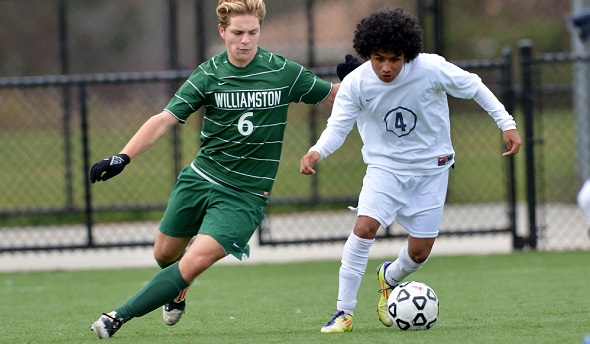
PHOTO: Grand Rapids South Christian’s Marlon Bykerk (4) advances the ball during last season’s Lower Peninsula Division 3 Final win over Williamston. He and his team return to the championship game Saturday. (Click to see more from High School Sports Scene.)