

Huron to Take Next Step in Magnificent Rise with 1st Semifinal Appearance
By
Doug Donnelly
Special for MHSAA.com
October 28, 2025
When Luis Gomez Dominguez became a head soccer coach, he started thinking about what programs he wanted to emulate.
 He found one in Troy Athens.
On Wednesday, Gomez-Dominguez gets a chance to knock Athens out of the playoffs and lift Ann Arbor Huron to the Division 1 Final.
“They do a great job,” Gomez-Dominguez said. “They do things the right way, even little things like having Grandparents Day. It’s a great program.”
New soccer coaches in the state would be on the right track if they start emulating what Gomez-Dominguez has done at Huron. He’s been head coach for seven seasons, oversees a program of nearly 90 soccer players, and Wednesday takes his 16-1-3 squad to Troy for a Semifinal game against the Red Hawks (14-3-4).
“I like to say it’s been a process, a three-year process,” Gomez-Dominguez said.
Last week the River Rats captured the school’s first Regional title. They won the Southeastern Conference and have steadily increased their number of wins each season, from four both of his first two seasons in 2019 and 2020 to 16 this year.
 “We started building the program,” he said. “After COVID, our numbers just exploded.”
With the huge interest in soccer, Huron made the decision not to cut players.
Instead, the program drew up a plan for a freshman team, two junior varsity teams – an A and a B – and the varsity team.
“I think it gives players a clear path,” Gomez-Dominguez said. “You start with the program on the freshman team, progress to the first JV team as a sophomore, maybe play on the ‘A’ JV team as a junior and as a senior, you are ready to contribute to the varsity.”
Sometimes, of course, players jump that progression.
Three years ago, a substantial group of sophomores were on the varsity. Nasser Diarra, Kyle Johnsen, Kinley Poole, Philip Leucht, Amadou Sidibe and Matthew Pletcher all made the top team as the River Rats won 11 games.
“They were the core,” Gomez-Dominguez said. “We thought if we keep them together and add a few pieces around them, we would see the success.”
The plan worked. Those six are now seniors, part of an 18-senior varsity squad.
“We have a lot of experience,” Gomez-Dominguez said.
Poole is among the top scorers on the team with 12 goals and 10 assists. He’s a four-sport athlete at Huron, playing wide receiver on the football team, guard on the basketball team and sprinter in track. He’s likely to run track in college, Gomez-Dominguez said.
Pletcher is the starting goalkeeper. He’s allowed just four goals all season. Leucht has seven goals and three assists. Sidibe is a do-everything defender.
 “He’s a lockdown defender,” Gomez-Dominguez said. “He’s our Swiss Army knife. He manages the other team’s attacking players. He can play anywhere on defense, and we line him up as a midfielder for defensive duties.”
Senior Malic Kasham is the team’s top goal scorer with 13. Jules Heskia has five goals, as does sophomore Kaito Yoshida.
Two more seniors – Unejs Ramaxhiku and Christopher Zou – joined the program this year after playing for MLS NEXT, a year-round club program. Zou has four goals and four assists.
“I think they saw the kind of fun we were having and wanted to be part of it,” Gomez-Dominguez said.
This season’s team, ranked No. 2 in Division 1, includes five sophomores and seven juniors.
The River Rats already have had a historic season when it comes to defense. They have given up just seven goals all fall.
“We are keeping an eye on the record book for that,” Gomez-Dominguez said.
The coach grew up in the Ann Arbor area, graduated from Pioneer and played college soccer at Madonna. He was an assistant coach with the River Rats when the head coach moved to California, and was named head coach. He has 65 wins over his seven seasons.
Huron has embraced a program-wide attitude. Gomez-Dominguez has five assistant coaches; the team is active on social media and lists its goals and expectations on a website dedicated to the program.
Huron defeated Troy Athens earlier this season, 2-1, but Gomez-Dominguez isn’t taking Wednesday’s game lightly.
“A lot has changed since then,” he said. “That game was played on a Saturday morning. It felt like a Saturday morning game. This one will be at night, at Troy High School, under the lights and we expect a big crowd. We are taking a fan bus. It will be a great atmosphere.”
 Doug Donnelly has served as a news and sports reporter at the Adrian Daily Telegram and the Monroe News for 30 years, including 10 years as city editor in Monroe. He's written a book on high school basketball in Monroe County and compiles record books for various schools in southeast Michigan. He is now publisher and editor of The Blissfield Advance, a weekly newspaper. E-mail him at [email protected] with story ideas for Jackson, Washtenaw, Hillsdale, Lenawee and Monroe counties.
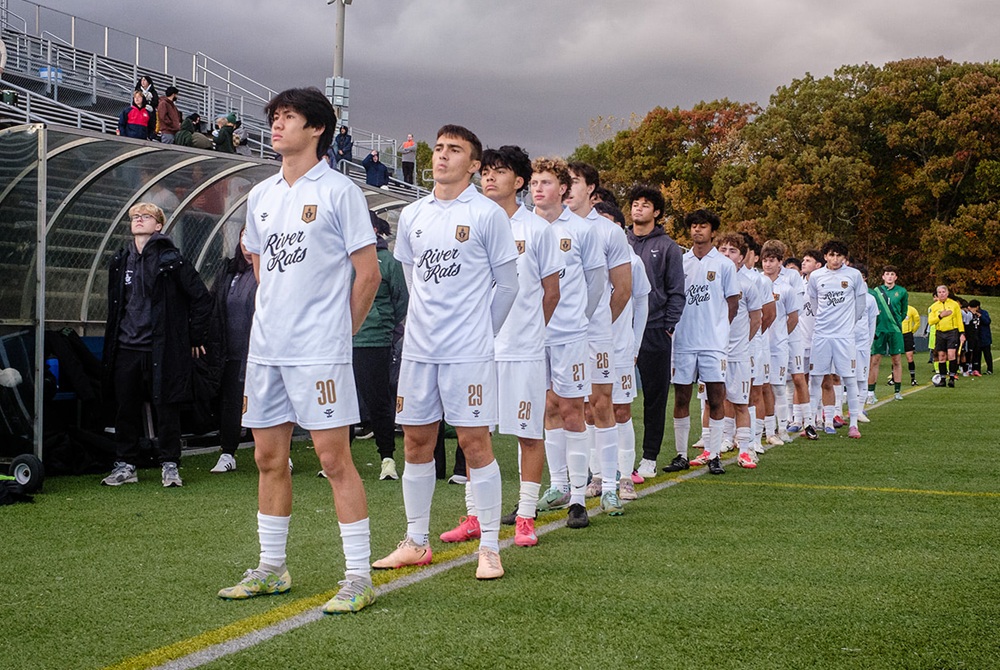
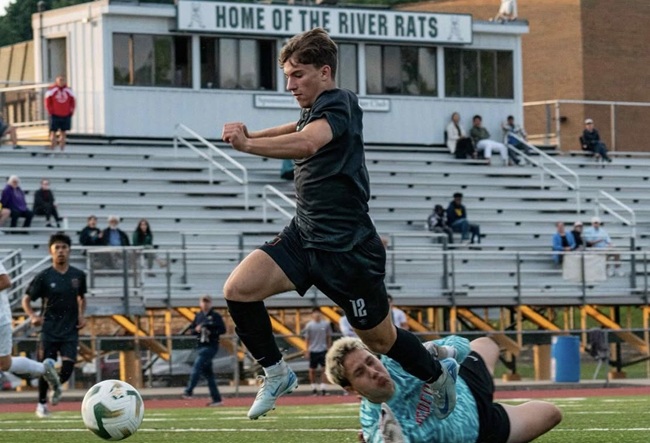
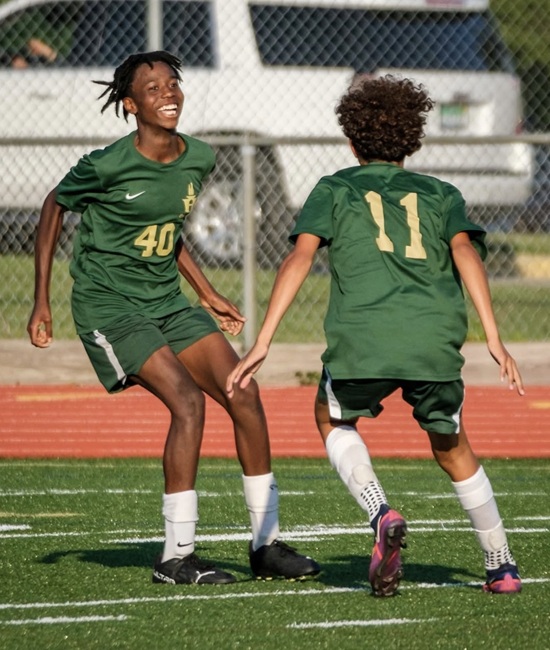
PHOTOS (Top) Ann Arbor Huron players stand for the national anthem before a game this season. (Middle) Andrew Rooks controls the ball as he charges up field. (Below) Kinley Poole (left) and Malic Kasham celebrate a moment. (Photos courtesy of the Ann Arbor Huron boys soccer program.)
McGuire Emerges from Cancer, Amputation to Return to Golf Course, Soccer Pitch
By
Tom Spencer
Special for MHSAA.com
June 3, 2022
A lot has happened since Dan Alto and MacKale McGuire first met eight years ago around the game of golf.
 Alto was helping out at the Cadillac Country Club. McGuire was playing there in the junior golf program.
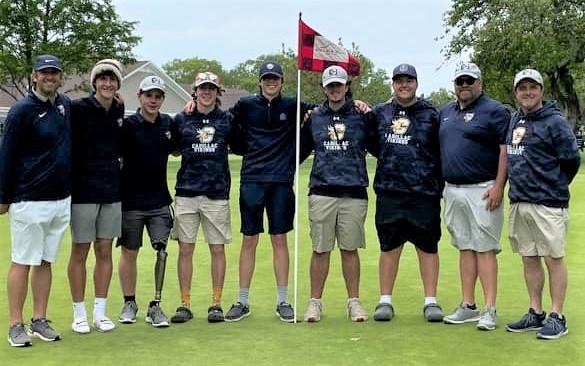
Today, Alto coaches golf at Cadillac High School, and McGuire serves as the captain preparing to lead the Vikings into the MHSAA Finals next weekend.
“Mac is an extremely polite, determined young man,” Alto said. “He is an outstanding student, which will serve him well as he attends college and pursues a career.
“With his work ethic, I have no doubt that Mac is going to find great success in whatever he decides to do.”
McGuire has plans to play golf at the next level as he moves on to Kalamazoo College in the fall.
Many might assume the last few years that have passed since Alto and McGuire first met have been a struggle — but not McGuire.
 His left leg was amputated above the knee four years ago after a battle with osteosarcoma, a type of bone cancer.
McGuire is now preparing to walk at commencement. He looks back and sees only a varsity golfer, soccer player and theatre performer ready to take on the world.
“I just consider myself another person,” said McGuire, known as Mac to many. “I guess everyone has their differences.
“I guess mine is a more apparent kind of thing.”
McGuire learned to walk again with a prosthetic leg. He returned to golfing almost immediately and eventually played soccer and mastered downhill skiing. He’s been cancer free for more than five years.
When he steps on the golf course every day, he wants his teammates, coaches and opponents to see nothing more than a golfer. He’s seen all kinds of reactions to what others call a disability.
There’s no need to be politically correct around McGuire. In fact, he’d prefer you not be.
“Personally it (political correctness) just feels weird,” he said. “Just say it and get it over with.”
McGuire holds down the third golfing spot for the Vikings. He’s ready for some tough competition at the Finals after Cadillac qualified with a third-place finish at their Lower Peninsula Division 2 Regional.
“Mac is the kind of teammate coaches love,” said Alto, who with Brandon Bailey took over the Vikings golf program just as COVID-19 canceled the 2020 season. “He offers to drive younger teammates to practice when needed.
“He is never late for practice and leads by example … (and) always is happy for teammates that play well, even if he doesn't.”
McGuire’s tee shots get plenty of distance, but it’s the green game where he shines.
“I would say his true strength would be on the putting green,” Alto said. “He does a nice job of making the 5 to 6-foot putts that can save a round, and rarely three putts.”
Alto said McGuire is much more focused on his team’s success than his own.
“Like all golfers he wants to shoot a low score, but I get the feeling he wants to play well in order to help our team achieve goals more so than individual accolades,” Alto pointed out.
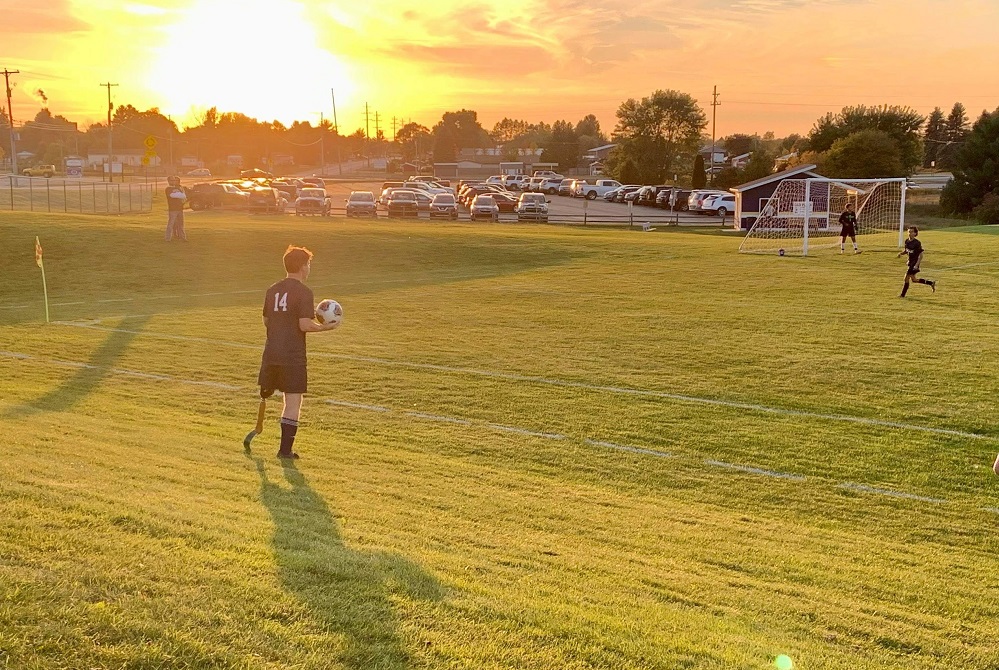
As a youngster, McGuire played a lot of soccer, basketball and golf. He really didn’t think soccer would be in his future when he made the decision to have his leg amputated in a Florida hospital.
 “When I had the amputation, I didn’t even think it was a possibility I’d be able to play soccer,” he said. “I didn’t think soccer was in the question.”
He served as team manager for the Vikings’ JV soccer squad is sophomore season. One day, he was given the chance to play in a game.
“The coach just randomly told me to get out there and start playing,” he recalled. “I found out it was something I actually could do if I decided to work at it.
“I was able to play varsity my senior year.”
Paul King, who took over the Vikings boys soccer program in 2021, had met McGuire before he entered high school. He’s thrilled he had a chance to coach him on the soccer field.
“Mac isn't ever going to let his disability be an excuse,” King said. “He pushes himself to be better every day at practice, and he encourages others to do the same.
“If he gets beat, he never blames it on his disability. He just works harder so that it doesn't happen again.”
McGuire’s competitive nature has served him well, his coaches note.
“Mac is extremely competitive,” Alto said. “He puts in as much – or more – work as anyone on the team.
“He has a very strong desire to play well.”
Growing up with two younger brothers, McCoy and MacGill, has fueled the Cadillac senior’s competitive fire.
“It is who I am. I have two younger brothers I have to beat at everything,” McGuire said. “I have a love for competing, no matter what it is.”
The competitive drive will serve well as he heads off to K College, King said.
“Mac has been through a lot,” King said. “If he can overcome cancer, I don't see anything slowing Mac down.
“I am so proud of him and consider myself lucky for having the chance to get to coach him and get to know the amazing person he is.”
 Tom Spencer is a longtime MHSAA-registered basketball and soccer official, and former softball and baseball official, and he also has coached in the northern Lower Peninsula area. He previously has written for the Saginaw News, Bay County Sports Page and Midland Daily News. He can be reached at [email protected] with story ideas for Manistee, Wexford, Missaukee, Roscommon, Ogemaw, Iosco, Alcona, Oscoda, Crawford, Kalkaska, Grand Traverse, Benzie, Leelanau, Antrim, Otsego, Montmorency, Alpena, Presque Isle, Cheboygan, Charlevoix and Emmet counties.
PHOTOS (Top) MacKale McGuire prepares for a throw-in during a Cadillac soccer game. (Middle) McGuire sends a shot toward the green. (Below) Cadillac celebrates advancing to this season’s LPD2 Final. From left: Brandon Bailey, Davin Brown, MacKale McGuire, Ben Drabik, Noah Traviss, Harry Chipman, Conner Putman, Dan Alto and Mike McGuire. (Action photos courtesy of Paul King. Golf team photo courtesy of the Cadillac Country Club.)