

Keeper Keys Country Day's D2 Triumph
November 3, 2018
By Jeff Chaney
Special for Second Half
COMSTOCK PARK – Jon Dougherty stood tall for 100 minutes of soccer.
And then some.
Under constant pressure Saturday at Comstock Park from undefeated and top-ranked Grand Rapids Forest Hills Northern, Dougherty, the senior goalkeeper for Detroit Country Day, made save after save throughout regulation and then overtime to keep his team in a scoreless Division 2 title game.
Then in the penalty kick shootout, Dougherty made one more big save and the Huskies missed the net on another shot, giving the Yellowjackets a 4-2 advantage in penalty kicks for a 1-0 victory and the program’s state-record 15th MHSAA Finals championship.
The title Saturday was the program’s first in Division 2. The Yellowjackets moved from Division 3 this fall.
"Credit to Forest Hills Northern, they were a great opponent," Dougherty said. "They were big, fast and physical and really wore us down the whole game. I just did what I had to do to keep the ball out of the net. I just kept telling my defenders where to be in position, and they did a (heck) of a job, too."
During regulation, Dougherty stopped 12 Forest Hills Northern shots. He stopped four more in the two 10-minute overtime periods. Then the one in the penalty kick session to give him a full day’s work and make his coach very proud.
"They (FHN) are a wonderful team," said Detroit Country Day coach Steve Bossert, whose team ended the year with a 20-5-2 record. "And we had a good gameplan, the kids executed it and I think we have the best goalie in the state. He made the difference."
 Especially early.
"Some of those flighted balls early, he had to reach over and make great saves in a lot of traffic," Bossert said. "And they have a lot of big bodies. He was the best."
The higher-regarded team coming into Saturday's title game was the Huskies, who had not lost in 24 games this fall.
And Forest Hills Northern played like that all game, controlling tempo and pushing the ball into the Yellowjackets' defensive end time and time again. But the Huskies could not penetrate Detroit Country Day's defense and Dougherty.
"It doesn't really matter if you don't score," said FHN coach Daniel Siminski, whose team ended its year 23-1-1. "This is my fifth state finals, and I have lost three on PKs. And when you are or are not the best team, today they were the best team because they won, shots or no shots."
The Huskies also fell in a shootout in their first championship match appearance, to Mason in 2015.
"Country Day played a great defensive game," Siminski added. "They made it difficult for us to create. And when we had chances, we didn't score. That is how it goes sometimes. This is a tough pill to swallow after the season we had."
Senior midfielder Kevin Tang netted Country Day’s final penalty kick that put the game away.
The championship was Country Day’s first since 2011.
"This was a great high school soccer game," Bossert said. "I think it is a shame that somebody has to lose like that. Obviously, I am very excited that we won. I am not a very big fan of the tiebreak, but it is what it is and we ended up on the better end of it."
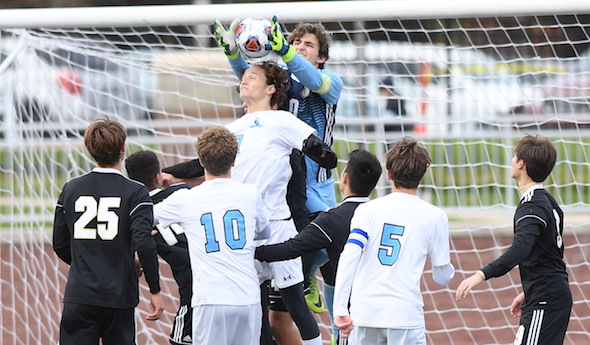
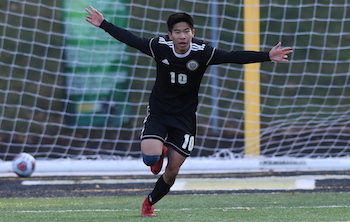
PHOTOS: (Top) Country Day keeper Jon Dougherty gathers a shot just over the head of a Forest Hills Northern player Saturday at Comstock Park. (Middle) Yellowjackets senior Kevin Tang celebrates during his team’s Division 2 Final victory.
Balanced Falcons Bring Title Back Home
November 9, 2012
By Geoff Kimmerly
Second Half editor
East Kentwood’s exit in the 2011 District Final was the team’s earliest from the MHSAA boys soccer tournament since 2003.
Although it came against a formidable opponent, Grand Rapids Forest Hills Central, that was ranked just a few spots lower and had beaten the Falcons earlier in the season, the loss still didn’t sit right for a team that had won three of the past four Division 1 Finals.
East Kentwood made the fixes this fall to push that championship run to four of the last six.
The Falcons get a Second Half High 5 this week after finishing another title push with a 1-0 win over Grand Blanc in Saturday’s Division 1 Final at Troy Athens. They finished this fall 22-1-4.
“Every team has a personality, and the personality of this team was unity,” Conlon said. “That’s not coach-speak. They bought into each other, bought into their roles, were very unselfish.
“Last year, we focused on the wrong things, and that bit us at the end of the season. When you play great teams like Grand Blanc and Novi, it comes down to trusting teammates. And we won a 1-nothing tight game … because we trusted someone up top, and he scored.”
East Kentwood totaled an impressive 85 goals this season, considering especially the strong schedule again this fall. That lone goal in the Final came from junior Emir Cengic, a defender who will be part of the attack in 2013 but hadn’t scored this season before tapping in the team’s final goal of 2012.
That ending was indicative of the balanced contributions from all over the field. Senior midfielder Charlie Constantino is perhaps the team’s best-known talent, and he had a solid 10 goals and 11 assists. But senior forward T.J. Ifaturoti led the team with 16 goals and senior defender Tyler Moorman also added 10. Senior midfielder Josh Hagene had a team-high 12 assists, with junior forward Erick Pizano also totaling 11.
The balance extended to the net, where senior Denis Duratovic had nine shutouts and a 1.0 goals-against average. But sophomore Peyton Gonzalez finished the run with shutouts in the Semifinal and Final, giving him four in eight games with a 0.38 GAA. Both were beneficiaries of a group that prided itself on defense although it was known more for its attack.
“There’s definitely a pressure on the guys. We have a bunch of our former players who come back and tell them how good they were, so the guys have expectations to live up to,” Conlon said. “Honestly, we don’t talk a lot about state championships. We talk about doing the right thing and focusing on the game at hand. It sounds like coach-speak, but really, that’s what we focus on
The Falcons final moments of 2012 were part another show of unity and tribute to one of many who helped establish the program’s success and expectations before them. They posed in the team photo with their trophy and medals wearing black T-shirts with the words “Seal Team Three” in honor of former player David Warsen. The Navy Seal played for East Kentwood from 2001-04 and died in August in Afghanistan. Two of his brothers also played for the Falcons; Ryan was the main keeper when the team won its previously most-recent title in 2010.
“Today was just a fun celebration,” Conlon said after the photos were taken. “That’s the way we looked at the day.”
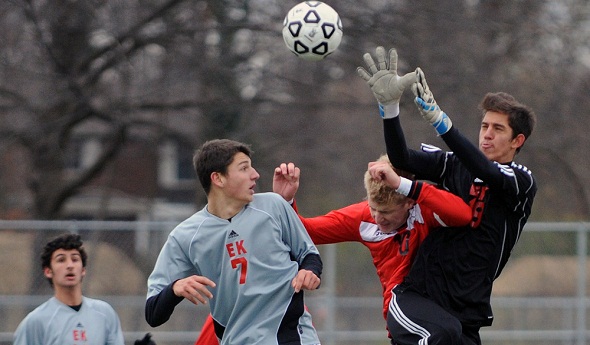
PHOTO: East Kentwood goalkeeper Peyton Gonzalez (far right) prepares to snag a shot amid teammates and Grand Blanc players during the Falcons' 1-0 win in the MHSAA Division 1 Final. (Click to see more from HighSchoolSportsScene.com.)