

'Underdog' Western Building on 2017 Run
By
Tom Markowski
Special for Second Half
September 27, 2018
DETROIT – Few equate competitive soccer with teams from Detroit, especially those in the Detroit Public School League. And that’s just fine with Detroit Western coach Forest Farmer and his players.
 Being an underdog can work to one’s advantage.
Western is one of two schools in the PSL (Detroit Cass Tech is the other) that sponsors a boys soccer team that competes in the MHSAA Playoffs. Western’s program had its beginnings during the 2002-03 school year, and last season the Cowboys came of age.
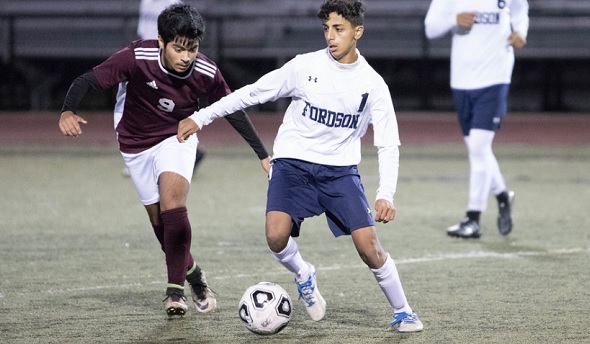
Western won the school’s first District title in the sport by defeating Dearborn Fordson, 7-1, in the final. The Cowboys had opened tournament play by downing Wyandotte Roosevelt, 6-1, and then defeating, U-D Jesuit, 2-1 in a shootout, in the District Semifinal.
Western lost to Detroit Catholic Central, 3-0, in a Regional Semifinal, and the Shamrocks went on to win the Division 1 championship.
That was Western’s only loss, as the Cowboys finished 18-1-2. This season they are 4-2.
Since the MHSAA began sponsoring the boys soccer tournament in 1982, all but three Class A/Division 1 championships have been won by public schools in suburban Detroit or more recently Grand Rapids, or by members of the Detroit Catholic League.
 It’s a struggle for programs like Western and Cass Tech to be successful. Coaches from established programs often don’t look to schedule teams like Western and Cass Tech because there’s at least the perception that teams from the city won’t be competitive and the games will be lopsided.
“We basically play whoever we can,” said the 50-year-old Farmer, who’s now in his sixth season as Western’s head coach. “We’re able to schedule 13 to 14 games while others play 18 or so. We’re not in a league. We’d like to get into a league.”
Farmer said he’s grateful for programs like those from Birmingham Seaholm and Birmingham Brother Rice that annually schedule Western. By playing these established programs, the Cowboys are able to gauge where they are as a team and better prepare for the MHSAA tournament.
Farmer jumped at the opportunity to coach at Western. He played soccer at Rochester Adams and dabbled in coaching other sports, like baseball and football, before he returned to soccer. He said initially he had difficulty convincing students to participate. But once they bought into what he was trying to teach, the numbers started to increase.
Western doesn’t have a freshman or a junior varsity team, but there are 22 athletes in the program. Sure, Farmer would love to have a sub-varsity team help feed the varsity. But the silver lining is he is able to coach his players all four years of their high school careers.
“I’m tough on them. All of the kids want to learn, and they know what to expect,” he said. “And the parents love it. I get tremendous support. Here, I get to run the team like I want to. It’s old school.”
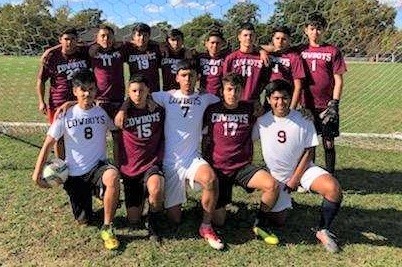 A handful of Farmer’s players have gone on to play in college, including Dylan Borzcak, a sophomore midfielder at Oakland University. Generally, Farmer will encourage his players to go to college, first and foremost. Then, if they do plan on playing soccer, he often suggests somewhere like nearby Schoolcraft College to get their feet wet – as Borzcak did before transferring to Oakland.
Steve Sanchez, 17, is one of four seniors on Western’s team. Not only has soccer been his main sport throughout his life, but he’s never played anything else. Even so, Sanchez, a defender, does not plan on playing soccer in college. He has a 3.5 grade-point average and is planning on majoring in engineering.
“My family has always been a soccer family,” he said. “My dad (Paramon Sanchez) played soccer when he was younger, and I grew up watching my brother, Paramount, play (at Western).
“This year our team is a work in progress. We lost eight seniors off of last year’s team but, yeah, we’re getting better. There’s no one individual who can outperform anyone else, so we’re all competing.”
Angel Magana is a junior striker and, like Sanchez, is a team captain. Magana, 16, started playing soccer at age 7 but, unlike Sanchez, plans on playing soccer in college. Magana’s brother, Brayan, is a freshman on the Western team.
“I pretty much like everything about the sport,” Angel Magana said. “I like scoring. This is the first year I’m playing striker, and I try to make the effort to score. I was a center mid last year and scored two goals. This year I’ve got 10.
“Winning the District was a great feeling. Underdogs? For sure. All of the Catholic schools and the others see us that way. I definitely consider ourselves as the underdogs. I like to have others feel that way. It’s great to show that we can play with them.”
 Tom Markowski is a contributing writer for the State Champs! Sports Network. He previously covered primarily high school sports for the The Detroit News from 1984-2014, focusing on the Detroit area and contributing to statewide coverage of football and basketball. Contact him at [email protected] with story ideas for Oakland, Macomb and Wayne counties.
PHOTOS: (Top) Detroit Western's Angel Magana, left, defends against Fordson during last season's District Final. (Middle) Western coach Forest Farmer. (Below) The Cowboys are off to a 4-2 start this fall. (Top photo courtesy of Southgate Press & Guide; middle photos courtesy of Detroit Western’s soccer program.)
Preview: Boys Soccer Finals Guaranteed to Provide Unforgettable Finishes
By
Geoff Kimmerly
MHSAA.com senior editor
October 31, 2025
A first-time champion guaranteed in Division 1.
The possibility of two teams finishing this fall undefeated.
A Division 3 team making the MHSAA Boys Soccer Finals despite entering the tournament unranked.
A potential repeat champion, and another contender seeking its first title this century.
The program with the most Finals wins looking to add one more, and a contender coming off defeating the top-ranked team now seeking to finish No. 1.
Those are just a few storylines heading into Saturday’s season-concluding matches at Grand Ledge High School.
Saturday’s first Final will be Division 4 at 10 a.m., followed by Division 3 at 12:30 p.m., Division 2 at 3:30 and Division 1 at 6 p.m. Tickets cost $11 and may be purchased online only at GoFan. All four Finals also will be broadcast and available with subscription on the NFHS Network.
Division 1 | Division 2 | Division 3 | Division 4
Below is a glance at all eight contenders, with statistics through Regionals:
Division 1
ANN ARBOR HURON
Record/rank: 17-1-3, No. 2
Michigan Power Rating: No. 4
Coach: Luis Gomez-Dominguez, seventh season (66-44-16)
League finish: Second in Southeastern Conference Red
Championship history: Has never appeared in an MHSAA Final.
Players to watch: Kinley Poole, sr. F (12 goals, 10 assists); Malic Kasham, sr. F (13 goals, 4 assists); Philip Leucht, sr. M (7 goals, 3 assists); Matthew Pletcher, sr. GK (9 shutouts).
Outlook: Huron over the last two weeks has celebrated its first Regional championship and now first trip to the Finals, after navigating a tournament path that’s included wins over No. 13 Dearborn Edsel Ford and honorable mentions Troy Athens and Detroit U-D Jesuit. The River Rats have shut out their last three opponents and given up only seven goals all fall, with their lone loss 1-0 to Saline as the rivals split their season series. Pletcher made the all-state second team last season, and Poole and Leucht earned honorable mentions.
PORTAGE CENTRAL
Record/rank: 23-0-2, No. 1
Michigan Power Rating: No. 2
Coach: Tim Halloran, 12th season (175-57-28)
League finish: First in Southwestern Michigan Athletic Conference
Championship history: Has never appeared in an MHSAA Final.
Players to watch: Gunnar Thorhallsson, sr. GK (0.26 goals-against average, 17 shutouts); Max Bailey, sr. F (12 goals, 21 assists); Carter Seim, soph. M (11 goals, 11 assists); Marshall Neumann, sr. M (6 goals, 8 assists).
Outlook: Portage Central also won its first Regional title last week on the way to this first Finals appearance, and defeated No. 5 Clarkston in a Semifinal shootout to get here. But Halloran has plenty of experience coaching on the season’s last day, as he led Hackett Catholic Prep’s girls to three Division 4 titles and two runner-up finishes over a 14-year run ending in 2010. This is his second tenure with Central; he previously coached from 2008-14 and took over again in 2021. Thorhallsson has qualified for the MHSAA single-season shutouts list this fall and made the all-state third team last season. Bailey made the second team, and Neumann also made the third team in 2024. Seniors Gavan Sherman and Oliver Ruggiero also both had 10 goals entering the week.
Division 2
HUDSONVILLE UNITY CHRISTIAN
Record/rank: 19-0-4, No. 2
Michigan Power Rating: No. 5
Coach: Ian Billin, fourth season (67-9-12)
League finish: First in Ottawa-Kent Conference Black
Championship history: Six MHSAA titles (most recent 2023), four runner-up finishes.
Players to watch: Jackson Kamminga, sr. M/F (12 goals, 4 assists); Logan Lutke, sr. D/M (3 goals, 3 assists); Jack VanEyk, sr. M (15 goals, 12 assists); Alen Deppe, jr. GK (0.35 goals-against average).
Outlook: Unity is seeking its second Finals championship in three seasons and first in Division 2 since 2012 after most recently winning Division 3 in 2023. The Crusaders defeated honorable mentions Holland Christian and Holland High, No. 12 Mason, No. 6 Edwardsburg and then Cedar Springs to get here, and also downed No. 10 Grand Rapids South Christian during the regular season. Opponents have scored only eight goals against them. Kamminga made the all-state third team and Lutke earned an honorable mention last season.
WARREN DE LA SALLE COLLEGIATE
Record/rank: 20-4-2, No. 4
Michigan Power Rating: No. 15
Coach: Thaier Mukhtar, 37th season (616-147-99)
League finish: Third in Catholic High School League Central
Championship history: Six MHSAA titles (most recent 2024), one runner-up finish.
Players to watch: Dominic Baldarotta, jr. GK (0.65 goals-against average); Max Wyszczelski, sr. D (2 goals, 4 assists); Nikolai Zacharko, sr. M (10 goals, 15 assists); Andrew Corder, jr. F (38 goals, 15 assists).
Outlook: A year after winning their first championship since 2005, the Pilots are seeking their second in a row led by several players with big-game experience. Corder and Baldarotta made the all-state first team last season, Zacharko made the second team and Wyszczelski made the third. After finishing third in their league to Division 1 No. 11 Detroit Catholic Central and U-D Jesuit, De La Salle has outscored its six postseason opponents by a combined 31-2 – with shutouts of No. 9 Melvindale and No. 5 Bloomfield Hills Cranbrook Kingswood in its last two matches and a 6-1 win over No. 3 New Boston Huron in the Regional Semifinal.
Division 3
DETROIT COUNTRY DAY
Record/rank: 21-2-1, No. 2
Michigan Power Rating: No. 1
Coach: Steve Bossert, 11th season (165-54-24)
League finish: Does not compete in a league.
Championship history: 15 MHSAA titles (most recent 2018), two runner-up finishes.
Players to watch: Tino Haratsaris, sr. M (22 goals, 19 assists); Evan Stark, sr.; Micah Zacks, sr. F (15 goals, 14 assists); Mitchell Hamway, jr. GK (0.90 goals-against average).
Outlook: Country Day also most recently finished Division 3 runner-up two years ago and has its most wins in one season under Bossert, who now has led the team to three championship matches. The Yellowjackets’ only losses this season were to No. 4 Ann Arbor Greenhills and Division 2 top-ranked Grand Rapids Forest Hills Central, and they defeated Division 3 Flint Powers Catholic and No. 7 Alma during the regular season before a tournament run that’s included victories over top-ranked Pontiac Notre Dame Prep, No. 6 Grosse Ile and Greenhills among others. Haratsaris made the all-state first team last season, and Stark and Zacks made the second team.
SOUTH HAVEN
Record/rank: 18-4-4, unranked
Michigan Power Rating: No. 14
Coach: Randy Bautista, first season (18-4-4)
League finish: Second in Southwestern Athletic Conference Lakeshore
Championship history: Division 3 co-champion 2003, three runner-up finishes.
Players to watch: Noah Weaver, sr. F (17 goals, 8 assists); August Zoet, sr. F (24 goals, 4 assists); Levi DeLaRosa, sr. F/M (10 goals, 15 assists); Angel Barajas, jr. M (5 goals, 13 assists).
Outlook: South Haven has won 11 of its last 12 games on the way to making the Finals for the first time since finishing Division 3 runner-up in 2009. The path has been one of the toughest in any division. The Rams in the Semifinal handed No. 14 Fremont its only loss this season, and South Haven also defeated No. 15 Fennville, No. 8 Grand Rapids NorthPointe Christian, No. 11 Grand Rapids Catholic Central and No. 12 Paw Paw over its last five games – all decided by one goal. The Fennville win avenged a 2-1 league title-deciding loss. Weaver earned an all-state honorable mention last season.
Division 4
GROSSE POINTE WOODS UNIVERSITY LIGGETT
Record/rank: 19-2-1, No. 6
Michigan Power Rating: No. 2
Coach: David Dwaihy, 11th season (156-37-13)
League finish: First in Catholic High School League Intersectional 1
Championship history: Four MHSAA titles (most recent 1999), four runner-up finishes.
Players to watch: Ravi Hines, sr. GK (0.40 goals-against average); Ollie Cooley, jr. M (6 goals, 10 assists); Brady Ancona, jr. M (12 goals, 14 assists); Brendan Logan, fr. F (13 goals, 5 assists).
Outlook: Liggett is making its first Finals trip since finishing Division 4 runner-up in 2019, and has four shutouts over its six tournament games despite navigating postseason matches with No. 12 Detroit Cristo Rey, No. 9 Allen Park Inter-City Baptist, honorable mention Hillsdale Academy, No. 8 Plymouth Christian Academy and No. 4 Lansing Christian. The Knights have improved seven wins from a year ago and tied their most under Dwaihy. They start only four seniors, with multiple underclassmen playing key roles.
LELAND
Record/rank: 15-8-2, No. 10
Michigan Power Rating: No. 11
Coach: Rob Sirrine, fifth season (78-34-6)
League finish: Tied for first in Northwest Conference
Championship history: Division 4 champion 2018.
Players to watch: Ravell Smith, sr. GK (0.72 goals-against average); Eli Ulbrich, sr. D (3 goals); Ignacio Creamer, sr. M (12 goals, 14 assists); Adrian Spencer, sr. M (16 goals, 3 assists).
Outlook: Leland has won three Regional titles over the last four seasons and broke through for its second championship match appearance with a 2-1 Semifinal win over top-ranked Grandville Calvin Christian. The Comets also defeated No. 3 North Muskegon in their Regional Final and clinched the District title with a shutout of Maple City Glen Lake, with which it shared the league championship. Smith made the all-state first team last season, Ulbrich and Creamer made the third team and Spencer earned an honorable mention. Senior forward Weston Burda had added another 15 goals and six assists heading into this week.
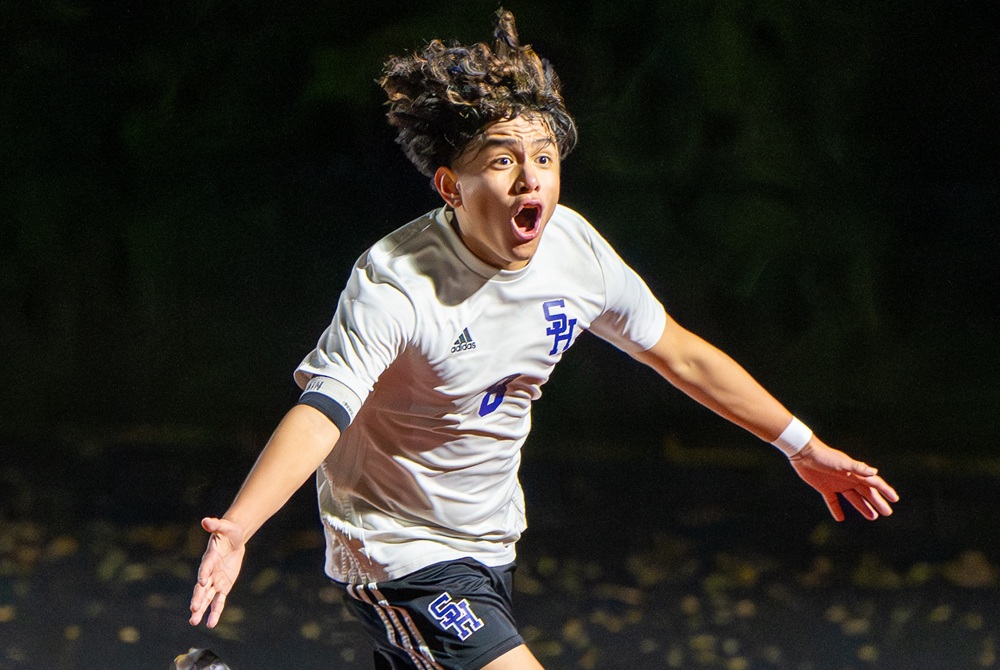
PHOTO Levi DeLaRosa celebrates during South Haven's 2-1 Semifinal win over Fremont on Wednesday. (Photo by Michigan Sports Photo.)