

Preview: Racers Seek to Double Up Again, Team Races Could See Another 1st-Time Champ
By
Geoff Kimmerly
MHSAA.com senior editor
March 12, 2026
An impressive sixsome could dominate championship lists – and storylines – at this weekend’s MHSAA Lower Peninsula Boys Swimming & Diving Finals.
Six swimmers will attempt to win multiple races for the second year in a row, and Otsego senior Liam Smith will pursue a third-straight two-title day as he looks to add to his career haul of five individual championships.
Last season’s Finals also saw a first-time team title winner, and could see one or more again this weekend. Annual contenders Ann Arbor Pioneer and Saline are expected to continue their season-long battle in Division 1, and Bloomfield Hills Cranbrook Kingswood is pursuing a fourth-straight championship in Division 3 but is ranked behind two potential first-time winners. The Division 2 team race includes two possible first-timers among the top three contenders as well.
Preliminaries at all three Finals sites begin at noon Friday, with Saturday championship events starting at noon as well. Both days of all three meets will be streamed live and viewable with subscription on the NFHS Network. For information on purchasing tickets, plus psych sheets, dive orders and more, visit the Boys Swimming & Diving page – and see below for a glance at several team and individual contenders to follow.
Division 1 at Oakland University
Reigning champion: Saline
2025 runner-up: Ann Arbor Pioneer
2026 top-ranked: 1. Ann Arbor Pioneer, 2. Saline, 3. Northville.
Saline broke Pioneer’s four-year hold on the championship last season with its first since 2013, and those two are expected to contend for the top spot again – with Pioneer the winner of both their regular-season dual and their Southeastern Conference Red championship meet this winter. Saline has all three relays and nine individual qualifiers seeded to score (among the top 16) this weekend, plus three strong divers competing, while Pioneer has all three relays and 11 individuals seeded to score and a diving contender as well. Northville finished runner-up most recently in 2022 and placed third last season, and will attempt to break into the top two with a solid group of all three relays and nine individuals seeded to score and a strong diver as well.
Issac Adanin, Saline junior: After winning the 100-yard breaststroke and 200 individual medley last season, he’s seeded second in both races in 56.13 and 1:50.72, respectively.
Benjamin Bricker, Troy senior: The top seed in the 200 freestyle (1:38.53) and third seed in the 100 backstroke (49.84) didn’t swim at the Finals last season but was a top-eight placer in both races as a sophomore in 2024.
Samuel Campbell, Milford senior: He’s seeded first in the backstroke (48.62) and fourth in the 200 freestyle (1:40.69) after finishing second in the backstroke and third in the 200 a year ago.
Charles Knoepp, Ann Arbor Pioneer junior: He’s looking to improve on last season’s third place in the 500 freestyle and seventh in the IM, seeded first in the 500 (4:28.21) and fifth in the 200 free (1:41.56) this time.
Trae Lewis, West Bloomfield senior: He’s the top seed in the IM (1:50.01) and second seed in the backstroke (49.60) as he heads to his first Finals, adding to a decorated club career.
Oliver Ottenwess, Grandville senior: The top seed in the butterfly (49.53) and second seed in the 200 free (1:39.62) after finishing third in the butterfly and fourth in the backstroke last year.
Baylor Perkins, Grand Blanc senior: He could make a big jump after finishing sixth in the breaststroke and 10th in the 50 freestyle last year, seeded seventh in the 50 this time and first in the breaststroke (55.59).
Brady Stenson, Northville senior: The reigning champion in the 200 freestyle and runner-up in the 500 is seeded second in the 500 (4:32.71) and third in the 200 (1:39.66) this time.
Camren Turowski, Detroit Catholic Central junior: He’ll be looking to add to individual championships in the 50 and 100 freestyles from last season and two relay titles from 2024, seeded first in the 50 (20.45) and 100 (44.58) this weekend.
Ann Arbor Pioneer 400 freestyle relay: An expected group of Knoepp, senior Edwards Zhang, junior Isak Woods and freshman Gavin Martens enters with a top-seeded time of 3:02.88 – with the all-Finals record 3:02.06 swam by Bloomfield Hills Broth Rice in 2014.
Joseph Rosales, Saline junior: He finished 16th in Division 1 diving a year ago but won his Regional last week with a Division 1-best 460.60.
Division 2 at Eastern Michigan University
Reigning champion: Detroit U-D Jesuit
2025 runner-up: Byron Center
2026 top-ranked: 1. Byron Center, 2. Detroit U-D Jesuit, 3. Portage Central.
Both Jesuit and Byron Center earned their highest places at a Finals last season, and the rankings say they’ll switch spots but maintain top-two finishes. Byron Center has all three relays and 16 individual seeded to score – including four top seeds – plus three divers competing. Reigning champion Jesuit has all three relays seeded among the top four in their events, 20 individuals seeded to score, and a diver competing. Portage Central is seeking its first top-two Finals finish and expected to rise significantly from 12th a year ago, with all three relays and 11 individuals seeded to score.
Anthony Kopinski, Dexter junior: He’s seeded first in the backstroke (51.46) and third in the butterfly (51.08) after finishing 10th in backstroke and seventh in the 200 freestyle in 2025.
Charlie McCuiston, Detroit U-D Jesuit junior: He won the 100 freestyle and swam on the championship 400 free relay last season, and could add to that haul seeded first in the 100 (45.25) and 200 freestyles (1:39.93) and swimming on the top-seeded 400 free relay (3:09.89).
Carter Nelson, Byron Center senior: The top seed in the 500 (4:36.46) finished sixth in that race and 12th in the 200 freestyle a year ago.
Ryder Nichols, Byron Center junior: He finished second in the breaststroke and also swam the IM last season and returns this weekend seeded first in the breaststroke (56.11), ninth in the IM and expected to swim on the top-seeded 200 medley relay (1:33.21).
Elliot Rijnovean, Birmingham Seaholm senior: He’s won the backstroke, butterfly and swam on the champion 200 medley relay the last two seasons, and enters his last Finals seeded first in the butterfly (50.60) and third in the 50 (21.44).
Joshua Webert, Livonia Churchill senior: He finished 12th in both the IM and butterfly last season, but is expected to move up substantially seeded first in the IM (1:54.76) and fourth in the butterfly (51.43) this weekend.
Lucas Witham, Grand Rapids Forest Hills Central senior: The top seed in the 50 (21.11) and fourth seed in the 100 freestyle (46.68) finished second in the 50 and fourth in the 100 last season.
William Blind, Portage Northern senior: The reigning Division 2 diving champion posted the highest score for all Division 2 Regionals last week at 492.20.
Division 3 at Holland Aquatic Center
Reigning champion: Bloomfield Hills Cranbrook Kingswood
2025 runner-up: Holland Christian
2026 top-ranked: 1. Holland Christian, 2. Spring Lake, 3. DeWitt.
Cranbrook has won the last three Division 3 championships but enters this weekend ranked No. 4, although the Cranes will pursue a four-peat with three relays top-seeded and nine individual qualifiers also seeded to score. Holland Christian is seeking to claim its first team title since winning Division 3 back-to-back in 2018 and 2019, and has finished runner-up three of the last five seasons. The Maroons have all three relays and 10 individuals seeded to score, plus two divers competing. Spring Lake and DeWitt both are seeking their first top-two Finals finish, Spring Lake entering with all three relays and 10 individuals seeded to score and DeWitt with all three relays and seven individuals seeded among the top 16, plus two divers competing.
AJ Farner, Bloomfield Hills Cranbrook Kingswood senior: The reigning champion in the backstroke and 200 free also has been part of four relay titles and enters this weekend seeded first in the breaststroke (57.17), sixth in the 200 and slated to swim on two top-seeded relays.
Sam Harper, Plainwell senior: He won the 500 and finished second in the 200 free last year and returns as the top seed in both at 4:40.01 and 1:41.99, respectively.
Jack Higgins, Detroit Country Day senior: He’s seeking repeats in the 50 and 100 freestyles seeded second in both at 21.53 and 47.51, respectively.
Kade Opsal, Adrian senior: After finishing second in the backstroke and tying for second in the 50 last year, he is seeded first in both in 50.10 and 20.98, respectively.
Jake Shoemaker, Holland Christian junior: He’s seeded first in the 100 freestyle (46.37) and second in the 200 (1:42.92) after finishing third in the 100 and third as well in the backstroke last season.
Liam Smith, Otsego senior: He’s won three straight championships in the butterfly and the last two in the IM, and enters his last Finals seeded first in both in 48.57 and 1:50.52, respectively.
Charlie DeHaan, Holland Christian junior: He finished third in diving last season but could give his team a repeat winner (Parker Schut) following graduated teammate after posting the top score at any Division 3 Regional last week by more than 60 points at 480.40.
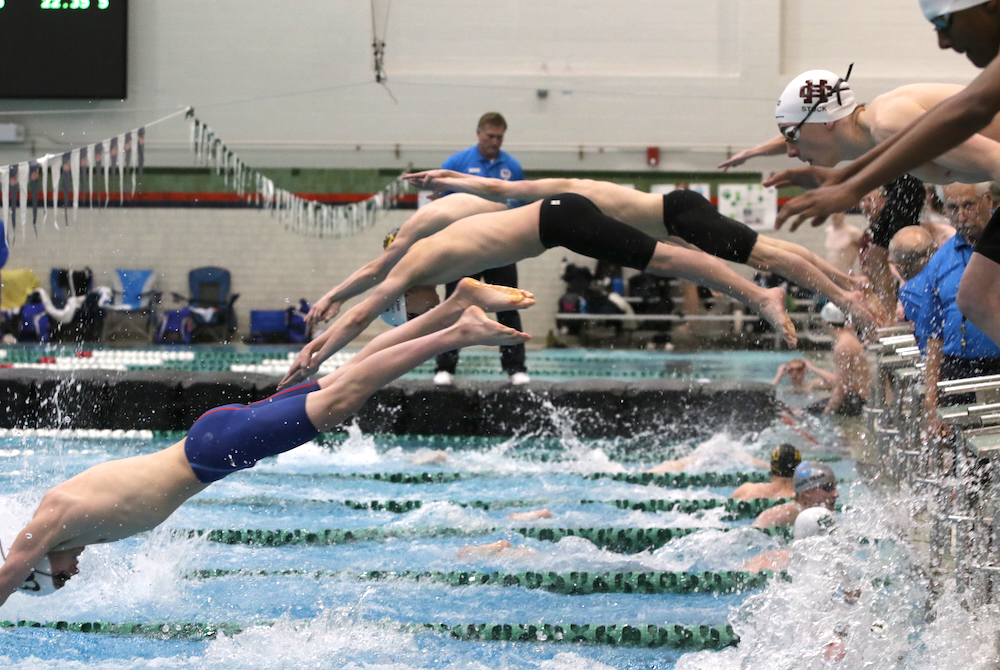
PHOTO Swimmers launch during a race at the 2025 Lower Peninsula Division 3 Final. (Click for more from High School Sports Scene.)
Preview: Team Titles Too Close to Call
By
Geoff Kimmerly
MHSAA.com senior editor
March 7, 2019
The races for team championships at this weekend’s Lower Peninsula Boys Swimming & Diving Finals could, as a group, finish as the closest in recent memory.
Both Division 1 and Division 3 have a pair of teams tied for the top spot in the rankings heading into Friday’s preliminaries. Meanwhile, Dexter is the three-time reigning Division 2 champion but extended its streak with a slim victory a year ago.
Preliminaries are Friday and Finals are Saturday, with action beginning at noon for both. All three Finals also will be streamed live and can be watched with subscription on MHSAA.tv. Click for lineups and seed times for all three meets, and see below for a number of team and individual contenders at all three meets.
LP Division 1 at Holland Aquatic Center
Reigning champion: Ann Arbor Skyline
2018 runner-up: Holland West Ottawa
2019 top-ranked: T-1. Holland West Ottawa, T-1. Detroit Catholic Central, 3. Birmingham Rice
Skyline won it first championship last season, breaking a four-year winning streak by Brother Rice. West Ottawa finished 67 points back, and a championship this weekend – the program’s first since 1971 – would be a crowning achievement for a senior class that has otherwise dominated. West Ottawa has 12 individual entries and all three relays seeded to score among the top 16, with five top seeds. Detroit Catholic Central has only one top seed, but 11 individual entries and all three relays seeded to score plus a diver. Rice has nine individual entries and three relays seeded to score, plus a diver. The Shamrocks are competing for their first MHSAA Finals title and finished seventh a year ago, while Rice finished third a year ago.
Hunter Gubeno, Howell junior – After taking fifth in the 500 last season, Gubeno is expected to climb the podium multiple times with the top seeds in that race by four seconds (4:33.82) and the 200 free (1:40.98).
Derek Maas, Holland West Ottawa senior – Maas won the 100 backstroke and finished third in the 200 individual medley as a junior and also swam on the champion 200 medley relay. He has the top seeds in the IM (1:52.73) and butterfly (50.23) and is expected to swim on the top-seeded medley relay (1:34.28) and fourth-seeded 400 free relay.
Liam McDonell, Birmingham Brother Rice senior – The top seed in the backstroke (51.93) also will swim the butterfly and on the 200 medley and 400 free relays. He finished 12th in the backstroke at last year’s Finals.
Henry Schutte, Grand Rapids Forest Hills Central senior – The four-time Finals champion sprinter is looking to add a few more titles to his two in both the 50 and 100 freestyles won the last two seasons. He’s seeded first in the 50 at 20.35 seconds, 34 hundredths off his all-Finals record 20.01 swam last season. He’s also seeded first in the 100 at 44.27 and is expected to swim on the third-seeded 200 freestyle relay and ninth-seeded 200 medley relay.
Khadin Soto, Holland West Ottawa senior – Soto finished sixth in the breaststroke and also was part of that medley relay championship in 2018. He’s seeded first in the breaststroke (56.17) and sixth in the 200 freestyle, and is slated to swim on the 200 medley and fourth-seeded 400 freestyle relays.
Holland West Ottawa 200 freestyle relay – Senior Sam Smith, juniors Gavin Temple and Jamahl Hogan and freshman Kevin Maas enter with the top seed time of 1:25.16, 1.48 seconds off the meet record swam in 2015 by Ann Arbor Pioneer.
William Henry Schirmer, Ann Arbor Skyline senior – Schirmer is seeking to finish his high school career with his third straight Division 1 championship. His Regional score of 529.20 was nearly 47 points higher than the rest of the Division 1 field, and he should make a run at the meet record of 528.45 achieved in 2015.
Division 2 at Eastern Michigan University
Reigning champion: Dexter
2018 runner-up: Rochester Adams
2019 top-ranked: 1. Dexter, 2. Birmingham Seaholm, 3. Birmingham Groves.
Dexter has won three straight Division 2 championships, last season’s by 21.5 points. The Dreadnaughts have 10 individual entries and all three relays seeded to score this weekend, plus two divers competing. Seaholm, which finished fifth last season, has 11 individual entries and all three relays seeded to score. Groves was third last season, 50.5 points off the lead, and could make a move with eight individual entries and three relays seeded to score, including a top seed.
Alexander Capizzo, Fraser junior – Capizzo won the 200 IM and 500 freestyle as both a freshman and sophomore. He’s the top seed in the IM (1:53.79) and the third seed in the 500 (4:41.08).
Niklas Eberly, Dexter senior – Eberly won the butterfly and 200 free last season and was on the winning 200 free relay. Switching things up a bit, he’s seeded second in the 50 (21.06) and first in the butterfly (49.13) and is expected to swim on the top-seeded 400 free relay (3:12.07) and fourth-seeded medley relay.
Jacob Grover, Byron Center senior – Grover is competing in Division 2 this weekend after finishing second in the breaststroke and fourth in the IM in Division 3 in 2018. He is seeded first in the breaststroke (57.61) and third in the IM (1:55.13) and will swim on the medley and 200 freestyle relays.
Eric Hieber, Walled Lake Western junior – After finishing ninth in the 200 free and fifth in the 500 last year, Hieber is expected to make a big jump. He’s seeded first in both races, at 1:40.68 in the 200 and by nine seconds in the 500 at 4:31.73. He also is expected to swim on the 200 and 400 free relays.
Luke Lezotte, Midland Dow junior – In his first season at Dow after moving from Florida, Lezotte will chase at least one meet record. He’s seeded first in both sprints – his 20.52 in the 50 is seven hundredths of a second off the record achieved in 2010 – and he’s seeded first in the 100 free (46.12) by more than a second. He’s also slated to swim on the top-seeded 200 free relay (1:27.38) and second-seeded medley relay.
Tyler Vo, Holland senior – Vo finished sixth in the backstroke last season but is seeded first in that race this weekend (52.23). He’s also seeded fifth in the butterfly (52.46) and expected to swim on the 200 free and medley relays.
Hunter Hollenbeck, Okemos junior – The reigning champion scored 548.40 to win his Regional by nearly 146 points, and his score was 90 higher than any other diver in Division 2. He scored 503.15 at last season’s Final and could make a run at the meet record of 537 from 2009.
Division 3 at Oakland University
Reigning champion: Holland Christian
2018 runner-up: East Grand Rapids
2019 top-ranked: T-1. Holland Christian, T-1. East Grand Rapids, 3. Spring Lake.
A year ago, Holland Christian broke Bloomfield Hills Cranbrook Kingswood’s four-year hold on the Division 3 title. East Grand Rapids is hoping to break a streak of three straight runner-up finishes by taking the next step. Holland Christian is talented and deep, with 15 individual entries and all three relays seeded to score (with two top seeds) plus a diver competing. East Grand Rapids also has 15 individual entries and three relays seeded to score, plus a diver. Spring Lake has only seven individual entries with its three relays seeded to score – but six top seeds and an opportunity to make things interesting at the top.
Jonas Cantrell, Mason sophomore – Cantrell is seeded first in the 500 (4:41.86) after finishing 14th a year ago. He’s also seeded third in the 200 freestyle (1:45.44) and slated to swim on the 400 free relay.
Andrew Dobrzanski, Milan freshman – Heading into his first Finals, Dobrzanski is seeded first in the IM (1:57.08) by more than two seconds and the breaststroke (58.01) by more than a second. He’s also expected to swim on the 200 medley and 400 free relays.
Kevin Losee, Spring Lake junior – Losee finished fourth in the 200 and 500 freestyles and as part of two runner-up relays in 2018. He’s seeded first in the 200 (1:43.99) and second in the 500 (4:48.07) and expected to swim on top-seeded 200 (1:25.27) and 400 (3:07.52) freestyle relays.
Cam Peel, Spring Lake senior – Last season’s champ in the 100 free (and third-place finisher in the 50) is seeded first in both with a 20.85 in the 50 and by two seconds with a 44.81 in the 100. The 100 time is 16 hundredths of a second faster than the meet record he swam last season. He’s also slated to swim on the top-seeded 200 and 400 free relays.
Riley VanMeter, Holland Christian senior – He finished second in the butterfly and backstroke last season and swam on two winning relays, and could lead a repeat run entering as the top seed in the butterfly (49.75) and third in the backstroke (52.60) and with spots on the second-seeded 200 and 400 freestyle relays. His butterfly time is six tenths of a second off the meet record set in 2015.
Joey Wachter, Spring Lake junior – After finishing fifth in the backstroke and ninth in the 100 free last season, Wachter also is expected to surge. He’s seeded first in the backstroke (51.15) and second in the 50 (21.09) and also will swim on the 200 and 400 free relays.
Spring Lake 200 freestyle relay – Wachter, senior Sam Sella, Losee and Peel enter with a 1:25.27 seed time, 2.25 seconds off the meet record achieved in 2016.
Spring Lake 400 freestyle relay – Freshman Charles Brown along with Losee, Wachter and Peel have a seed time of 3:07.52, exactly three seconds off the meet record swam by Holland Christian a year ago.
Caden Petrak, St. Johns senior – The reigning champion won his Regional with a score of 467.85, although it was only the second-highest in Division 3 behind that of East Grand Rapids’ junior Nicholas Merritt (478.45).
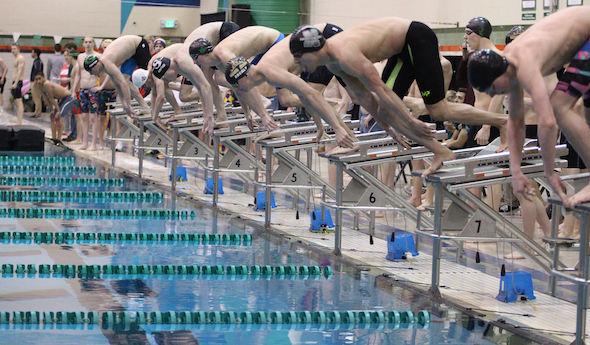
PHOTOS: Swimmers prepare to launch at the start of a championship race at the 2017 Lower Peninsula Division 2 Finals. (Click for more from HighSchoolSportsScene.com.)