

Armada's Fredette Receives NFHS Honor
January 16, 2020
By Geoff Kimmerly
Second Half editor
Longtime Armada tennis coach David Fredette has been named one of 23 National Coaches of the Year for 2018-19 by the National Federation of State High School Associations (NHFS) Coaches Association.
Fredette was selected first at the state level and then from among the eight sections that make up the NFHS – Michigan is part of Section 4 with Illinois, Indiana, Iowa and Wisconsin.
The following brief bio includes an excerpt from Fredette’s coaching philosophy, which nominees were asked to submit after being identified as candidates for the awards.
 David Fredette began Armada’s tennis program in 1966 and coached the boys team through the 2018 season. He led more than half his teams over the years to the MHSAA Finals, and 17 to top-10 finishes at the championship meet – including four straight from 2009-12. He also was a major contributor during the early days of the Michigan High School Tennis Coaches Association, and began serving on its board in 1982. Four times he was selected MHSTeCA state Coach of the Year: in Class C-D in 1982, Class B in 1992, and as one of two selections in Division 4 in both 1998 and 2018. Fredette was inducted into the MHSTeCA Hall of Fame in 1988. Armada’s tennis courts are named for him.
Fredette played tennis at Dowagiac High School and then Benton Harbor Community College. He also coached basketball and football during his time at Armada.
“Athletics give students a chance to become student-athletes, which means athletics teach athletes discipline, a strong work ethic, and cooperation with others. Athletics teach athletes how to not only compete, but how to handle both winning and losing. … I know that students who play sports upon graduation are more prepared to face the challenges that life presents them. While I always expected my players to work hard, I wanted my athletes to enjoy the experiences on and off the courts. My former players tell me how much they enjoyed competing, but also how much fun they had on the trips we went on together, whether it was to play top competition across the state of Michigan or on the Florida trips I took my boys teams on over Easter vacation from 1989 through 2001 to practice and bond as a team. Athletes learn how to compete, but they also gain friendships that last a lifetime, if only in their memories.”
Four more Michigan coaches earned honors in Section 4. Brighton girls swimming & diving coach Jason Black led the Bulldogs to a Lower Peninsula Division 1 Finals runner-up finish in Fall 2018, its best placing in program history. Dexter boys swimming & diving coach Michael McHugh was selected for the second-straight year as a Section 4 winner after leading his team to its fourth-straight Lower Peninsula Division 2 championship last winter. Battle Creek St. Philip volleyball coach Vicky Groat at one point guided the Tigers to nine Class D championships in 10 seasons from 2005-14 and is the sixth-winningest coach in MHSAA volleyball history with a record of 1,154-262-93. Bloomfield Hills Academy of the Sacred Heart co-coach Judy Hehs helped lead that program to its second-straight Lower Peninsula Division 4 championship this past fall, its sixth title in eight seasons, in her final tournament before retirement. She previously was named NFHS Coaches Association National Coach of the Year for girls tennis in 2016.
The NFHS has been recognizing coaches through an awards program since 1982. Winners of NFHS awards must be active coaches during the year for which they receive their award.
Stoney Creek Leaders Speak Up to Save Lives
May 26, 2017
By Geoff Kimmerly
Second Half editor
The crowd for Rochester Hills Stoney Creek’s boys basketball game against rival Rochester was as rowdy as could be hoped for most of the evening Feb. 28.
 But it fell silent during halftime as Stoney Creek juniors Nate Davis, Kevin Price and Isabella Ubaydi spoke of how suicide had affected them and their community.
A student had committed suicide every year during their high school careers – including Price’s brother just six months before.
All three are members of the school’s Cougar Athletic Leadership Council, which put on the Suicide Prevention Awareness basketball game not only to raise money for the American Foundation for Suicide Prevention, but also to start the conversation on a sensitive topic that has hit home.
“We wanted to get the word out that it’s OK to talk about these issues – help the topic get out of the dark,” Ubaydi said.
“It was insane. It was awesome. There were so many people. Our student section area where we all sit was filled up to the top row. There were a lot of people from the community who didn’t go to Stoney Creek, or have alumni (associated with the school) or anything like that. But they were at Stoney Creek, and it was great to show people actually care in our community.”
The leadership council is a club made up of Stoney Creek athletes who coordinate special events, including for athletics, with an eye especially on helping the community’s youth, elderly and those with disabilities. Ubaydi, Price and Davis are co-chairs of the CALC’s special events committee.
The tragic circumstances of the last three years led the group to bring suicide prevention to the forefront. While Ubaydi spoke mostly about why the event was held and how donations would be spent, Price and Davis (Price’s best friend) talked about how suicide had affected them personally. “You could hear a pin drop,” Ubaydi said. “After we were done, (the crowd) gave a standing ovation.”
CALC raised nearly $3,500 selling T-shirts that also included free student admission to the game. After Ubaydi, Price and Davis spoke, buckets were passed through the crowd during a “miracle minute” and filled with another $1,200.
All profits from the night, including $500 from concessions, were donated to the American Foundation for Suicide Prevention, and Ubaydi said the $1,000 from the Community Service Award also will be sent to AFSP.
She’s since heard stories from teachers of classmates coming forward to express worries about people in their lives, a sign awareness is paying off. At the same time, Ubaydi and her co-chairs are just as concerned about people who didn’t attend the Suicide Prevention Awareness game and might be experiencing troubles in their lives – but the hope is the event spoke loudly enough to be heard by anyone who needs help.
All three leaders are juniors beginning to contemplate their futures after high school; Ubaydi is leaning toward Roanoke College in Virginia to study political science and minor in theology, while Price is considering Michigan State to study environmental science and Davis is looking at options for pre-law or political science. They hope to host the suicide prevention event again as seniors before they graduate, with future CALC students then carrying on the mission.
“Suicide is an uncomfortable topic to talk about. Since people saw us relating to how it has affected us personally, the community will become comfortable discussing mental illnesses together,” Ubaydi wrote in CALC’s award application.
“I wanted to have this event so people understand that the influence that one person can make may be life-changing. This then causes them to be there for others, see the signs quicker, and save more lives.”
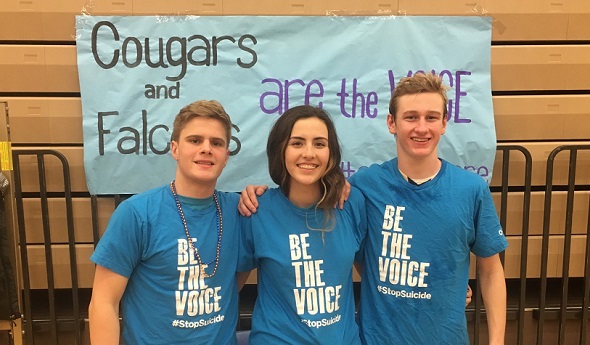
PHOTO: (Top) Cougar Athletic Leadership Council leaders Kevin Price, Isabella Ubaydi and Nate Davis show their shirts from the school’s Suicide Prevention Awareness night. VIDEOS: (Top) State Champs! Network covered the event and interviewed its organizers. (Below) Davis, Ubaydi and Price speak during halftime, also filmed by State Champs! Network.
2017 Community Service Awards
Sunday: Colon "Yard Squad" - Read
Monday: Bailey Brown, Brighton - Read
Tuesday: Justice Ottinger, Newaygo - Read
Thursday: Katie Sesi, Ann Arbor Huron - Read
Friday: Nikki Sorgi, Utica Ford - Read
Friday: Cougar Athletic Leadership Council, Rochester Hills Stoney Creek - Read