

Performance: Dow's Varun Shanker
October 20, 2016
 Varun Shanker
Midland Dow senior - Tennis
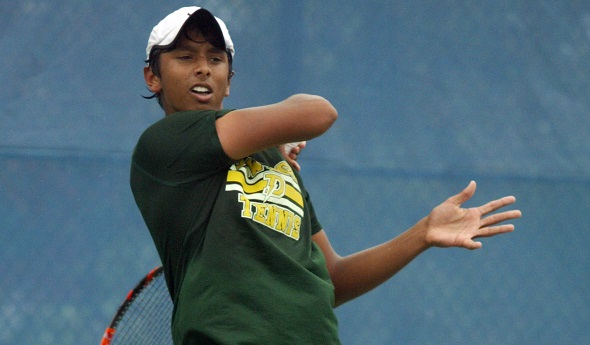
Shanker finished an incredibly successful and in ways unprecedented career Saturday by winning the No. 1 singles championship at the MHSAA Lower Peninsula Division 2 Final while leading the Chargers to their first team championship since 2013. Shanker became the first No. 1 singles champion for his school's prestigious program since 1999 and finished 32-1 this season in earning the Michigan National Guard “Performance of the Week.”
This was Shanker’s third season at No. 1 singles; he also won No. 3 singles as a freshman as Dow earned a fifth straight Division 2 team title. The next fall, Shanker became the first sophomore captain in Chargers history, and as a sophomore and junior he made the Division 2 semifinals at the top flight. But this fall was special; Shanker’s only loss was to Birmingham Groves’ Gabe Liss, who Shanker came back to beat two weeks later, and total his season sheet included victories over four of the top-six seeded players in Division 2 and three of the top five at the Division 1 Final including eventual champion Steven Forman of Troy. Shanker had 11 wins over players considered among the top 100 in their age groups in the Midwest, including a 7-6 (6), 3-6, 7-6 (8) nail-biter over Kalamazoo Loy Norrix freshman Reed Crocker in Saturday’s championship match. Shanker finished 115-19 over his four varsity seasons.
 Shanker followed into the program his brother Vikram, a 2014 graduate who remains tied for second in MHSAA history with 132 career doubles wins and who was named an MHSAA/Farm Bureau Scholar-Athlete Award winner as a senior. Similarly, Varun has a 4.0 grade-point average (4.79 weighted) and is a National Merit Scholarship semifinalist. He’s been part of teams that have won three first-place A.H. Nickless Innovation Awards and a total of $135,000 in scholarship and grant money for work in water purification by electrodialysis, piezoelectric devices and microbial fuel cells. He’s contemplating studying biomedical engineering as he considers opportunities for academics and tennis at the next level.
Coach Terry Schwartzkopf said: “As Dow’s only three-year captain in history, Varun demonstrated the character, drive, determination, and dedication needed in order to claim a championship. In terms of community, he has organized beautification projects within Midland and participated providing free tennis clinics in the tri-cities. He has handled grant applications for team income, ordered inventory including uniforms and warm-ups, and handled media relations. As for athletics, we have had talented teams who won championships based on the depth of talent. This year, it was based upon work and improvement. Varun spent the offseason corralling kids, encouraging them to train, and even offering rides when needed. During season, he would work daily with players individually, deconstructing and rebuilding pieces of their game. He ... worked more as an assistant coach than a player. Varun unified, inspired, and took players to task when needed. He had no issue calling out players due to lack of effort and praising those who worked hard. In 17 seasons as a coach, Varun is without a doubt the strongest captain I have ever had. There was never a single time in four years where I questioned his loyalty to the program, his drive to succeed, or his willingness to give all he had to help his team succeed. In fact, I have never wanted a player to win a championship more than him because that was never his focus. From the beginning, his focus was team. He was content that if he played his best he would be satisfied with his outcome, provided the team was successful."
Performance Point: “Coming into the tournament as the one seed, there’s always a little pressure,” Shanker said. “For me, this year was different. This year, I knew, was my chance, that I could do something special. That I could fulfill my dream of always winning the one singles position. I knew I’d have tough opponents to play in the tournament, but I definitely came in with a focused mindset, and obviously it’s tough to not reflect on that last match, those last few points. … I was down two match points, and he literally needed one point to win twice. I want to say my back was against the wall; that’s as close as it’s going to be. To me, it was about believing. I saw my teammates cheering for me; I saw my coach. I saw it was (about) way more than one match, but all the support, and I was able to find it in myself to get a little bit tougher and mentally to be able to pull it out. The support was unbelievable.”
Dow dynasty: “It’s been unbelievable. We had a tradition of excellence here when I came in as a freshman; we had won four consecutive state titles. When I finally joined the team freshman year, I was finally able to understand why it’s like that. Coach instills hard work and preparation, and that was the reason we were able to achieve that. As my career progressed, I was able to learn what some of the things are that are able to make us successful, what some of the things lead to. During my four years, we had a lot of ups and downs – that’s definitely fair to say. My sophomore year, actually, we were supposed to win the state title (Dow finished third). It was a little bit of a letdown to walk away, but that definitely fueled the next few years. We learned how to get back up and dust ourselves off.”
 Vikram’s lead: “My brother has had the biggest impact on my life, sports, academics – pretty much every facet of my life, and I do credit him for a lot of this. Growing up, the first reason I picked up a tennis racket was him. I was always big into swimming, but ever since he picked up a racket, I followed suit. He’s a great supporter and has always been a great coach for me.”
Name on the shirt: “High school tennis always has been one of my most favorite parts of the year. Being able to combine the team element to (tennis), it’s hard to describe, but it really enhances it being able to share the process with a group of teammates, both practice and competition. It truly does become a team sport. Representing my school and the community has been a favorite part of high school, rather than just playing as an individual on the USTA circuit. The community in Midland has helped us a lot in becoming great athletes, especially the Midland Tennis Center. Being able to represent playing for my school, it allows me in a certain way to represent the great things they’ve helped us (accomplish).”
Dr. Shanker: “I’m not sure whether I want to go into biotechnology; I definitely always have aspired to be a doctor. I just love that being a doctor, you’re able to help people, but you’re also on the cutting edge of science. That always has been really intriguing to me.”
- Geoff Kimmerly, Second Half editor
Every week during the 2016-17 school year, Second Half and the Michigan National Guard will recognize a “Performance of the Week" from among the MHSAA's 750 member high schools.
The Michigan Army National Guard provides trained and ready forces in support of the National Military Strategy, and responds as needed to state, local, and regional emergencies to ensure peace, order, and public safety. The Guard adds value to our communities through continuous interaction. National Guard soldiers are part of the local community. Guardsmen typically train one weekend per month and two weeks in the summer. This training maintains readiness when needed, be it either to defend our nation's freedom or protect lives and property of Michigan citizens during a local natural disaster.
Previous 2016-17 honorees:
Oct. 13: Anne Forsyth, Ann Arbor Pioneer cross country – Read
Oct. 6: Shuaib Aljabaly, Coldwater cross country – Read
Sept. 29: Taylor Seaman, Brighton swimming & diving – Read
Sept. 22: Maggie Farrell, Battle Creek Lakeview cross country – Read
Sept. 15: Franki Strefling, Buchanan volleyball – Read
Sept. 8: Noah Jacobs, Corunna cross country – Read
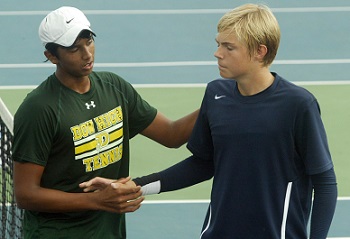
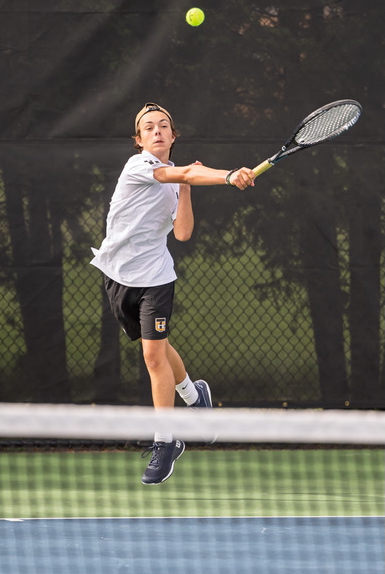
PHOTOS: (Top) Midland Dow's Varun Shanker follows through on a return during his No. 1 singles championship match Saturday. (Middle) Shanker shakes hands with Loy Norrix's Reed Crocker after securing the title. (Click to see more from HighSchoolSportsScene.com.)
'House Larry Built' Celebrates Nykerk's Work Constructing TC Central Tennis
By
Tom Spencer
Special for MHSAA.com
September 26, 2025
Legendary.
 If you don’t know much about the history of Traverse City Central tennis, all you have to do is take a stroll through the newly-renovated and named Larry Nykerk Trojan Tennis Center.
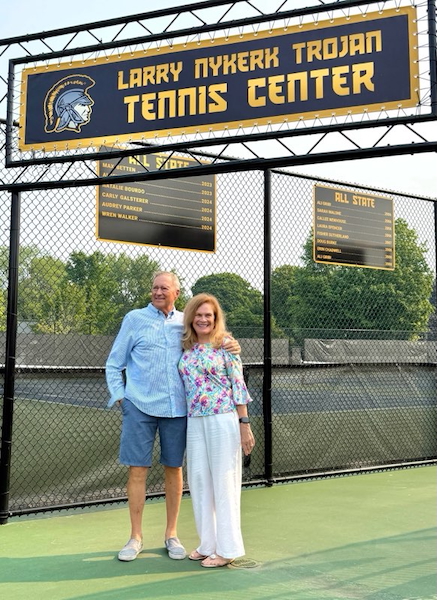
The facility was named after the long-time coach as this season commenced.
Nykerk, whose tennis legacy in Traverse City reaches back to 1968 when he launched a brand-new junior varsity boys tennis program at Central, is thrilled and honored to have the 12-court complex named after him.
He’s proud a local media organization dubbed it the “House Larry Built.”
But he’s even prouder of the program’s rich, successful history and a label many placed on the Trojans before they were a part of a conference and had to travel a long way to find suitable competition.
“We were independent for so many years from about ‘87 till maybe ‘97, and maybe even more than that,” Nykerk explained. “We were the ‘Notre Dame of the North’ in a lot of sports because we were independent and we were a dominant state, elite tennis power for all those years — on the girls side in particular.”
Central’s girls program is currently riding a streak of 43 years qualifying for the MHSAA Finals. The boys have qualified for the Finals 18 straight seasons.
The program’s current coaches are feeling a little bit of pressure to keep the streaks alive as they see Nykerk’s name every time they hit the home court.
During his tenure at Central, Nykerk won regional coach of the year honors 28 times, was named Michigan tennis coach of the year thrice (in 1984 and 2007 for boys tennis, and in 1997 for girls), and was shortlisted for national coach of the year in 2011.
“What am I most pleased with looking back at the accomplishments for what we did in the program is just the continuity of success,” Nykerk said. “It's not just one time with a good team, not just with the guys or just with the girls, but just the overall program that was up their top five, so many years.”
Nykerk coached the Trojans to 40 Regional championships. He had 13 players win individual Finals championships, and 65 players had 100 wins or more.
He retired once before returning to coach the Trojans. Today he’s a big supporter of the program and his successors — Casey Christensen on the boys side and Lisa Seymour on the girls.
 “I would consider him our number one supporter,” said Christensen, now in his fourth year at the helm of the Trojans. “He comes to our matches and watches and supports the team. He put so much work into the entire process of the renovations of the courts. I don't think a lot of people realize that he has been a part of court renovations and sport promotion not only for our program specifically at Traverse City Central, but for the sport of tennis and the greater Traverse City area and statewide.”
Christensen stepped into the Trojans program after Shane Dilloway’s seven-year run coaching the boys and girls teams at Central. Dilloway was an assistant coach under Nykerk.
Today, Christensen is humbled to be a part of Trojan tennis.
“What a legacy to be able to have his name there and for us to be part of it but also to just be part of this greater story that goes so far beyond all of us,” Christensen said. “We’re competitive regionally, and at the state level and conference, but 18 years in a row of the state tournament? I don't know if there's a longer streak out there — there probably is — but it is a testament to our program’s consistency.”
Christensen is continuing Nykerk’s legacy and the boys program’s success. He guided the Trojans to a ninth-place finish at the Lower Peninsula Division 2 Final last fall.
“We graduated a lot a lot of experienced guys,” Christensen said. “And so the challenge for us this year has been re-tooling the roster with some first-year guys, but a lot of them are seniors. It's a challenge in that we only get them for a year and the season is so compact, but it's also an advantage because when you get older guys, that comes with emotional maturity and physical maturity, too, for sure.”
The Trojans do have six players back with high hopes of repeating last year’s first-place finish at the Regional. Alex Lamphier is now a senior and playing No. 1 singles. He won the Regional individual title at No. 2 in 2024.
Holden Berry, a doubles player last year, is now the Trojans’ No. 2 singles player. Also back are doubles partners Nate Brewer and Chris Girrbach and Helly Taylor and Oliver Christensen.
Strong competition early actually spoiled things a bit, handing the Trojans a few losses.
And while they have their newly-renovated courts named after Nykerk, they’re still traveling far to play the best competition they can.
“We're not afraid to go and play anyone,” Christensen said. “And we're kind of road warriors, man. We're on the road a lot. In order to do well in states, you need to play the Ann Arbors and the Midlands and Portage Northern.”
The Trojans traveled across town twice this week en route to their 22nd-straight Big North Conference championship. The event took place over two days due to weather conditions. Petoskey and Cadillac finished three and four points, respectively, behind the Trojans at the conference meet.
Taylor and Ollie Christensen led the way winning the No. 1 doubles crown. Brewer and Girrbach captured the No. 2 doubles title, and Brady Johnson and Henry Yonts came out on top in No. 4 doubles.
 “Doubles play was great for us today, but our singles contributed too,” Christensen said moments after the 22nd-straight conference title. “We got points from every play, which is, I think that's ultimately what pushed us over the top.”
Lamphier and Berry helped secure the title with conference runner-up honors, both pushing their matches to 10-8 tie-breakers.
The Trojans now have their sights on the Division 2 Regional at the Midland Tennis Center. Midland Dow is the favorite the win the October Regional. Central expects to be in the mix for one of the other Finals-qualifying spots to keep the streak alive.
In addition to Big North foes Alpena and Traverse City West, the Regional will feature the host Midland Dow, Bay City Western, East Lansing, Flushing, Midland High and Mount Pleasant.
“East Lansing got added to our Regional and they’re historically pretty tough,” Christensen said. “Midland Dow is the cream of the crop, and the rest of us are just kind of playing catch up from there. It's going to be a dogfight for those second and third spots in the region to get automatically to states.”
And while the boys get the first chance to keep their streak alive, the girls are already feeling a little pressure to do the same in the spring.
Lisa Seymour, a former assistant coach under Nykerk at Central and varsity coach at West, heads up the girls program. She took over the Trojans girls in 2022.
And Seymour is thrilled the courts now bear Nykerk’s name.
“It just was such a natural thing for them to name the courts after him because they really are, you know, his courts,” she said. “Obviously he's a legend up in the Traverse City and Northern Michigan region. Even downstate, people and coaches knew him and some of the ones that are still coaching still do.”
The timing of naming the courts after Nykerk may add to the excitement this spring. The girls will be a young team after graduating 16 seniors last season.
“I don't want to say it's a pressure thing, but it's always in the back of your head — a lot of coaches don't ever experience getting to states,” Seymour said, noting the younger players did win the JV conference championship last year. “I don't want to call it a rebuilding year. We do have some really good foundational things in place.”
 Tom Spencer is a longtime MHSAA-registered basketball and soccer official, and former softball and baseball official, and he also has coached in the northern Lower Peninsula area. He previously has written for the Saginaw News, Bay County Sports Page and Midland Daily News. He can be reached at [email protected] with story ideas for Manistee, Wexford, Missaukee, Roscommon, Ogemaw, Iosco, Alcona, Oscoda, Crawford, Kalkaska, Grand Traverse, Benzie, Leelanau, Antrim, Otsego, Montmorency, Alpena, Presque Isle, Cheboygan, Charlevoix and Emmet counties.
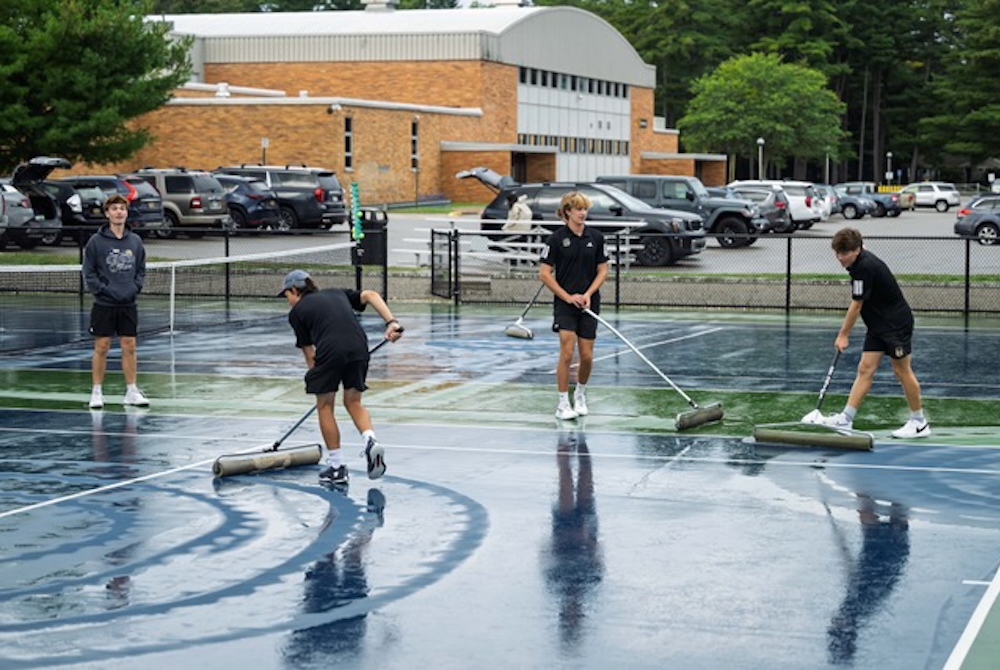
PHOTOS (Top) Traverse City Central tennis players clear water from the Larry Nykerk Trojan Tennis Center courts this fall. (Middle) The facility was named after the longtime Central coach, who began coaching tennis at the school in 1968. (Below) A Trojans player sends back a volley. (Athlete photos by TC Rick Sports Photography. Nykerk photo courtesy of the Traverse City Central athletic department.)