

Aspirations High as Reigning Champion Hackett Vaults Into New Season
By
Pam Shebest
Special for MHSAA.com
March 14, 2023
KALAMAZOO — Harrison Wheeler has not been a pole vaulter for very long – two weeks to be exact – but he already has some lofty goals.
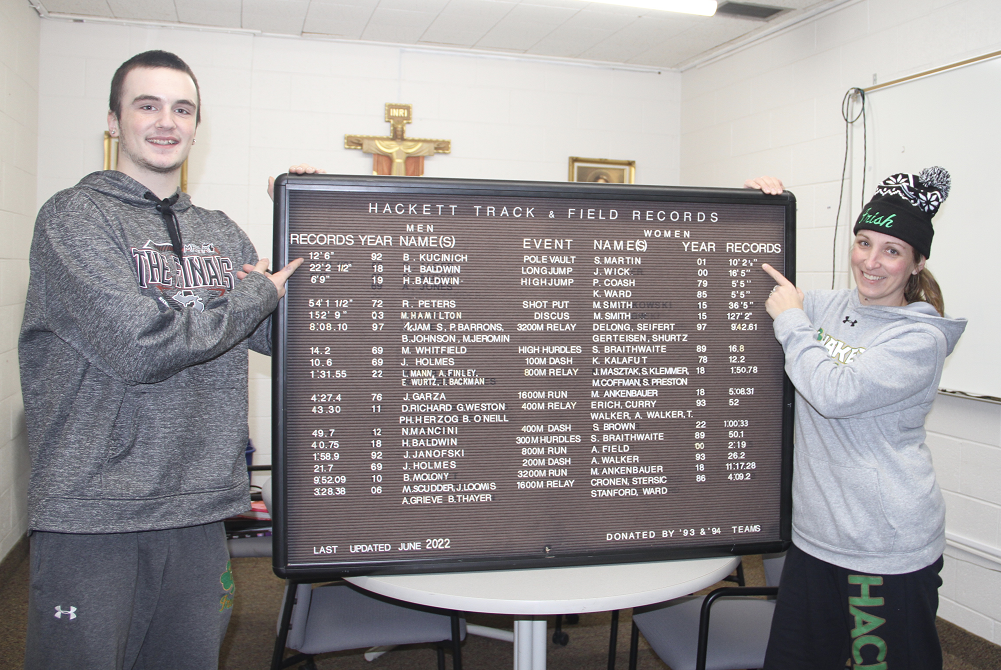
 The sophomore is aiming for the Kalamazoo Hackett Catholic Prep record board and, if he makes it, he will be in good company.
Coach Shelly (Martin) Germinder, a 2001 Hackett graduate, still holds the girls record of 10 feet, 2½ inches.
“I’m hoping to have my name next to hers (on the record board),” Wheeler said.
The sophomore has a few feet to go before surpassing current record holder Brian Kucinich, who vaulted 12 feet, 6 inches in 1992.
Wheeler’s unofficial best is 9 feet; officially it is 8 feet, 6 inches.
“That is going to be a very big jump in my pole vaulting career,” he said.
Wheeler is one of 42 athletes on the reigning MHSAA Lower Peninsula Division 4 champion boys team, which includes 12 seniors and 13 juniors. Besides Wheeler, the team has six sophomores and 10 freshmen.
One of the returners is senior Liam Mann, who helped lead the Irish to the Finals title last year.
Mann, Andrew Finley, Evan Wurtz and Isaac Backman won the 800-meter relay with a time of 1:31.55 last season, setting a school record as well.
While he lost his relay mates, Mann said there are good runners to replace them.
“(Senior) Brice Brown is coming out to do track, and I’ve been working with him this winter,” Mann said. “Jude Coffman, who is a sophomore, is coming out this year. I think he’s going to be a good addition to our 4-by-1.
“(Junior) Gabe Oeurn, last year he was running solid times, but this year he’s been putting in the work and I think he’ll be able to break that 12-second barrier.”
Mann, who will attend Ashland (Ohio) University on a track scholarship in the fall, also added gold in the 200-meter dash (22.82) last season.
“Last year, I played basketball and was able to lift to keep in shape,” he said. “This year, I wanted to focus all my time on track, so I’ve been doing indoor track, practicing once a week and going to meets on weekends.”
He continued to put his skills on display as a running back during football season with Kalamazoo United, ending the fall with 1,413 rushing yards on 177 carries and 267 receiving yards on 10 catches.
Opportunities & possibilities
The biggest group of competitors impacted by graduation are the sprinters, coach Charissa Dean said.
“Hackett’s been really big on sprinting talent in general,” she said. “But track has 17 events, and only two of them are open sprint events and two are relays.
 “The other 13 are wide open for possibilities, and there’s a lot of younger talent that’s coming back this year. While they didn’t go to the state meet, they are the next generation of athletes coming up.”
Among that next generation are freshmen Marek Butkiewicz and Sean Siems, who “are incredibly talented athletes,” Dean said.
“(Junior) Gavin Sehy figured out how to do the distance thing this year in cross country.”
Sehy said he wanted to run track, but wasn’t sure where he fit.
“I thought I was mid-distance when I was younger, but my dad forced me to do cross country my sixth-grade year and it turned out I was decent at it so I kept doing (long distance) in track,” he said.
“It’s kind of brutal at times to train for long distance, mentally and physically, because you have to go on long runs, but I have fun with it. At the cross country state finals, I hit an 11 flat split at the two-mile, which beat my 3,200 best from last season, so we have yet to see my best times.”
Butkiewicz and Sehy have been running consistently six days a week all winter to prepare for their first meet, March 22.
“I’ve never done track,” the freshman said. “I know I can perform well. I know my times compared to other people.”
A sophomore this year, Alex Dumont had a 400-meter time that “came out of nowhere,” Dean said. “Toward the end of the season we recruited him to do the 4x8, so an 800-meter runner. That kid came through.
‘We actually took him to the state meet in the 4x8. He did the lead leg, and I clocked him at a 2:07. He was sprinting. It was an amazing leg in that relay.”
Seeing potential
It was Germinder who converted Wheeler to the pole vault last year.
“Harrison’s a strong athlete, and just the way his mind works in that he asks questions and he wants to learn and he wants to improve,” she said.
“He wants to work hard, and he wants to put in the time. That’s something you need for that, along with the athletic component.”
 Wheeler, who said he was shocked at being successful right away, competed for two weeks last season before a foot injury suffered on a vault sidelined him.
“It took her a whole season to finally convince me to do it,” he said. “I grabbed a pole one day and ended up being really good at it. Ever since, I’ve had a love of it.
“The feeling I have once I get in the air is almost like I’m just floating. When you get really good vaults and you get that nice height and good form, you get what we call a ‘stall.’ You just feel like you’re sitting up in the air for a second. It’s gotta be the coolest thing ever.”
Germinder has the background to help the Irish vaulters.
While at Hackett, she competed in the AAU National Championships and said she learned from the best, Oran Mitchell, a noted pole vaulting coach.
Her own coaching style revolves around the safety of the athletes.
“You can teach a lot of people to grab hold of a pole and pop yourself over,” she said. “But I want to make sure my athletes are safe. That’s really, really important to me, and that’s something that was instilled in me.
“When you’re jumping 6 to 16 feet, that’s a long way to fall. Safety is very important to me. If you’re not willing to put in the time, then I’m not the coach for you.”
Germinder said one of the foundations on which the team is built is leadership, which was instilled in the younger athletes by last year’s seniors.
“That’s one of the things our program is built on,” she said. “If you’re there because you want to get ready for the next sports season, we’ll coach you for that.
“If you want to be a state champion, we’ll coach you for that. That’s the really unique thing about track. There’s something for everyone, whatever that might be.”
As for the girls team, numbers are steadily climbing.
Five years ago, the team had just two girls. This year, 25 girls are on the team.
No matter girls or boys, track or field events, one thing is common for all the athletes.
“We pray before every meet, we put God first, and all those pieces have fallen into place for us.” Germinder said.
“I really believe that foundation is what is going to be our success this year. It’s there, it’s just a different team.”
 Pam Shebest served as a sportswriter at the Kalamazoo Gazette from 1985-2009 after 11 years part-time with the Gazette while teaching French and English at White Pigeon High School. She can be reached at [email protected] with story ideas for Calhoun, Kalamazoo and Van Buren counties.
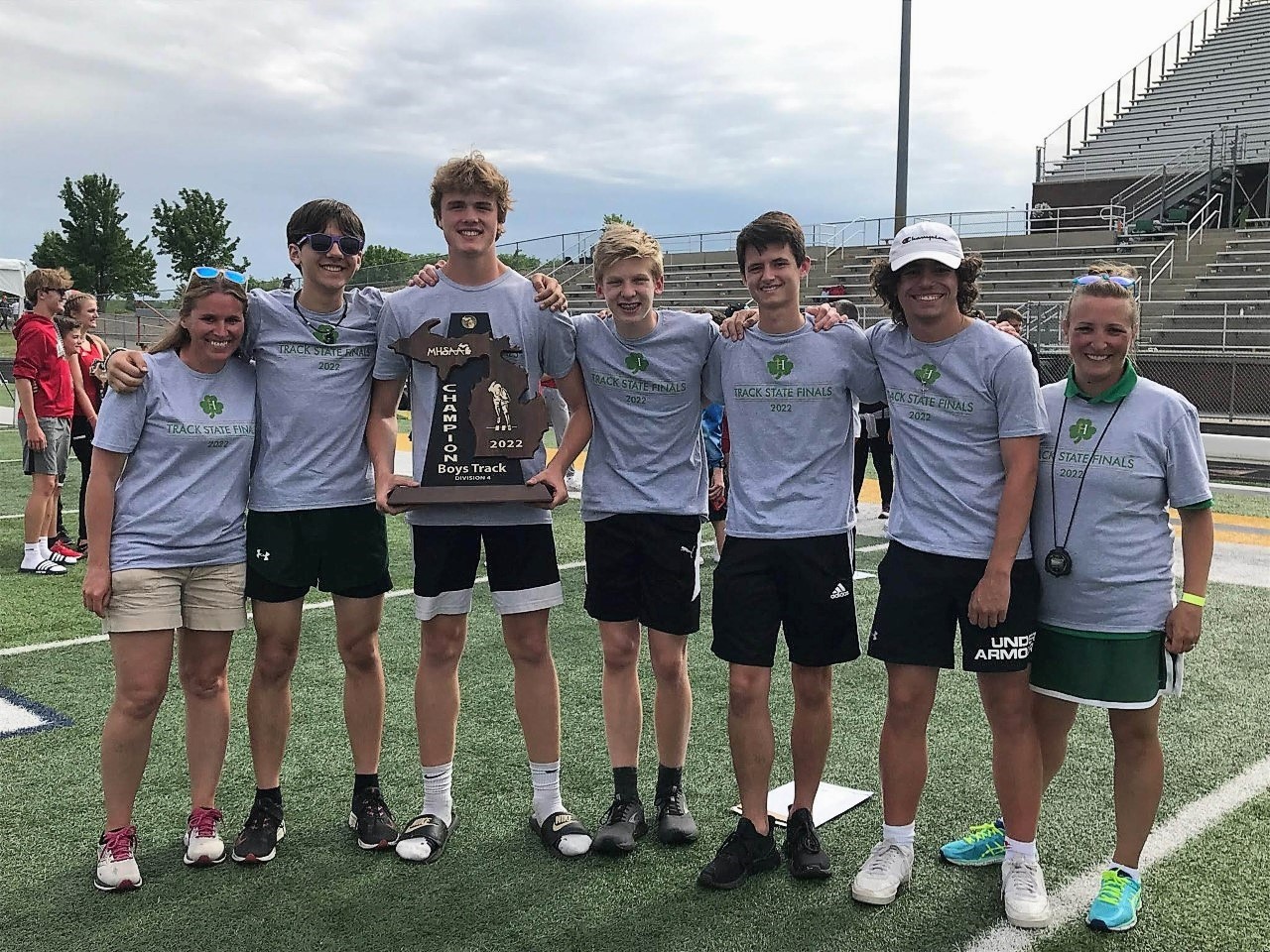
PHOTOS (Top) Hackett's Harrison Wheeler points to the pole vaulting record he hopes to break this season, while pole vaulting coach Shelly (Martin) Germinder points to the record she still holds at the school. (Middle) Clockwise from top left: Hackett head track & field coach Charissa Dean, Liam Mann, Germinder and Gavin Sehy. (Below) The Irish celebrate last season’s Finals championship, from left: Dean, Sehy, Logan St. Martin, Alex Dumont, Mitch Eastman, Nick Doerr and Germinder. (Top photo and head shots by Pam Shebest; team photo courtesy of Hackett track & field.)
Performance of the Week: East Kentwood's De-Mani Roberts
May 28, 2026
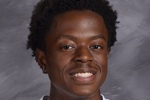 De-Mani Roberts ♦ East Kentwood
Sophomore ♦ Track
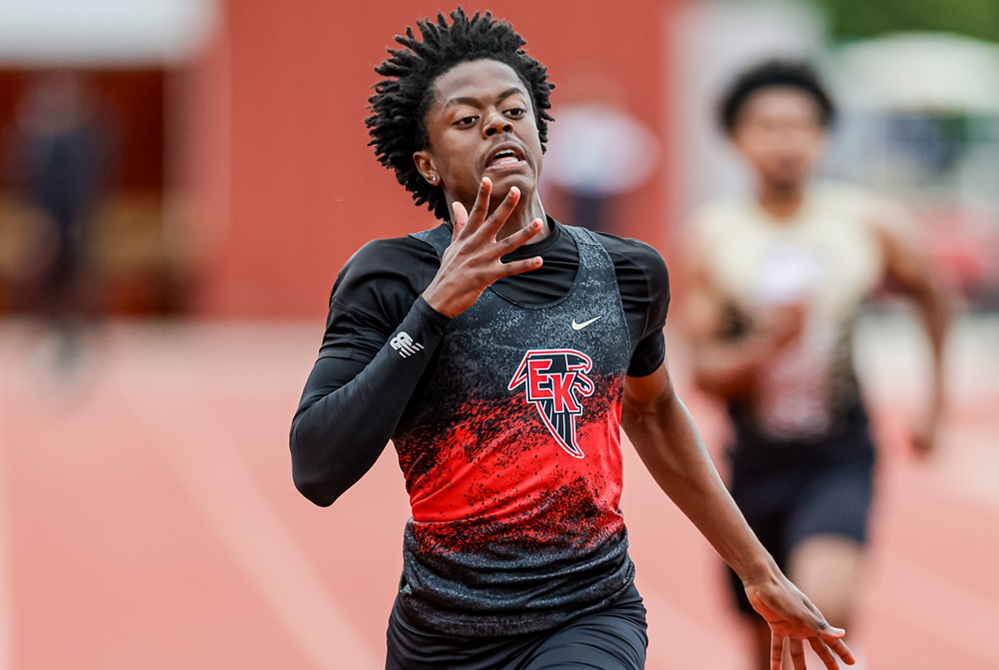
Roberts has made impressive strides in the second season of high school outdoor track, cutting nearly a half-second off his top 200-meter time from a year ago and more than a second off his freshman-year best in the 400 in helping East Kentwood become a favorite to win the team championship at Saturday's Lower Peninsula Division 1 Finals. Roberts won the 200 in a personal-best 21.26 seconds and ran on the winning 800 relay (1:26.83) as the Falcons won the Michigan Interscholastic Track Coaches Association (MITCA) Division 1 team championship last weekend.
That 200 time and his top 400 time of 47.55 seconds are both the fastest in the state in those respective races this spring, all divisions included. Roberts is undefeated in both races, a notable jump even as he finished 14th in the 200 and ran on three top-12 relays at last year's MHSAA Finals. That top 200 time also trails the current LPD1 Finals record by only 25 hundredths of a second, and he could make a run at Finals records in both individual races with half his high school career remaining. Roberts also has run cross country for East Kentwood the last two seasons.
@mhsaasports 🏃POW: De-Mani Roberts #eastkentwood #track #highschoolsports #performanceoftheweek #MHSAA ♬ Bright and fun upbeat pops, Kids, Animals, Pets, Fun, Cute, Happy, Playful, Upbeat(1465232) - SAKUMAMATATA
@mhsaasports 🏃POW: De-Mani Roberts #funfacts #tiktalk #performanceoftheweek #highschoolsports #MHSAA ♬ Girly and cute synth pop - SAKUMAMATATA
Follow the MHSAA on TikTok.
MHSAA.com's "Performance of the Week" features are powered by MI Student Aid, a division within the Department of Lifelong Education, Advancement, and Potential (MiLEAP). MI Student Aid encourages students to pursue postsecondary education by providing access to student financial resources and information. MI Student Aid administers the state’s 529 college savings programs (MET/MESP), as well as scholarship and grant programs that help make college Accessible, Affordable and Attainable for you. Connect with MI Student Aid at www.michigan.gov/mistudentaid and find more information on Facebook and X @mistudentaid.
Previous 2025-26 honorees
May 22: Taleon Guess, Temperance Bedford golf - Report
May 15: Zacchaeus Brocks, Detroit Catholic Central track - Report
May 7: Savanah Thompson, Howard City Tri County soccer - Report
April 30: Eliza Schwass, Ludington track - Report
April 23: Emily Postema, Ravenna softball - Report
April 16: Katie Berkshire, Gaylord track - Report
March 26: Kayla Hairston, Goodrich basketball - Report
March 19: Liam Smith, Otsego swimming - Report
March 12: Jack Sayen, Houghton hockey - Report
March 5: Devin Patrick, St. Clair Shores Lake Shore - Report
Feb. 26: Madison Nieuwenhuis, Plainwell wrestling - Report
Feb. 20: Sophie Ramey, Allen Park competitive cheer - Report
Feb. 13: Cam Ryans, Grand Rapids Northview basketball - Report
Feb. 6: Melanie Kolnitys, Midland Dow basketball - Report
Jan. 29: Stella Musialowski, Huron Valley United gymnastics - Report
Jan. 22: Baylor Perkins, Grand Blanc swimming - Report
Jan. 15: Delaney Vanier, Flint Kearsley bowling - Report
Jan. 8: Stevie Hall, Detroit Cass Tech basketball - Report
Dec. 18: Ethan Martha, Ishpeming Westwood basketball - Report
Dec. 11: Louis Smith, Three Rivers wrestling - Report
Dec. 4: Traverse Moore, DeWitt football - Report
Nov. 28: Elizabeth Eichbrecht, West Bloomfield swimming - Report
Nov. 20: Brady Kieff, Blanchard Montabella football - Report
Nov. 13: Ella Laupp, Battle Creek Harper Creek swimming - Report
Nov. 7: Hunter Eaton, Charlevoix cross country - Report
Oct. 31: Stephen Gollapalli, Lansing Christian tennis - Report
Oct. 23: Talya Schreiber, Pickford cross country - Report
Oct. 16: Avery Manning, Dexter golf - Report
Oct. 9: Brady Van Laecke, Hudsonville football - Report
Oct. 2: Sarah Giroux, Flat Rock volleyball - Report
Sept. 25: Sam Schumacher, Portage Central tennis - Report
Sept. 18: Kaylee Mitzel, Saline field hockey - Report
Sept. 11: Natasza Dudek, Ann Arbor Pioneer cross country - Report
Sept. 4: Kate Posey, Big Rapids golf - Report
PHOTO East Kentwood's De-Mani Roberts runs to a win in the 200 meters at the MITCA Division 1 championship meet. (Photo by Miles Postema.)