

Belleville Boys Follow Davis-Price's Direction to Historic Championship
By
Steve Vedder
Special for MHSAA.com
May 31, 2025
KENTWOOD – Three years ago the Belleville athletic department asked Candice Davis-Price whether she was interested in taking a shot at making boys high school track & field history.
It took little time for her to buy into the notion – and then three springs to see it happen.
Davis-Price led Belleville to its first Finals championship in this sport in any division, and also became the first female coach to lead a Michigan boys track team to a Lower Peninsula Division 1 Finals title during Saturday's meet at East Kentwood. Belleville finished with 57 points to outdistance runner-up Northville, which finished with 35.
Previously an outstanding multi-sport athlete at Ann Arbor Pioneer, Davis-Price took over the Belleville program three years ago and quickly built a champion by accomplishing everything from collecting superior athletes for the sport to juggling a busy life off the track.
Heading her beliefs is that talent should be pointed toward where it's most likely to succeed.
"I coach athletes and not positions or events," she said. "It's important to identify talent and get guys to believe in whatever they're doing."
But a Finals title? In just three short seasons? Last year the Tigers came within a hair of winning, scoring 38 points to finish behind only Kalamazoo Central (41 points) and Clinton Township Chippewa Valley (39). Davis-Price said that finish both boosted her coaching status with male athletes and proved to them success could be had at the school in boys track – whoever the coach.
"I won't say (success) was expected, but it's become standard," said Davis-Price, a sprinter who won three Finals titles at Ann Arbor Pioneer and also was an outstanding three-year letterwinner in basketball. "Last year was kinda hard to stomach. We learned we had to be able to spread out the points, and we did."
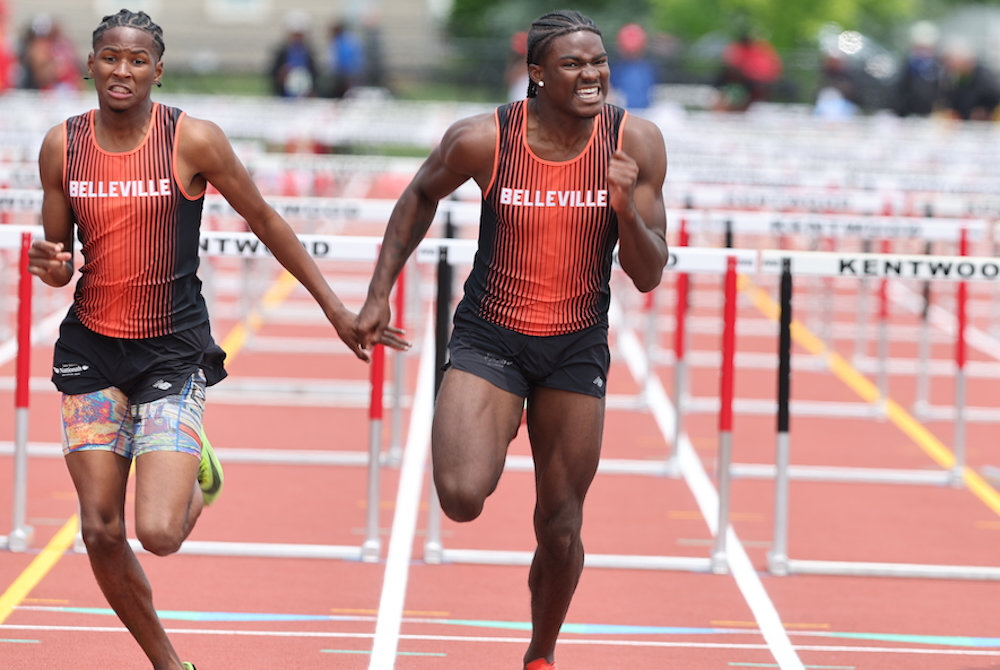
Giving Belleville's chances a huge boost was senior Will (Jaiden) Smith, who turned a good junior season into going out with a bang this year. He won the 110 hurdles (13.35) and 300 hurdles (37.79) and finishing fifth in the 200 dash after a year after finishing fourth in the 110 hurdles, second in the 300 and just missed scoring in the 200. He was seeded first in the 300 and second in the 200 going into this Finals. He was also part of Saturday's winning 1,600 relay (3:15.52).
Smith said the key to making the jump from good to outstanding is not getting caught up in success.
"You can't get used to it because if you get comfortable, you'll fall back," he said. "I know they were going to be tough races, but you've got to push yourself to do better."
Grand Haven was third with 31 points, while Novi and Oak Park both had 28.
Belleville was outstanding in the relays, also winning the 400 (41.85) and 800 (1:26.50).
 Among the other winners Saturday was senior Quincy Isaac of Canton, who claimed the long jump (24-11½) for a third-consecutive season. Each championship, Isaac said, featured a different pathway to the medal stand.
"Each year had different expectations, like with the first one I was nervous because I was one of the youngest guys there." he said. "There were still a lot of nerves as a junior and trying to win it twice in a row. This year I knew what I had to do, then I pulled a hamstring at the conference meet and didn't even go to the Regional. I didn't practice, didn't compete and came here with almost nothing."
One performer who did come to the meet with something was East Kentwood junior pole vaulter Reece Emeott. A Finals champ by nine inches last year and the son of Falcons coach Dave Emeott, Reece said there was one major difference between winning the event this year (16-0) as opposed to a year ago.
"This year was more about relief," he said. "We were expected to win, and it happened. Last year there was no pressure, no expectations. I could just jump how I jumped. This year was a huge relief."
The pole vault was particularly rugged this year as five of the top eight vaulters turned in personal bests.
Emeott said he already has designs on next season and a third individual title, but he expects a radically different showing. In the attempt to bolster the Falcons as a whole, he plans on spreading his talent to the long jump, 100-meter dash and maybe even a relay.
"The main goal will be to win a (team) state title," he said. "This is good, but that would be way better."
Samson Gash of Detroit Catholic Central won the 100-meter dash (10.41) after a strong second half to his race.
"I took the lead about halfway through and I like my time for sure," he said. “I knew it would be a fast (event), but there was no worry about times. It is what it is, but it was pretty exciting," he said. "It feels good, but I've got more work to do."
That work, however, may not come in track. He's being recruited by football programs including Illinois, Michigan State, Purdue, West Virginia and Vanderbilt.
"We're talking with the school and family about what we're going to do," he said.
Among other champs were two Walled Lake Central field event performers. Garrod Alexander won the shot (64-1.25), while Giovanni Charles took the high jump (6-8).
Also in field events, Ray Glory Ejoyokah of Birmingham Groves won the discus (179-3).
Other winners were senior Jeremy Dixon of Kalamazoo Central (21.11). A year ago he helped Central to the team championship by winning the 100 and finishing second in the 200 while also assisting on two winning relays.
Rounding out the other Finals champs were Byron Center’s Brady Leyendecker in the 400 (47.96), Wendell Childs of Clarkston in the 800 (1:50.71), Luka Hammond of Grand Haven in the 1,600 (4:09.69) and Beckett Crooks of Ann Arbor Pioneer in the 3,200 (9:00.80).
Northville won the 3,200 relay (7:41.24), and Oak Park the 1,600 (3:15.52).
PHOTOS (Top) Belleville hurdlers Will (Jaiden) Smith, right, and Schmar Gamble approach the finish in the 110 final Saturday. (Middle) Detroit Catholic Central's Samson Gash, right, and Novi's Chance McNeill set the pace in the 100 dash final. (Click for more from Carter Sherline/RunMichigan.com.)
North Branch Cousins Carry on Family Tradition with Record-Setting Throws
By
Paul Costanzo
Special for MHSAA.com
April 16, 2025
Aubree Deshetsky wasn’t able to be there last week when her cousin, Eli Bickel, broke the 30-year-old North Branch discus record.
 She was there, however, when the former record holder, her dad Daniel Deshetsky, got the call.
“I was with my dad at a volleyball tournament in Louisville,” Aubree Deshetsky said. “We wanted (Eli) to break the record. It was cool to see him do that.”
Bickel not only knocked his uncle off the Broncos’ record board with his throw of 160 feet, 4 inches on April 11 at Davison, he joined Aubree as the school’s all-time leaders in the event. She had thrown 131-5 two days earlier, breaking her own school record.
The similarities go well beyond that. Both have committed to Division I universities in other sports. Deshetsky will be playing volleyball at Wofford (South Carolina), while Bickel has committed to play football at Michigan State.
And they’re both still juniors.
“I think for both of them, they’re not done,” North Branch athletic director and throwing coach Al Margrif said. “They’re both really motivated to be able to make their best marks this year. Eli, he puts in a lot of study. He watches a lot of film. He has a cousin that he talks to that’s a (collegiate) throws coach. He’s more technical and a student of discus. Aubree, she’s a super-fast learner. She’s just so athletic, and it just comes out so much.”
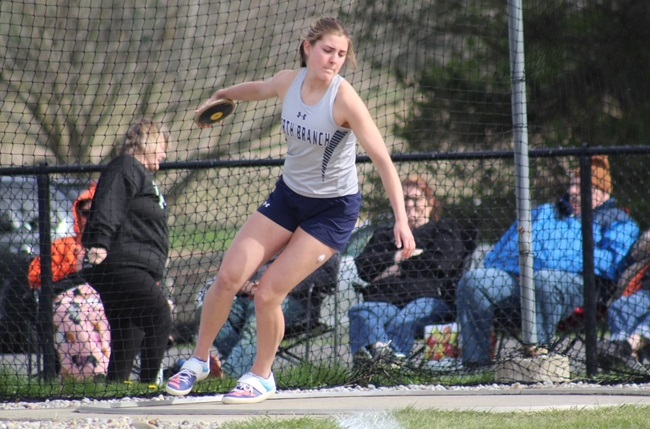 Deshetsky is a two-time Finals champion in volleyball, winning titles her freshman and sophomore seasons. She’s also a returning all-state thrower, having taken fifth in the shot put and sixth in the discus at the Lower Peninsula Division 2 Finals a year ago.
That’s despite never really being solely focused on throwing. During her freshman year, she ran the 200, 400 and 800 meters, multiple relays and also high jumped along with her throwing events.
As a sophomore, she cut back on some of those races and the high jump, but was part of North Branch’s 400-meter relay team, which qualified for the Division 2 Finals.
And all along, she’s been playing high-level club volleyball, which takes her around the country.
“I kind of (started throwing) because my dad threw in high school,” she said. “It’s just something my family has done. I was really a big high jumper and 800 runner in middle school and early high school, but once volleyball ramped up more, it was harder to train for those, so I focused more on the throwing side. I got serious into discus last year. But my coach, he literally puts us in events at the meets to get us the most points, so I just do whatever he asks and hope for the best.”
She threw 127-1 at the Blue Water Area Conference championship meet a year ago to claim the school record. That came last May, so to be well ahead of that right now in early April is a good sign for what she wants to accomplish this season.
“I was actually very surprised,” she said. “That meet was my first time throwing outdoors this year. We’ve just been practicing inside, but something that’s helped this year, our school has these foam rings and with rubber discs, I can basically do a full throw into a divider in the gym. But I honestly did not expect to throw that far. I’m kind of aiming for the 140 mark this year. I think starting out at 131 is a good starting point.”
Bickel, who will play on the offensive line at MSU, has been more focused on throwing since middle school. He started tagging along to throwing practices when his sister Natasha, a 2023 North Branch graduate who was Deshetsky’s volleyball teammate, began competing in high school, and realized pretty quickly he had a future in the sport. So much so that he originally thought throwing could be his path to becoming a college athlete.
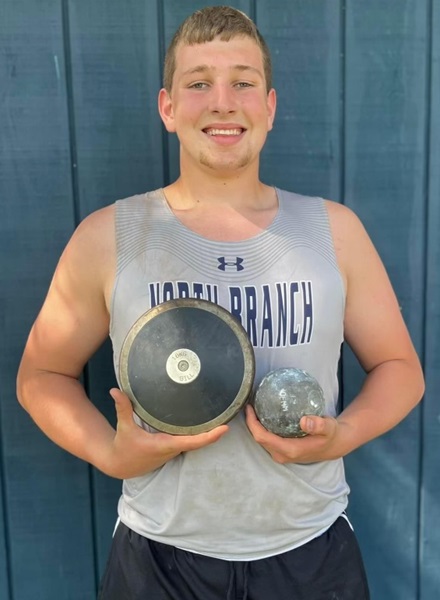 All along, he had his uncle’s record in his sights.
“It’s been a goal of mine,” Bickel said. “I knew I could do it. Last year was a frustrating year, because I hit that mark so many times in practice, but I never could in a meet. This was my first meet this year – I got cleared on Tuesday (after recovering from a torn meniscus), then the next day I threw 151 and felt good. Then Friday came and my first two throws, I was over-excited, but my next throw, I really connected.”
Bickel is a four-sport athlete at North Branch, as he wrestled and played basketball this winter. Even though he did get injured in January, he said the MSU staff has been supportive of him continuing to branch out.
“They actually encouraged it,” Bickel said. “They wanted people who could stay moving and be athletic on the offensive line.”
His football commitment could mean this is his final track season, however, as there’s a chance he will enroll early at MSU. That put some more urgency into breaking that record this season and getting back to the Division 2 Finals to make up for a disappointing finish a year ago.
He’s certainly on track to do that, as his record-breaking throw is currently the best in Division 2 this spring.
The best throw for Division 2 girls, meanwhile, belongs to Deshetsky.
It’s fitting for cousins who have had simultaneous success for so long.
“Our family is very close together,” Bickel said. “We actually do 4-H in the summer, and they show pigs out of our barn. I go to every one of her volleyball games that I can make it to. On the track side of things, there are times on a Saturday afternoon where I’ll ask her if she wants to go practice throwing, and she’ll do it.”
 Paul Costanzo served as a sportswriter at The Port Huron Times Herald from 2006-15, including three years as lead sportswriter, and prior to that as sports editor at the Hillsdale Daily News from 2005-06. He can be reached at [email protected] with story ideas for Genesee, Lapeer, St. Clair, Sanilac, Huron, Tuscola, Saginaw, Bay, Arenac, Midland and Gladwin counties.
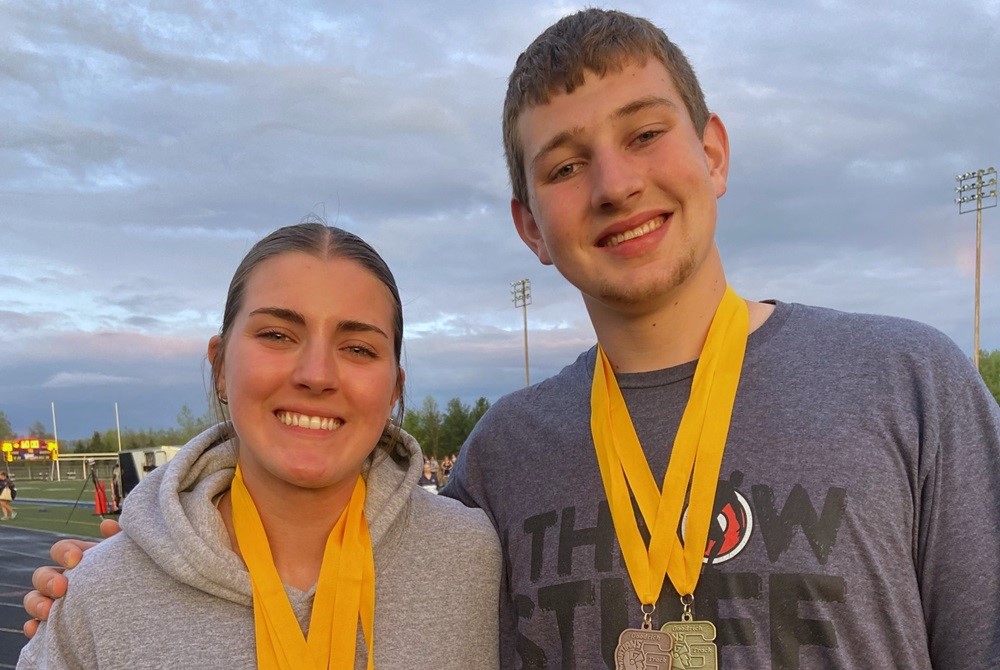
PHOTOS (Top) Cousins Aubree Deshetsky, left, and Eli Bickel take a photo together during a successful day last season at the Goodrich Invitational. (Middle) Deshetsky unwinds during a discus throw. (Below) Bickel holds up his discus and shot put. (Photos courtesy of the North Branch athletic department.)