

Blind Vaulter Builds on Promising Launch
By
Paul Costanzo
Special for MHSAA.com
May 24, 2019
When Bradly Rainwater’s family members learned he was born blind, they decided to not put any limits on him.
 As it turned out, Bradly had the same mindset.
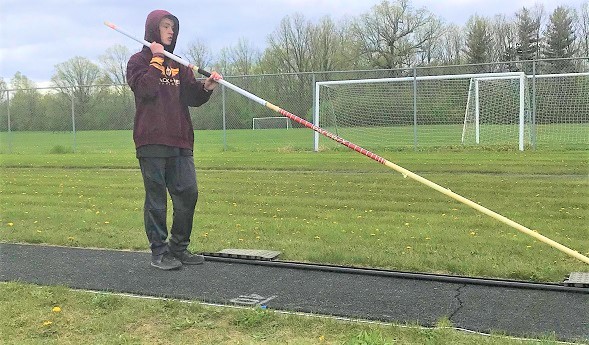
The Davison sophomore is a pole vaulter on the track & field team. It’s an event that he took up not just because his father and uncle were former all-state pole vaulters, but because it was one of the most difficult events in any sport.
“I have always gone after the hardest things,” Rainwater said. “I thought this would be another thing that I would see if I could do it.”
Rainwater, who also is a member of the marching band and wrestling teams at Davison, recently finished his first full season competing as a vaulter and has proven that he can do it, with a personal best of 8 feet, 6 inches. But he’s not satisfied with simply clearing a height in competition – he wants to go higher.
“In the end, I’d like to go to state and get a reasonable placing,” Rainwater said of his career goals. “That would be good for me. I’d enjoy that. For someone in a situation like mine, or a situation similar, you have to work twice as hard to get things where you want them to be. But I am dedicated to it.”
Davison pole vaulting coach Brad Rainwater, Bradly’s grandfather, is also dedicated to it, and is doing all he can to help his grandson reach his goals. Brad Rainwater has been coaching for four decades, but had to teach himself some new tricks when Bradly came along.
“It’s a learning process for us, as well,” Brad Rainwater said. “We started by putting our heads together, my sons and I, and I took it basically like I would coach anyone, but we had to be more hands-on. Basically, it’s step-by-step. It’s the same way when he wrestles; they have to literally do every movement like step, step, step, step. Everything on the vault is done by steps, so we start him with doing three steps, then four steps, then five steps. We’re thinking of ways to teach him to turn, so we use a lot of rings and high bar so he can get that feel.
“What it’s done for me is made me a better coach, because I have to break everything down. Now I’m a little more technical with them all.”
Recently, Bradly began using a track on the runway to help guide his pole to the box, which allows him to start his run farther back. He’s made steady improvement throughout the season, setting his personal best May 13 during a dual meet against Flint Carman-Ainsworth and matching it two days later at the Heritage Hawks Last Chance Invitational.
During practices with a bungee cord, he has cleared more than 10 feet. He’s also started imparting wisdom on other vaulters.
“If I have young vaulters, he teaches them the first three steps and a plant,” Brad Rainwater said. “If people are around (Bradly) and they didn’t know he was blind, because he’s actually doing the drills or showing kids how to do drills, they go, ‘He’s blind?’”
Bradly said the reaction from teammates and opponents alike has been great.
 “They work with me some, like they’ll say, ‘You didn’t turn correctly,’ or ‘You didn’t do this correctly,’ which I appreciate, because criticism like that I can’t necessarily see on film,” he said. “Opponents, some of them come up to me and say thank you to me, and that I inspired them. It’s still hard for me to grasp, because I’m not as good as I should be, but I appreciate people saying that.”
While there’s no official number of blind individuals who have competed in the pole vault, it is rare.
“I know that he’s only one of maybe three others in the state (history), and the other three had some sight,” Brad Rainwater said. “We try not to limit him; we try not to put him in a box that he can or can’t do that. As far as I know, he’s one of the very few in the country that’s doing this. We love it, because we hope it opens doors for other kids that have desire to do other things.”
Bradly, however, said he hasn’t quite grappled with the fact that what he’s doing is special, as he feels he still needs to get better. That’s his focus now, and it’s reflective of someone who has played sports his entire life, from T-ball to soccer to basketball, and now wrestling and track.
He’s not a blind pole vaulter; he’s simply a pole vaulter. And when he’s done, he wants to be known as a great one.
“I’ve always had the attitude of why not,” he said. “Why not work extra hard to be as good as they are?”
 Paul Costanzo served as a sportswriter at The Port Huron Times Herald from 2006-15, including three years as lead sportswriter, and prior to that as sports editor at the Hillsdale Daily News from 2005-06. He can be reached at [email protected] with story ideas for Genesee, Lapeer, St. Clair, Sanilac, Huron, Tuscola, Saginaw, Bay, Arenac, Midland and Gladwin counties.
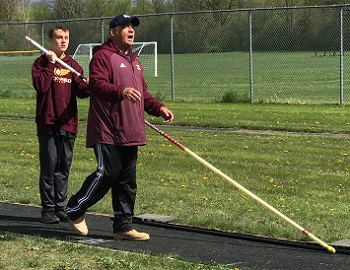
PHOTOS: (Top) Davison pole vaulter Bradly Rainwater lines up for an attempt this spring. (Middle) Rainwater works with his grandfather Brad Rainwater, the school’s longtime pole vaulting coach. (Photos and video provided by the Rainwater family.)
Performance of the Week: East Kentwood's De-Mani Roberts
May 28, 2026
 De-Mani Roberts ♦ East Kentwood
Sophomore ♦ Track
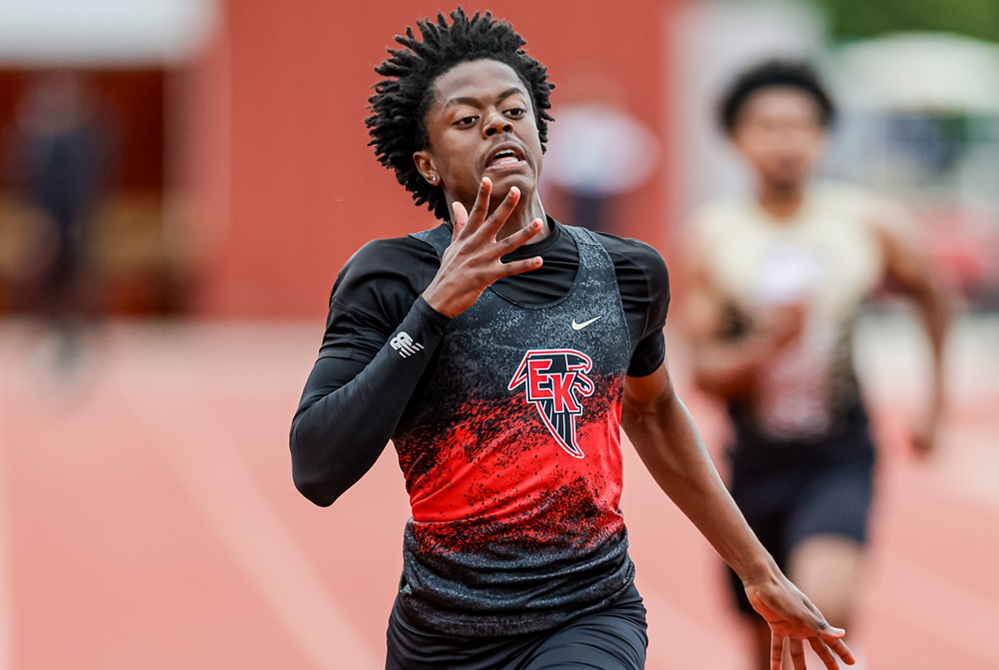
Roberts has made impressive strides in the second season of high school outdoor track, cutting nearly a half-second off his top 200-meter time from a year ago and more than a second off his freshman-year best in the 400 in helping East Kentwood become a favorite to win the team championship at Saturday's Lower Peninsula Division 1 Finals. Roberts won the 200 in a personal-best 21.26 seconds and ran on the winning 800 relay (1:26.83) as the Falcons won the Michigan Interscholastic Track Coaches Association (MITCA) Division 1 team championship last weekend.
That 200 time and his top 400 time of 47.55 seconds are both the fastest in the state in those respective races this spring, all divisions included. Roberts is undefeated in both races, a notable jump even as he finished 14th in the 200 and ran on three top-12 relays at last year's MHSAA Finals. That top 200 time also trails the current LPD1 Finals record by only 25 hundredths of a second, and he could make a run at Finals records in both individual races with half his high school career remaining. Roberts also has run cross country for East Kentwood the last two seasons.
@mhsaasports 🏃POW: De-Mani Roberts #eastkentwood #track #highschoolsports #performanceoftheweek #MHSAA ♬ Bright and fun upbeat pops, Kids, Animals, Pets, Fun, Cute, Happy, Playful, Upbeat(1465232) - SAKUMAMATATA
@mhsaasports 🏃POW: De-Mani Roberts #funfacts #tiktalk #performanceoftheweek #highschoolsports #MHSAA ♬ Girly and cute synth pop - SAKUMAMATATA
Follow the MHSAA on TikTok.
MHSAA.com's "Performance of the Week" features are powered by MI Student Aid, a division within the Department of Lifelong Education, Advancement, and Potential (MiLEAP). MI Student Aid encourages students to pursue postsecondary education by providing access to student financial resources and information. MI Student Aid administers the state’s 529 college savings programs (MET/MESP), as well as scholarship and grant programs that help make college Accessible, Affordable and Attainable for you. Connect with MI Student Aid at www.michigan.gov/mistudentaid and find more information on Facebook and X @mistudentaid.
Previous 2025-26 honorees
May 22: Taleon Guess, Temperance Bedford golf - Report
May 15: Zacchaeus Brocks, Detroit Catholic Central track - Report
May 7: Savanah Thompson, Howard City Tri County soccer - Report
April 30: Eliza Schwass, Ludington track - Report
April 23: Emily Postema, Ravenna softball - Report
April 16: Katie Berkshire, Gaylord track - Report
March 26: Kayla Hairston, Goodrich basketball - Report
March 19: Liam Smith, Otsego swimming - Report
March 12: Jack Sayen, Houghton hockey - Report
March 5: Devin Patrick, St. Clair Shores Lake Shore - Report
Feb. 26: Madison Nieuwenhuis, Plainwell wrestling - Report
Feb. 20: Sophie Ramey, Allen Park competitive cheer - Report
Feb. 13: Cam Ryans, Grand Rapids Northview basketball - Report
Feb. 6: Melanie Kolnitys, Midland Dow basketball - Report
Jan. 29: Stella Musialowski, Huron Valley United gymnastics - Report
Jan. 22: Baylor Perkins, Grand Blanc swimming - Report
Jan. 15: Delaney Vanier, Flint Kearsley bowling - Report
Jan. 8: Stevie Hall, Detroit Cass Tech basketball - Report
Dec. 18: Ethan Martha, Ishpeming Westwood basketball - Report
Dec. 11: Louis Smith, Three Rivers wrestling - Report
Dec. 4: Traverse Moore, DeWitt football - Report
Nov. 28: Elizabeth Eichbrecht, West Bloomfield swimming - Report
Nov. 20: Brady Kieff, Blanchard Montabella football - Report
Nov. 13: Ella Laupp, Battle Creek Harper Creek swimming - Report
Nov. 7: Hunter Eaton, Charlevoix cross country - Report
Oct. 31: Stephen Gollapalli, Lansing Christian tennis - Report
Oct. 23: Talya Schreiber, Pickford cross country - Report
Oct. 16: Avery Manning, Dexter golf - Report
Oct. 9: Brady Van Laecke, Hudsonville football - Report
Oct. 2: Sarah Giroux, Flat Rock volleyball - Report
Sept. 25: Sam Schumacher, Portage Central tennis - Report
Sept. 18: Kaylee Mitzel, Saline field hockey - Report
Sept. 11: Natasza Dudek, Ann Arbor Pioneer cross country - Report
Sept. 4: Kate Posey, Big Rapids golf - Report
PHOTO East Kentwood's De-Mani Roberts runs to a win in the 200 meters at the MITCA Division 1 championship meet. (Photo by Miles Postema.)