


Busy Block Does it All During 3-Sport Spring
By
Geoff Kimmerly
MHSAA.com senior editor
May 3, 2017
By Geoff Kimmerly
Second Half editor
LANSING – Dawson Block has his seven varsity letters earned over the last 2½ years piled on a table in his bedroom.
 They aren’t in any particular order or out for display. In fact, they’re probably the most disorganized part of an incredibly organized guy’s impressive high school sports career.
As sports teach lessons, it’s obvious what the Lansing Christian junior is learning most this spring. Time management is a must when you’re playing three sports in one season, with competitions usually four or five days a week and one day to practice for all of them.
But he’s pulling it off – and then some.
In fact, the main downside – not counting the busy schedule – is that he can’t dedicate more time to all three. He’s run a personal-best in track in the 800 meters and is only a few seconds from his best in the 1,600. He’s a regular scorer for a golf team that’s in serious contention for its first league title and could make the MHSAA Finals for the first time. His return to the pitcher’s mound has included two solid outings – not bad for someone who hasn’t played baseball since middle school. And on top of it all, he’s carrying a 3.95 grade-point average as he makes academic lessons a priority while picking up more on the track, course and diamond.
“I’m a big fan of sports,” Block said. And it’s just that simple, even when scheduling gets complicated.
“I like running. I like being outside, playing golf, trying to get the swing down. And baseball is something (where) I have a decent throw, so it makes it a lot easier. I just like pitching.
“I’ve done track for a long time, and I feel I’m pretty good at it and I can’t see myself not doing it. The past few years I’ve fallen in love with golf, and I have a drive to want to be good at it and potentially play in college if I get good enough. Baseball, I’m more just there to help the team out; they need arms, so I do it for that reason.”
A spring day in the life of Block looks like this:
On days when he doesn’t have a game/match/meet, he’ll go to golf or track practice after school. If he goes to track, he’ll get done at 4:30 or 5 p.m., then head over to the driving range by himself to hit balls. Or, he could go from golf or track practice after school and catch the end of baseball practice, where coach David Miranda will work with him on pitching. Or, Block will hit track practice, then the golf range, and as happened last week, pitch to his dad Jason in their yard until it’s too dark to see the ball. If Dawson goes to golf and baseball practice, he’ll finish his sports night with a running workout.
 And then from about 8 p.m. until he’s done, Block takes care of his homework.
“I’ve never met a kid – and I’ve been coaching for 12 years or more at Lansing Christian in baseball, golf, basketball and soccer – Dawson is just, ever since I can remember, over the top,” said Jason Block, who in addition to being Dad is also the Pilgrims’ boys golf coach. “Whatever he’s in, he’s going to try to within reason be the best he can be. When we’d play flag football, he’d do practice and then run with a parachute after practice; he always does the extra mile.
(But) if anyone can do it, it would be Dawson. His work ethic is off the charts. It basically became a situation of we got the calendar out, (said) here’s a track meet, here’s a golf match, where are the holes? Is there any way without killing ourselves that we can make this work?”
Track and golf always were sure to be part of Dawson’s schedule. He’s competed in both all three years of high school so far. But he hadn’t thrown since middle school – although he pitched well enough back then that Miranda, who had coached against some of Block’s teams when Dawson was a kid, approached him in church a few times to ask him to join on – if only to lend another left-handed option to the pitching staff.
“I told him no for a long time,” Block said. “But then I was like, maybe this wouldn’t be bad. Maybe I can do this with the other things, just come when I can and pitch. I just decided that one day at church.”
It no doubt helped that Block had done similar juggling before. In addition to two previous years of spring dual sporting, Block was the second-fastest finisher on the cross country team that placed 13th at the Lower Peninsula Division 4 Finals in the fall, coming in 45th with a time of 17:29.6 – and balanced that sport with playing on the junior varsity soccer team.
During the winter, Block was on the junior varsity basketball team – but then also ran every night after practice to keep his mileage up for spring.
Block has run the 800 this spring in 2:13.87, his career best, and his 4:55.23 in the 1,600 at a tri-meet April 18 was fewer than three seconds off his personal record for that race. On the golf course he’s averaging 45 strokes for nine holes and shot an 86 as Lansing Christian won last week’s Duane Blatt Invitational hosted by Pewamo-Westphalia. He threw one inning Saturday in his second baseball outing after allowing only one run over multiple innings during his first.
 From the Dad point of view, Jason can be impressed with Dawson’s organization; his son always has his clothes laid out for the next day and hand-writes his schedule in a calendar he keeps handy. At the same time, Jason said occasionally he wishes Dawson would find time for more fun and going out with friends. But Block’s parents have made sure not to push any of these athletic opportunities on him, and the fact he continues to be a model student in the classroom is a good sign he’s making everything fit.
Anticipating three varsity letters this spring and at least four over his senior year, Block could graduate with 14 after playing more than 20 sports seasons. That pile in his room is going to get a little higher.
And so will that stack of benefits from playing so much. Along with time management, Block quickly points to patience – especially on the golf course – as a lesson he’s derived from athletics. There’s something there about bouncing back as well after a bad shot or other mistake.
And he got an interesting history lesson from one of his teachers, Eric Thomas, who told Block the story of Jim Thorpe, who won Olympic gold medals and played Major League Baseball and in the National Football League a century ago.
As noted above, the main downsides to this spring for Block have been less sleep – he’s staying up a little late getting that homework done and has to talk himself into a second wind sometimes – and the inability to be everywhere at once. He doesn’t like feeling like he’s letting any of his teammates down – and he does his best to be with all of them as much as possible.
But he’d also tell anyone interested to give three sports in one season a try.
“It can be a lot of work, a lot of struggle,” Block said. “But if you’re willing to work hard and have some determination, you can do it.”
 Geoff Kimmerly joined the MHSAA as its Media & Content Coordinator in Sept. 2011 after 12 years as Prep Sports Editor of the Lansing State Journal. He has served as Editor of Second Half since its creation in Jan. 2012. Contact him at [email protected] with story ideas for the Barry, Eaton, Ingham, Livingston, Ionia, Clinton, Shiawassee, Gratiot, Isabella, Clare and Montcalm counties.
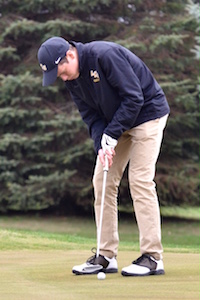
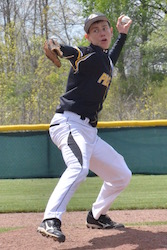
PHOTOS: (Top) Lansing Christian’s Dawson Block races down the straightaway during a race this spring. (Middle) Block lines up a putt during a golf competition. (Below) Block throws during a baseball game Saturday, May 7. (Photos courtesy of Jason Block.)
Baldwin Makes Wise Choice to Try Track
By
Pam Shebest
Special for MHSAA.com
March 26, 2019
KALAMAZOO — Three years ago, Heath Baldwin was sitting in the stands watching his sister, Hope, play volleyball when he started chatting with head coach Lauren Cholometes’ husband.
 The current Kalamazoo Hackett Catholic Prep senior had no clue that chitchat would turn into a life-changing event.
It turns out that Simon Cholometes was also Hackett’s track & field coach and owns Areté, a training center in Three Rivers where Baldwin’s buddy Eric Wenzel works out.
Intrigued, Baldwin – then a sophomore playing football, basketball and baseball – visited the facility.
“He set up a hurdle and had me do it, and I was pretty good at it so I wanted to try it,” said Baldwin, who was already playing baseball in the spring but added track to become a dual-sport athlete that season.
“Coach C convinced me to do (track),” he said. “I was more of a baseball guy until then. I gave it a try my sophomore year, and it went pretty well.
“This past year, I didn’t really have too many expectations going in. Then it kind of got big and I started to really love it.”
That is an understatement.
 That first season, two years ago, Baldwin qualified for the MHSAA Lower Peninsula Division 4 Finals in four events, finishing fifth in the 110-meter hurdles, eighth in the high jump, 10th in the long jump and 14th in the 300 hurdles.
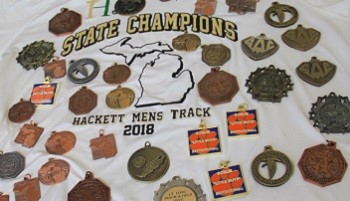
Last year, as a junior, Baldwin led the Irish from a 38th-place finish in 2017 to the D4 meet championship, winning the 100 hurdles (14.83 seconds) and the long jump (22 feet, 2½ inches) while placing fourth in the 300 hurdles and seventh in the high jump.
The senior, who also has earned honors in football, basketball and baseball, is one of six finalists for the Detroit Athletic Club’s “Michigan High School Athlete of the Year” award, which will be presented in May.
His track success also has led to a scholarship at University of Michigan next year.
This spring, Cholometes hopes Baldwin can help lead the Irish back to the top.
“Our expectations are pretty high,” the coach said. “We lost a few key contributors, but there’s no reason the team shouldn’t be better than last year’s team.”
Baldwin’s goal this year is to hit the 23-plus foot mark in the long jump, something the coach said is a possibility.
“He’s got that athleticism, and combine that with how coachable he is, and he’s got a solid work ethic, too,” Cholometes said. “It’s been a joy to work with him, and to see him be successful like that is pretty cool.”
This season, the 6-foot-4 lanky senior gave up baseball to concentrate solely on track.
Football a family legacy
Baldwin earned his love of football from his father, Roger, who passed away in 2016.
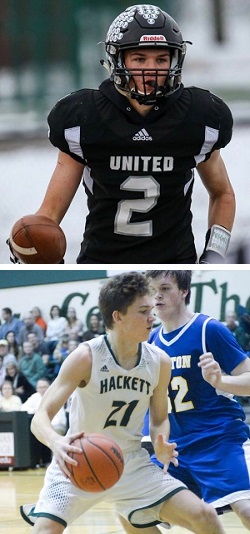 ‘My dad was a big football fan, and all my brothers had played,” Heath said. “My dad coached me until eighth grade.”
As a junior varsity player for United, a Hackett and Kalamazoo Christian cooperative team, “They needed a kicker, and I kinda just started that and got pretty good at it,” he said.
That kicking carried over to his varsity play, and this year he made 48 of 53 extra-point attempts and booted field goals of 33 and 36 yards, earning him all-state first-team honors.
Baldwin performed double duty, catching 50 passes for 910 yards and 18 touchdowns at wide receiver as well.
“It’s a little disappointing I didn’t get to 1,000 (yards), but I’m not too mad about it,” he said. “It was a fun season. We had a good time, but I wasn’t really focused on stats until after the season.”
United coach Jesse Brown, whose team finished 11-1, said he is not surprised at Baldwin’s success in any sport.
“His size and speed are the two things that stand out the most,” Brown said. “There isn’t anything that he can’t do, from track, football, basketball and baseball.
“Hands down, he is one of the best high school athletes I have ever seen. He was clutch in so many tight games of the past few years, making unbelievable catches, field goals and even this year at defensive end.”
All-around opportunities
Of all his sports, basketball is his least favorite to play, Baldwin said, but he likes the camaraderie. He and many teammates have played together since their YMCA days.
The center was hoping to reach 1,000 career points as a three-year varsity starter, but fell 82 points short.
“I just tried to out-hustle everybody because I’m not the best shooter,” said Baldwin, who earned all-Southwestern Athletic Conference honors all three seasons. “I get rebounds and put-back points, get the scrappy points and they all add up.”
This year, he averaged 20.2 points per game, 8.1 rebounds and 2.1 blocks. He racked up 38 points in a game against Coloma and hit double digits in 20 of the team’s 21 games.
Coach Mark Haase said Baldwin became one of the team’s best free throw shooters this season.
“He has great athleticism and is even a better teammate though,” Haase said. “He became a decent 3-point shooter this year as well.
 “He has great agility and coordination. It also helps that he has played three sports each year in high school. It helps to make a more well-rounded athlete.”
Baldwin said track has become his favorite sport for several reasons.
“I like the adrenaline it gives you, just lining up, competing head-on-head with other people,” he said. “If you lose, you can’t blame it on anybody else, just you.
“I do like the individual aspect of the sport … you hold yourself accountable.”
Several Division II and III colleges were interested in Baldwin in both football and basketball, but he decided to continue his love for track.
“The bigger schools were coming around, and I wanted a bigger school because I’ve been at private schools my whole life with not very many kids in my class,” he said. “I wanted the bigger atmosphere.
“I knew I wanted to do Michigan State or Michigan. It was a pretty tough decision.
“I’m just grateful to Coach C for convincing me to do track because I never would be in the position I am in today.”
 Pam Shebest served as a sportswriter at the Kalamazoo Gazette from 1985-2009 after 11 years part-time with the Gazette while teaching French and English at White Pigeon High School. She can be reached at [email protected] with story ideas for Calhoun, Kalamazoo and Van Buren counties.
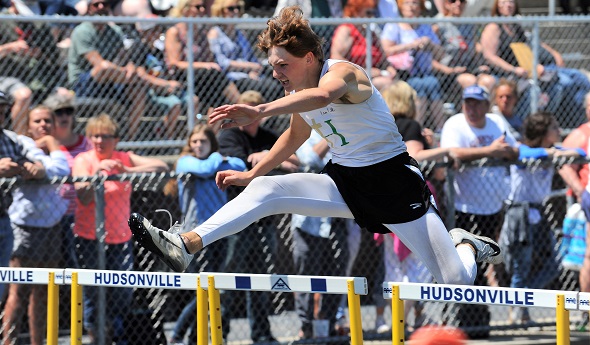
PHOTOS: (Top) Kalamazoo Hackett’s Heath Baldwin takes on a hurdle during last season’s 110-meter Division 4 championship race. (Middle top) Baldwin, left, and track coach Simon Cholometes. (Middle) Baldwin was a standout on both the football and basketball teams as well. (Below) A shirt from last season shows many of Baldwin’s track & field accomplishments. (Track photo by RunMichigan.com, football by Daniel J. Cooke Photography and basketball by Scott Dales. Shirt and heads shots by Pam Shebest.)