


Duckett's Mentorship Continues to Inspire as Standout Pair Help Set Pace for Loy Norrix
By
Pam Shebest
Special for MHSAA.com
April 29, 2026
KALAMAZOO — After losing their longtime mentor and coach, the Kalamazoo Loy Norrix track & field teams are dedicating their seasons to Ted Duckett, who died unexpectedly Jan. 8.
 “We’re still feeling it now,” said head coach Bradley Schmidt, who leads both the boys and girls programs. “When you lose that wealth of knowledge, parts of seven decades of coaching.
“He knew so much. Not just the knowledge of how track works, the Xs and Os, but how to get the most out of kids. There are a lot of kids who ran just because he was the coach. To lose him was tough.”
Senior high jumper Jaylind Motton is one of those drawn to the sport by the legendary coach.
“When I was a sophomore, I was in basketball and I’ve been able to dunk since eighth grade year, so I’ve just had the ability to jump high,” Motton said.
“Coach Duckett convinced me to join track because of it and do high jump.”
Senior Jackson Lam, who owns two school records, also credits Duckett with his success.
“Coach Duckett gave me such good advice,” Lam said. “Compliments didn’t come often from him, but when he did, I knew I was doing something right.
“It’s definitely hard with him gone. It took me a while to get over it. I think I will be able to turn it around and use it as motivation to run the season in honor of him.”
Part of that motivation came during Friday’s Don Lukens Invitational hosted by Norrix.
Lam was named the Coach Duckett Male VIP Award recipient.
The award isn’t new, but the name of the award has been changed to honor the former coach.
A year ago, Lam set the 1,600 school record at the Invitational when his time of 4:13.32 bested the 4:19 mark set by Gary Harris in 1968.
"It was an incredible day for me,” Lam said. “I felt like everything I worked for paid off.
Earlier this season he broke that record again, turning in a personal-best 4:12.07.
Although the Knights boys team finished second to Portage Central on Friday, Lam bested that mark once more at 4:10.6, which is also a meet record.
Using that second-place finish as motivation, Schmidt hopes the team improves on its 33rd-place finish at last year’s MHSAA Lower Peninsula Division 1 Finals.
 “It helps that kids are getting more mature, getting more training,” said Schmidt, who finished his fifth Boston Marathon a week ago. “It’s nice to see improvement in kids who did some offseason work. If you just rely on the work in-season, it’ll never happen.”
Lam is one who works on his running all year and already has qualified for the Finals in the 1,600 meters.
“It’s almost like having an unpaid coach,” Schmidt said of Lam. “He talks to the kids at their level, makes sure they’re warming up, they’re stretching, they’re warming down, they’re getting ready at the right times for their events, they’re eating right and sleeping right.
“It’s one thing to come from a coach, it’s another thing to come from a peer, a teammate. It’s nice to have that experience on the team for sure.”
Adapting to change
Going from middle school to high school was a big adjustment for Lam.
“I learned a lot,” he said. “I learned that middle school is nothing like high school running. I came out of middle school feeling good. Like, man, I’m good, I can beat people.
“Then I get to high school and I’m racing guys who are half a foot taller than me, and they’ve been running double the amount of time I’ve been running. They taught me a lot of good things.”
Lam first tasted success in high school in 2023 on the 3,200 relay team as the only freshman running with three seniors – Samuel Allen, Oskar Wiedenhoeft and Gryffin Hurley.
Lam said he looks up to Allen as a mentor. Allen currently holds Norrix’s 800 record of 1:51.1, a mark Lam is chasing.
 “He taught me a lot about the 800 – how you pace it, how you prepare yourself for it,” Lam said. “The best way to learn is by watching, so I was able to watch him.”
Another runner who pushes Lam to improve is Hackett Catholic Prep standout Marek Butkiewicz. The two train together often, including on the Kal Haven Trail.
Since Norrix is in Division 1 and Hackett is Division 4, the two don’t compete head-to-head.
“We both like to push each other in runs and workouts,” Butkiewicz said. “We’re close in fitness and that also helps.
“He’s a great kid, super smart, super nice, very down to earth, intelligent, mature. A super hard worker.”
One thing they don’t agree on is colleges. Lam is headed to University of Michigan, while Butkiewicz is going to Michigan State on a track scholarship.
“We both have similar goals,” Butkiewicz said. “He’s going to Michigan academically so there’s a little rivalry there, but it’s healthy.”
Although Lam does not have a spot waiting on the U-M track team, he plans to continue running. “My goal since I was a kid is to break 4 minutes in the mile,” he said.
Soaring to new heights
While dunking a basketball is a lot different than soaring over a horizontal bar in track, Motton uses the spring in his step to reach new heights.
As a sophomore, his personal best was 6-foot-4, “but I was inconsistent with it, going from 6-2 to 5-10 to 5-8,” he said. “My junior year I had a growing (spurt) and was stuck between 5-10 to 6-2.”
 Motton, who is 6 feet tall, is having a breakout senior season, and no one is more surprised than he is at his performance: “I came out at the indoor meet and jumped 6-9, then currently PR-ed at 6-10.”
That personal record set a school record as well and was special in many ways.
“Since last year, I didn’t really take track that serious,” Motton said. “I was doing it just for fun. Coach Duckett’s passing sparked something inside of me, made me more determined to do better for him. I went out and jumped for him, PR-ed, broke the school record and I feel good for it.”
Schmidt said going from 6-4 last season to 6-9 during the indoor season and 6-10 at the Eastern Michigan University Relays on March 21 was impressive.
“To see that type of improvement is inspiring to all the kids,” he said. “They can see he put in the time, he put in the effort, he put in the work, watching videos, trying different drills to work on his craft.
“To make that much gain in such a short time is unheard of. It shows the kids that wherever you’re at, you can still improve.”
Motton said the key to being a good high jumper is not the spring in your step, but technique.
“If you have a good form, you can be a good jumper,” he said. “It’s not really about jumping high; it’s how you approach it.”
Motton is not satisfied with the school record.
“My current goal is to clear 7-foot,” he explained, “but once I clear 7-foot, my actual goal is to go 7-3.”
 Pam Shebest served as a sportswriter at the Kalamazoo Gazette from 1985-2009 after 11 years part-time with the Gazette while teaching French and English at White Pigeon High School. She can be reached at [email protected] with story ideas for Calhoun, Kalamazoo and Van Buren counties.
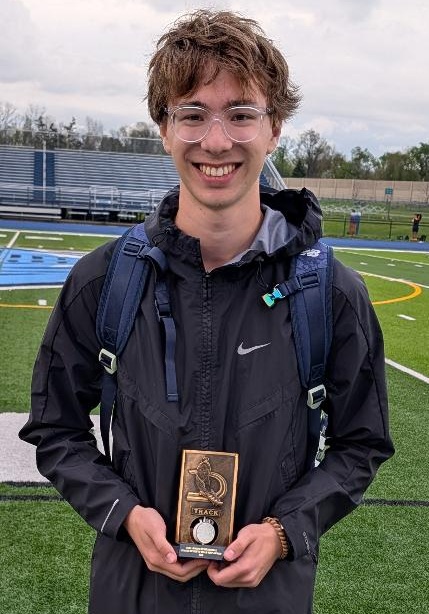
PHOTOS (Top) Kalamazoo Loy Norrix’s Jaylind Motton, left, and Jackson Lam are among those competing this year inspired by past coach Ted Duckett’s memory. (2) Knights track coach Bradley Schmidt. (3) Lam shows off his Coach Duckett Male VIP Award won this season. (4) Motton. (Action and meet photos courtesy of the Loy Norrix athletic department. Headshots by Pam Shebest.)
Constantine Football All-Stater, Wrestling Champ Aiming for Grand Finale
By
Scott Hassinger
Special for MHSAA.com
April 30, 2024
CONSTANTINE – Bennett VandenBerg has earned many accolades over the last four years as a three-sport athlete at Constantine.
But the awards aren't what the 6-foot-3, 240-pound standout will remember most when reflecting on his memories as an all-state football player, state champion wrestler and record-breaking throwing specialist on the Falcons' track & field squad.
"I'll remember how I represented our school and pushed myself to be the best I could be in each sport that I played," said VandenBerg, who has earned 12 varsity letters.
VandenBerg has evolved into one of the most accomplished athletes in the state this school year as a senior, especially standing out among those from smaller communities.
This past fall he was named first-team Division 5-6 all-state at defensive end in football before winning the Division 3 Individual Finals wrestling title at 285 pounds in early March at Ford Field.
VandenBerg's final goal is to win the discus title at the Lower Peninsula Division 3 Finals on Saturday, June 1, in Kent City to end his Constantine career all-state in all three sports.
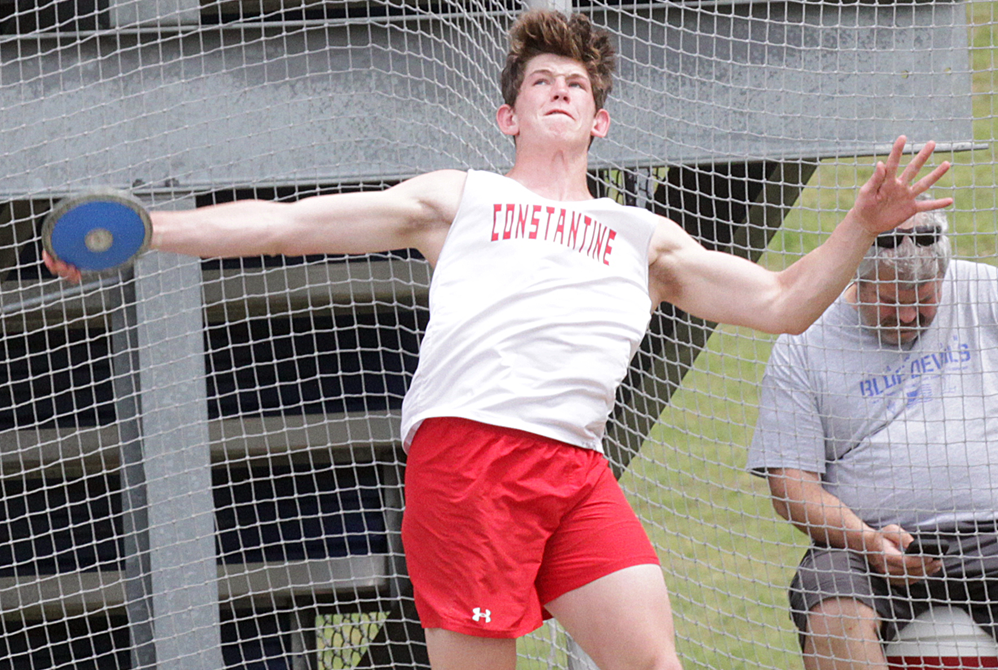
He broke the school record in the discus his junior year with a throw of 158 feet, 1 inch; the previous mark of 156-6 had been held by Doug Polasek since 1986. VandenBerg has eclipsed his school record twice this spring, most recently with a personal-best toss of 170-9 in a Southwestern Athletic Conference double dual meet with Schoolcraft and Kalamazoo Christian. He ranks No. 4 statewide in the event regardless of enrollment division. Lawton junior Mason Mayne at 175-4 is the only Division 3 competitor with a better throw than VandenBerg.
"It's really cool to have your name up on the school record board, but I'd like to make that mark more untouchable before I'm done," VandenBerg said. "My goal is to be a state discus champion. I've put in the necessary work for it. It would be nice to end my career that way."
Kyle Rimer, Constantine's veteran boys track & field coach, is most impressed with VandenBerg's leadership and presence in working with the Falcons' younger athletes.
 "Bennett loves to compete. Ever since he was a freshman, we've also had him on our 400-meter relay team. That's something he really enjoys doing. He's not just a thrower, but a good overall athlete with lots of drive,” Rimer said. “There's a lot of individuality in track & field, but I think he does a great job of leading the younger kids. He has the drive, accountability and technique to achieve his goal of being a state champion in his throwing events.”
VandenBerg is already a two-time Finals placer in the discus, earning sixth as a junior and seventh his sophomore year. He admits being a little disappointed with his distance at the 2023 state meet.
"In that particular event (discus) you need lots of focus and determination because there are a ton of tiny things you can mess up on that affect your throw. To become better you need to be consistent, show up every day and be willing to put in the work," VandenBerg said. "Right now I'm working on my speed in the circle and quickness in my follow-through."
VandenBerg also has been pleased with his improvement this spring in the shot put. He's increased his distance by over five feet and hopes to break the school record in that event as well. John Kampars (1967) holds Constantine's shot put record at 54-8¼, and VandenBerg's personal best is 48-10 in a double-dual meet this season against Parchment and Centreville.
"Shot put is a difficult event. You need power, but your form has to be top-notch – otherwise it's tough to move that 12-pound ball," VandenBerg said. "I would love to qualify for state in both the discus and shot put and be all-state in each. That would be amazing if I could be a state champion in either of those events."
VandenBerg has put in extra work in the offseason with special instruction from Bill Griffey of Next Throw in Plainwell, along with working with Constantine assistant track & field and head football coach Shawn Griffith.
"Bennett puts a lot of time into working on his throwing. He spends a lot of time in the weight room, and he's a bigger kid who is not afraid to be coached and listens to what other people tell him," Griffith said. "We're excited to see what he can do now that we've had warmer weather recently."
 VandenBerg's motivation this spring follows a tremendous wrestling season that saw him finish 54-0 and capture the 285 championship with a 3-0 win in the title match over Reed City junior Wyatt Spalo.
"I gained 20 pounds of muscle and did everything you need to do to become a better athlete to wrestle the heavyweight division. Winning the title was overwhelming. It was everything I ever wanted, and the first 20 minutes after winning it was relief, especially after losing in the Finals as a junior. I just went into that last match and wrestled smart and confident," VandenBerg said. "My speed and strength gave me an advantage over the bigger heavyweights I faced this year."
Vandenberg, 188-22 with 104 career pins, became the 10th Finals champion in Constantine wrestling history and the first to achieve the feat since Kevin Watkins won a 152-pound crown in 2000.
VandenBerg competed at 189 as a freshman and sophomore. He was a Regional qualifier as a freshman and finished sixth in Division 3 as a sophomore before ending his junior campaign as the Finals runner-up at 215.
"Bennett is a competitor who hates to lose, and if he does he learns from it. He had a lot of good practice partners on the team his first three years, and he wasn't going to be denied after losing in the Finals as a junior," said Constantine wrestling coach Dale Davidhizar Jr.
VandenBerg played on Constantine's varsity football team for four years. He got a lot of extra playing time as a freshman when Constantine reached the Division 6 Semifinals during in the COVID-shortened season. He led the Falcons in rushing as a sophomore before switching to tight end as a junior. Out of necessity, VandenBerg returned to lead Constantine in rushing and scoring again as a senior.
"Bennett learned a great deal from the older guys on the team his first three varsity seasons. He learned leadership qualities and is a very unselfish kid who is willing to do what's best for his team," Griffith said.
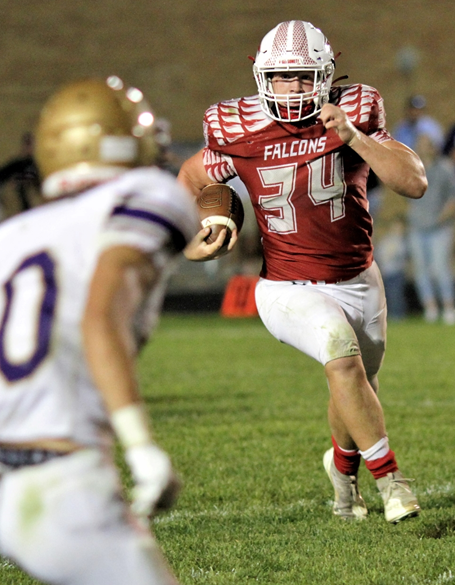
VandenBerg is most proud of Constantine winning a District crown last fall, especially after his senior class went 0-5-1 as eighth graders. VandenBerg posted 164 solo tackles at defensive end during his final high school season and was Constantine's main offensive weapon with 1,354 yards and 16 touchdowns rushing on 186 carries.
"Winning Districts as seniors in football was a special moment. As eighth graders, we weren't exactly the most athletic team, but we put in the work as we got older to become successful," VandenBerg said.
VandenBerg has been invited to play for the West team at the annual Michigan High School Football Coaches Association's East-West All-Star Game this summer.
College coaches have shown interest in VandenBerg in all three sports, especially football and wrestling. VandenBerg, who carries a cumulative GPA of 3.989 and scored 1110 on his SAT, is weighing his options in athletics but knows he wants to study either ecology or forestry in college.
"I love being outdoors and doing what I love to do," VandenBerg said.
 Scott Hassinger is a contributing sportswriter for Leader Publications and previously served as the sports editor for the Three Rivers Commercial-News from 1994-2022. He can be reached at [email protected] with story ideas for Berrien, Cass, St. Joseph and Branch counties.
PHOTOS (Top) Constantine’s Bennett VandenBerg competes in the discus during a home meet his junior season. (Middle) VandenBerg, top position, battles Wyatt Spalo in their Division championship wrestling match at 285 pounds in March at Ford Field. (Below) VandenBerg (34) carries the football during a 2023 regular-season home game against Schoolcraft. (Photos by Brandon Watson/Sturgis Journal.)