

Football Future Awaits, but Mayne Focused First on Finishing Track Finals Sweep
By
Pam Shebest
Special for MHSAA.com
April 22, 2025
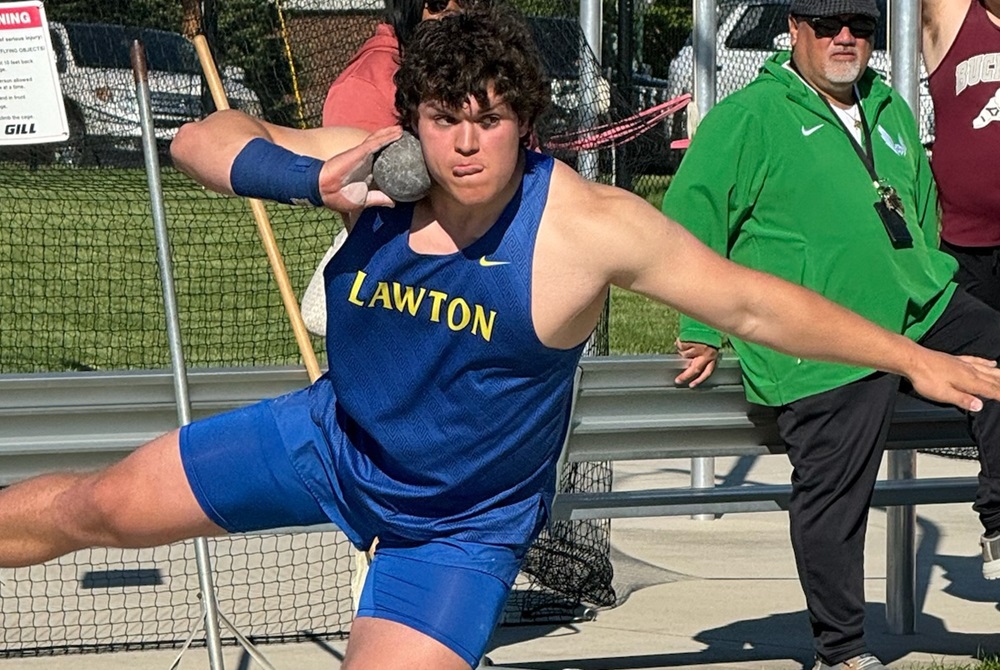
LAWTON — One inch. One lousy inch.
 That was the difference between a championship and second place for Mason Mayne in the shot put at last year’s MHSAA Lower Peninsula Division 3 Track & Field Finals.
One year later, it is still fresh in the mind of the personable Lawton senior as he begins his quest for more hardware.
“That one hurt,” said Mayne, whose best attempt finished second to a 60-foot, 2-inch toss by Pewamo-Westphalia’s Gavin Nurenberg.
“That really burned. You start to wonder, did they measure it wrong? What if I just literally put a little more into it? It drove me to work harder toward it.”
That harder work paid off during the second event that day as Mayne defeated the then-senior Nurenberg 166-6 to 165-11 in the discus to claim Lawton’s first-ever track & field state championship in that event.
Besides taking home that Finals title last year, Mayne holds school records with an indoor-season shot of 62-6 and outdoor of 60-9, as well as a discus toss of 178 feet.
An all-state football player and outstanding student as well, Mayne had opportunities to continue his athletic careers in both sports before signing with Northwestern University. But he also made the decision to compete for his high school one more time this spring instead of graduating early to begin his college career – much to the delight of Lawton track & field coach Mike Meyer.
“He’s been nothing but a joy ever since his freshman year,” Meyer said. “He’s a good, hard worker, obviously a great athlete. All his talent is definitely a nice problem to have.
“He’s been a two-year captain for us, so a good leader, (he) does everything and more than what we ask. That’s why he has the success that he has.”
All-around talent
Mayne said coaching is one big crossover from football to track & field.
“Listening to someone tell you what to do and then do it, I think that’s a super big part of throwing,” he said. “If someone tells you how to do something better in your throw to make it technically better, and you can’t do it, then you can’t get better.
“Playing football for so long, I’ve had so many coaches tell me to do this just a little bit different. And being able to flip that and make that change and adjustment, that’s what makes me able to get better at throwing.”
Mayne said hurling the disc takes more finesse than the shot.
“Technical-wise, the shot put (12 pounds) is easier because I can base it more on how much muscle I can put into it,” he said. “Discus is lighter, (3.5 pounds) but you also have to use your technique a lot more.
“Also, you have to push your body to a point of really stretching it back, allowing it to create a lot of torque into the disc to be able to throw it far enough for it to be worth anything.”
As for those windy days competing in field events, “A lot of people think that the wind behind you helps you,” Mayne said. “That’s actually not true.
“It actually bats the disc down. In the discus, as a right-handed thrower, you want the wind to come across a little bit from your left to throw into. Think of it as an airplane wing, holding up the airplane, the air coming into it. With the shot, it doesn’t matter. It’s just throwing it.”
Lawton’s athletes who specialize in field events also compete in some running competition. Mayne has run the 200 this season and took a turn running the 100 last spring as well.
 “We usually have our throwers run the 200,” Meyer said. “We like athletes instead of just specializing in just one or two things for the (Southwest Athletic) Conference.
“We have all of our kids run two, three and sometimes four events. It can be a long day at a track meet if your events are done and you have nothing to do.”
Mayne is not only an accomplished athlete, but carries a 4.19 grade-point average.
“With the way my mom (Pat) raised me and my brother (Carter) both, she’s a teacher at Paw Paw in the elementary,” he said. “She raised us with the idea that academics are very important. That’s where I’m academically driven.
“She might get mad at me for saying this, but if I miss an assignment, I’m getting a picture on my phone with a circle around it of the assignment missing in my grade book. It’s very important to me.”
That emphasis motivates Mayne’s advice for freshmen who play sports.
“Stay on top of (academics),” he said. “For so many years my mom kept me on top of things. Now I’m able to stay on top of things better myself.
“Your freshman year is the make-or-break it. Having an older brother helped a lot because without him, he wouldn’t have told me that and I wouldn’t have stayed ahead of it.”
Tough decisions
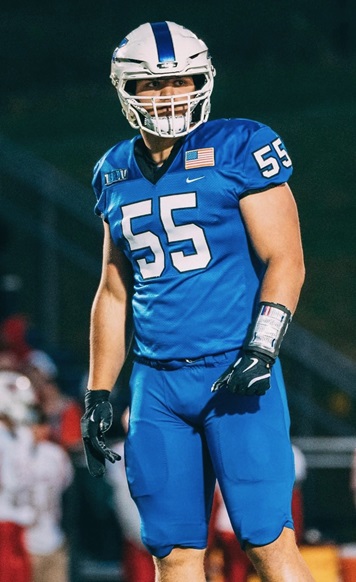
Mayne’s outstanding performances in throwing events last year attracted several college scholarship offers for track in addition to several he’d received previously for football. Choosing a college was not an easy decision for the defensive lineman, who is a two-time Kalamazoo Gazette Dream Team selection in that sport.
“It’s funny because I was really, really considering track for a while,” said the 6-foot-3, 275-pound Mayne. “After my sophomore year when I had a very successful track season, I started to lean toward track.”
 But a trip to the Big House to watch University of Michigan play tilted the scale to football.
“I was watching and I realized I just couldn’t give it up,” he said. “I love both sports, but something about football, the team atmosphere, just sitting in the stadium gets me antsy, that atmosphere and that vibe. That’s really what flipped me into the football aspect. That electricity from the fans and the guys around you. I haven’t experienced any other sport like it.
“It was a very tough decision. I was sad that I couldn’t go multiple ways. Many fantastic coaches recruited me. It’s unfortunate that you have to tell coaches you can’t go to their program because you’re choosing a different program.”
Mayne said he had specific criteria in mind when choosing a college. “Academics is a priority here,” he said. “I also want to play football at a very high level, and then the last is a family aspect.
“Northwestern just checked all the boxes.”
Before the season, Meyer thought he might lose Mayne to early graduation since “he’s a very, very good student. We chatted and he said, ‘Coach, I definitely want to be throwing. I love throwing,’ and he’s a man of his word.
“Once he told me that, I was more excited for the season.”
At one point, Mayne did indeed consider leaving high school to enroll early at Northwestern, which would have meant missing his final spring throwing season.
However, “my mom wasn’t ready for me to leave, which I’m fine with,” he said. “I understand that. I’m her youngest child, I get it.
“Also, you get to start throwing indoors and it’s like, ‘I don’t want to give this up, either.’”
 Pam Shebest served as a sportswriter at the Kalamazoo Gazette from 1985-2009 after 11 years part-time with the Gazette while teaching French and English at White Pigeon High School. She can be reached at [email protected] with story ideas for Calhoun, Kalamazoo and Van Buren counties.
PHOTOS (Top) Lawton’s Mason Mayne begins to unwind while throwing the shot during a meet. (Middle) Lawton track & field coach Mike Meyer. (Below) Mayne stands tall on the football field. (Action photos courtesy of Mason Mayne; headshot by Pam Shebest.)
Reeths-Puffer's 'Marvin Moore Experience' On Track for Memorable Finish
By
Tom Kendra
Special for MHSAA.com
May 14, 2026
Not many high school kids have started their own non-profit organization.
 But, then again, there are not many kids quite like Muskegon Reeths-Puffer senior Marvin Moore – who as a sophomore founded Rocket-Powered Positive Path Forward, Inc. (Rocket-Powered.org) a nonprofit committed to igniting young people’s confidence, fueling their potential and launching them toward brighter futures.
“I wanted to help kids not get discouraged by seeing negative things online or get down on themselves if it seems like other kids are having all of the success,” said the soft-spoken Moore. “I just want to be there for other people.”
Moore somehow finds time to grow and develop the organization while playing three sports and maintaining a 3.977 GPA, with a schedule packed with Advanced Placement classes.
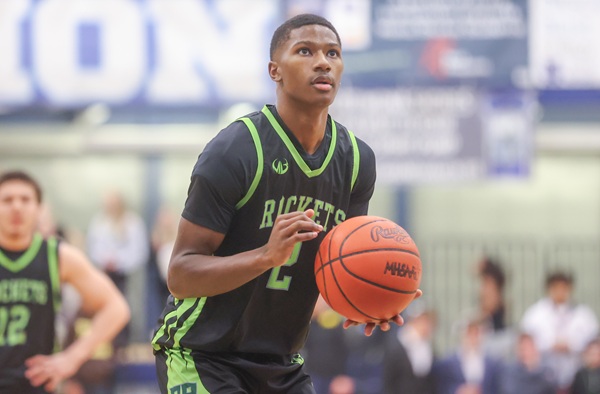
He is best known as a basketball player, a three-year varsity starter and 1,000-point career scorer for the Rockets. Moore, a 6-foot, 175-pound guard, will play college basketball next year at Kalamazoo College.
“I challenged the younger guys in our program,” said R-P boys basketball coach JR Wallace, who recently completed his second year as varsity coach. “I told them: Marvin is leaving us, but he showed you how to do it, with great humility and the attitude of doing whatever he can for the team.”
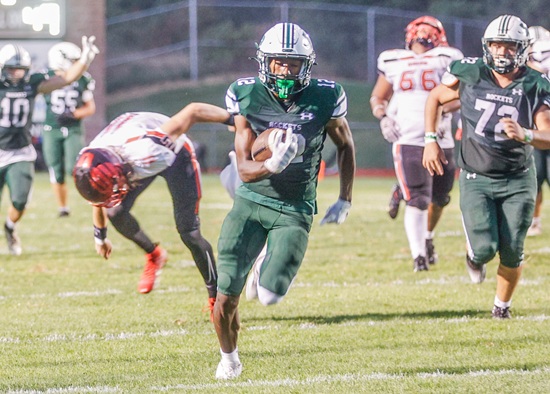 Moore was also a standout receiver in football who was having a breakout season as a junior – including during a memorable win over Grand Rapids Union when he caught a touchdown pass, ran for another TD, intercepted a pass and had a long kickoff return. Unfortunately, his season was cut short by a dislocated shoulder against Byron Center – and he decided to not play football his senior year for fear of re-injuring that shoulder and jeopardizing his senior basketball season.
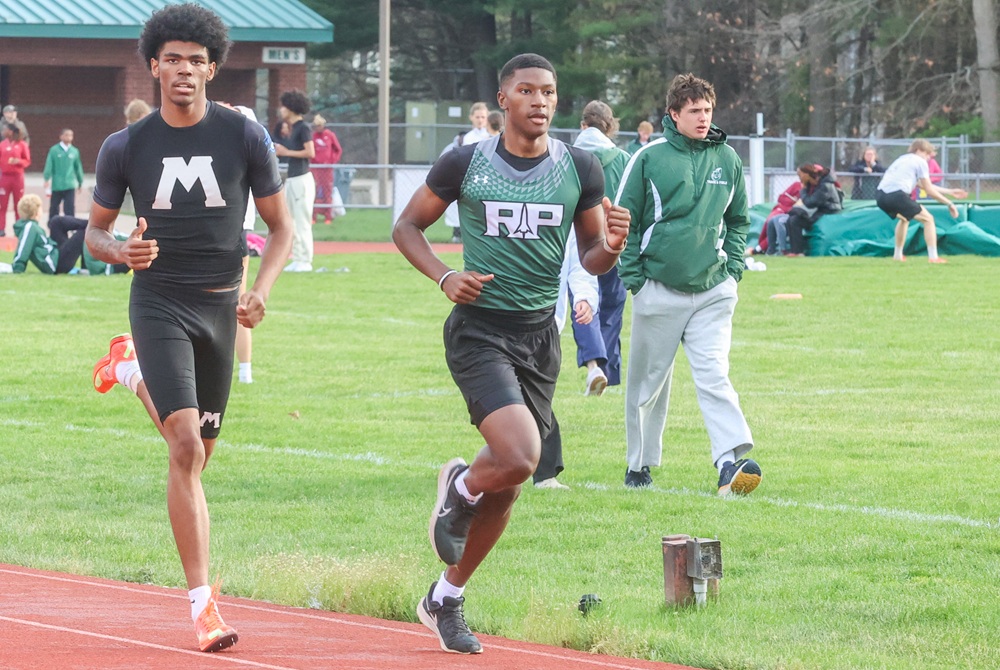
He is now one of the Muskegon area’s top track & field athletes, entering Friday’s Lower Peninsula Division 1 Regional at Zeeland as the top seed in the 400-meter dash after a couple of big wins over the past couple of weeks.
Moore achieved one of his main goals earlier this month by winning the 400 at the Greater Muskegon Athletic Association city meet.
Last week, he edged Jenison’s Kole Bassler to win the 400 at the Ottawa-Kent Conference Green meet with a personal-best time of 49.97.
He was able to post that sub-50 second time despite running it right after helping his team to a conference title in the 800-meter relay and also running the second leg of the 400-meter relay.
“He’s always been a little bit tired running the 400 in our big meets so far,” explained R-P boys track coach Don Ketner, who is also hoping for a big day Friday from senior Mason Darke, the top seed in both the 110- and 300-meter hurdles. “This Friday, we will finally be getting the full Marvin Moore experience, and we’ll see how low he can go.”
Ketner believes Moore has a shot to eclipse the 300 school record of 48.88, set by Jared Meier in 2008.
Moore, who ranks sixth on the school’s career basketball scoring list with 1,095 points, would love to add his name to the track school record board in the gym which has meant so much to him throughout his life.
He was first moved up to the varsity basketball team late in his freshman year, and truly emerged as a sophomore – averaging 10 points for a Puffer team which finished 19-4 and co-champion of the O-K Green.
 R-P lost a loaded senior class after that season (notably current Central Michigan athletes Jaxson Whitaker and Travis Ambrose), and with the Rockets in somewhat of a rebuilding mode, several athletes transferred to other schools.
“There were some schools that reached out and asked me to go there, but I started my whole career at Reeths-Puffer and I wanted to end it here at Reeths-Puffer,” said Moore, the son of Marvin and Kathy Moore, who plans to major in accounting in college. “I wanted to stay with my friends and be there for them and support them any way possible.”
The Rockets struggled on the basketball court the past two seasons, but Moore certainly provided some bright spots. He was a three-time all-conference pick and an MLive Muskegon Area Dream Team selection this past year, averaging 20 points per game despite facing constant double teams.
Moore helped his team snap an 11-game losing streak on Jan. 24, scoring 15 of his game-high 24 points during the fourth quarter including a floater off the glass as time expired in a 65-63 win over visiting East Grand Rapids.
Two weeks later, Moore scored 37 points and almost single-handedly helped the Rockets erase a 10-point deficit against Caledonia over the final three minutes, driving for a bucket during the final seconds in a 65-62 win. He remembers a huge student section was going crazy that night at R-P’s Dan Beckeman Arena, and that excitement carried over to a school dance after the game.
“That was such a fun night all the way around and something I will never forget,” said Moore, who was awarded the prestigious Lux Esto Scholarship at Kalamazoo College.
“We had a lot of losses the past couple of years, but honestly, I will never forget so many of those Friday nights. It was so much fun playing at home and having the whole community there for us.”
 Tom Kendra worked 23 years at The Muskegon Chronicle, including five as assistant sports editor and the final six as sports editor through 2011. E-mail him at [email protected] with story ideas for Muskegon, Oceana, Mason, Lake, Oceola, Mecosta and Newaygo counties.
PHOTOS (Top) Muskegon Reeths-Puffer’s Marvin Moore, middle, runs the inside lane during a meet this season. (Middle) Moore lines up for a free throw. (Below) Moore breaks away on a run against Grand Rapids Union. (Photos by Joe Lane.)