

Football Future Awaits, but Mayne Focused First on Finishing Track Finals Sweep
By
Pam Shebest
Special for MHSAA.com
April 22, 2025
LAWTON — One inch. One lousy inch.
 That was the difference between a championship and second place for Mason Mayne in the shot put at last year’s MHSAA Lower Peninsula Division 3 Track & Field Finals.
One year later, it is still fresh in the mind of the personable Lawton senior as he begins his quest for more hardware.
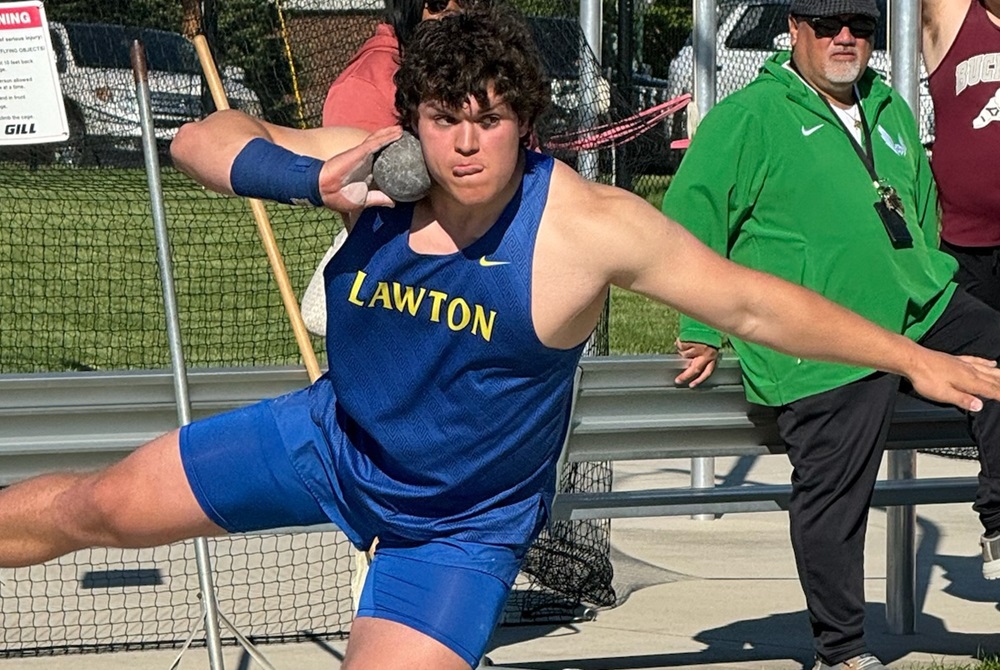
“That one hurt,” said Mayne, whose best attempt finished second to a 60-foot, 2-inch toss by Pewamo-Westphalia’s Gavin Nurenberg.
“That really burned. You start to wonder, did they measure it wrong? What if I just literally put a little more into it? It drove me to work harder toward it.”
That harder work paid off during the second event that day as Mayne defeated the then-senior Nurenberg 166-6 to 165-11 in the discus to claim Lawton’s first-ever track & field state championship in that event.
Besides taking home that Finals title last year, Mayne holds school records with an indoor-season shot of 62-6 and outdoor of 60-9, as well as a discus toss of 178 feet.
An all-state football player and outstanding student as well, Mayne had opportunities to continue his athletic careers in both sports before signing with Northwestern University. But he also made the decision to compete for his high school one more time this spring instead of graduating early to begin his college career – much to the delight of Lawton track & field coach Mike Meyer.
“He’s been nothing but a joy ever since his freshman year,” Meyer said. “He’s a good, hard worker, obviously a great athlete. All his talent is definitely a nice problem to have.
“He’s been a two-year captain for us, so a good leader, (he) does everything and more than what we ask. That’s why he has the success that he has.”
All-around talent
Mayne said coaching is one big crossover from football to track & field.
“Listening to someone tell you what to do and then do it, I think that’s a super big part of throwing,” he said. “If someone tells you how to do something better in your throw to make it technically better, and you can’t do it, then you can’t get better.
“Playing football for so long, I’ve had so many coaches tell me to do this just a little bit different. And being able to flip that and make that change and adjustment, that’s what makes me able to get better at throwing.”
Mayne said hurling the disc takes more finesse than the shot.
“Technical-wise, the shot put (12 pounds) is easier because I can base it more on how much muscle I can put into it,” he said. “Discus is lighter, (3.5 pounds) but you also have to use your technique a lot more.
“Also, you have to push your body to a point of really stretching it back, allowing it to create a lot of torque into the disc to be able to throw it far enough for it to be worth anything.”
As for those windy days competing in field events, “A lot of people think that the wind behind you helps you,” Mayne said. “That’s actually not true.
“It actually bats the disc down. In the discus, as a right-handed thrower, you want the wind to come across a little bit from your left to throw into. Think of it as an airplane wing, holding up the airplane, the air coming into it. With the shot, it doesn’t matter. It’s just throwing it.”
Lawton’s athletes who specialize in field events also compete in some running competition. Mayne has run the 200 this season and took a turn running the 100 last spring as well.
 “We usually have our throwers run the 200,” Meyer said. “We like athletes instead of just specializing in just one or two things for the (Southwest Athletic) Conference.
“We have all of our kids run two, three and sometimes four events. It can be a long day at a track meet if your events are done and you have nothing to do.”
Mayne is not only an accomplished athlete, but carries a 4.19 grade-point average.
“With the way my mom (Pat) raised me and my brother (Carter) both, she’s a teacher at Paw Paw in the elementary,” he said. “She raised us with the idea that academics are very important. That’s where I’m academically driven.
“She might get mad at me for saying this, but if I miss an assignment, I’m getting a picture on my phone with a circle around it of the assignment missing in my grade book. It’s very important to me.”
That emphasis motivates Mayne’s advice for freshmen who play sports.
“Stay on top of (academics),” he said. “For so many years my mom kept me on top of things. Now I’m able to stay on top of things better myself.
“Your freshman year is the make-or-break it. Having an older brother helped a lot because without him, he wouldn’t have told me that and I wouldn’t have stayed ahead of it.”
Tough decisions
Mayne’s outstanding performances in throwing events last year attracted several college scholarship offers for track in addition to several he’d received previously for football. Choosing a college was not an easy decision for the defensive lineman, who is a two-time Kalamazoo Gazette Dream Team selection in that sport.
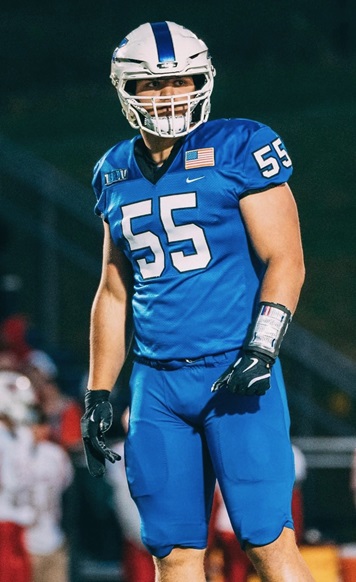
“It’s funny because I was really, really considering track for a while,” said the 6-foot-3, 275-pound Mayne. “After my sophomore year when I had a very successful track season, I started to lean toward track.”
 But a trip to the Big House to watch University of Michigan play tilted the scale to football.
“I was watching and I realized I just couldn’t give it up,” he said. “I love both sports, but something about football, the team atmosphere, just sitting in the stadium gets me antsy, that atmosphere and that vibe. That’s really what flipped me into the football aspect. That electricity from the fans and the guys around you. I haven’t experienced any other sport like it.
“It was a very tough decision. I was sad that I couldn’t go multiple ways. Many fantastic coaches recruited me. It’s unfortunate that you have to tell coaches you can’t go to their program because you’re choosing a different program.”
Mayne said he had specific criteria in mind when choosing a college. “Academics is a priority here,” he said. “I also want to play football at a very high level, and then the last is a family aspect.
“Northwestern just checked all the boxes.”
Before the season, Meyer thought he might lose Mayne to early graduation since “he’s a very, very good student. We chatted and he said, ‘Coach, I definitely want to be throwing. I love throwing,’ and he’s a man of his word.
“Once he told me that, I was more excited for the season.”
At one point, Mayne did indeed consider leaving high school to enroll early at Northwestern, which would have meant missing his final spring throwing season.
However, “my mom wasn’t ready for me to leave, which I’m fine with,” he said. “I understand that. I’m her youngest child, I get it.
“Also, you get to start throwing indoors and it’s like, ‘I don’t want to give this up, either.’”
 Pam Shebest served as a sportswriter at the Kalamazoo Gazette from 1985-2009 after 11 years part-time with the Gazette while teaching French and English at White Pigeon High School. She can be reached at [email protected] with story ideas for Calhoun, Kalamazoo and Van Buren counties.
PHOTOS (Top) Lawton’s Mason Mayne begins to unwind while throwing the shot during a meet. (Middle) Lawton track & field coach Mike Meyer. (Below) Mayne stands tall on the football field. (Action photos courtesy of Mason Mayne; headshot by Pam Shebest.)
Britton Deerfield Boys Following Bigger Numbers to Championship Results
By
Doug Donnelly
Special for MHSAA.com
May 6, 2026
Each week during boys track & field season, Dustin Longnecker gathers his Britton Deerfield team in his classroom. They call it the “War Room.”
 Longnecker and his Patriots stand in front of the white board and go through the upcoming track meet or invitational event-by-event, figuring out where they can score the most points. The fact that BD is even focused on dual meets is a complete change of thinking for Longnecker.
“I’m so blessed,” he said. “I could go on and on about this group. I’ve never had numbers like this. My first year I had eight kids on the boys and girls team combined.
“One year I had this phenomenal sprinter, a high jumper with turf toe and some throwers. I’ve never cared about dual meets because we just couldn’t compete.”
As Longnecker says, this is “the good old days” for BD.
The Patriots finished the Tri-County Conference with a winning record at 3-2-1 and head into Friday’s league meet with a good shot at third place. They won a home invitational Friday against some established programs from the Lenawee County Athletic Association and Cascades Conference.
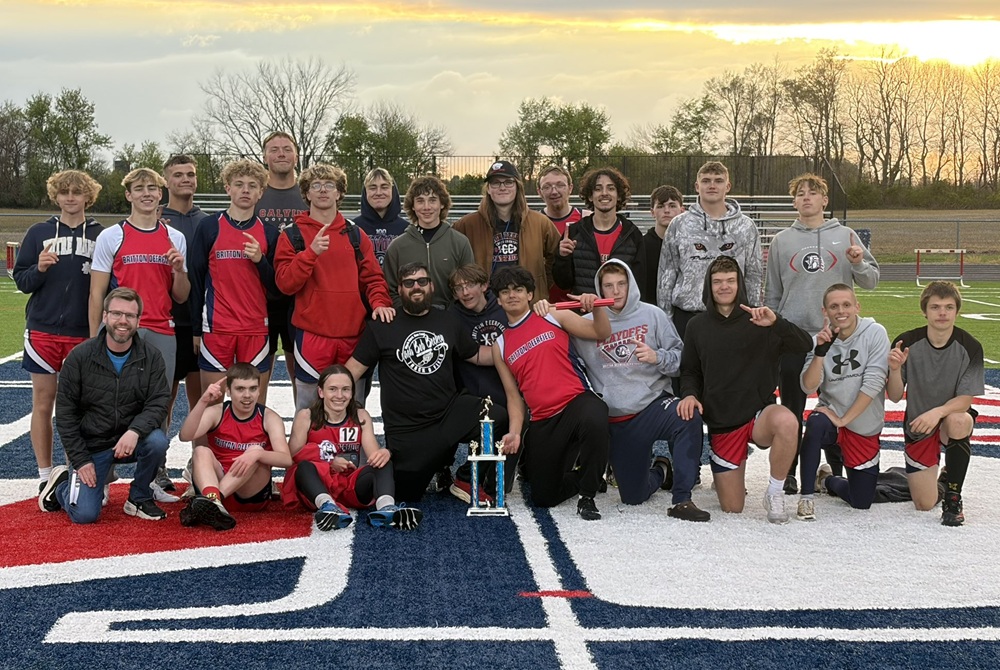
“Before the season Erik (Johnson) asked me what kind of trophy to get for the Bob Beckey Invite. I said I didn’t care because we’d never sniff that,” said Longnecker, referring to a conversation with his athletic director. “Turns out, we won. It was so great for the kids. We score up to eight places and had all sorts of kids contribute. That was the great thing about it. It is more special when everyone contributes.”
The Beckey Invite was named after longtime coach Bob Beckey, who died in 2016.
Ottawa Lake Whiteford coach Jay Yockey coached at BD previously and was elated to hear BD took home the trophy.
“Bob was also a great guy and coach, and he loved track, but he loved our athletes more,” Yockey said. “So, to see BD win an invite that is named after him is incredible. Bob had a saying that he used often when he was happy. He would say, ‘I’m tickled pink.’ Now he probably would be embarrassed to have an invite named after him, but to know the school he last coached at won that invite, I would have to imagine that he would say that he was ‘tickled pink.’”
Longnecker has had to utilize various strategies over the years as a track coach due to BD’s low numbers. For example, he’s seldom been in favor of pushing kids to run in four events in one day. He’s also never concerned himself with winning dual meets.
“We have a winning record in the TCC for the first time in my career,” he said. “I never thought I’d say that. We just don’t win dual meets. We haven’t had the numbers. This year, the kids have been all about it. We have a really strong freshman and junior class. The great thing about it is that it is really from top to bottom. The kids are still getting better.”
 Typically, Longnecker is focused on getting kids to qualify for the MHSAA Finals and run record times at BD.
This year he can do both.
“I was a two-miler in high school,” he said. “I’ve never had a kid who would run it here. This year, I have Donovan McCarthy who runs it. He doesn’t like it, but he likes scoring points.”
McCarthy finished third in the 3,200 at the Beckey Invitational in a great finish.
“He fought a kid from Hudson the whole way,” Longnecker said. “Performances like that is why I love this group.”
The Patriots 400 relay is knocking on the door of a Finals-qualifying time. Freshman Elijah Fortune is a talented athlete who vomited twice and took a nap in the parking lot before returning to the track and helping his team win that race.
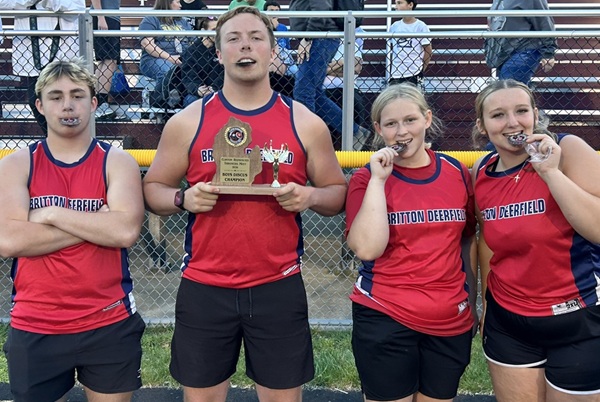
BD could get multiple distance runners to the Finals, and all four throwers have had an impact this season, especially senior Andrew Bunker.
“He’ll have both records before the season is over,” Longnecker predicted about Bunker.
Bunker has been an amazing story in his own right. He weighed less than 200 pounds when the Britton Deerfield 8-player football season ended in 2024. He’s now up to 275 and will play college football. He’s become a fitness guru, counting every calorie and working out daily with a stringent routine.
“I try to stay clean,” he said. “I track my protein, carbs and fat. I try to eat as clean as I can. You can’t always eat clean 24/7. I’m in high school. I just do the best I can – a lot of chicken, eggs and rice. I think in that first year we went through dozens and dozens of eggs. (My brother and I would) come home and just devour eggs after the gym – eggs, rice and chicken. You just have to eat what you can.”
Longnecker said Bunker has turned into a great team leader for track, too.
“He’s such a cerebral kid. It’s rare to be around a kid who is that committed to anything,” the coach said.
For Britton Deerfield, which has a high school enrollment of 125, the track numbers might stay high for the next few years. Longnecker credits the middle school coaches with helping kids get interested – and stay interested – in track & field.
“We have a good nucleus right now,” he said. “I think next year we’re going to be just as solid.”
 Doug Donnelly has served as a news and sports reporter at the Adrian Daily Telegram and the Monroe News for 30 years, including 10 years as city editor in Monroe. He's written a book on high school basketball in Monroe County and compiles record books for various schools in southeast Michigan. He is now publisher and editor of The Blissfield Advance, a weekly newspaper. E-mail him at [email protected] with story ideas for Jackson, Washtenaw, Hillsdale, Lenawee and Monroe counties.
PHOTOS (Top) The Britton Deerfield boys track & field team gathers around coach Dustin Longnecker after winning its Bob Beckey Invitational. (Middle) Patriots throwers (from left) Drew Bunker, Zach Gonzalez, Kurina Dotson and McKenna Allshouse show off their trophy and medals won at the Clinton Throwers Meet. (Photos courtesy of the Britton Deerfield athletic department.)