

Full Team Effort Helps Gladstone Go Distance
June 19, 2019
By Geoff Kimmerly
Second Half editor
With Gladstone’s boys track & field team set to begin competition two months ago, longtime coach Gary Whitmer described his team in a local newspaper preview as a mystery.
 There were signs it could be a special spring, going back at least a year, when the Braves finished third at the Upper Peninsula Division 1 Finals thanks in part to then-freshman Calvin Thibault winning both hurdles races.
Whitmer also took notice at the end of the fall when his cross country team finished third in UPD1 – one point ahead of annual distance power Marquette – with Gladstone senior Adam Bruce the individual champion.
The Upper Peninsula Track & Field Finals can be a little bit different game than the championship meets downstate. But Gladstone’s boys solved all the mysteries and played the Finals game well. The MHSAA/Applebee’s “Team of the Month” for May won league championships in both the Great Northern and Mid-Peninsula Conferences, then claimed their Division 1 Regional before winning its first Finals since 2013 on the first day of June.
The Braves won with 127 points, 30 ahead of both Ishpeming Westwood and Marquette – the runners-up in Gladstone’s league title wins. The Braves also broke a four-year Finals winning streak for Marquette, the UP’s largest school with 950 students – twice as many as Gladstone’s 460.
“Downstate, you can come (to the Finals) with 4-5 really good athletes and win it, because there are so many schools,” Whitmer said. “But up here, if you don’t have the numbers … when you get in with Marquette and the Sault and bigger schools, you have a different strategy. You’ve got to get as many kids in there as you can.”
Gladstone had 40 athletes on its boys team this spring. Just fewer than half – 18 – qualified for the Finals during the Braves’ 24-point win at their May 16 Regional. Of that 18, 15 placed among the top six to score in their events at the June 1 Finals.
While Marquette has owned UPD1 over the last decade with seven titles since 2010, Gladstone was similarly dynastic winning six straight from 2004-09 and then again in 2013. But compared to that most recent previous champ, this Braves team enjoyed an important variety of talented athletes – with a boost from a comeback by one of the program’s best all-time.
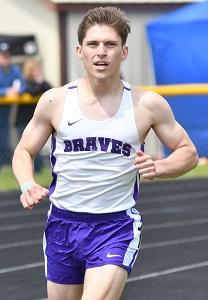 Bruce had hip surgery in January and didn’t start racing again until May. But whereas Gladstone didn’t place anyone in the 1,600 and 3,200 during the 2013 title run, Bruce won both races this time both at the Regional and Finals. He didn’t get up to speed to break his school records set in both in 2018, but still came through with 20 points at the championship meet and likely would have scored more if he’d run the 800 – the only event at this year’s Finals where Gladstone didn’t have a placer. Bruce was held out of that race to keep his still-recovering legs fresh for the others. He also didn’t run on the 3,200 relay, which without him still cut 25 seconds off its previous best to place third.
“I don’t think the kids think they could’ve done it,” Whitmer said of winning it all. “He kept encouraging them and gave them confidence there was that possibility.”
Thibault did repeat as winner in both hurdles races and took third in the 100 and second in the 200. Sophomore Blake Servant won the discus by more than five feet, and junior Luke Van Brocklin just missed breaking the school record in the 400 while finishing second in a fast, tightly-contested race. Senior hurdler/sprinter James McKnight and junior thrower Greg Chenier also placed in multiple individual events.
Also adding to the Braves’ championship score were senior Jake Strasler, juniors Louis Berube, Jarret St. John and Kyle Van Brocklin; sophomores Wyatt Madden, Lucas Hughes and Ethan Milam; and freshmen Giovanni Mathews and Hunter Potter.
Gladstone won all but one of its meets this spring – finishing behind Marquette in late April at an event that allowed unlimited entries. Sadly, the Braves had additional motivation as well this season after longtime athletic director and assistant coach Matt Houle died Nov. 9. He had coached since the mid-1980s and remained part of Whitmer’s staff since the latter took over as head coach in 2002.
Whitmer had planned to retire with Houle, but not this soon. He’s eager to continue working with the program they helped build, already excited about a strong distance runner coming up and his team’s improving field events.
“I’ll be 64 this year, my wife is a family physician up here, and all six of our kids went to Gladstone High School and graduated from here,” Whitmer said. “I’m just going to keep plugging away, and I enjoy it. We have a great bunch of kids.”
Past Teams of the Month, 2018-19
April: Garden City baseball – Read
March: Holland West Ottawa boys swimming & diving – Read
February: Lowell wrestling – Read
January: Farmington United gymnastics – Read
December: Warren Woods-Tower wrestling – Read
November: Rochester Adams girls swimming & diving – Read
October: Leland boys soccer – Read
September: Pickford football – Read
August: Northville girls golf – Read
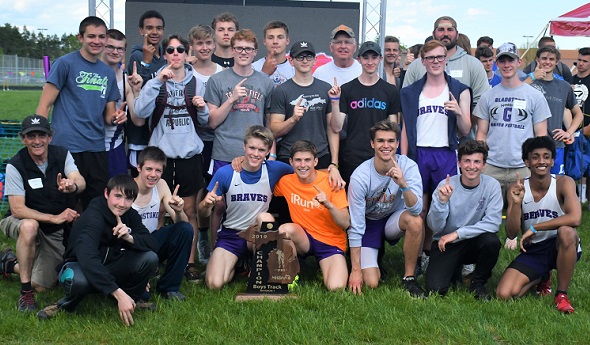
PHOTOS: (Top) Gladstone poses with its championship trophy after winning the UPD1 Finals. (Middle) Adam Bruce finishes his title-winning run in the 3,200. (Photos by Cara Kamps.)
Performance of the Week: East Kentwood's De-Mani Roberts
May 28, 2026
 De-Mani Roberts ♦ East Kentwood
Sophomore ♦ Track
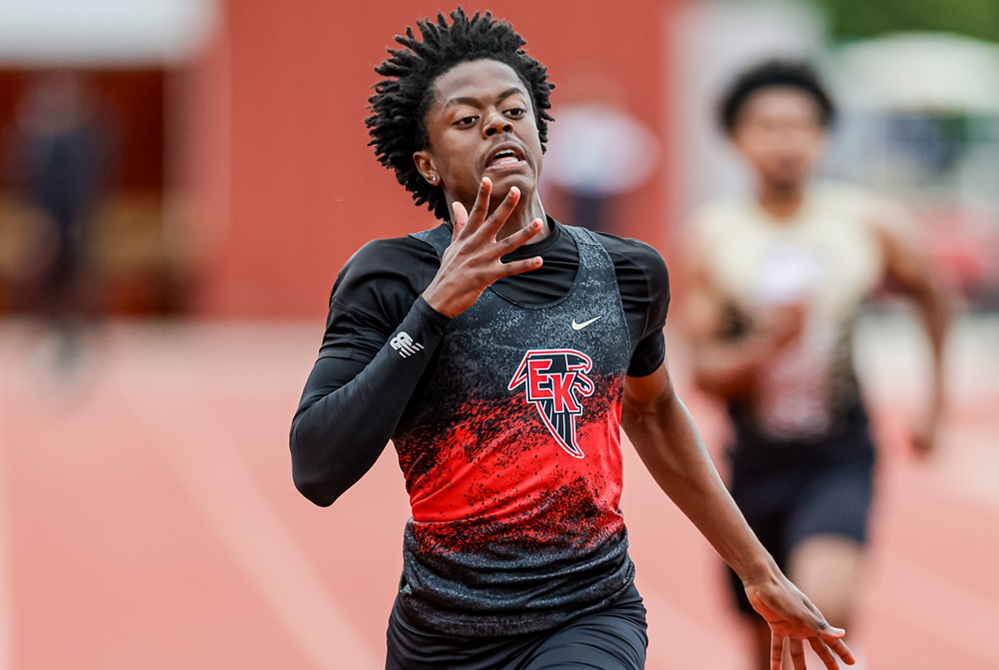
Roberts has made impressive strides in the second season of high school outdoor track, cutting nearly a half-second off his top 200-meter time from a year ago and more than a second off his freshman-year best in the 400 in helping East Kentwood become a favorite to win the team championship at Saturday's Lower Peninsula Division 1 Finals. Roberts won the 200 in a personal-best 21.26 seconds and ran on the winning 800 relay (1:26.83) as the Falcons won the Michigan Interscholastic Track Coaches Association (MITCA) Division 1 team championship last weekend.
That 200 time and his top 400 time of 47.55 seconds are both the fastest in the state in those respective races this spring, all divisions included. Roberts is undefeated in both races, a notable jump even as he finished 14th in the 200 and ran on three top-12 relays at last year's MHSAA Finals. That top 200 time also trails the current LPD1 Finals record by only 25 hundredths of a second, and he could make a run at Finals records in both individual races with half his high school career remaining. Roberts also has run cross country for East Kentwood the last two seasons.
@mhsaasports 🏃POW: De-Mani Roberts #eastkentwood #track #highschoolsports #performanceoftheweek #MHSAA ♬ Bright and fun upbeat pops, Kids, Animals, Pets, Fun, Cute, Happy, Playful, Upbeat(1465232) - SAKUMAMATATA
@mhsaasports 🏃POW: De-Mani Roberts #funfacts #tiktalk #performanceoftheweek #highschoolsports #MHSAA ♬ Girly and cute synth pop - SAKUMAMATATA
Follow the MHSAA on TikTok.
MHSAA.com's "Performance of the Week" features are powered by MI Student Aid, a division within the Department of Lifelong Education, Advancement, and Potential (MiLEAP). MI Student Aid encourages students to pursue postsecondary education by providing access to student financial resources and information. MI Student Aid administers the state’s 529 college savings programs (MET/MESP), as well as scholarship and grant programs that help make college Accessible, Affordable and Attainable for you. Connect with MI Student Aid at www.michigan.gov/mistudentaid and find more information on Facebook and X @mistudentaid.
Previous 2025-26 honorees
May 22: Taleon Guess, Temperance Bedford golf - Report
May 15: Zacchaeus Brocks, Detroit Catholic Central track - Report
May 7: Savanah Thompson, Howard City Tri County soccer - Report
April 30: Eliza Schwass, Ludington track - Report
April 23: Emily Postema, Ravenna softball - Report
April 16: Katie Berkshire, Gaylord track - Report
March 26: Kayla Hairston, Goodrich basketball - Report
March 19: Liam Smith, Otsego swimming - Report
March 12: Jack Sayen, Houghton hockey - Report
March 5: Devin Patrick, St. Clair Shores Lake Shore - Report
Feb. 26: Madison Nieuwenhuis, Plainwell wrestling - Report
Feb. 20: Sophie Ramey, Allen Park competitive cheer - Report
Feb. 13: Cam Ryans, Grand Rapids Northview basketball - Report
Feb. 6: Melanie Kolnitys, Midland Dow basketball - Report
Jan. 29: Stella Musialowski, Huron Valley United gymnastics - Report
Jan. 22: Baylor Perkins, Grand Blanc swimming - Report
Jan. 15: Delaney Vanier, Flint Kearsley bowling - Report
Jan. 8: Stevie Hall, Detroit Cass Tech basketball - Report
Dec. 18: Ethan Martha, Ishpeming Westwood basketball - Report
Dec. 11: Louis Smith, Three Rivers wrestling - Report
Dec. 4: Traverse Moore, DeWitt football - Report
Nov. 28: Elizabeth Eichbrecht, West Bloomfield swimming - Report
Nov. 20: Brady Kieff, Blanchard Montabella football - Report
Nov. 13: Ella Laupp, Battle Creek Harper Creek swimming - Report
Nov. 7: Hunter Eaton, Charlevoix cross country - Report
Oct. 31: Stephen Gollapalli, Lansing Christian tennis - Report
Oct. 23: Talya Schreiber, Pickford cross country - Report
Oct. 16: Avery Manning, Dexter golf - Report
Oct. 9: Brady Van Laecke, Hudsonville football - Report
Oct. 2: Sarah Giroux, Flat Rock volleyball - Report
Sept. 25: Sam Schumacher, Portage Central tennis - Report
Sept. 18: Kaylee Mitzel, Saline field hockey - Report
Sept. 11: Natasza Dudek, Ann Arbor Pioneer cross country - Report
Sept. 4: Kate Posey, Big Rapids golf - Report
PHOTO East Kentwood's De-Mani Roberts runs to a win in the 200 meters at the MITCA Division 1 championship meet. (Photo by Miles Postema.)