

Lessons Learned on Track Have Jibowu's Business Surging to Quick Success
By
Paul Costanzo
Special for MHSAA.com
August 1, 2022
Athletics showed Soj Jibowu just how far he could push himself.
All the time spent on the track, working to become the state’s best high school 400-meter runner, and then more than that, taught him to stretch beyond what he thought were his limits.
So, when it came time to make a decision on whether to jump fully into his apparel company, Varlo, or keep it as a part-time side venture, the 2001 Saginaw Heritage graduate knew he could take himself to another level if needed.
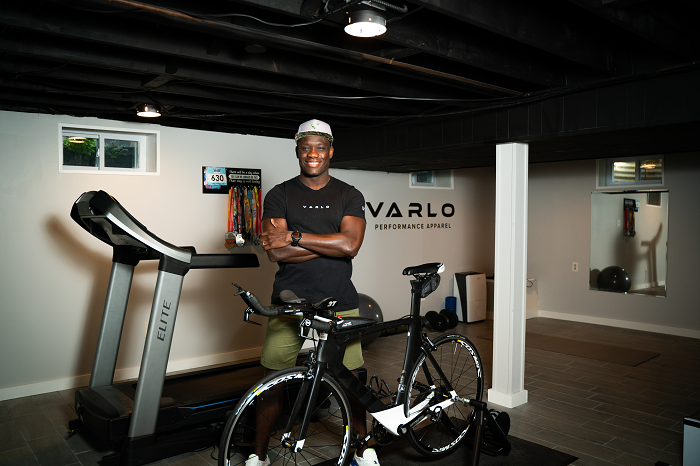
Jibowu is the founder and CEO of Varlo, a clothing company that specializes in outfitting triathletes, but also offers casual wear for men and women. The company is just over three years old, but its clientele includes hundreds of triathletes, eight professionals, three NCAA programs and even hospitals. Merchandise is sold in eight countries.
All of that is validation for Jibowu, who took the leap to pursuing the company full-time just one year into its existence.
“When I resigned (from a medical sales job) to do this full-time, my wife was pregnant with our second child, my daughter wasn’t even walking yet,” said Jibowu, who now lives in Cherry Hill, N.J., with his wife and two young children. “Where was my state of mind to leave my very comfortable, high-paying job to pursue this – to sell clothes?”
His mind was in the same place that helped him reach tremendous heights as a runner, both at Heritage and Central Michigan University.
Jibowu, who was born in Nigeria and spent much of his childhood in Huntsville, Ala., was part of some incredible Heritage teams. He graduated a year behind eventual NFL safety Stuart Schweigert, who he ran with on the Finals-winning 1,600 relay in 2000. Another member of that relay was Derold Sligh, who won the 400-meter Finals title that year, setting the Lower Peninsula Division 1 Finals record in the process. The Hawks were LP Division 1 runners-up as a team that season.
“I ran track when I was younger, and I was terrible,” Jibowu said. “In high school, if I look back at it, I probably would have called it impostor syndrome. I think that was me up until maybe like somewhere in my senior year when I started to think, ‘I’m pretty fast.’ … I had so many dominant people around me, in my mind, I was still the slow guy.”
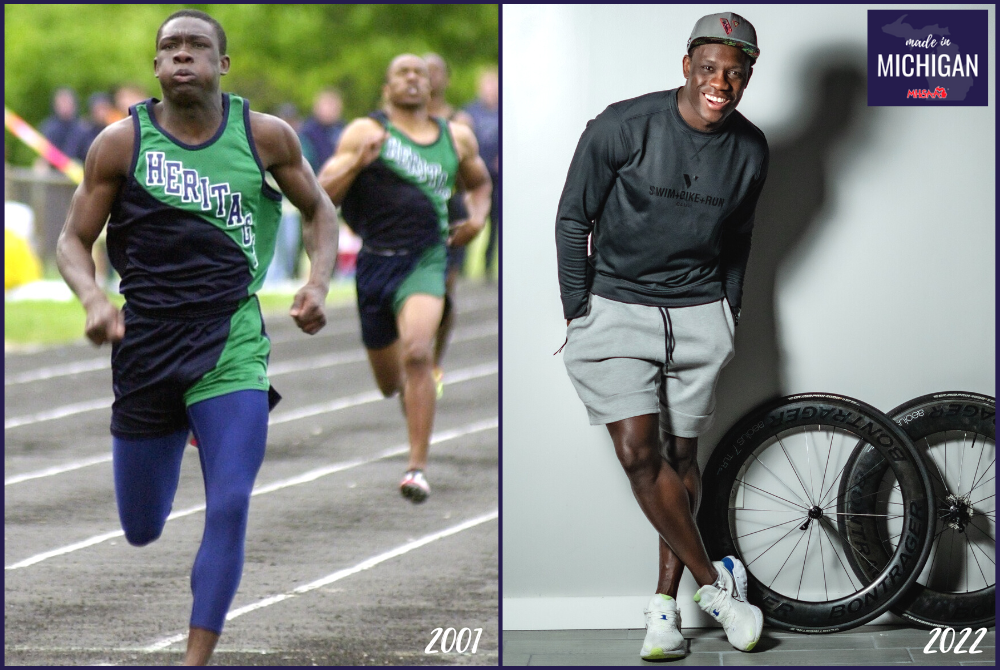
 As a senior, Jibowu erased that self-doubt. He led Heritage to its first, and still only, Division 1 Finals title, running the 400 in 48.28 and breaking the record Sligh had set the year prior.
It was working to get to that point that Jibowu still credits with his ability to push himself in all things.
“I preach this all the time: if you have the ability to be involved in sports at a young age, do it,” Jibowu said. “It’s a gift, first of all. You don’t know any better when you’re young, you think you’re just training your body, but what’s really, truly occurring is you’re training your mind and building discipline. You’re building your character as far as who you are as a person. What is your will? How far are you willing to push? Am I able to be coached? Am I able to learn? Am I able to lose over and over again and keep going? Am I able to navigate to feel what it’s like to win? What you’re truly developing is how to manage and handle life.”
Jibowu said he didn’t finalize his college decision until late in the process, as he had to work on his test scores into the summer. While at CMU, he majored in biomedical science and chemistry, and he excelled, admitting he was a much better student in college than in high school.
He was also reunited with Sligh on the Chippewas track team, and had a successful career. He was regularly within the top five in the 200 and 400 in the Mid-American Conference, and won a MAC title in the 400 at the 2004 indoor championships. His personal bests in the races were 21.19 and 46.81, respectively.
After graduating from CMU, Jibowu began working as a pharmaceutical rep, then moved into medical sales.
While he remained active, it wasn’t until he took a trip to Chicago that he discovered triathlons.
“I remember seeing these really cool bikes and these really fit people, and then they jumped into Lake Michigan,” he said. “And I didn’t know that was possible, because I didn’t grow up swimming. I didn’t know that volume of people knew how to swim like that. Then they get out of Lake Michigan, jump on their bikes and they’re flying. Then they’re sprinting a 6K and I remember thinking, ‘Oh my God, these guys are the real freaking deal.’ I was hooked and wanted to start competing.”
As he began competing, the wheels for his current venture began turning. At this point, Jibowu was living out east and had worked for a pair of successful start-ups in the medical industry. That helped give him knowledge, and confidence, to make his own moves.
“I had always been into clothes and fashion, and how you express yourself with what you wear,” Jibowu said. “There was an opportunity there. The sport of triathlon is as old as me; it started in (1983). That’s a baby. That’s like basketball without the 3-point line. There’s so much opportunity for innovation.”
With that, Varlo was born, and it has since thrived, with Jibowu and the lessons he learned on a track in Saginaw paving the way.
“If you are in high school and have the ability to be in a sport, it’s a gift,” he said. “At that young of an age, truly learning to manage the trials and tribulations of life. That is a gift.”
2021-22 Made in Michigan
July 28: Running Set Life's Stage for Grosse Pointe South's Record-Setting Meier Sisters - Read
July 25: 2005 Miss Basketball DeHaan Cherishing Newest Title: 1st-Time Mom - Read
July 21: Championship Memories Still Resonate with St. Thomas Star Lillard - Read
July 14: Portage Central Champ Rolls to Vanderbilt, Writing Next Chapter in Alabama - Read
July 12: Coaching Couple Passing On Knowledge, Providing Opportunities for Frankfort Wrestlers - Read
June 30: Hrynewich's Star Continuing to Rise with Olympic, Pro Sports Arrivals - Read
PHOTOS (Top) At left, Heritage’s Soj Jibowu wins the 400 meters during the 2001 Saginaw Valley League championship meet. At right, Jibowu is the founder and CEO of the Varlo clothing company. (Middle) Jibowu’s company specializes in outfitting triathletes, and he has taken up the sport after a successful college track & field career. (Heritage photo courtesy of Saginaw News/MLive; current photos courtesy of Soj Jibowu.)
Performance of the Week: East Kentwood's De-Mani Roberts
May 28, 2026
 De-Mani Roberts ♦ East Kentwood
Sophomore ♦ Track
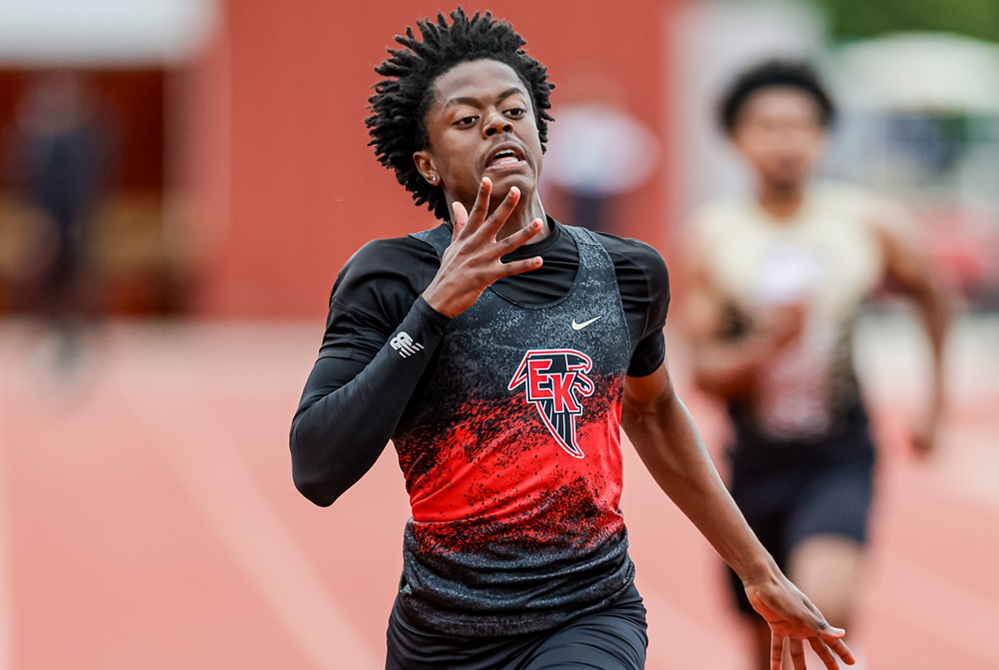
Roberts has made impressive strides in the second season of high school outdoor track, cutting nearly a half-second off his top 200-meter time from a year ago and more than a second off his freshman-year best in the 400 in helping East Kentwood become a favorite to win the team championship at Saturday's Lower Peninsula Division 1 Finals. Roberts won the 200 in a personal-best 21.26 seconds and ran on the winning 800 relay (1:26.83) as the Falcons won the Michigan Interscholastic Track Coaches Association (MITCA) Division 1 team championship last weekend.
That 200 time and his top 400 time of 47.55 seconds are both the fastest in the state in those respective races this spring, all divisions included. Roberts is undefeated in both races, a notable jump even as he finished 14th in the 200 and ran on three top-12 relays at last year's MHSAA Finals. That top 200 time also trails the current LPD1 Finals record by only 25 hundredths of a second, and he could make a run at Finals records in both individual races with half his high school career remaining. Roberts also has run cross country for East Kentwood the last two seasons.
@mhsaasports 🏃POW: De-Mani Roberts #eastkentwood #track #highschoolsports #performanceoftheweek #MHSAA ♬ Bright and fun upbeat pops, Kids, Animals, Pets, Fun, Cute, Happy, Playful, Upbeat(1465232) - SAKUMAMATATA
@mhsaasports 🏃POW: De-Mani Roberts #funfacts #tiktalk #performanceoftheweek #highschoolsports #MHSAA ♬ Girly and cute synth pop - SAKUMAMATATA
Follow the MHSAA on TikTok.
MHSAA.com's "Performance of the Week" features are powered by MI Student Aid, a division within the Department of Lifelong Education, Advancement, and Potential (MiLEAP). MI Student Aid encourages students to pursue postsecondary education by providing access to student financial resources and information. MI Student Aid administers the state’s 529 college savings programs (MET/MESP), as well as scholarship and grant programs that help make college Accessible, Affordable and Attainable for you. Connect with MI Student Aid at www.michigan.gov/mistudentaid and find more information on Facebook and X @mistudentaid.
Previous 2025-26 honorees
May 22: Taleon Guess, Temperance Bedford golf - Report
May 15: Zacchaeus Brocks, Detroit Catholic Central track - Report
May 7: Savanah Thompson, Howard City Tri County soccer - Report
April 30: Eliza Schwass, Ludington track - Report
April 23: Emily Postema, Ravenna softball - Report
April 16: Katie Berkshire, Gaylord track - Report
March 26: Kayla Hairston, Goodrich basketball - Report
March 19: Liam Smith, Otsego swimming - Report
March 12: Jack Sayen, Houghton hockey - Report
March 5: Devin Patrick, St. Clair Shores Lake Shore - Report
Feb. 26: Madison Nieuwenhuis, Plainwell wrestling - Report
Feb. 20: Sophie Ramey, Allen Park competitive cheer - Report
Feb. 13: Cam Ryans, Grand Rapids Northview basketball - Report
Feb. 6: Melanie Kolnitys, Midland Dow basketball - Report
Jan. 29: Stella Musialowski, Huron Valley United gymnastics - Report
Jan. 22: Baylor Perkins, Grand Blanc swimming - Report
Jan. 15: Delaney Vanier, Flint Kearsley bowling - Report
Jan. 8: Stevie Hall, Detroit Cass Tech basketball - Report
Dec. 18: Ethan Martha, Ishpeming Westwood basketball - Report
Dec. 11: Louis Smith, Three Rivers wrestling - Report
Dec. 4: Traverse Moore, DeWitt football - Report
Nov. 28: Elizabeth Eichbrecht, West Bloomfield swimming - Report
Nov. 20: Brady Kieff, Blanchard Montabella football - Report
Nov. 13: Ella Laupp, Battle Creek Harper Creek swimming - Report
Nov. 7: Hunter Eaton, Charlevoix cross country - Report
Oct. 31: Stephen Gollapalli, Lansing Christian tennis - Report
Oct. 23: Talya Schreiber, Pickford cross country - Report
Oct. 16: Avery Manning, Dexter golf - Report
Oct. 9: Brady Van Laecke, Hudsonville football - Report
Oct. 2: Sarah Giroux, Flat Rock volleyball - Report
Sept. 25: Sam Schumacher, Portage Central tennis - Report
Sept. 18: Kaylee Mitzel, Saline field hockey - Report
Sept. 11: Natasza Dudek, Ann Arbor Pioneer cross country - Report
Sept. 4: Kate Posey, Big Rapids golf - Report
PHOTO East Kentwood's De-Mani Roberts runs to a win in the 200 meters at the MITCA Division 1 championship meet. (Photo by Miles Postema.)