

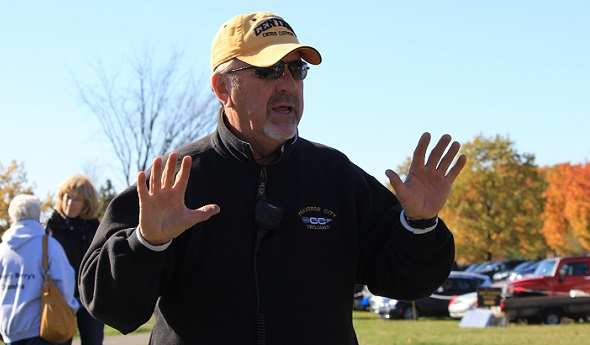
Longtime Coach Lober Steps Away from XC
By
Dennis Chase
Special for MHSAA.com
August 18, 2017
TRAVERSE CITY – When the Traverse City Central boys cross country team opened practice last Wednesday, the gregarious John Lober was nowhere in sight.
 Instead, the Michigan Interscholastic Track Coaches Association Hall of Fame coach was teeing it up on a golf course in Kalkaska County.
Lober, the driving force behind Traverse City Central boys running, stepped down as cross country coach after 28 years. He’ll continue as the track & field coach in the spring - his 49th year at Central and 54th season of coaching overall.
“I’m definitely going to miss it, but I’m lucky to say that a lot of these kids (in cross country) run track so I’ll still have an association with them,” Lober said. “It’s always about the kids and that association.”
Bryan Burns, who coached the Maple City Glen Lake girls to the Lower Peninsula Division 4 cross country title in 2000, is succeeding Lober.
“He’s a legend,” Central athletic director/assistant principal Mark Mattson said of Lober. “The guy’s put nearly 50 years into his craft at our school. That’s unprecedented. Fortunately, we get to keep him for track.”
Lober turned 75 in March.
“He’s 75 going on 35,” Mattson added. “He has such energy and passion. He’s everywhere - all the time.”
Still, Lober thought the time was right to make a change.
“I think it was my daughter who said something about me being in the fourth quarter,” he recalled. “Well, the greatest things happen in the fourth quarter. That’s when everything is on the line. Subconsciously, I’m thinking, ‘What are you going to do in the fourth quarter? How is this going to play out?’”
Lober experienced a taste of life without cross country last season – albeit for just two weeks – when he and his partner of 11 years, Margo Million, took a September vacation to New England.
And, as for any withdrawal symptoms in the last month, Lober’s been too busy for that to happen. He took in eight Traverse City Film Festival movies in late July and then the following week played 18 holes of golf four consecutive days with his visiting grandson and a friend.
“It’s been pretty Lober silent around (school), and I know that’s by John’s choice to stay out of the way and let Bryan Burns and his staff have that program be theirs,” Mattson said. “I’m sure that’s not easy for John because I know how much he cares for kids and how much pride he takes in our school and community. He paved the way for so many years. Nonetheless, he has the utmost respect for Bryan, who he helped put in place, and for what they want to do with the program going forward.”
Lober, and coaching companion Don Lukens, took over the Central cross country program in 1989 and turned it into one of the state’s best. According to statistics compiled by michtrack.org, Central had the fourth best program in the state in the 1990s – based on MHSAA Finals finishes – despite the fact the school was split (with West opening) in 1997. The Trojans were 12th from 2000-2009 and 11th from 2010-2016.
“Excellence is typified by a high achievement level over many years,” Lober said, “and I feel we’ve been an excellent program over the last 28 years.
“The system we established that first year (based on principles popularized by notable New Zealand runner and coach Arthur Lydiard) has proven to be a successful system. Little did Don and I know when we started working together that our talents would dovetail and create such a strong situation.”
Since 1989, Central has won 86 invitationals, eight Big North Conference titles and eight Regionals. The Trojans were runners-up in nine Regionals. Central finished second in Class A in 1996, five points behind White Lake Lakeland.
Central qualified for the MHSAA Finals the first 16 years under Lober and Lukens. That streak was snapped in 2005, but it led to one of the most satisfying seasons in 2006.
 “Those kids on the 2005 team were the first not to go to states, and they banded together and came back and took third (in Division 1) the next year,” Lober said. “They were awesome. That was a special team.”
The Finals runner-up team in 1996 was special, too. In fact, Lober is reminded of it every day. That squad, after its successful season, planted a tree in Lober’s front yard. Today, it towers over the front of his property.
Lukens, also in the MITCA Hall of Fame, built his legacy as a cross country and track coach at Kalamazoo Loy Norrix before retiring at 55 and moving north. He had 32 years of service in, but his move was hastened after he accidentally “chemically poisoned” himself.
“I was staining my place and I dumped the bucket all over the front of me,” he said. “But I wanted to finish because I had company coming from Pennsylvania. The next day my knees and elbows were so swollen – you talk about pain.”
Lukens originally was told he had lupus, but a trip to the Mayo Clinic revealed it was chemical poisoning.
He was told his condition would improve as time passed, but it would be advantageous if he could retire.
“They said, ‘Remember, stress is a factor. If you don’t retire, don’t plan much until after age 60,’” Lukens recalled. “Well, that scared the dickens out of me.”
Lukens, now 83, was serving as interim athletic director at the time. In the meantime, he and his wife had fallen in love with northern Michigan and purchased property along the Platte River in Benzie County. Lukens started building their house right before the move.
“Every morning I get up, sit on the porch and look at the river,” he said. “You talk about being blessed.”
His coaching days were not over, however. Benzie Central track coach Pete Moss asked if Lukens could work with the team’s pole vaulter in that spring of 1989. In late May, at the Traverse City Record-Eagle Honor Roll track meet, Lober approached Lukens about becoming his distance coach in track. When the cross country job opened, Lober and Lukens took on that responsibility as well.
It’s a union that still exists. Lukens is assisting Burns in cross country and Lober in track.
“I think my wife is happy I’m not in her hair all the time,” Lukens said. “I enjoy working with the kids. They keep me young.”
Lober, whose track team won the Class A title in 1992, feels the same. He retired from teaching during spring break in 2000 when his wife Julie’s cancer returned. She passed in August of that year. It was in those moments afterwards, seeing the support he had from his teams, that it hit him.
“I need them more than they need me,” he said.
Now that he’s not a part of the cross country program, Lober said he’ll miss the dynamics of team building and team bonding. He’ll miss watching raw athletes develop skills they didn’t realize they had. But he won’t be out of sight totally. He’ll be there for meets, just like he’s at other school sporting events during the year. After all, Traverse City Central has been his home away from home for 49 years.
“When we named Travis Schuba our new boys basketball coach last week, John was the first one looking for contact information to congratulate him and welcome him to our staff,” Mattson said. “That’s John Lober. Traverse City Central is family for John.”
And just how long will he coach track?
“I want to coach track a couple more years because I love it,” he said. “Last year was as much fun as I’ve ever had coaching track. Plus, I want to put 50 (years) in. If I’m lucky enough to do that, I’d love it.”
 Dennis Chase worked 32 years as a sportswriter at the Traverse City Record-Eagle, including as sports editor from 2000-14. He can be reached at [email protected] with story ideas for Manistee, Wexford, Missaukee, Roscommon, Ogemaw, Iosco, Alcona, Oscoda, Crawford, Kalkaska, Grand Traverse, Benzie, Leelanau, Antrim, Otsego, Montmorency, Alpena, Presque Isle, Cheboygan, Charlevoix and Emmet counties.
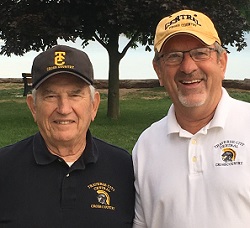
PHOTOS: (Top) Traverse City Central coach John Lober offers direction at a meet during his half-century career. (Middle) Central assistant Don Lukens, left, with Lober. (Photos courtesy of John Lober.)
Gull Lake XC Extends Tradition Cross-State
October 4, 2018
By Geoff Kimmerly
Second Half editor
In Randy Hunt’s mind, there was no way Richland Gull Lake’s cross country teams weren’t going to continuing their Homecoming tradition this fall – no matter how much farther they had to run.
Every year since 1993, Gull Lake’s runners have carried a game ball from their football opponent’s school to the Blue Devils’ stadium in advance of the Homecoming game. Previously, the longest trip was 72 miles from Niles.
But this fall, Gull Lake’s varsity didn’t have an opponent lined up for Homecoming until picking up Detroit Country Day – 138 miles to the east.
No problem. Over Thursday and Friday last week, past Farmington Hills, Ann Arbor, Jackson, Battle Creek and more, the Blue Devils again delivered the game ball.
 “Our runners are amazing and up to any challenge,” Gull Lake girls coach Robin Blackburn said. “We originally heard that our opponent this year was Detroit Country Day; we thought our athletic director was joking! No joke, she was serious.
“Next thought, how are we going to make this happen? We had lots of crazy ideas. My favorite was putting a treadmill on a flatbed truck and having them run. Obviously we couldn’t do that, but we knew we had to do this over two days. Once we started planning and mapping the course, everything fell into place.”
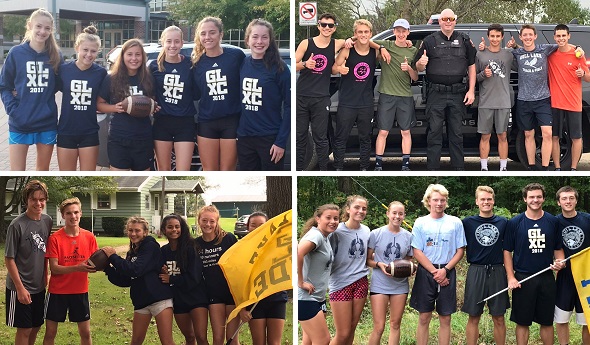
Runners filled out cards with whom, when and how far they wanted to run, and then Blackburn and Hunt, the boys coach, built the plan. The first shift left Gull Lake for Country Day at 5:30 a.m. Thursday. Makenzie Wank, Betsy Martens, Sarah Grimes, Kayla Eklund, Grace Foster and Abby Bell – running in pairs in 4-mile increments – tackled the first 35 miles west.
The next shift left from Gull Lake at 10 a.m. headed for Northfield Township, north of Ann Arbor. Joel Blackburn, Nick Dawson, Koby Fraaza, Read Knapp, Nate Krawczyk and Nate Alpers – running 5-mile increments – tackled the next 45-mile leg of the relay and even were questioned by a local police officer as to what they were up to in the middle of nowhere on dirt road.
“Usually we like the ball to be continuous, but obviously with such a distance and safety concerns, we split this one up,” Hunt said. “The kids were excited to do it, and as coaches we knew it would create an awesome memory/story.
“I think the kids liked it because it got them out of school but also for the team bonding. I was impressed with their commitment to the tradition.”
Freshmen Kristian Shyiak and Cameron Perkins took Friday’s first leg from Jackson, a 6.4 mile stretch, followed by 10 more shifts – all planned to exact distance and arrival time, while parents joined in to taxi groups to their starting points and back to the school.
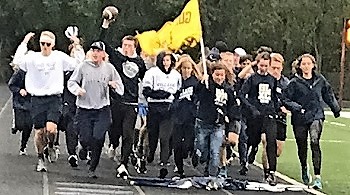 The plan was to finish with nearly a full lap at the track at 6:30 p.m., with the teams’ seniors then delivering the ball to the football officials at the 50-yard line. But with time getting short, the last group of four had to adjust, with each athlete running one mile as hard as he could to get the ball to the stadium and into the officials’ hands by 6:50 – and they made it with time to spare. “It was amazing to see the kids work so hard and do it gratefully,” Hunt said.
Others who took part in the relay were Lainie Scott, Lauren Adams, Sarah Donovan, Ashley Randall, Kaylie Murphy, Luke Larson, Zach Zahrt, Neil Gleason, Simon Hakman, Lilly Weigt, Jayne Flynn, Rachel Grimes, Justin Walker, John Porter, Tyler Ford, David Larson, Ruby Risser, Lija Krasts, Nick Martens, Elly Whitfield, Aelita Klausmeier, Lorelei Hess and Oliver Harnden.
“Cross Country doesn’t get a lot of coverage, but this even got the community involved and following our updates on Facebook and Instagram,” Blackburn said.
“We are about being a family. We do a lot outside of practice to build our unity. This was a special moment in our family – one none of us will forget.”
PHOTOS: (Top) Starting top left at Detroit Country Day, groups of Gull Lake cross country runners take turns carrying the game ball during their nearly 140-mile trek to Richland last week. (Middle) Blue Devils runners take their turn on a country road. (Below) All of the runners join together for the final stretch on Gull Lake’s track. (Photos courtesy of the Gull Lake cross country program.)