


Parchment Enjoys Exchange of Experiences
By
Pam Shebest
Special for MHSAA.com
May 23, 2016
PARCHMENT — Pecan pie and snow are just two surprises Khaled Bukhamseen found as an exchange student at Parchment High School.
 “Pies are not as famous back home,” he said. “I actually learned how to make them so I can do that back home.
“My favorite is pecan pie. Oh my gosh.”
The Dammam, Saudi Arabia, native, who played soccer in the fall and competed on the track & field team this spring, had never seen snow.
“It was pretty sweet the first couple times, but then I got sick of it,” he said, grinning. “It was like, ‘OK, we had fun, you can leave now.’
“I had to buy actual winter clothes.”
Another surprise was organized sports.
When Bukhamseen decided to try out for the Parchment track team, he figured he would just drop in for practice whenever he felt like exercising.
He got a reality check when he realized what a commitment he had to make.
“They told me about track and the activities you can do, like races,” he said. “I thought I would give it a try. I was pretty sure I would like it because I’m fast.
“I like the competition. Sometimes you do so good and you get first place and you feel like you’re the best on the team. That’s the good part about it.”
Parchment’s track season is over for all but the six individuals who qualified last week for the MHSAA Lower Peninsula Division 3 Finals. The exchange student is not one of them – but will finish his year in the United States with an experience valuable not only to him but his teammates and coaches as well.
The only high school sports at Bukhamseen’s school in Dammam are in physical education classes.
“I played soccer, but it was just a PE class where they try to vary the sports,” he said. “That was pretty much the only thing I did, and it was like once a week for 45 minutes.”
Once Bukhamseen showed interest in joining the track team, coach Matt Hodgson evaluated him for his strengths and weaknesses along with what the team needed.
“Khaled appeared to us to be stronger in the sprints than long distance,” Hodgson said. “I don’t think running five miles a day out on the road is something that interested him.”
 The coach also made sure the sprinter knew what was expected.
“Organized athletics (in Saudi Arabia) are not like they are in America,” Hodgson said. “In fact, one day we talked about it and he said when he first came out for track he thought it was something you kinda showed up for and practiced when you wanted to and made a meet when you wanted to.
“He said, ‘You don’t allow that, coach, do you?’ I said no; when you commit, you commit and you’re expected to be here every day.”
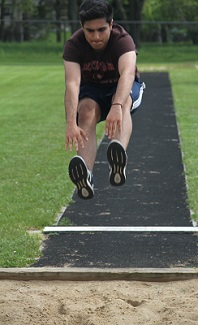
Bukhamseen competed in the 100- and 200-meter dashes, 400 relay and long jump.
Hodgson said Bukhamseen brought a lot of energy to the team.
“We always expect something quite hilarious to come out of his mouth daily,” the coach said. “He’s a good teammate who has really bonded with a lot of the kids on the team.
“Because he’s not used to this organization of athletics, he’s oftentimes running around saying ‘Coach, when’s my event, what am I doing?’ We always expect him to be a little frazzled at times at meets, and it’s quite comical.”
Bukhamseen wasn’t the only one benefiting from the exchange program. Members of the track team did, too.
“He’s given us a different perspective on the world, and he’s told us about the people of Saudi Arabia,” said Donavan Hodgson, the coach’s son, who runs anchor on the 400 relay team. He’s a really funny guy and a really cool guy, too.”
Students also are getting a lesson in culture.
“I think in the United States, especially, there’s a really bad rap on Muslims and people from those areas,” Donavan Hodgson said. “Khaled’s the exact opposite of what (some may) think. He’s the most passive-aggressive guy ever. He’s a really good guy.”
Bukhamseen started the school year with the Kellay Fall and Bill Evans family and for the last few months has lived with the Kira and Franz Griggs family.
 Kira Griggs was an exchange student in Paraguay when she was 15 years old and sees hosting a student as paying it forward.
“They really integrate into your family much more than you think,” she said. “You adapt to each other; he’s just another family member.
“He’s a typical teenager; always on his phone, out with friends. His English is so perfect. He’s a great kid, a great student. He has a lot of friends.”
Bukhamseen said it is not unusual for Saudis to study in the United States, especially for college, and his two brothers are currently studying in Seattle.
Although his native language is Arabic, Bukhamseen speaks excellent English.
“In Saudi Arabia it’s mandatory to learn English in first grade,” he said. “My dad has kept it up with me. My dad went to Houston to college.”
Bukhamseen takes most of his class notes in English, but, “If I have a note to the side, I’d write it in Arabic quick, especially a vocab test every Friday,” he said. “I would write the equivalent of the word in Arabic so I wouldn’t forget it.”
Track wasn’t his only sport at Parchment.
When he first came to the United States in August, he integrated himself by joining the soccer team.
That also was an awakening.
“Having a team and a coach and practices, it’s way different than having it just once a week,” he said.
“I had to work out a little extra. They started earlier than me because I came a little late (August) to start the season.”
Soccer coach Matt Streitel has had exchange students on his teams before and said that each boy brings something different to the team.
“It’s cool,” he said. “You get that culture you might not get from other students.
 “Khaled had a little bit of skill and was excited to be there.”
Bukhamseen had to go through a rigorous workshop before being accepted into the AFS Intercultural Program.
“Khaled has a great sense of humor,” said David Person, co-coordinator for the West Michigan chapter. “He had to go to Riyadh for orientation and he said it was from 7 to 8, so he thought he’d be in and out in an hour but it was a 13-hour orientation.
“What he had to go through to get here was very stringent. He’s the cream of the crop.”
Bukhamseen is also part of the YES Program, a government-sponsored youth exchange and study, Person said.
“He’s here under U.S. government scholarship,” he said. “They go out and choose the best students ever, the future leaders.
“The YES Program works with programs that have large Muslim populations. He’s one of three YES students in this (southwest Michigan) area.”
The others are at Kalamazoo Central and Battle Creek Central.
 Pam Shebest served as a sportswriter at the Kalamazoo Gazette from 1985-2009 after 11 years part-time with the Gazette while teaching French and English at White Pigeon High School. She can be reached at [email protected] with story ideas for Calhoun, Kalamazoo and Van Buren counties.
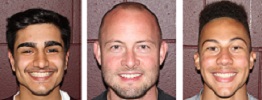
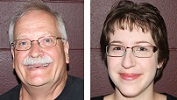
PHOTOS: (Top) Khaled Bukhamseen rounds a turn during a recent Parchment track practice. (Middle top) Bukhamseen, Parchment coach Matt Hodgson, teammate Donavan Hodgson. (Middle below) Bukhamseen trains in the long jump. (Below) David Person, Kira Griggs. (Photos by Pam Shebest.)
Generations of Dedication, Pride Fuel Milford's 34-Year Regional Hosting Run
By
Steve Vedder
Special for MHSAA.com
May 22, 2026
It may seem a bit of a stretch on the surface, but it makes perfect sense to Brian Salyers.
How can planning a wedding feature work much along the same lines as a school hosting an MHSAA Lower Peninsula Regional track meet for 34 straight seasons?
Easy, contends Salyers. Both take an immeasurable amount of planning.
"I have a couple friends who planned a wedding," said Salyers, Milford's girls track coach. "I told them I'd hosted a track meet, and they're so much alike. There are so many things you entrust other people with. There is so much work to be done, you're hoping things go smoothly."
Like a wedding, Salyers said Milford takes great pride in the event's final outcome. The meet's philosophy includes more than being a stepping stone of funneling deserving athletes along to the MHSAA Finals. At Milford, Salyers said organizers have worked diligently for more than three decades to ensure the participants not only leave with lifelong memories, but also that the meet brings together an entire community.
Volunteers from the school work alongside Milford natives not connected in any way to a track program in a multitude of roles from timing races to rototilling and raking long jump pits, selling dogs and T-shirts and taking tickets. Alumni from up to 45 years ago faithfully return to the school to pitch in whenever needed while also taking a moment to rehash old memories with former track teammates.
 Put it all together, Salyers said, and the meet is special.
"It's a melting pot," Salyers said of the mostly unpaid volunteers who work the meet. "It's like, who can come and do it this year? It's not always a fluid list because we pull from such a large group."
The large group has been banding together since 1993. Started by former Mavericks track and cross country coach Gene Balawajder, the school hosted its first Regional in 1988. After moving to a nearby site for a couple years, the Regional landed back at Milford for keeps 34 years ago. Whether it was those first Regionals in the late 1980s or the three and a half decades since, Salyers said the school and community's philosophy hasn't wavered: Take care of the athletes foremost, but also bring the community together to ensure that care happens by organization, identifying issues and swiftly taking action to solve problems.
Milford athletic director James Marszalek said the school handily recruits about 30 people for various positions, only a "handful," he said, who are paid. He said the key to ensuring a smooth meet begins with the volunteers and longtime meet organizer Chris Ceresa, a former athletic director and current assistant coach.
"The No. 1 thing is making sure we have competent people in the right positions and that we make sure it's a day the kids will remember," he said. "But it definitely takes an army."
Ceresa said much of the meet's success comes down to planning and the unselfishness of alumni. For instance, at this year's meet there were five alumni working the long jump, four on the throwing events and two on both the high jump and pole vault as well as many involved as timers.
Ceresa begins recruiting for the following year's Regional at the current event. There he seeks commitments from officials and event workers 12 months in advance.
"We take it very personally; the staff is very committed to the meet," he said. "If you talked to our colleagues at other schools, I think they would tell you they love to come here. It's quite a spectacle, a matter of pride."
The meet even features an unofficial system of where and how volunteers are used. Meet newcomers typically start out in smaller roles, eventually working themselves into the meet's most prestigious position: being an official timer for races. Unfortunately, when the meet became the last Regional in the state to go to electric timing more than a dozen years ago, there was no need for about 20 volunteers who worked as hand timers at the finish line.
 Milford boys track coach Eric Hincka ran in the meet as a junior and senior before graduating in 1998. He said while some Regionals typically run more smoothly than others, because of the hours upon hours of organization and the quality of the volunteers, the Milford event annually draws praise from visiting coaches and participants. And that's no accident, he said.
"Every year you hear horror stories of meets which have problems," he said. "We try our best to see that everything is done right so we don't run into problems. We want to honor the kids – it's our philosophy and we take pride in it.
"At Milford, it's multi-generational. Gene as the founder set the standard, and we're just trying to follow in his footsteps."
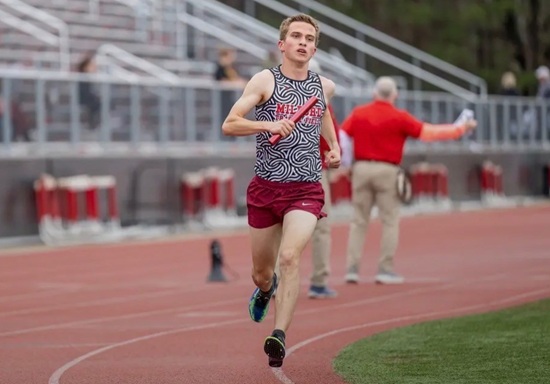
The athletes notice, Milford senior distance runner Kyle O'Rourke said. Headed to run at Michigan State next season, O'Rourke's pedigree in the meet is three-generational. His grandfather has clerked and also made T-shirts for volunteers while O'Rourke has had an older brother and sister run at the Regional. His mother also ran in the meet.
"It's touching for me to see all the old alumni to come back and work; a highlight of the season," said O'Rourke, a six-time all-stater in track and cross country. "They treasured their time here, and now many of them are part of a community that unites to make this meet run well.
"Yeah, it comes in handy (competitive-wise) that this meet is home for us. But there is also a certain pride in us hosting it. I think we all take pride in how we conduct ourselves at the Regional."
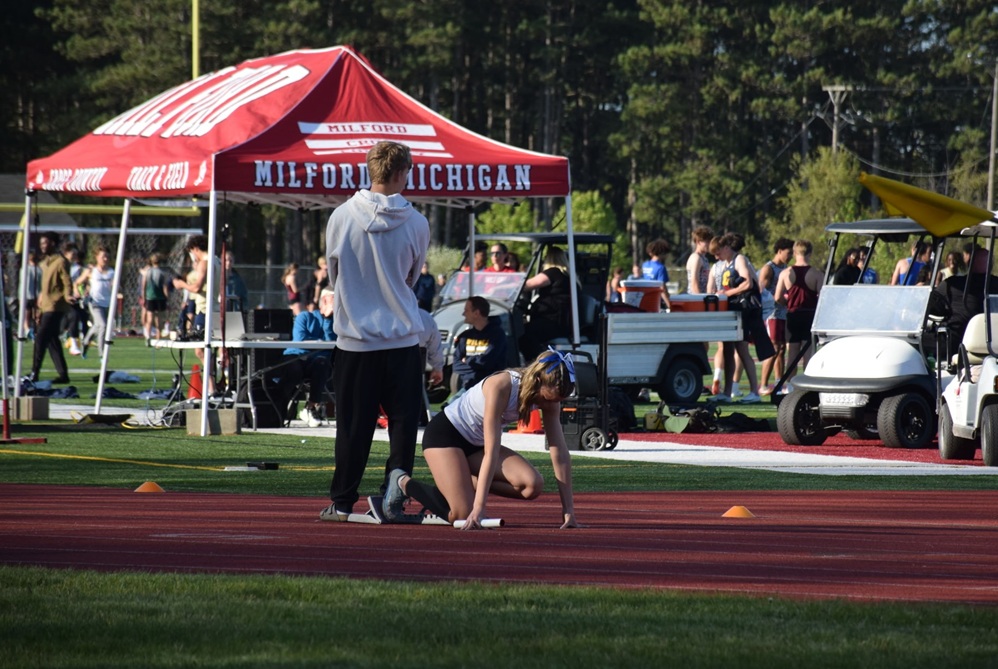
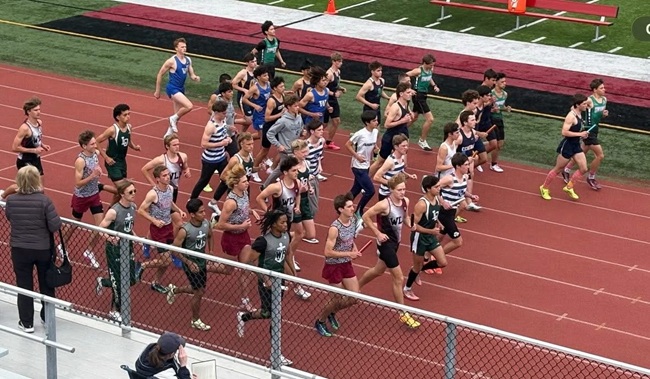
PHOTOS (Top) A relay runner sets up in a starting block during the Lower Peninsula Division 1 Regional hosted by Milford on May 15. (Middle) Runners move toward the starting line before their relay. (Below) Milford’s Kyle O’Rourke rounds a curve during a relay. (Photos courtesy of the Milford athletic department.)