

Preview: Prepare for Close Finishes
June 1, 2018
By Geoff Kimmerly
Second Half editor
Predicting the outcomes of MHSAA Track & Field Finals can be quite a leap.
But here's a semi-reliable forecast after hours of poring over the qualifiers for Saturday's seven boys meets: Expect plenty of close competition as a number of teams have the singular standouts needed to push them into championship contention.
 Below is a look at some of the teams and individuals to watch at Saturday’s boys meets. All events begin at 9 a.m. local time on both peninsulas.
Click for meet information including all qualifiers. Check out MHSAA.TV for live streaming of running events from both peninsulas, available with subscription, and come back Saturday night for results as they come in and coverage of all seven meets on Second Half.
The MHSAA Track & Field Finals are presented by the Michigan Army National Guard. (All times/measurements referenced below were achieved during Regional competition.)
LP Division 1 at East Kentwood
Top Regional scores: 1. East Kentwood 166½, 2. Grand Blanc 139, 3. Oak Park 134.
East Kentwood is the reigning champion and has won six of the last nine LPD1 titles, doing so last year by 16½ points. Rockford was second and Oak Park third, and both could figure prominently again into Saturday’s final result.
East Kentwood: The Falcons return only one reigning champion – junior Logan Brown in the shot put, where he’s the top seed (57-8½) – but have plenty of options for scoring points. Senior Job Mayhue was second in the 110 hurdles last season and enters the weekend the top seed in that race (13.83) and the 300 (37.15). East Kentwood also will run the fourth-seeded 400 (42.80) and 800 (1:28.5) relays and third-seeded 1,600 relay (3:23.6).
Rockford: The rival Rams might have the best chance of catching East Kentwood. Senior Cole Johnson is the reigning 1,600 champ, and he’s seeded sixth in that race (4:20.02) and fifth in the 800 (1:55.59). Senior Gavin McIntyre is seeded second in the discus (157-1), and all four relays will run with multiple having a chance to break into the final heat.
Ann Arbor Pioneer’s Nick Foster: He finished third in the 1,600 as a sophomore in 2017 but could claim both long distance races this time with the top seed in the 3,200 (9:16.6) and the second seed in the 1,600 (4:17.84).
Macomb Dakota’s Jeron Kelley: After finishing ninth in the 100 and missing out on the 200 championship heat as a junior, Kelley enters as the top seed in the 100 (10.75) and third in the 200 (21.93).
Ypsilanti Lincoln’s Matthew Moorer: The senior speedster will try to repeat in the 400 and add the 200 title after finishing second in the latter last season. He’s seeded first in the 200 (21.56) and second in the 400 (48.07).
LP Division 2 at Zeeland
Top Regional scores: Dearborn Divine Child 179½, 2. Zeeland East 151½ 3. Chelsea 128½.
Zeeland East claimed its first championship in the sport last season, by 29 points over runner-up Coldwater. Those two appear to have the best chances of pushing for the title again, with a few others including Chelsea also in a possible mix.
Coldwater: Last year’s finish was Coldwater’s first among the top two at a Finals, and many of the key contributors are back. Senior Shuaib Aljabaly took second in the 3,200 last season and will return for that race and as the top seed in the 1,600 (4:13.9). Throws have been another area of strength, and sophomore Dylan Targgart is seeded first in both the discus (165-10) and shot put (59-4), with senior teammates Zach Gipple (56-3) and Cole Targgart (53-2½) seeded second and fourth, respectively, in the latter. Both Targgarts placed in the discus last spring. Senior Adam Bailey also has a second seed, in the 300 hurdles (40.0), after finishing sixth a year ago.
Zeeland East: The Chix’ power lies also lies in throws and hurdles, plus relays. Senior Brenden Knoll (162-9) and junior Boone Bonnema (150-3) are second and fourth-seeded in shot put, and Knoll is the third seed in discus (53-7¾); he was shot put runner-up in 2017. Senior Corbin DeJonge has the top seed in the 110 hurdles (14.83) and the fourth in the 300 (40.31) after taking fourth last season in both races. But the deciding points could come from top-seeded 400 (43.47) and 800 (1:30.3) relays.
Dearborn Divine Child’s Luke Ciarelli: The reigning champion in the high jump enters his final high school meet as the second seed (6-3).
Fruitport’s Cameron Oleen: He won the 400 last season as a junior and enters as the second seed in that race (50.39) plus will compete in the 800.
Wyoming Lee’s Thomas Robinson: The senior sprinter won the 100 and 200 in LPD3 the last two seasons, but could do the same in LPD2 as he enters with top seeds of 10.97 and 22.17, respectively.
LP Division 3 at Comstock Park
Top Regional scores: Warren Michigan Collegiate 164, Berrien Springs 153, Clare 144¼.
Five of the last six seasons have seen a first-time champion in LPD3. The last three seasons also have seen three straight runner-up finishes by Hillsdale (also seeking its first title). Saugatuck, Berrien Springs, Clare and Hanover-Horton are among teams that appear to have enough in what could be a low-scoring meet. Of those three, only Clare has won an MHSAA Finals in this sport – in 2000.
Clare: The Pioneers have talent spread throughout the lineup, starting with top-seeded 400 (44.06) and 800 (1:30.3) relays. Senior Noah Nivison has the top seed in discus (157-10), while senior Zac Stickler has the second seeds in discus (151-4) and shot put (56-9½); he was sixth in discus in 2017. Senior Xavier Martin adds another second seed in the 200 (22.23), and the 1,600 relay also has potential coming in as the fifth seed (3:31.4).
Hanover-Horton: The Comets could get points early with the top-seeded 3,200 relay (8:14.4) and have multiple racers in the 1,600 and 3,200. Senior Logan Melling is the top seed in the 800 (1:59.1) and the eighth seed in the 1,600 (4:26.8) after finishing second in the 1,600 and third in the 800 a year ago. Senior Dakota Manee adds the fifth seed in the 400 (51.04).
Houghton Lake’s Jackson Blanchard: The reigning champion in both hurdles races has the second seed in the 110 (14.97) and the top seed in the 300 (38.64), and he’ll also run the 200 in his final high school meet.
Hillsdale’s Spencer Eves: The reigning high jump champion, now a junior, is tied for the second-highest seed jump (6-4).
Chesaning’s Sam Forsyth: A senior, he won the long jump last season and is seeded third (tied) in that event (20-9) and sixth in the 200 (22.66).
Saugatuck’s Corey Gorgas: After coming in second in the 3,200 last season as a sophomore, Gorgas is seeded first in that race (9:34) and the 1,600 (4:21.7).
Harbor Springs’ Jeremy Kloss: He won the 1,600 and 3,200 in LPD4 as a sophomore and enters the LPD3 race Saturday with the second seed in the 800 (1:59.1) and the fourth in the 1,600 (4:25.7).
Kent City’s Giovanni Weeks: The junior standout is seeded first in the long jump (21-3) and 200 (21.99) and second in the 100 (11.06).
LP Division 4 at Hudsonville
Top Regional scores: Whittemore-Prescott 181, Southfield Christian 140, Lutheran Westland 135.
Whittemore-Prescott needed only 36 points last season to win its first championship in this sport, and the scoring could be that spread out again. If that’s the case, Addison, Kalamazoo Hackett or Hillsdale Academy might find itself contending as well. Hillsdale Academy was fifth last season, but only 10 points off the lead.
Addison: The Panthers will go after their first championship in this sport. Senior thrower Donovan Underwood is seeded first in discus (152-2) and fourth in shot put (46-½). Senior Dakota Knieper is seeded second in the 200 (50.74), and a handful of others are seeded in the 5-8 range of their respective events. All four relays are seeded seventh or higher, led by the third-seeded 800 (1:34.71).
Whittemore-Prescott: With competitors in 10 individual events and two contending relays, the Cardinals will have an opportunity to repeat. They won last year without a champion in any one event and enter Saturday without a top seed. But the 800 relay is seeded second (1:32.60) and the 1,600 relay is seeded third (3:34.18).
Marcellus’ Derek Flory: The reigning champion in the long jump and 300 hurdles is seeded first in the 300 (40.18) and third in the 110 hurdles (15.23) and will jump as well in his final high school meet.
Hale’s Patrick Harris: The reigning 400 champ is seeded first as a junior (50.52) and also will run the 200.
Harbor Beach’s Daniel Lanfear: He’s back as a senior to aim for a repeat in the high jump.
Sand Creek’s Alec Muck: The junior sprinter has three individual championships over his first two seasons and is seeded first in the 100 (10.77) and second in the 200 (22.11).
UP Division 1 at Kingsford
Top Regional scores: 1. Marquette 84½, 2. Houghton 57, 3. Gladstone 53½.
Marquette is aiming to extend its UPD1 Finals winning streak to four straight seasons after finishing more than 50 points better than runner-up Iron Mountain a year ago. Houghton, however, finished only 3½ points out of the second spot last year and will make a push for its first team championship since 1992.
Marquette: The Redmen’s massive win last season came with only two individual champions. Only two individuals and two relays are seeded first for this weekend; junior Raphael Millado has the top spot in high jump (6-7) after finishing runner-up a year ago, and junior Mathurin Gagnon is first in the 800 (2:03.66).
Houghton: The Gremlins return more star power, led by senior Clayton Sayen – the reigning champion in the 200 and two-time reigning winner of the 400. He’s seeded first in the 100 (11.58) and 400 (51.34) and second in the 200 (23.38). Senior Kameron Simpkin is the reigning champ in pole vault, and senior Seth Helman is one of the peninsula’s top distance runners – he’s seeded third in the 1,600 (4:40.72) and second in the 3,200 (10:26.29).
Gladstone’s Adam Bruce: The junior emerged last season winning the 3,200, and he’s seeded third in that race (10:26.69) and the 800 (2:04.54) and second in the 1,600 (4:37.86).
Negaunee’s Colton Yesney: Arguably the top distance runner in the U.P. the last two school years, he’ll finish his career trying for a second straight win in the 1,600 and seeded first in that race (4:27.76) and the 3,200 (10:03.52), third in the 400 (53.48) and fourth in the 800 (2:04.57).
UP Division 2 at Kingsford
Top Regional scores: 1. Ishpeming 65, 2. Iron Mountain 64½, 3. Newberry 45.
Newberry is the reigning champion after breaking Ishpeming’s three-year winning streak last spring. However, the Hematites finished second and may be the team to beat – although they’ll now have to fend off Iron Mountain again. The Mountaineers were the 2016 runners-up, then finished second last year in UPD1.
Iron Mountain: This could be the Mountaineers’ year to break through with a first team title since 2000. Junior Charlie Gerhard won the 300 hurdles in UPD1 last season and is seeded first in that race by more than a second (41.97). He’s also seeded second in the 110 hurdles (15.76) and tied for third in high jump (5-9). Seniors Michael Kulas (400 – 51.05) and Jacob Tucker (high jump – 6-3) and two relays also are seeded first.
Ishpeming: The Hematites have only two top seeds, but 11 among the top three – and that depth should pay off. Those number one seeds belong to sophomore Jonah Broberg in the 800 (2:10.32) – who is followed in that race by senior teammate Kyle Pruett (2:11.79) – and senior Hart Holmgren in the long jump (19-2½).
Stephenson’s Montell Glover: As a sophomore last year, he swept the 100, 200 and 400; as a junior he’s seeded first in the 100 (11.5) and 200 (23.02) and second in the 400 (51.25).
Ironwood’s Nick Niemi: The reigning champion in the 3,200 is seeded first in that race (10:24.85) and in the 1,600 (4:45.98) now as a junior.
Norway’s Inocencio Stankevich: He won the 300 hurdles last season and could double his total in his final high school meet, entering as the second seed in the 300 (43.32) and the top seed in the 110 hurdles (15.52).
UP Division 3 at Kingsford
Top Regional scores: Rapid River 83, Bessemer 80¼, Pickford 75½.
Rapid River will compete for its third straight team championship after edging Bessemer by four points at last year’s Finals. A Bessemer championship would be its second ever – and first since 1951.
Rapid River: Three returning individual champions give the Rockets a substantial start on their three-peat attempt. Senior Luke Gustafson won the pole vault last season and is tied for the top seed (11-6). Senior Logan Hardwick won the discus and is the top seed in that event (154-9) and the second seed in the shot put (45-9). And senior Lucas Sundling took first in the 400 in 2017 and is seeded first in that race (53.94) and the 100 (11.54) as well.
Bessemer: The Speedboys’ run at history will be aided by two returning individual champions. Senior Isaiah Aili won the 800 and 1,600 last year and is seeded second in both (2:09.43 and 4:51.07, respectively). Senior Brayden Tomes will look to repeat in the 200, where he’s seeded fifth (24.74), and he’s also seeded seventh in the 100 (12.0) and first in the 300 hurdles (44.34).
Pickford’s Nicholas Edington: He’s aiming to repeat in the high jump and is among those tied for fifth seed at 5-8.
Brimley’s Austin Plotkin: The sophomore will look to add to last year’s 3,200 title, and enters seeded fifth in that race (10:58.35) and seventh in the 1,600 (4:54.34).
Ewen-Trout Creek’s Jacob Witt: The senior football and basketball star is also a reigning shot put champion; he’s seeded first in that throw (45-11) and third in discus (143-9).
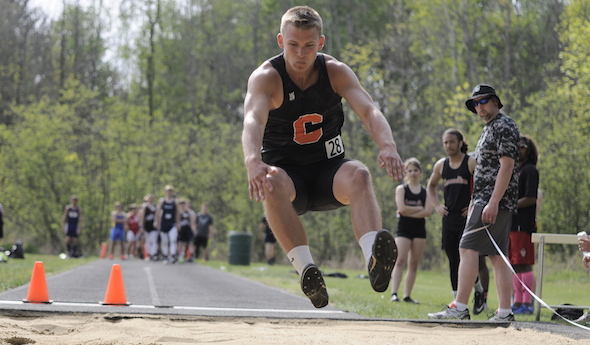
PHOTO: Reigning LPD3 long jump champion Sam Forsyth of Chesaning prepares to land during his Regional last month. (Click to see more from HighSchoolSportsScene.com.)
Revived Mancelona Boys Charging Ahead
May 9, 2019
By Chris Dobrowolski
Special for Second Half
Ability alone won’t get it done on the track.
 That’s why the transformation of the Mancelona boys track & field team didn’t happen until the Ironmen added confidence to their talent.
“I always thought they could do it,” said Rick Ancel, Mancelona’s head coach. “I always thought we had a lot of talent. They just didn’t believe in themselves, and they ran mediocre. Once they started believing, the workouts changed. The times changed. There are very few people they are afraid of. They get beat on certain days, but they don’t beat themselves up. I think before this change they were afraid before they ever got on the track.”
Since they’ve developed some faith in themselves the Ironmen have been a force to be reckoned with, running undefeated through every regular-season invitational they competed in last year on the way to capturing the Ski Valley Conference title. With most of its squad returning this season, Mancelona has continued to dominate meets and figures to be a shoo-in to capture the league crown for a second straight year when the conference championships are run May 22. The squad has been so impressive that it earned a No. 6 ranking in the Michigan Interscholastic Track Coaches Association Division 3 poll two weeks ago.
“It’s kind of hard to think about (being ranked) because a couple years ago we weren’t even winning our conference let alone being ranked at the state level,” said junior Johnny Ancel, one of the team’s three captains, along with classmates Tommy Palmer and Wesley Fulk.
Members of the team or coaching staff point to when Rick Ancel took over as head coach before last year as the pivotal moment when the Ironmen’s outlook, preparation and performance all changed. Ancel, who ran collegiately at Saginaw Valley State, deflects the credit back to his team and its willingness to do what it takes to find success.
“I do remember during the year that the workouts started changing,” said Rick Ancel. “They started going from trying to complete a workout because they had to run that much to trying to improve. Instead of just getting through it, they were doing the workout to get better.”
The fruits of their labor paid off in the form of the league crown, a fifth-place finish in the Regional — which came in their first year competing in Division 3 — MHSAA Finals qualifiers in three events and a school record in the 1,600-meter relay.
“At the end of last year I was feeling pretty good,” said Fulk. “We were only losing two of our (top) people, so the majority of our team was still going to be here. I knew we were going to be better than last season.”
The Ironmen haven’t disappointed. In an indoor meet at Central Michigan University in mid-March, the Ironmen kicked off their season by finishing second among Division 3 and 4 teams, easily surpassing their 11th-place finish a year ago. They followed that by winning their first five regular-season meets outside. Only a second-place finish at the Blue Devil Classic in Gaylord — where Mancelona tested itself against Division 1 and 2 teams — broke up the streak of regular-season first-place finishes that started early last season.
“This year we added some big meets,” said Rick Ancel. “We really tried to ramp up our competition this year.”
 Ancel’s veteran squad has welcomed the tougher competition. It’s a core of athletes who individually have the versatility to fill in at a number of different events and compete at a high level. The three captains, for instance, can run any event from the 100-meter dash up to the 800-meter run.
“We can try more people in different spots,” said Fulk.
It comes down to doing whatever the team needs at a particular meet. Even though track & field is in many ways an individual sport, the Ironmen see it from a team standpoint and embrace that perspective.
“We always start every meet and end every meet together as a team,” said Palmer. “You can’t do it alone, obviously. You can’t win a meet with just us three who are here or just one of us.”
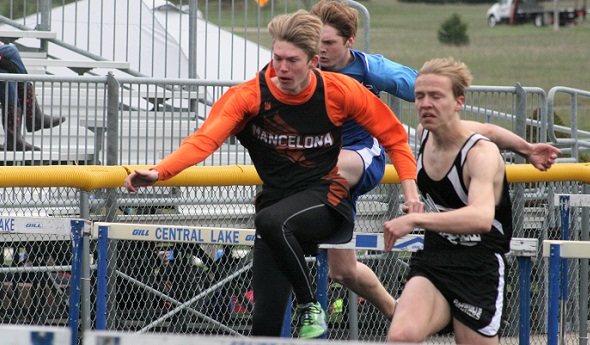
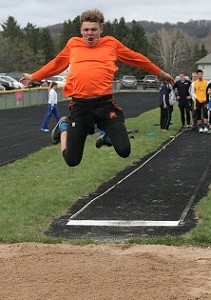
Two years ago the Mancelona team had only 11 members. Depth is not an issue any longer, however, as the Ironmen have bolstered their roster and now have nearly every event covered. Sophomore Ryan Rebh is ranked among the best hurdlers in the state in Division 3. Sophomore Jayden Alfred is the reigning Regional champion in the high jump and long jump and has emerged as the team’s top sprinter this season. Sophomore distance runner Tyler McClure is a Finals qualifier in the 3,200-meter run. Junior Michael Wagner is one of the better discus throwers in the Ski Valley Conference. James Dunne, Ben Palmer, Sam Squires and Austin Anderson have been key point scorers as well.
Mancelona also has four top-notch relays — all four should be favored to win conference crowns — highlighted by the 1,600 team. Ancel, Tommy Palmer and Fulk all return for that squad and have their sights set on breaking the school record for a second straight year.
“We’re just trying to find the right day where we all run fast at the same time,” said Johnny Ancel. “We could probably break it again right now. We just haven’t found the day.”
Records aside, the Ironmen seem to have the lineup that could challenge for a Regional title. Mancelona’s last Regional championship came in 2012, but that was in Division 4. Running in Division 3 is a bit more difficult, the Ironmen say, but they are up for the challenge.
“Harbor Springs was (in Gaylord), and they’re in our division. They’re really good. We’ll meet them again at Regionals,” said Rick Ancel. “That will be a tough day for us, but I think we’ve got a shot at winning that.”
 Chris Dobrowolski has covered northern Lower Peninsula sports since 1999 at the Ogemaw County Herald, Alpena News, Traverse City Record-Eagle and currently as sports editor at the Antrim Kalkaska Review since 2016. He can be reached at [email protected] with story ideas for Manistee, Wexford, Missaukee, Roscommon, Ogemaw, Iosco, Alcona, Oscoda, Crawford, Kalkaska, Grand Traverse, Benzie, Leelanau, Antrim, Otsego, Montmorency, Alpena, Presque Isle, Cheboygan, Charlevoix and Emmet counties.
PHOTOS: (Top) Mancelona’s Ryan Rebh leads the charge through the 110-meter hurdles during a recent meet. (Middle) Jayden Alfred launches during the long jump. (Photos by Chris Dobrowolski.)