

Record-Setter Dzurka Dreaming Big, but First Focused on Goal #1: Stay Healthy
By
Paul Costanzo
Special for MHSAA.com
April 22, 2026
When it comes to end of season goals, Midland Dow senior Zach Dzurka is keeping it simple: Get there.
 To an outsider, that aspiration might seem overly simple for a runner who has the state’s fastest 300-meter hurdles time and is ranked fourth in the 110 hurdles this spring, regardless of division. But after the opportunity to compete at the MHSAA Lower Peninsula Division 1 Finals was taken away from him a year ago, Dzurka is taking nothing for granted.
“Just try to keep on PRing (setting personal records) and hope to not get injured,” Dzurka said. “I’ve always been super injury-prone for some reason. But the goal is to keep myself healthy until states.”
Dzurka set a pair of Dow records on April 17 at the Graves/Swayze Relay Meet in Midland, running the 300 hurdles in 37.82 and 110s in 14.47. His 300-hurdle time is the fastest in the state so far this year, and just 0.03 seconds off last year’s Division 1 Finals championship time, run by Will Smith of Belleville, who has since graduated.
“I wouldn’t say surprising is the right word; this is totally expected for him,” Dow coach Jenna Oskvarek said. “He’s been working his butt off to make sure he can reach his goals. It was kind of only a matter of time, we knew (times this fast were) going to happen, we just didn’t know when. We couldn’t be happier.”
Dzurka, who also holds the school indoor record for the 60-meter hurdles (8.33), had already claimed the 300 hurdles record a year ago and was unbeaten in both outdoor hurdles events throughout the 2025 season.
But a persistent hamstring injury ended his season early.
“It wasn’t anything so extensive that it was season-ending, but we didn’t want to push it and injure him more long-term,” Oskvarek said. “It was more of a conversation with Zach about, ‘This is why we’re making the decision we are, so what do we need to do to support you to get you back to where you want to be?’ As much as we wanted the team to have success and wanted him to run, it’s not about us. He was completely understanding. There was disappointment, of course, but he knew why we made the decision we made and was totally on board. He could see the long-term reasons.”
Dzurka said the injury was never fully diagnosed, but it also wouldn’t go away.
“One practice I was hurdling and I felt like a mild sharp pain, and it would not stop,” he said. “It hurt each time I would hurdle. I thought it was going to get worse if I kept going. I was doing all the hamstring exercises, but it wouldn’t stop. It was really weird, because it finally stopped, literally the day after (the Finals). That was annoying.”
 Dzurka said he has been battling smaller injuries since his sophomore year, when he suffered a bulging disc in his back during a soccer game. In that moment, his feet got crossed up after making a pass, and when he fell to the ground took all the impact on his knees, which triggered the back issue, as well as arthritis.
He believes a lot of the soft-tissue injuries he’s dealt with stem from that back injury, which he’s mostly managed, but does still continue to work through.
“I would look up online how to fix back pain or how to fix bulging discs,” he said. “Then I would just brute-force the exercises until the pain went away. I was a pretty good coach for myself.”
Dzurka gives a lot of credit to Oskvarek and the Dow coaching staff for helping him get healthy – and keep him that way.
“We’re staying hopeful and staying careful as we do with all our athletes, so we can maximize his success and make sure not to run him into the ground,” Oskvarek said.
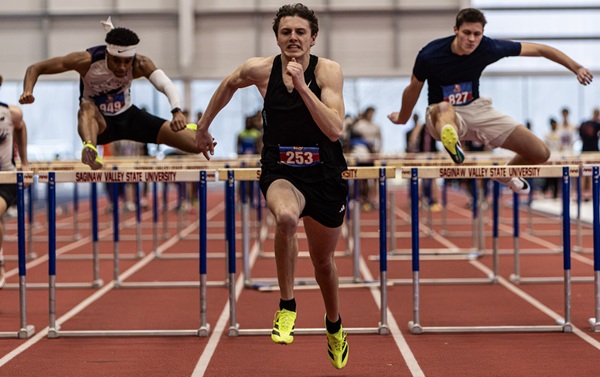
When healthy, Dzurka continues to thrive on the track in events he wasn’t introduced to until he was a freshman. He recently signed to run at Saginaw Valley State, where Oskvarek believes the resources and training available will allow Dzurka to take another leap forward.
“We always talk about how, especially at Dow, we’ve had such luck with such amazing athletes over the years, but we tell them that if you’re having this much success in high school, once you get to college, it’s just another ceiling to be broken,” Oskvarek said. “We prepare them to know that you’re having so much success here, imagine what you can do in college.”
Dzurka said the 400 hurdles will likely be his specialty moving forward, as he’s already seeing he’s more built for longer races.
“Before the season I said I was going to go sub-14 in the 110s, and that’s something to shoot for,” he said. “But I have super long legs that take a long time to get going, so I don’t know about that. But before the season I was joking with my buddies that I was going to go sub-37 in the 300 hurdles, and that’s actually possible.”
Sub-37 seconds would put him in rare company, as just four Michigan runners have ever done it. And, if he accomplishes his first goal of getting to the Finals in good health, could very likely put him at the top of the podium.
“It really would mean a lot because of how much I know I’ve put into the sport,” Dzurka said. “Even at indoor states, I came in third place this year, and at indoor states last year, I had my first-ever false start. So, getting to redeem myself would be great.”
 Paul Costanzo served as a sportswriter at The Port Huron Times Herald from 2006-15, including three years as lead sportswriter, and prior to that as sports editor at the Hillsdale Daily News from 2005-06. He can be reached at [email protected] with story ideas for Genesee, Lapeer, St. Clair, Sanilac, Huron, Tuscola, Saginaw, Bay, Arenac, Midland and Gladwin counties.
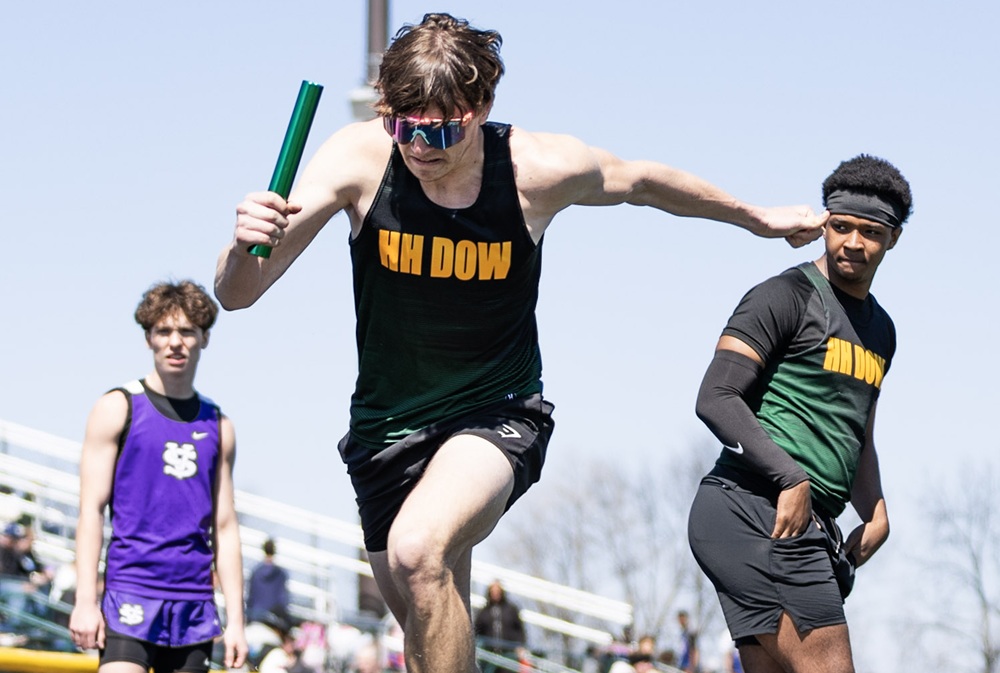
PHOTOS (Top) Midland Dow’s Zach Dzurka, with baton, takes off to start a relay race. (Middle) Dzurka, middle, leads a hurdles race during an indoor meet at Saginaw Valley State. (Photos courtesy of the Midland Dow athletic department.)

Longtime Coach Lukens Remembered for Building Champions, Changing Lives
By
Tom Spencer
Special for MHSAA.com
September 27, 2024
The results speak for themselves as there were conference, Regional and MHSAA Finals championship and runner-up finishes.
 But those accomplishments are not necessarily why Don Lukens will be remembered by most. It will be for the lives he touched and successes his student-athletes found after graduation.
Lukens impacted two communities separated by 200 miles during multi-decade coaching tenures for multiple high school programs.
Lukens died Sept. 15 at age 90. He was well-known across the state for his coaching as he spent 27 years teaching at Kalamazoo Loy Norrix, where he coached with Ted Duckett, and 33 years coaching at Traverse City Central with John Lober. Duckett, now 78, and Lober, 82, are still coaching today.
Tico Duckett, one of the most accomplished running backs in Michigan State University football history, is one of thousands of kids Lukens recruited into the running world. Duckett, who went on to play in the National Football League, credits Lukens for recruiting first-time track athletes from challenging life situations and turning them into college scholarship recipients.
Lukens knew how to get the best individual performances out his athletes, recalled Duckett, whose high school running career ended with a hamstring injury sustained during Regional preliminary sprints.
“I can tell story after story of kids that he plucked out of class, and they are successful today,” said the first MSU back to rush three times for more than 1,000 yards. “Between him and my dad, they would take kids that had no direction, no future, no hope and bring them in and teach them track and teach kids what you put into it is what you’re going to get out.”
Lukens had graduated from Western Michigan University where he’d participated in football and track. During his 38 years coaching track, Lukens’ teams posted a dual meet record of 220-24, won 20 conference championships, nine MHSAA Regional championships, a Lower Peninsula Class A title and finished runners-up twice.
Lukens’ cross country teams also were impressive with a record of 198-60 during his 34 years of coaching. They won 14 conference championships and 12 MHSAA Regional titles.
Tico Duckett has memories of being recruited to the sport as a child while his father served as an assistant coach at Loy Norrix.
“Coach Lukens would say, ‘I can’t wait ’til you get here,’” the former MSU star fondly recollected. “Coach Lukens loved track – he breathed and ate track.”
Loy Norrix hosts the highly-competitive Don Lukens Relays every May. Duckett attended this year’s meet as he often does. It was Lukens’ ability to recruit and coach track that made the Knights stand out across the state.
 “Loy Norrix track was special,” said Duckett, proudly noting the Knights’ dual-meet dominance. “When we would go places and get off the bus, people would literally say, ‘There’s Loy Norrix,’ and they would literally talk about us, and we would show ’em on the track and we backed it up.”
Inside the halls and walls of Loy Norrix, the Duckett name is engraved on trophies and next to track & field records earned by Tico Duckett and his brother TJ, who also went on to play professional football. Ted Duckett took over the head coaching duties when Lukens retired and moved to Platte Lake in Benzie County.
Word traveled fast that Lukens had arrived in Northern Michigan, and he immediately was asked to help Benzie Central by another legendary coach, Pete Moss, who died in 2019.
Lober ran across Lukens at a meet at Benzie and recruited him to coach distance running at Traverse City Central – which at the time had just five athletes committed to participate in those races.
Central had a prior history of success in sprints and field events, but the Trojans won the 1992 Class A title as their distance runners had become competitive enough to start contributing points at the Finals.
“We started coaching together in 1989, and we had 30-plus glorious years together,” Lober said. “We ended up qualifying right off the bat for the state finals, and we went 16 years in a row.”
Lober too was known for his recruiting to the sport.
“When we talked with kids, I’d be talking in one side of the kid’s ear and Don would be talking in the other,” Lober said with a laugh. “By the time we were done, the kid didn’t have a prayer of not joining the team.”
Lukens continued at Central until 2021, stepping aside as he ended 62 years of coaching.
Cody Inglis, now a senior assistant director for the MHSAA, served as Central’s athletic director while Lukens coached. He was well aware of Lukens’s coaching at Loy Norrix as he grew up a distance runner for nearby Portage Northern.
Inglis noted most of Northern Michigan knew very little of Lukens’ resume prior to his coming north. Inglis was coaching and serving as athletic director at the time for Suttons Bay when Lukens first joined the Trojans.
“People in Traverse City didn’t understand the success he had at Loy Norrix,” Inglis said. “I remember thinking, ‘Oh my gosh, Traverse City Central was good, and they’ll be even better’ and it’s no secret that the reason their cross country program took off was because of Don Lukens.”
Lukens won the inaugural Coaching Legacy Award at the 2019 Traverse City Record-Eagle/John Lober Honor Roll Meet. Going forward, the award will be named after Lukens.
Lukens is survived by his wife Rosinda, daughters Paige Gray of Gladwin, Wendy Pohl of Kalamazoo and Donyelle Hayhoe of Lansing, and five grandchildren: Brynn Rusch, Ian Gray, Westyn Hayhoe, Travis Hayhoe and Lucas Hayhoe.
The Trojans will host a memorial tribute to Lukens the day after next year’s Bayshore Marathon in Traverse City. A graveside service was held for Lukens on Monday at the Benzonia Township Cemetery.
 Tom Spencer is a longtime MHSAA-registered basketball and soccer official, and former softball and baseball official, and he also has coached in the northern Lower Peninsula area. He previously has written for the Saginaw News, Bay County Sports Page and Midland Daily News. He can be reached at [email protected] with story ideas for Manistee, Wexford, Missaukee, Roscommon, Ogemaw, Iosco, Alcona, Oscoda, Crawford, Kalkaska, Grand Traverse, Benzie, Leelanau, Antrim, Otsego, Montmorency, Alpena, Presque Isle, Cheboygan, Charlevoix and Emmet counties.
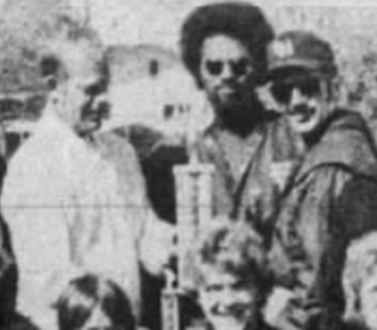
PHOTOS (Top) Longtime coach Don Lukens, far left, is pictured during the 2015 LP Cross Country Finals with past Traverse City Central runner John Steen (center) and Trojans coach John Lober, with Jane and Jack Steen standings in front. Jane and Jack Steen are current Traverse City Central runners. (Middle) The Niles Daily Star published this 1976 photo of Lukens (back row, second from right) and coach Ted Duckett (back row, center) receiving the championship trophy at the Daily Star Relays from publisher Bill Applebee. (Top photo courtesy of John Lober.)