

Robichaud 3-Sport Legend Wheatley Selected to National High School Hall of Fame
By
Geoff Kimmerly
MHSAA.com senior editor
March 11, 2024
The playing career of 1991 Dearborn Heights Robichaud graduate Tyrone Wheatley remains one of the most storied in Michigan high school sports history. His prestige gained during that early stage of his athletic stardom has been recognized nationally as well, as Wheatley was one of 12 honorees announced today as this year’s inductees into the National High School Hall of Fame by the National Federation of State High School Associations (NFHS).
Wheatley – who grew up in Inkster and is currently the head football coach at Wayne State University – will be inducted as one of 11 honorees selected for the 41st Hall of Fame class at a ceremony during the NFHS summer meeting July 1 in Boston. The rest of the class is made up of three more athletes, four coaches, two former state association administrators and a game official. Wheatley was nominated by the Michigan High School Athletic Association.
Wheatley will become the Hall of Fame’s 10th inductee from Michigan, joining the MHSAA’s first full-time Executive Director Charles E. Forsythe (inducted 1983), River Rouge boys basketball coach Lofton Greene (1986), Warren Regina athletic director, softball and basketball coach Diane Laffey (2000), Fennville basketball and baseball standout Richie Jordan (2001), Grosse Pointe Woods University Liggett boys and girls tennis coach Bob Wood (2005), Bloomfield Hills Cranbrook hockey standout Jim Johnson (2007), Owosso football, basketball and baseball all-stater Brad Van Pelt (2011); Vermontville Maple Valley baseball national record holder Ken Beardslee (2016) and retired MHSAA Executive Director John E. “Jack” Roberts (2022).
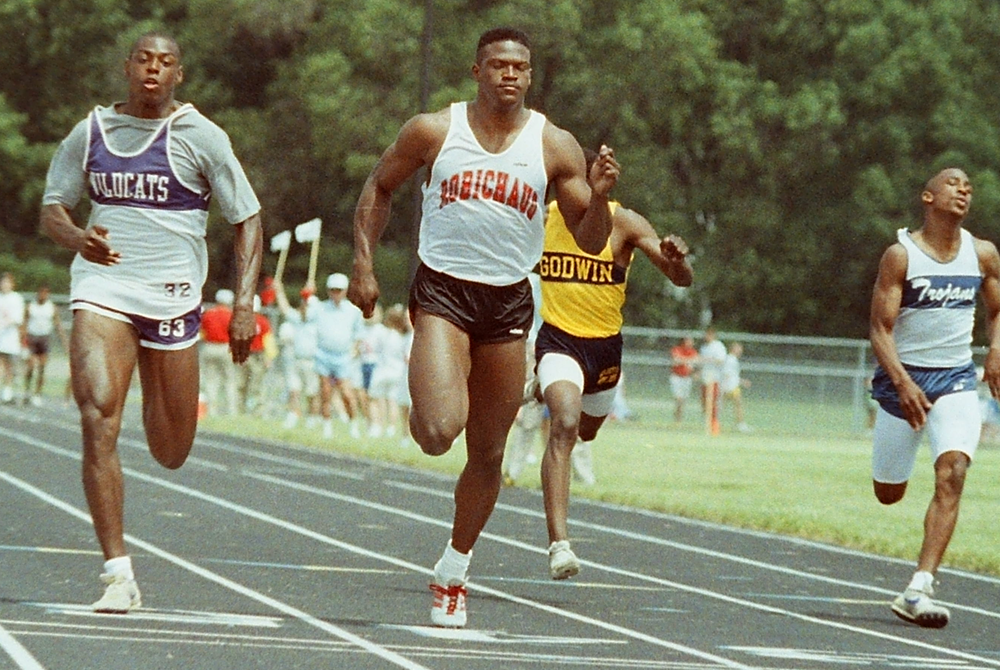
To the greater public, Wheatley surely is best known as a star running back for University of Michigan who went on to play 10 seasons in the NFL for the New York Giants and Oakland Raiders. However, he is arguably most glorified in Michigan high school athletics for his accomplishments on the track, where as a junior in 1990 he became the first (of still only two) athletes to win four individual events at an MHSAA Lower Peninsula Finals – placing first in the 100 and 200-meter dashes, 110-meter hurdles and long jump. He led Robichaud to the Class B team title that day, scoring 40 of its 49 points. Wheatley completed his high school career in 1991 with three more Class B individual track & field championships and nine total over his final three seasons; he was injured in the 100 during that senior-year meet and could not run his final race to attempt another four-title day.
Wheatley’s meet records of 13.7 seconds in the 100 at the 1991 LP Class B Final and 23-10¾ in long jump in 1989 still stood when the four-Class track & field format was retired after the 1999 season. He also remains the only athlete to win the 100 three times at the prestigious Mehock Relays in Mansfield, Ohio, also finishing first in the 110 hurdles and 200 and runner-up in the long jump at that meet in 1991.
Wheatley was similarly accomplished on the high school football field, leading his team to a state championship in 1990 and earning a Parade All-America honor. Over three varsity seasons total he ran for a combined 4,257 yards and 67 touchdowns, including 2,010 yards and 33 scores on 208 carries as a senior in 1990 – the latter despite playing quarterback half of that season (and throwing five touchdown passes). He played quarterback, running back, defensive back, punter, kicker and returned kicks, and he scored 252 points over 13 games as a senior and 484 over 38 career games.
Wheatley also was a standout on the basketball court for Robichaud, averaging 14 points and 16 rebounds per game as a senior in earning all-state recognition in that sport as well.
“My city where I come from, Inkster, means the world to me. I grew up in an incredible era of sports in Michigan (with successful University of Michigan and Detroit pro teams) … but if you ask me who my idols were, they were the guys I grew up with playing on the playground,” Wheatley said. “After you come from a basketball game where you see Jarvis Walker drop 30, or Earl Jones running the last 200 of a race backwards … you hear people talk about them, you hear their reverence about them, and I just wanted to be put in the conversation of the best to come out of Inkster, forget the state. I can tell you this for sure: I’m not the best athlete to come out of Inkster, just the person who got the recognition. And my foundation was built watching, taking notes, preparing, working out and just trying to be one of the guys.
“(Robichaud was) the step. Because without Robichaud … Michigan, the NFL, me coming back to coach, it doesn’t happen,” Wheatley said. “Without the Robert Yaucks (his football coach at Robichaud), the Coach (Leit) Jones (his Robichaud track coach), the Coach (Mercer) Brysons, the (coach) Wade Cooks, the (coach Jeff) Flounorys, the Millie Hursins (his academic advisor) of the world, this doesn’t happen. Without my high school teammates, none of this happens. So it’s not just a step. What’s the saying – the first impression is the lasting and best impression? Robichaud was it.”
Wheatley returned to Robichaud as its varsity football coach in 2007 and led that team to a 9-2 record and the MHSAA Playoffs for the first time since 1994 – after Robichaud had finished 0-9 the previous season. He has served as an assistant football coach at four college programs including U-M and Syracuse, and with the Buffalo Bills, Jacksonville Jaguars and Denver Broncos.
He also served as Morgan State University's head coach from 2019-21 and just completed his first season as head coach at Wayne State, which finished 3-8 – an improvement of two wins from 2022 and the program’s best record since 2019.
Wheatley graduated from University of Michigan in 2008 with a bachelor’s degree in kinesiology. He and wife Kimberly have five children: Tyrone Jr., Terius, Tyrique, Tiana and Tamari. Tyrone Jr., an offensive tackle, played this past season for the New England Patriots.
“Many of us who grew up in Michigan grew up as fans of Tyrone Wheatley because of what he accomplished at the college level – but his legendary story begins at Dearborn Heights Robichaud, where his outsized athletic ability was on full display in every sport he played,” MHSAA Executive Director Mark Uyl said. “Michigan has produced several professional athletes in a variety of sports and nearly 50 Olympians in track & field alone, and what Tyrone Wheatley achieved as a high school athlete remains a standard few have approached. We are ecstatic that he will deservedly take his place among the all-time elite high school athletes nationally as well.”
The National High School Hall of Fame was started in 1982 by the NFHS. The 11 individuals were chosen after a two-level selection process involving a screening committee composed of active high school state association administrators, coaches and officials, and a final selection committee composed of coaches, former athletes, state association officials, media representatives and educational leaders. Nominations were made through NFHS member associations. Also chosen for this class were athletes Joe Mauer (Minnesota), Takeo Spikes (Georgia) and Dot Ford Burrow (Mississippi); sport coaches Paula Kirkland (South Carolina), Gary Rankin (Tennessee), Roy Snyder (Pennsylvania) and Ronald Vincent (North Carolina); former state association administrators Mike Colbrese (Washington) and Marie Ishida (California), and baseball/football game official David Core (Oklahoma).
For more on this year’s Hall of Fame class, visit the NFHS Website.
PHOTO Tyrone Wheatley crosses the finish line first during one of his nine MHSAA Finals track & field championship victories. (MHSAA file photo.)
Several 1st-Time Winners Highlight 2025-26 MHSAA Parade of Champions
By
Geoff Kimmerly
MHSAA.com senior editor
June 18, 2026
Three schools celebrated their first Michigan High School Athletic Association Finals championships in any sport during the 2025-26 school year as 39 teams total won first Finals titles in their respective sports.
Holland Calvary, in boys cross country, Durand in boys bowling and Walled Lake Northern in softball won their schools’ first Finals championships in any sport, as 88 schools total won at least one of the 132 MHSAA team titles awarded over the three seasons.
A total of 23 schools won two or more championships this school year, paced again by Marquette with eight earned in girls and boys cross country, boys golf, girls skiing, girls and boys swimming & diving, boys tennis and boys track & field. Detroit Country Day was next with seven Finals championships, followed by Detroit Catholic Central with six and Ann Arbor Pioneer with four.
Bloomfield Hills Cranbrook Kingswood, Negaunee, Northville and Rockford all won three titles in 2025-26. Winning two were Birmingham Seaholm, Charlevoix, Farmington Hills Mercy, Flint Kearsley, Flint Powers Catholic, Grand Rapids West Catholic, Jackson Lumen Christi, Lake Linden-Hubbell, Lowell, Newberry, Orchard Lake St. Mary’s, Pewamo-Westphalia, Ravenna, Rudyard and West Iron County.
A total of 48 champions were repeat winners from 2025-26. A total of 31 teams won championships for at least the third-straight season, while 22 teams extended title streaks to at least four consecutive seasons. The Lowell wrestling program owns the longest title streak at 13 seasons, followed by Dundee wrestling’s nine consecutive titles and runs of seven straight Finals victories by the Detroit Catholic Central ice hockey team and Marquette’s boys cross country and boys swimming & diving programs.
This school year saw the addition of field hockey and boys volleyball to the MHSAA’s postseason tournament offerings. Eighteen of the MHSAA's 30 team championship tournaments are unified, involving teams from the Upper and Lower Peninsulas, while separate competition to determine title winners in both peninsulas is conducted in remaining sports.
For a sport-by-sport listing of MHSAA champions for 2025-26, click here (PDF).
The MHSAA is a private, not-for-profit corporation of voluntary membership by more than 1,500 public and private senior high schools and junior high/middle schools which exists to develop common rules for athletic eligibility and competition. No government funds or tax dollars support the MHSAA, which was the first such association nationally to not accept membership dues or tournament entry fees from schools. Member schools which enforce these rules are permitted to participate in MHSAA tournaments, which attract more than 1.4 million spectators each year.
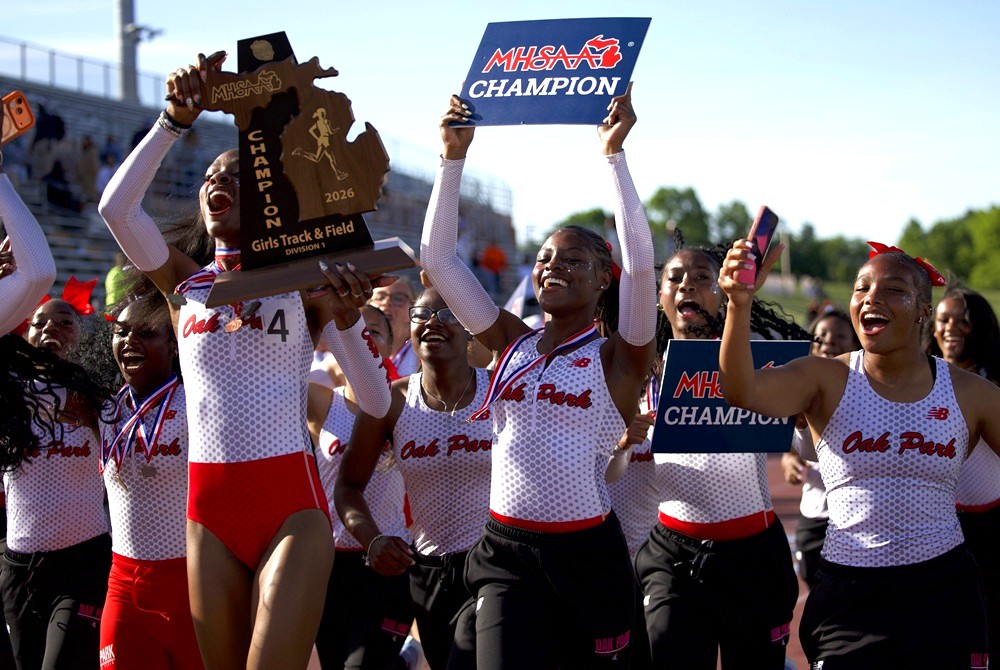
PHOTO The Oak Park girls track & field team hoist their championship trophy and sign May 30 at Rockford High School. (Click for more from RunMichigan.com.)