

Zingsheim's Story an Award-Winner
May 31, 2012
By Geoff Kimmerly
Second Half editor
Zack Zingsheim’s career highlight is an easy pick.
It was just a few months ago, at Michigan International Speedway, when he stunned even himself by winning the MHSAA Division 3 cross country championship.
He can describe in vivid detail being the last to come out of the chute at the finish, looking into the grandstand and telling himself to always remember the moment. He can see again his teammates further down the chute, chanting his name. The goose bumps he felt. How they jumped the fence, lifted him to their shoulders and carried him off the course.
It was the greatest day he could remember. And it ended with a pie in the face.
“I remember how surreal the moment was,” he said. “Since I was a little kid, I thought it would be so cool to win the state meet for cross country; the atmosphere is so amazing.”
Nearly as amazing is he doesn’t remember the flavor of the pie.
Zingsheim tells a story with the best of them – thanks in part to a keen photographic memory and attention to detail.
But he gets a Second Half High 5 this week because of his status as one of the state’s top high school runners – and what a tale he’s spun over the last year.
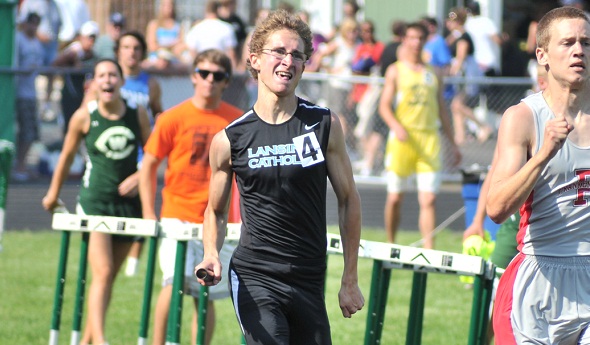
Zingsheim has the top-seeded Division 3 time in the 800 meters (1:55.30) heading into Saturday’s Finals at Comstock High School, and also runs on the top-seeded 800, 1,600 and 3,200 relays. He and his teammates won the 800 relay at last season’s Finals, and he has or is part of school records in all four of those races, plus the 400. He’s also the fastest in Cougars cross country history.
Another of his favorite stories to tell explains why.
Diamond in the rough
He remembers seeing the Corunna baseball diamond in the distance. That’s key to this story.
Zingsheim was a freshman in 2009, running the second leg of the 800 relay, and had just taken the baton. His right hip had been feeling tight and then painful over the previous couple of weeks, but he felt great at that point as he glanced ahead and saw the baseball field.
The next step, he felt like he got hit with a baseball square in the right hip. But there was no baseball.
He tried to bring the leg forward, and couldn’t. He dragged his leg the next 100 meters to complete his handoff, and then collapsed.
Zingsheim did see a “flabby piece of bone just laying there.” He started crying. His parents immediately drove him to the hospital as he screamed the lyrics to whatever was on the radio to try to forget the pain. (And yes, he remembered one off the songs: “Boom Boom Pow” by the Black Eyed Peas.)
The flexor muscle that connected his hamstring to his pelvis had torn and taken the top of that part of his pelvic bone with it.
Next came months of therapy and changes. He’d started on the freshman basketball team, but decided to stop that sport and focus on running. Still, he couldn’t get in shape that summer because he couldn’t put in the miles, and his sophomore cross country season wasn’t what he’d wanted – until he ran a personal best late in the season and got a needed confidence boost.
“There’s something so special about being able to run so hard and seeing hard work come to fruition on the course or the track,” Zingsheim said. “And especially, seeing how far I had to come. I wanted to see what kind of runner I could become if I put all that work in.”
His 1,600 relay finished eighth at the 2010 Division 3 Finals, another turning point. A year later, Lansing Catholic coach Tim Simpson needed a fill-in on the 800 relay. The date was April 13, 2011 – a day shy of two years since he’d suffered the pelvic break. “I’ve never been so nervous for another race,” he said. But the Cougars set a school record, and he’s been on that relay since.
A long road traveled
“He’s come a long way, but he’s always had that ability,” Simpson said. “He ran 50-70 miles a week during the summer. He reads about the top runners, follows it, so he know what they’re doing, what you’re supposed to do if you’re going to be good.”
There’s always an eye on the details; Zingsheim’s got a reputation among his classmates as the guy who always is last to turn in his tests. He gets done quickly, but spends the rest of the period double and triple-checking his answers to make sure everything is right.
There are plenty of other stories, of course. Like how he and his talented classmates – Lansing Catholic’s senior boys also played in the Division 5 Football Final in the fall – split up during middle school into football teams that stayed the same for months and turned into fierce rivalries. (He played receiver.)
He’s earned the story-teller role in his family too; at gatherings he’s often the go-to guy for a “quirky” or “goofy” family tale.
But the stories he’ll be most proud to be part of are those that get passed down to Lansing Catholic runners after him.
Zingsheim was in first grade when his brother Brandon was a senior on the cross country and track teams and began the Cougars’ tradition of saying a “Hail Mary” and chanting “Hey Cougars, what we going to do?” Zack is among those who now lead that rally.
Lansing Catholic had outstanding runners before Zingsheim. But with him and a strong group of individuals including distance seniors Jimmy Hicks (who will walk-on at the University of Georgia), Austin Winter and Joe Marrah, they could cap their careers with the team’s first MHSAA championship.
“What I really wanted to do by the time my tenure was done was lay a foundation. Build the program; do things the right way,” Zingsheim said. “I wanted to teach guys what it means to be an LCC runner.
“The last four years, we’ve really been able to build that program. … And I’m so excited to see where the program is going the next couple of years.”
Click to read more about Zingsheim's inspirations and aspirations.
PHOTO: Lansing Catholic's Zack Zingsheim was part of the championship-winning 800 relay at last season's Division 3 Final.
Performance of the Week: East Kentwood's De-Mani Roberts
May 28, 2026
 De-Mani Roberts ♦ East Kentwood
Sophomore ♦ Track
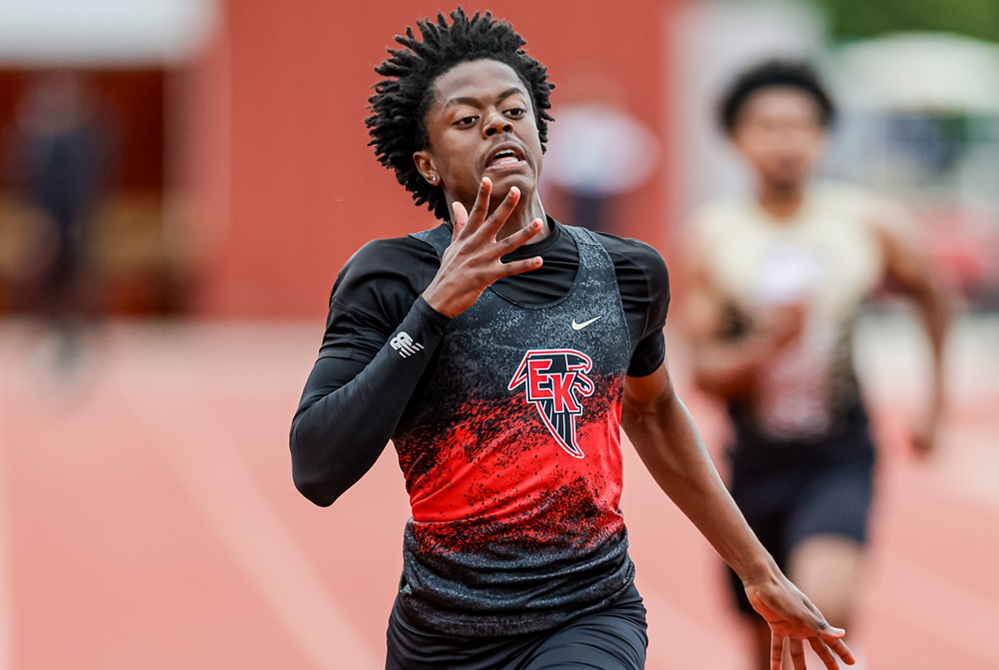
Roberts has made impressive strides in the second season of high school outdoor track, cutting nearly a half-second off his top 200-meter time from a year ago and more than a second off his freshman-year best in the 400 in helping East Kentwood become a favorite to win the team championship at Saturday's Lower Peninsula Division 1 Finals. Roberts won the 200 in a personal-best 21.26 seconds and ran on the winning 800 relay (1:26.83) as the Falcons won the Michigan Interscholastic Track Coaches Association (MITCA) Division 1 team championship last weekend.
That 200 time and his top 400 time of 47.55 seconds are both the fastest in the state in those respective races this spring, all divisions included. Roberts is undefeated in both races, a notable jump even as he finished 14th in the 200 and ran on three top-12 relays at last year's MHSAA Finals. That top 200 time also trails the current LPD1 Finals record by only 25 hundredths of a second, and he could make a run at Finals records in both individual races with half his high school career remaining. Roberts also has run cross country for East Kentwood the last two seasons.
@mhsaasports 🏃POW: De-Mani Roberts #eastkentwood #track #highschoolsports #performanceoftheweek #MHSAA ♬ Bright and fun upbeat pops, Kids, Animals, Pets, Fun, Cute, Happy, Playful, Upbeat(1465232) - SAKUMAMATATA
@mhsaasports 🏃POW: De-Mani Roberts #funfacts #tiktalk #performanceoftheweek #highschoolsports #MHSAA ♬ Girly and cute synth pop - SAKUMAMATATA
Follow the MHSAA on TikTok.
MHSAA.com's "Performance of the Week" features are powered by MI Student Aid, a division within the Department of Lifelong Education, Advancement, and Potential (MiLEAP). MI Student Aid encourages students to pursue postsecondary education by providing access to student financial resources and information. MI Student Aid administers the state’s 529 college savings programs (MET/MESP), as well as scholarship and grant programs that help make college Accessible, Affordable and Attainable for you. Connect with MI Student Aid at www.michigan.gov/mistudentaid and find more information on Facebook and X @mistudentaid.
Previous 2025-26 honorees
May 22: Taleon Guess, Temperance Bedford golf - Report
May 15: Zacchaeus Brocks, Detroit Catholic Central track - Report
May 7: Savanah Thompson, Howard City Tri County soccer - Report
April 30: Eliza Schwass, Ludington track - Report
April 23: Emily Postema, Ravenna softball - Report
April 16: Katie Berkshire, Gaylord track - Report
March 26: Kayla Hairston, Goodrich basketball - Report
March 19: Liam Smith, Otsego swimming - Report
March 12: Jack Sayen, Houghton hockey - Report
March 5: Devin Patrick, St. Clair Shores Lake Shore - Report
Feb. 26: Madison Nieuwenhuis, Plainwell wrestling - Report
Feb. 20: Sophie Ramey, Allen Park competitive cheer - Report
Feb. 13: Cam Ryans, Grand Rapids Northview basketball - Report
Feb. 6: Melanie Kolnitys, Midland Dow basketball - Report
Jan. 29: Stella Musialowski, Huron Valley United gymnastics - Report
Jan. 22: Baylor Perkins, Grand Blanc swimming - Report
Jan. 15: Delaney Vanier, Flint Kearsley bowling - Report
Jan. 8: Stevie Hall, Detroit Cass Tech basketball - Report
Dec. 18: Ethan Martha, Ishpeming Westwood basketball - Report
Dec. 11: Louis Smith, Three Rivers wrestling - Report
Dec. 4: Traverse Moore, DeWitt football - Report
Nov. 28: Elizabeth Eichbrecht, West Bloomfield swimming - Report
Nov. 20: Brady Kieff, Blanchard Montabella football - Report
Nov. 13: Ella Laupp, Battle Creek Harper Creek swimming - Report
Nov. 7: Hunter Eaton, Charlevoix cross country - Report
Oct. 31: Stephen Gollapalli, Lansing Christian tennis - Report
Oct. 23: Talya Schreiber, Pickford cross country - Report
Oct. 16: Avery Manning, Dexter golf - Report
Oct. 9: Brady Van Laecke, Hudsonville football - Report
Oct. 2: Sarah Giroux, Flat Rock volleyball - Report
Sept. 25: Sam Schumacher, Portage Central tennis - Report
Sept. 18: Kaylee Mitzel, Saline field hockey - Report
Sept. 11: Natasza Dudek, Ann Arbor Pioneer cross country - Report
Sept. 4: Kate Posey, Big Rapids golf - Report
PHOTO East Kentwood's De-Mani Roberts runs to a win in the 200 meters at the MITCA Division 1 championship meet. (Photo by Miles Postema.)