

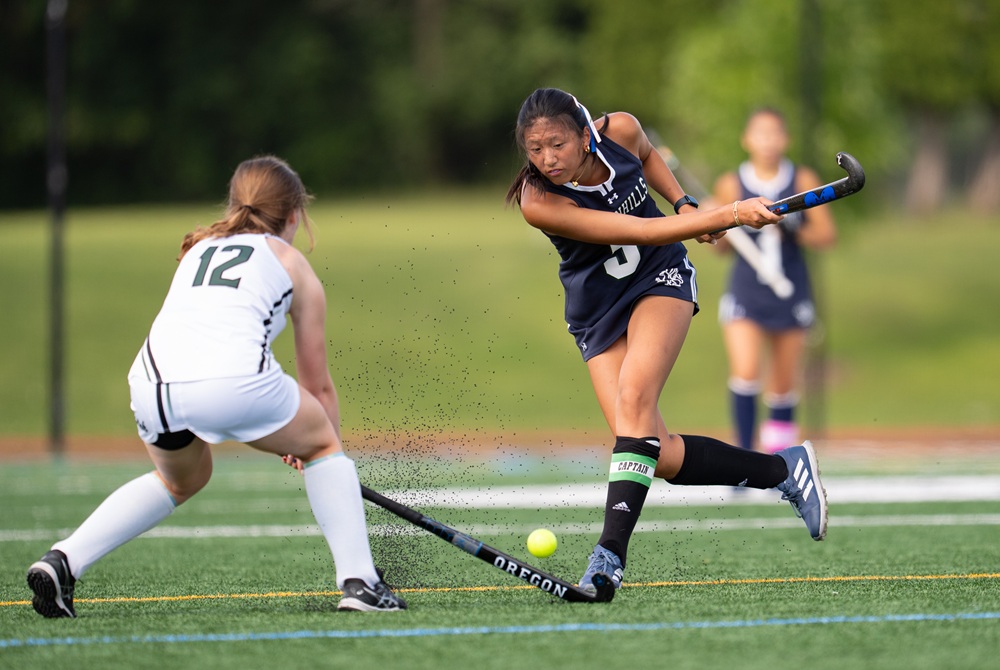
Be the Referee: Field Hockey Basics
By
Paige Winne
MHSAA Director of Brand Management
September 3, 2025
Be The Referee is a series of short messages designed to help educate people on the rules of different sports, to help them better understand the art of officiating, and to recruit officials.
Below is this week's segment – Field Hockey Basics - Listen
Field Hockey is now a fully sponsored MHSAA sport. So let’s start by getting up to speed on some basics.
Field Hockey is a fall sport.
Games are administered by two officials.
Each team plays with 11 players on the field – including the goalkeeper.
The field is 100 yards by 60 yards – roughly the same size as a football field.
The goals are 12 feet wide and seven feet high, with the penalty stroke line being drawn seven yards in front of the center of the goal.
Players are not allowed to play the ball with the rounded side of the stick – nor are they allowed to charge, hit, shove, or trip an opposing player.
Field hockey games are 60 minutes long, played in four 15-minute quarters.
Previous 2025-26 editions
Aug. 26: Golf Ball Bounces Out - Listen
PHOTO by Jamie Crawford/JC Sports Photography.

Be the Referee: Playoff Selection
October 7, 2015
This week, MHSAA assistant director Mark Uyl explains how officials are chosen to work football playoff games.
Be The Referee is a series of short messages designed to help educate people on the rules of different sports, to help them better understand the art of officiating, and to recruit officials.
Below is this week's segment - Playoff Selection - Listen
As the regular season reaches the halfway point, the MHSAA begins to look ahead to the five weeks of the football playoffs. Crews and officials are selected at mid-season for the tournament based on a number of factors.
Each official receives a rating from both schools following every game worked, and this rating average serves as the starting point for selection with the highest rated crews being considered first. The MHSAA also considers experience of the crew, recommendations for leagues and officials associations, football rule exam score (from a test) each official completes as well as the strength of the schedule the crew has worked during the season.
All of these factors are considered when selecting the very best officials to work the most important games of the season.