

1979: Rice Meets Moeller in 'Biggest Game Ever'
August 30, 2019
By Ron Pesch
Special for Second Half
DATELINE: Cincinnati, Ohio, 1979
“The Brother Rice-Moeller game is the biggest game any Michigan high school football team has ever played.”
Hal Schram - ‘The Swami’
Detroit Free Press
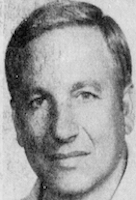
“I’m nervous as heck,” said Birmingham Brother Rice coach Al Fracassa to Free Press sportswriter Mick McCabe. “This is the biggest challenge of my life.”
On Saturday, September 22, 1979, Fracassa’s Warriors travelled 270 miles south from the hotbed of Michigan high school football to the hotbed of Ohio high school football for a first-ever showdown with Cincinnati Moeller. Heading into the 1980s, many would argue that Brother Rice was the top football (and perhaps the top boys prep sports) program in the state of Michigan. At the same time, many would say Moeller had replaced Washington Massillon High School as the premier grid program in the Buckeye State, and that Moeller also represented the nation’s top prep football team. To quote McCabe in his pregame write-up:
 “Moeller had a 53-game winning streak snapped last fall after winning Ohio’s Class AAA state championship the previous three years. It also won the mythical national championship in 1976 and ’77. Seventeen players from (the 1978) Moeller team received college scholarships, including wide receiver Tony Hunter at Notre Dame and Larry Gates, the backup quarterback at Purdue.”
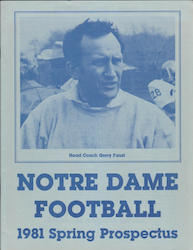
Moeller was coached by 44-year-old Gerry Faust – soon to become a Notre Dame legend. But in the fall of 1979, he was still building his impressive resume at Moeller.
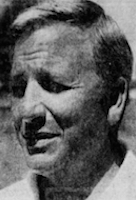 While both were all-male Catholic schools and maintained three football teams – varsity, JV and freshman – there were stark differences. Fracassa’s varsity coaching staff at the time included three members: Mike Popson, Ron Kalczynski and Mike Cieslak. In comparison, Faust had 17 assistant coaches on his varsity staff (and 25 student managers).
“Every year is a rebuilding year for us,” said Faust. “We average between 24 and 38 seniors a year and about 20 of them start.”
“Their second team is as good as most teams around here, and I’m not exaggerating,” Fracassa told McCabe.
Entering the contest, Faust had posted a 152-17-2 record in 17 seasons at Moeller, while Fracassa, in his 20th year as a head coach, was 123-31-8. A former Detroit Pershing and Michigan State quarterback, Fracassa was named head football coach at Royal Oak Shrine in June 1960. After eight seasons at Shrine, Fracassa moved to Brother Rice and compiled an 86-14-3 mark, including a Class A mythical state title in 1974. His Warriors began an impressive 24-game winning streak in 1976, earning an MHSAA Class A playoff title in 1977, but the streak was ended by North Farmington in the Semifinal round of the MHSAA tournament in November 1978.
Faust arrived at Moeller in 1960 to start a football team and had guided the squad since the school began playing varsity ball in 1963. He first started bringing outstate teams to Cincinnati in 1977 with a game against Monsignor Farrell High School of Staten Island, NY. Jesuit High from Dallas, Texas, followed with a visit to Moeller in 1978.
Both Moeller and Rice were undefeated to start the 1979 season. Faust’s Crusaders had allowed only three first downs over three games, including a big 34-7 win over city rival Cincinnati Princeton, the school that had ended Moeller’s long winning streak, and a 30-13 victory over powerhouse Pittsburgh Penn Hills, a school with an enrollment of 4,200 that had compiled consecutive Class AAA Western Pennsylvania Interscholastic Athletic League championships in the three previous years under coach Andy Urbanic. With the defeat of Penn Hills, the Crusaders were a flawless 3-0 against teams from across state lines entering the Brother Rice contest.
Undefeated in two games, Brother Rice was rated fourth in Class A in Hal Schram’s initial Top Ten rankings. Inexperienced following the graduation of quarterback Jon English (Michigan State) and receiver Marty Martinez (Stanford), the Warriors had downed St. Clair Shores Lake Shore, 21-7, then Grosse Pointe North, 13-7.
Game Time
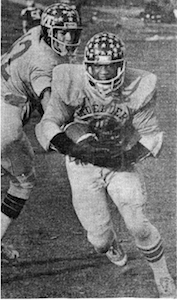
A crowd of 20,792 (including members of the Brother Rice pep band) packed the University of Cincinnati’s Nippert Stadium for the 8 p.m. prep version of the Michigan-Ohio State game. Moeller did not have its own field, playing games at Nippert, Cincinnati’s Riverfront Stadium (home to the NFL’s Bengals and MLB’s Reds), or a nearby high school field. Moeller dominated the first half with 282 yards of total offense to Brother Rice’s 64, but held only a 13-7 lead at the half. Senior wingback Eric Ellington awed the crowd with touchdown runs of 43 and 61 yards during the first quarter. Rice rebounded with a five-yard touchdown on a bootleg by 5-foot-11, 170-pound senior quarterback Brian Brennan following a fumble recovery by Emil Nagengast during the second period.
Starting their first possession of the third quarter on their own 33-yard line, Ellington ripped off a 34-yard run to the Rice 33 on Moeller’s first play of the drive. Three plays later, he went left for 10 yards and his third touchdown of the game. The Crusaders opened up a 33-7 lead in the fourth quarter before Rice got back on the scoreboard. Fracassa went to the playbook for some “razzle dazzle.”
Operating from their own 32-yard line with 2:19 left to play, “Brennan tossed a deliberate bounce pass on a lateral to reserve quarterback Dave Yarema,” wrote Randy Holtz in the Cincinnati Enquirer. “Yarema then fired a 68-yard touchdown to the wide open Steve Allen to finish the game’s scoring.”
“We’ve been using it a long time,” said Fracassa, commenting on the play with limited delight following the 33-14 loss. “We told the kids before the game that this would be one of the best teams they were ever going to play against. They’re really a tremendous team. If you can’t contain Ellington, you’re in trouble. You’ve got to be something else to catch this kid.”
Ellington ended with 178 yards on 10 carries.
“Eric really ran well,” added Faust. “He’s a great back, but you’ve got to give credit to (our) line up front.”
 Due to the early format of the MHSAA playoffs, which were introduced in 1975, the defeat likely had eliminated Brother Rice from the state playoff picture. A 10-7 loss to Catholic League opponent Detroit Catholic Central in Week 5 of the season and a 6-3 regular-season record ensured no postseason play for the Warriors in 1979. Detroit Catholic would end the year as Class A state champ with a perfect 12-0 record.
The Ohio High School Athletic Association had begun its football playoff system in the fall of 1972. To little surprise, Moeller went on to win the state’s Class AAA title for the fourth time in 1979, defeating Parma Padua Franciscan 41-7. Moeller again was proclaimed national champion by the National Sports News Service. (For those interested, highlights can be found here).
College Comes Calling
Back in Michigan, in February 1980, Fracassa applied for the head coaching position at Michigan State to replace Darryl Rogers, but wasn’t interviewed. When Frank “Muddy” Waters was named as MSU’s new coach, he offered Fracassa the position of offensive coordinator. But Fracassa chose not to go. In the fall, his Warriors again won the Class A championship. It wouldn’t be his last opportunity to jump to the college game.
The Great Experiment
In Ohio, Faust’s Crusaders would win the state and national titles again in late November 1980. After more than a month of rumors, on the day after winning the state title, Gerald Anthony Faust was officially announced as “the only head coach Notre Dame has ever selected from the high school ranks.”
Another Chance at MSU
Fracassa was a back-up signal caller at Michigan State. “I was always stuck behind the All-Americans,” he told the Detroit Times in 1960 shortly after taking charge at Royal Oak Shrine.
“First, he understudied Al Dorow,” wrote Wally Dwyer in the Times. “Then it was Tom Yewcic and finally Earl Morrall.”
Morrall’s son Matt, Leon Hart’s son Kevin, Tobin Rote’s son, Rocky, Roger Zatkoff’s son David and Jack Simmons’ son, Terry, were the offspring of past Detroit Lions who played on Fracassa’s 1974 champion.
 In December 1982, George Perles was named to replace Waters as head coach at Michigan State. A former teammate of Fracassa’s at MSU and, later, a coaching friend and rival when Perles coached Detroit St. Ambrose and Fracassa guided Shrine, Perles spoke to Fracassa about the possibility of joining the Spartans’ defensive staff. Again, Fracassa chose to remain at Brother Rice.
A Legacy Sealed …
In the fall of 1983, Fracassa’s Warriors grabbed another Class A title. It was the third of nine MHSAA championships his teams would ultimately earn. When he retired following the 2013 season, he was the state’s all-time winningest football coach with a 430-117-7 mark.
… and a Legacy Altered
In November 1985, Faust resigned from his position at Notre Dame.
“Faust said the job was ‘the fulfillment of a lifelong dream,’” wrote Mitch Albom in the Free Press, days after the announcement. “And he did it proud on most counts. He worked feverishly, turned out good men, a clean program. And technically, a winning program, 30-25-1. But nowhere near winning enough for Notre Dame.”
“Faust knew it.”
To the dismay of countless Irish fans, Notre Dame continued to honor its contract despite the losses. “No matter how loudly the fans yelled,” noted Albom, “the school would not fire Faust.”
“So, with a choked voice and moist eyes, he saved the university the ugliness of firing him by resigning with one game left on his contract.”
“We probably won’t see another Gerry Faust experiment again,” added Albom at the time. “Everyone will point out that it didn’t work the first time …”
“College football was once a game of its name. College kids playing football. That was long ago. Today it is a multimillion-dollar industry …”
The great experiment certainly altered memories of Faust, the structure of coaching contracts, and the path for all high school coaches who aspired to lead at a higher level. One might even say it was a turning point for winning and losing, and what would be ‘acceptable’ at all levels of sports across America.
P.S. Moeller and Rice again met in 2007, with the Crusaders again topping Brother Rice, this time 14-6. Both schools had entered this match-up with identical 2-1 records.
 Ron Pesch has taken an active role in researching the history of MHSAA events since 1985 and began writing for MHSAA Finals programs in 1986, adding additional features and "flashbacks" in 1992. He inherited the title of MHSAA historian from the late Dick Kishpaugh following the 1993-94 school year, and resides in Muskegon. Contact him at [email protected] with ideas for historical articles.
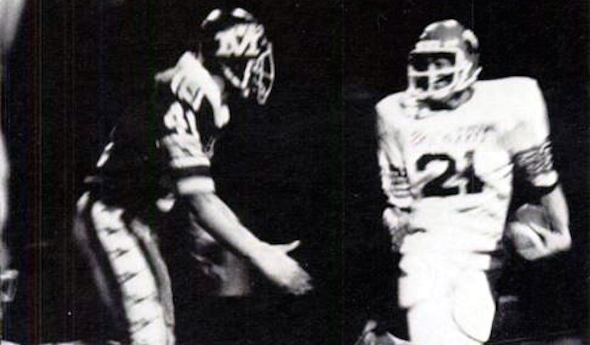
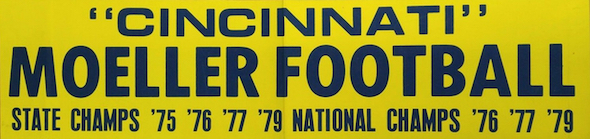
PHOTOS: (Top) Brother's Rice's Brian Brennan looks for an opening while a Moeller defender pursues. (2) Brother Rice coach Al Fracassa. (3) Moeller coach Gerry Faust. (4) A Moeller bumper sticker tells of its many successes during the 1970s. (5) Eric Ellington starred for Moeller against Brother Rice. (6) Faust left Moeller for Notre Dame in 1980. (Photos gathered by Ron Pesch.)
Marckel Supplies Marketing Magic to Hunter's Heisman-Winning Campaign
By
Doug Donnelly
Special for MHSAA.com
July 29, 2025
When he was hired at the University of Toledo in 2016 as assistant director of creative services, Derek Marckel thought he had found his dream job only a few months after graduating from college.
 Then he became Colorado University’s graphic designer for football in 2019 and thought he had finally landed the job he’s always wanted.
After stops at the Michigan State University to work with former football coach Mel Tucker, and University of Southern California to work with Lincoln Riley, Marckel, 32, is back in Colorado and certain he’s living the dream.
“This was the stuff I thought about doing when I was a kid,” said Marckel, who graduated from Ottawa Lake Whiteford High School in 2011. “I used to sit and draw pictures of all of my favorite University of Toledo football players, and then I’d take them and give them to the players or have them sign them. This is definitely what I’ve dreamed of doing someday.”
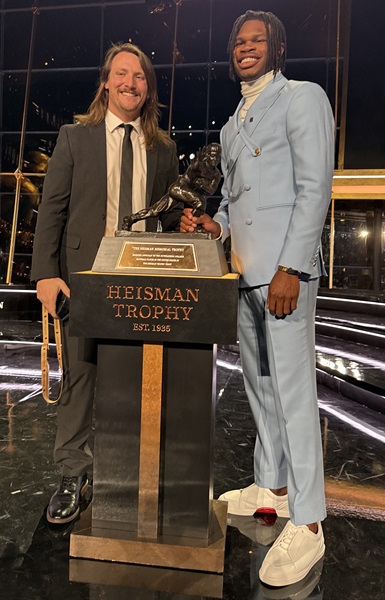
Last winter, Marckel was in New York City when his favorite subject – Colorado football player Travis Hunter – won the Heisman Trophy. It was a surreal moment for Marckel, who led a team of creative content makers who spent months last fall promoting Hunter for the biggest prize in all of college football.
“Going into the season, we knew he was going to have a pretty good chance,” Marckel said. “Once the games started playing out, we knew he had a legitimate shot.”
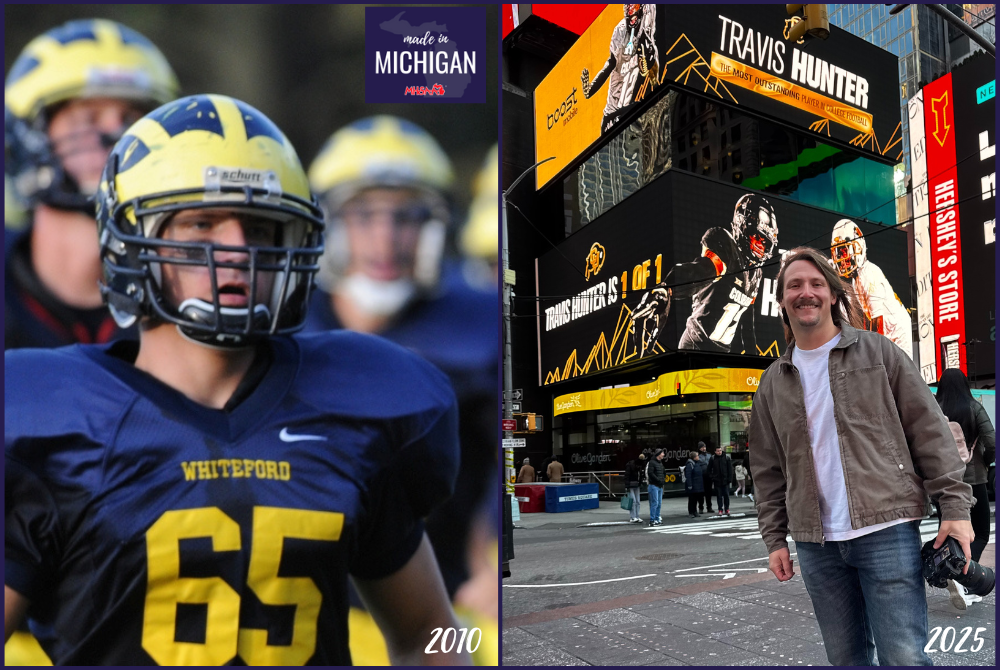
As senior art director at Colorado, Marckel led the Hunter-for-Heisman campaign. He was on the sidelines of every game, home and away, documenting Hunter and the rest of the Buffaloes. He designed billboards that were strategically placed around Denver and one in Times Square in New York City. Marckel’s team met weekly to plan a regular dose of social media posts and content promoting Hunter’s candidacy.
Heisman Trophy candidates emerge based on their on-field performances. But, behind the scenes, winning the trophy has long taken some pushing by colleges and universities.
“There’s a lot that goes into a campaign,” Marckel said. “You have to work with sponsors and donors who helped fund all of that. It’s a lengthy operation.”
As the season drew to a close, Colorado published a packet of information that Marckel designed and sent it to Heisman Trophy voters and the media. ESPN showcased his work.
“Almost everything we were doing was going viral,” Marckel said.
When it became clear Hunter was going to be a finalist for the award, Marckel was called upon to document the entire process. He and a member of his team went to New York City two days ahead of Hunter to be prepared when he landed in the city. Next were Heisman Trophy promotional appearances, photoshoots and the Heisman ceremony itself, and Marckel was there for all of it.
“It was Travis from sun-up to sun-down,” Marckel said. “We’d have little breaks during the day. I designed the billboard for him in Times Square. We had a photo shoot there.”
Helpfully, Hunter was a wonderful participant.
“We put a lot of work into it,” Marckel said. “Obviously it was his award, and he earned it, but it was very rewarding to us, too, to see our hard work pay off. I’ve been around thousands of athletes, and he’s probably my favorite one. He doesn’t necessarily love doing all of the media stuff, but he was comfortable around us.”
 Marckel was born in Toledo but grew up in southeast Michigan. He was football team captain for the Bobcats as a senior and began his interest in design, art and photography during his time at Whiteford.
“I knew from a young age that I wanted to work professionally in sports,” Marckel said. “During my time at Whiteford, I spent a lot of my high school career around the football program. I was lucky to have my first two years of varsity with Coach (Jack) Luettke and my senior year with Coach (Matt) Garno, who had a background in graphic design. This ended up being a great foundation for me to combine my passion for football and graphic design as I was heading into the real world.”
Marckel graduated from Bowling Green State University in 2016 with a bachelor's degree in technology & visual communication technology. He landed an internship with the University of Toledo where he started designing team schedule posters, pocket schedules and souvenir tickets. That’s when social media started revolutionizing the industry, especially college football.
“Social media was kind of secondary to everything else when I started there,” he said. “It started to shift. I got in at the perfect time. Things were really starting to pick up. That’s when I knew sports was going to be what I wanted to do.”
After getting a full-time job at Toledo, his work caught the eye of someone at Colorado, and Marckel went west to become a graphic designer with the Buffaloes. When Tucker left Colorado for Michigan State, Marckel followed him to East Lansing.
At first, he missed Colorado.
“Even on the drive to East Lansing, I was thinking, ‘Why am I leaving Colorado?’” Marckel said.
He stayed two years, then landed the role as director of creative media at USC, working sun-up to sun-down in Los Angeles. When the opportunity came to return to Boulder, he jumped at it, becoming senior art director.
The Buffaloes went 1-11 his first season back at Colorado. The entire football coaching staff was let go.
That’s when Marckel’s world took another big turn.
“The rumors started flying about Coach Prime,” Marckel said, referring to Deion Sanders. “There are always these theoretical situations about who the coach is going to be. We found out about 8 p.m. that it was Coach Prime. We had to be on the tarmac at 1:30 a.m. I don’t get starstruck anymore just because of what I’ve been able to do and who I’ve been able to be around, but as soon as he stepped off the plane, I realized I was getting myself into something huge.”
Pro football hall of famers regularly makes stops at Colorado practices. Warren Sapp joined the Colorado staff. Terrell Owens stops by regularly. A steady wave of Sanders’ former teammates from the Dallas Cowboys attended practices as well.
Marckel documents it all, through his camera – a skill he’s honed along the way.
“When I started at Toledo, I would shoot all of those games, but I wasn’t a great photographer,” he said. “As time has gone on, it’s become such an emphasis. I’ve really had to refine everything I do to become the best at it.”
Initially he had to win the trust of Sanders, who brought some of his own content creators with him to Colorado.
“It took a little while to get us into a groove,” Marckel said. “Now we work side by side every day. It’s a smooth operation now. We bounce ideas off of each other.”
Day to day, Marckel works on social media, marketing, photoshoots of recruits and documents workouts and practices for Colorado social media channels.
He works with the football team exclusively, sometimes long hours during the season.
“You get kind of get burned out by end-of-season, but it's worth it,” Marckel said. “You are on the field every day with Heisman Trophy winners, hall of famers and first-round picks. It’s a cool job when you step back and look at it. This is most fun I’ve had working in college football in 10 years.”
2025 Made In Michigan
July 28: Union City to Omaha: Skirka Takes Murray State Baseball to 1st College World Series - Report
July 22: TC West's Wheelock Still 'Living My Dreams' as CMU Assistant Soccer Coach - Report
July 17: Stevenson's Travels Following Lake Orion Success Include Space Force, Penn, NYC - Report
July 15: 'Who Will Cheer for the Nimrods?' Peterson IV, Watersmeet Found Fans Worldwide - Report
July 10: Feeding 'Drive to Win,' Loy Norrix Grad Morgan Impresses with Strong USBC Showing - Report
July 9: After Blazing Multiple Volleyball Trails, Bastianelli Charting Next Career Path - Report
PHOTOS (Top) At left, Whiteford's Derek Marckel takes the field as a senior in 2010. At right, Marckel poses for a photo this year in front of the Times Square display he designed to promote Colorado's Travis Hunter. (Middle) Marckel stands for a photo with Hunter during the Heisman Trophy ceremony. (Photos courtesy of Derek Marckel.)