

1979: Rice Meets Moeller in 'Biggest Game Ever'
August 30, 2019
By Ron Pesch
Special for Second Half
DATELINE: Cincinnati, Ohio, 1979
“The Brother Rice-Moeller game is the biggest game any Michigan high school football team has ever played.”
Hal Schram - ‘The Swami’
Detroit Free Press
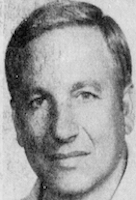
“I’m nervous as heck,” said Birmingham Brother Rice coach Al Fracassa to Free Press sportswriter Mick McCabe. “This is the biggest challenge of my life.”
On Saturday, September 22, 1979, Fracassa’s Warriors travelled 270 miles south from the hotbed of Michigan high school football to the hotbed of Ohio high school football for a first-ever showdown with Cincinnati Moeller. Heading into the 1980s, many would argue that Brother Rice was the top football (and perhaps the top boys prep sports) program in the state of Michigan. At the same time, many would say Moeller had replaced Washington Massillon High School as the premier grid program in the Buckeye State, and that Moeller also represented the nation’s top prep football team. To quote McCabe in his pregame write-up:
 “Moeller had a 53-game winning streak snapped last fall after winning Ohio’s Class AAA state championship the previous three years. It also won the mythical national championship in 1976 and ’77. Seventeen players from (the 1978) Moeller team received college scholarships, including wide receiver Tony Hunter at Notre Dame and Larry Gates, the backup quarterback at Purdue.”
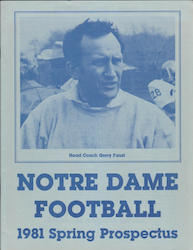
Moeller was coached by 44-year-old Gerry Faust – soon to become a Notre Dame legend. But in the fall of 1979, he was still building his impressive resume at Moeller.
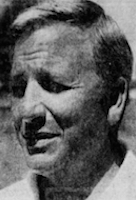 While both were all-male Catholic schools and maintained three football teams – varsity, JV and freshman – there were stark differences. Fracassa’s varsity coaching staff at the time included three members: Mike Popson, Ron Kalczynski and Mike Cieslak. In comparison, Faust had 17 assistant coaches on his varsity staff (and 25 student managers).
“Every year is a rebuilding year for us,” said Faust. “We average between 24 and 38 seniors a year and about 20 of them start.”
“Their second team is as good as most teams around here, and I’m not exaggerating,” Fracassa told McCabe.
Entering the contest, Faust had posted a 152-17-2 record in 17 seasons at Moeller, while Fracassa, in his 20th year as a head coach, was 123-31-8. A former Detroit Pershing and Michigan State quarterback, Fracassa was named head football coach at Royal Oak Shrine in June 1960. After eight seasons at Shrine, Fracassa moved to Brother Rice and compiled an 86-14-3 mark, including a Class A mythical state title in 1974. His Warriors began an impressive 24-game winning streak in 1976, earning an MHSAA Class A playoff title in 1977, but the streak was ended by North Farmington in the Semifinal round of the MHSAA tournament in November 1978.
Faust arrived at Moeller in 1960 to start a football team and had guided the squad since the school began playing varsity ball in 1963. He first started bringing outstate teams to Cincinnati in 1977 with a game against Monsignor Farrell High School of Staten Island, NY. Jesuit High from Dallas, Texas, followed with a visit to Moeller in 1978.
Both Moeller and Rice were undefeated to start the 1979 season. Faust’s Crusaders had allowed only three first downs over three games, including a big 34-7 win over city rival Cincinnati Princeton, the school that had ended Moeller’s long winning streak, and a 30-13 victory over powerhouse Pittsburgh Penn Hills, a school with an enrollment of 4,200 that had compiled consecutive Class AAA Western Pennsylvania Interscholastic Athletic League championships in the three previous years under coach Andy Urbanic. With the defeat of Penn Hills, the Crusaders were a flawless 3-0 against teams from across state lines entering the Brother Rice contest.
Undefeated in two games, Brother Rice was rated fourth in Class A in Hal Schram’s initial Top Ten rankings. Inexperienced following the graduation of quarterback Jon English (Michigan State) and receiver Marty Martinez (Stanford), the Warriors had downed St. Clair Shores Lake Shore, 21-7, then Grosse Pointe North, 13-7.
Game Time
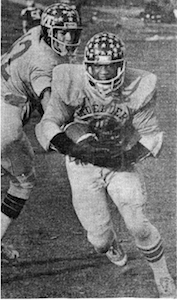
A crowd of 20,792 (including members of the Brother Rice pep band) packed the University of Cincinnati’s Nippert Stadium for the 8 p.m. prep version of the Michigan-Ohio State game. Moeller did not have its own field, playing games at Nippert, Cincinnati’s Riverfront Stadium (home to the NFL’s Bengals and MLB’s Reds), or a nearby high school field. Moeller dominated the first half with 282 yards of total offense to Brother Rice’s 64, but held only a 13-7 lead at the half. Senior wingback Eric Ellington awed the crowd with touchdown runs of 43 and 61 yards during the first quarter. Rice rebounded with a five-yard touchdown on a bootleg by 5-foot-11, 170-pound senior quarterback Brian Brennan following a fumble recovery by Emil Nagengast during the second period.
Starting their first possession of the third quarter on their own 33-yard line, Ellington ripped off a 34-yard run to the Rice 33 on Moeller’s first play of the drive. Three plays later, he went left for 10 yards and his third touchdown of the game. The Crusaders opened up a 33-7 lead in the fourth quarter before Rice got back on the scoreboard. Fracassa went to the playbook for some “razzle dazzle.”
Operating from their own 32-yard line with 2:19 left to play, “Brennan tossed a deliberate bounce pass on a lateral to reserve quarterback Dave Yarema,” wrote Randy Holtz in the Cincinnati Enquirer. “Yarema then fired a 68-yard touchdown to the wide open Steve Allen to finish the game’s scoring.”
“We’ve been using it a long time,” said Fracassa, commenting on the play with limited delight following the 33-14 loss. “We told the kids before the game that this would be one of the best teams they were ever going to play against. They’re really a tremendous team. If you can’t contain Ellington, you’re in trouble. You’ve got to be something else to catch this kid.”
Ellington ended with 178 yards on 10 carries.
“Eric really ran well,” added Faust. “He’s a great back, but you’ve got to give credit to (our) line up front.”
 Due to the early format of the MHSAA playoffs, which were introduced in 1975, the defeat likely had eliminated Brother Rice from the state playoff picture. A 10-7 loss to Catholic League opponent Detroit Catholic Central in Week 5 of the season and a 6-3 regular-season record ensured no postseason play for the Warriors in 1979. Detroit Catholic would end the year as Class A state champ with a perfect 12-0 record.
The Ohio High School Athletic Association had begun its football playoff system in the fall of 1972. To little surprise, Moeller went on to win the state’s Class AAA title for the fourth time in 1979, defeating Parma Padua Franciscan 41-7. Moeller again was proclaimed national champion by the National Sports News Service. (For those interested, highlights can be found here).
College Comes Calling
Back in Michigan, in February 1980, Fracassa applied for the head coaching position at Michigan State to replace Darryl Rogers, but wasn’t interviewed. When Frank “Muddy” Waters was named as MSU’s new coach, he offered Fracassa the position of offensive coordinator. But Fracassa chose not to go. In the fall, his Warriors again won the Class A championship. It wouldn’t be his last opportunity to jump to the college game.
The Great Experiment
In Ohio, Faust’s Crusaders would win the state and national titles again in late November 1980. After more than a month of rumors, on the day after winning the state title, Gerald Anthony Faust was officially announced as “the only head coach Notre Dame has ever selected from the high school ranks.”
Another Chance at MSU
Fracassa was a back-up signal caller at Michigan State. “I was always stuck behind the All-Americans,” he told the Detroit Times in 1960 shortly after taking charge at Royal Oak Shrine.
“First, he understudied Al Dorow,” wrote Wally Dwyer in the Times. “Then it was Tom Yewcic and finally Earl Morrall.”
Morrall’s son Matt, Leon Hart’s son Kevin, Tobin Rote’s son, Rocky, Roger Zatkoff’s son David and Jack Simmons’ son, Terry, were the offspring of past Detroit Lions who played on Fracassa’s 1974 champion.
 In December 1982, George Perles was named to replace Waters as head coach at Michigan State. A former teammate of Fracassa’s at MSU and, later, a coaching friend and rival when Perles coached Detroit St. Ambrose and Fracassa guided Shrine, Perles spoke to Fracassa about the possibility of joining the Spartans’ defensive staff. Again, Fracassa chose to remain at Brother Rice.
A Legacy Sealed …
In the fall of 1983, Fracassa’s Warriors grabbed another Class A title. It was the third of nine MHSAA championships his teams would ultimately earn. When he retired following the 2013 season, he was the state’s all-time winningest football coach with a 430-117-7 mark.
… and a Legacy Altered
In November 1985, Faust resigned from his position at Notre Dame.
“Faust said the job was ‘the fulfillment of a lifelong dream,’” wrote Mitch Albom in the Free Press, days after the announcement. “And he did it proud on most counts. He worked feverishly, turned out good men, a clean program. And technically, a winning program, 30-25-1. But nowhere near winning enough for Notre Dame.”
“Faust knew it.”
To the dismay of countless Irish fans, Notre Dame continued to honor its contract despite the losses. “No matter how loudly the fans yelled,” noted Albom, “the school would not fire Faust.”
“So, with a choked voice and moist eyes, he saved the university the ugliness of firing him by resigning with one game left on his contract.”
“We probably won’t see another Gerry Faust experiment again,” added Albom at the time. “Everyone will point out that it didn’t work the first time …”
“College football was once a game of its name. College kids playing football. That was long ago. Today it is a multimillion-dollar industry …”
The great experiment certainly altered memories of Faust, the structure of coaching contracts, and the path for all high school coaches who aspired to lead at a higher level. One might even say it was a turning point for winning and losing, and what would be ‘acceptable’ at all levels of sports across America.
P.S. Moeller and Rice again met in 2007, with the Crusaders again topping Brother Rice, this time 14-6. Both schools had entered this match-up with identical 2-1 records.
 Ron Pesch has taken an active role in researching the history of MHSAA events since 1985 and began writing for MHSAA Finals programs in 1986, adding additional features and "flashbacks" in 1992. He inherited the title of MHSAA historian from the late Dick Kishpaugh following the 1993-94 school year, and resides in Muskegon. Contact him at [email protected] with ideas for historical articles.
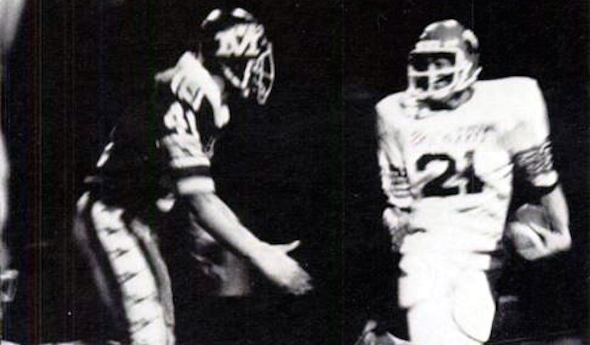
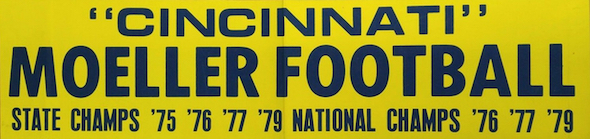
PHOTOS: (Top) Brother's Rice's Brian Brennan looks for an opening while a Moeller defender pursues. (2) Brother Rice coach Al Fracassa. (3) Moeller coach Gerry Faust. (4) A Moeller bumper sticker tells of its many successes during the 1970s. (5) Eric Ellington starred for Moeller against Brother Rice. (6) Faust left Moeller for Notre Dame in 1980. (Photos gathered by Ron Pesch.)
Playoffs Packed with Livonia Power
By
Tom Markowski
Special for Second Half
October 25, 2017
LIVONIA – Let the good times roll.
 Football fans in Livonia have been blessed recently with the success of Livonia Public Schools’ football programs, and this season is no exception.
Churchill, Franklin and Stevenson all qualified for the MHSAA playoffs, and glancing at the pairings all have a reasonable shot at winning their Pre-District games and perhaps a District title as well.
Churchill and Franklin are both 7-2 and open Division 2 play as visitors, Churchill at Pinckney (8-1) and Franklin at Walled Lake Western (8-1). Stevenson will compete in Division 1 and, even though the Spartans are 5-4, will play host to Detroit Catholic Central (5-4). All three games are Friday at 7 p.m.
All three are members of the Kensington Lakes Activities Association. Franklin has made the playoffs three consecutive seasons and reached a Division 2 Semifinal in 2015. Churchill has qualified for the playoffs five of the last seven seasons and Stevenson, the most consistent program of the three, is in for the fifth time in the last six seasons. (Livonia Clarenceville, another public school in Livonia, is not part of the Livonia Public School system and did not make the playoffs this fall.)
The three head coaches agree that the source of this recent success is a thriving little league program, the Livonia Junior Athletic League. Four teams compete in the league – the Blue Jays, Eagles, Falcons and Orioles – and players range in age from 6 to 13. Those 6 and 7-year-olds compete in flag football.
The LJAL is the lifeline to the high schools because Livonia Public Schools does not sponsor middle school or junior high football.
“We’ve always had a strong little league program,” Franklin coach Chris Kelbert said. “With the little league program, our feeder program, we’ve worked hard to develop a system for them to do what we do.”
 The Livonia schools haven’t always been so successful. Franklin, for example, won the first Class A title in 1975, then went 30 years before making its next playoff appearance. Stevenson made the playoffs just once in the first 19 seasons of the MHSAA tournament. But since 1993, the Spartans have qualified 16 times highlighted by a Division 1 championship game appearance in 2007 and a Semifinal appearance the following season.
Then there’s Churchill. The Chargers made the playoffs in 1979, then seemingly disappeared. Not only did they not make the playoffs again until 2004, the Chargers had one of the poorest runs in terms of victories in state history. From 1990-96 they won one game. At one point Churchill lost 34 consecutive. Following those rugged years the Chargers finished 2-7 five straight season (1997-2001).
Times have changed. John Filiatraut, now the head coach at Dearborn Divine Child, helped guide the Chargers out of those rough times as they won the school’s first District title in 2004 and finished 8-4. Except for a 1-8 season in 2005, Churchill has remained competitive since that bounce-back season.
Bill DiFillipo was an assistant under Filiatraut and is in his fifth season as Churchill’s head coach. He said talent in his program keeps improving and he credits the coaches, on his team and within the LJAL, for that progress. He also said the healthy rivalry that exists between the three schools has sparked enthusiasm and an increase in competitiveness.
“This is Churchill’s best run,” he said. “You have to have good feeder teams. We’ve done a good job of developing kids. Our senior class was 0-9 as freshmen, and they were 2-7 on the JV. Over at Franklin, Chris has done a good job. When Randy (Micallef) took over, Stevenson was down. Randy and his staff have done a good job of getting them back.”
Stevenson won just five games combined in 2010 and 2011. The Spartans made the playoffs in 2012 and missed the playoffs the following season, but then rattled off three straight appearances and will make it four straight this weekend.
The three programs annually play for a city championship. Stevenson has won the last two defeating Churchill and Franklin in each of the last two seasons.
Franklin’s only losses this fall were to Churchill and Stevenson, and the Patriots have won five straight since the second of those defeats.
 Kelbert and his staff have done a remarkable job this season. Running back Isaac Moore was a part-time starter last season, and none of the other 10 starters on offense had started even one game. Franklin returned three starters on defense.
“We have a young offensive line,” Kelbert said. “We have two seniors there, and neither one played offense line before. But we’re clicking now. It’s been frustrating at times. We knew we had some good players coming back. After the Howell game (a 21-0 Franklin victory in Week 5), we saw some improvement. Our defense has been lights out all season. We adopted a new philosophy on defense. We wanted to be more athletic and have more speed. When Romeo won (the 2016 Division 1) title, they won it with small linemen who couldn’t be blocked. We figured we could use that philosophy. The game has changed dramatically in the 19 years I’ve coached in high school.”
Kelbert faced a different test this season. He’s starting his son, Jacob, at quarterback, and he’s just a sophomore. Jacob Kelbert played on the freshmen team last season after going through Livonia’s little league program.
“It has its challenges,” Kelbert said of coaching the eldest of his three sons. “I forget he’s young sometimes. I expect him to play like a senior.”
DiFillipo also has a first-year starter at quarterback, but at least this one was on varsity last season as a back-up. Junior Drew Alsobrooks has played well this season, and he’s benefitted from an experienced offensive line. Four seniors start on the offensive line and the lone junior, Ethan Gyurnek, started last season as a sophomore.
DiFillipo adds that it’s been a team effort.
“Our defense has played the best in the 10 years that I’ve been here,” he said. “We’re giving up 14 points a game.
 “Franklin and us have had the best two defenses in our division (KLAA Gold). Grand Blanc has the best offense, and we held them to nine points. Franklin shut them out.”
It’s been a different season for Stevenson. The Spartans started 4-0, then lost three straight. They beat Salem, 31-10, in Week 8 before losing to Franklin, 35-21, in a KLAA crossover.
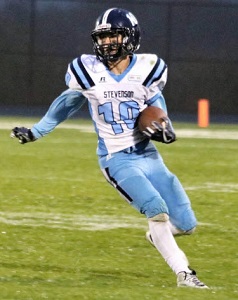
Micallef said he’s noticed an improvement in the level of skilled athletes to come through the three programs. Specifically in his program, players like quarterback Parker Graham, all-purpose athlete George Ferguson and two-way back Devin Dunn all have had experiences in other sports as well that have contributed to their competitive nature.
“The coaches have become progressively better across the board,” Micallef said. “And some of the kids who might have gone to private schools now are staying put. Catholic Central moving from Redford to Novi has had a hand in keeping some of the Livonia kids here.
“We have some really good athletes this season. Parker was a running back last year, and we played him in the secondary, too. But with him moving to quarterback, I’ve kept him off the defense. But I had him at linebacker last week, and he had like seven or eight tackles. Both him and Ferguson play basketball and baseball, and Devin is a multi-sport athlete, too. In crunch times, these kids have played in so many big baseball games or big basketball games that they’re not afraid to make the big play. They embrace that.”
 Tom Markowski is a columnist and directs website coverage for the State Champs! Sports Network. He previously covered primarily high school sports for the The Detroit News from 1984-2014, focusing on the Detroit area and contributing to statewide coverage of football and basketball. Contact him at [email protected] with story ideas for Oakland, Macomb and Wayne counties.
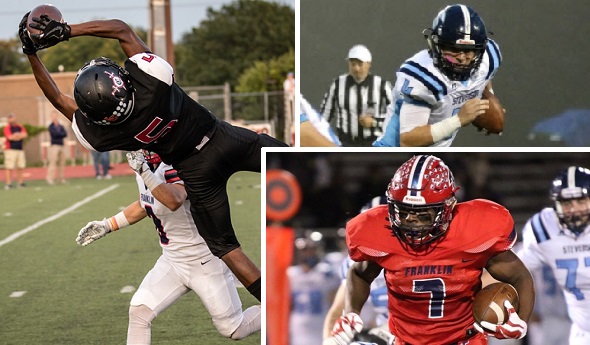
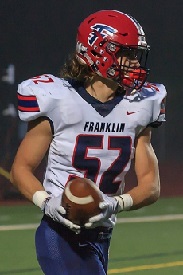
PHOTOS: (Top) Clockwise from left, Churchill’s Martell Dooley, Stevenson’s Parker Graham and Franklin’s Isaac Moore are among standouts for the Livonia Public Schools’ three playoff-bound varsity teams. (Middle top) Churchill junior quarterback Drew Alsobrooks has stepped in well as the starter this fall. (Middle below) Senior linebacker Jacob Mass helps key a more athletic Franklin defense this season. (Below) Senior George Ferguson is one of the multi-sport athletes making major contributions to Stevenson’s success. (Photos courtesy of the Churchill, Stevenson and Franklin football programs.)